 Whilst the fitter was busy laying the kitchen floor we did our usual round walk to St Keynes’ well. Here is the poem by Southey…
The Well of St. Keyne
BY ROBERT SOUTHEY
A Well there is in the west country,
And a clearer one never was seen;
There is not a wife in the west country
But has heard of the Well of St. Keyne.
An oak and an elm-tree stand beside,
And behind doth an ash-tree grow,
And a willow from the bank above
Droops to the water below.
A traveller came to the Well of St. Keyne;
Joyfully he drew nigh,
For from the cock-crow he had been travelling,
And there was not a cloud in the sky.
He drank of the water so cool and clear,
For thirsty and hot was he,
And he sat down upon the bank
Under the willow-tree.
There came a man from the house hard by
At the Well to fill his pail;
On the Well-side he rested it,
And he bade the Stranger hail.
“Now art thou a bachelor, Stranger?” quoth he,
“For an if thou hast a wife,
The happiest draught thou hast drank this day
That ever thou didst in thy life.
“Or has thy good woman, if one thou hast,
Ever here in Cornwall been?
For an if she have, I’ll venture my life
She has drank of the Well of St. Keyne.”
“I have left a good woman who never was here.”
The Stranger he made reply,
“But that my draught should be the better for that,
I pray you answer me why?”
“St. Keyne,” quoth the Cornish-man, “many a time
Drank of this crystal Well,
And before the Angel summon’d her,
She laid on the water a spell.
“If the Husband of this gifted Well
Shall drink before his Wife,
A happy man thenceforth is he,
For he shall be Master for life.
“But if the Wife should drink of it first,—
God help the Husband then!”
The Stranger stoopt to the Well of St. Keyne,
And drank of the water again.
“You drank of the Well I warrant betimes?”
He to the Cornish-man said:
But the Cornish-man smiled as the Stranger spake,
And sheepishly shook his head.
“I hasten’d as soon as the wedding was done,
And left my Wife in the porch;
But i’ faith she had been wiser than me,
For she took a bottle to Church.”
And its listed building entry..10/187 St Keyne’s Well and cross to south east 21.8.64 II
Well house of Holy Well of St Keyne and cross opposite . Circa C16 rebuilt in July 1936 by the Liskeard Old Cornwall Society. Granite ashlar with gabled roof of large granite blocks. Rectangular in plan. Well opening in front gable end with round granite chamfered arch and jambs with pyramid stops. Rectangular well shaft. Situated in low stone rubble retaining wall. Robert Southey’s poem quoted the legend concerning the race of brides and grooms to the well after the wedding service. “If the husband of this gifted well Should drink before his wife A happy man henceforth is he For he shall be master for life”. The poem continues “I hastened as soon as the wedding was done And left my wife in the porch But I’faith she had been wiser than I For she took a bottle to the church.” The poem also describes the old well “An oak and an elm tree stand beside And behind does an ash tree grow And a willow from the bank above Droops in the water below”. These were thought to have sprung from 1 root planted by St Keyne. In 1703 the trees were blown down and were replaced by trees planted by Mr Rashleigh of Menabilly. In the 1930s, the trees had decayed and the lane was widened and consequently the well was rebuilt. Illustration of the unrestored well together with a ballad appear in the Gentleman’s Magazine, 1799 and 1822. In Blights Cornish Crosses, and in A Lane-Davies Holy Wells of Cornwall, 1970. An illustration in the National Monuments Record illustrates the well-house arch as a pointed granite arch with ovolo moulded arch and jambs. The full text of Southey’s poem is quoted by M L Quiller Couch in Ancient and Holy Wells of Cornwall. Directly opposite the well opening is an incised granite stone cross with an alisee patee cross and a carved semi-circular panel below. Resited in 1951. J Meyrick A Pilgrims guide to the Holy Wells of Cornwall, 1982 A Lane-Davies Holy Wells of Cornwall, 1970
Back up the hill to the church and here is the entry in Cornwall Historic Churches Trust..
St. Keyne Parish Church

The Church of St. Keyne is located on high ground at the southern extremity of the village of St. Keyne within the parish of the same name, the second smallest in Cornwall. The parish lies on the edge of the Looe valley between the parishes of Liskeard (to the north and east) and Duloe (to the south and west).
St Kayne seems to be the most ancient spelling, but Kaine, Keane, Kean and Keyne, have also been used. St. Keyne is noted in 12th century Welsh sources as being one of the children of King Brychan of Brecon in Wales. Her brother Berwin is noted as being in Cornwall and may be St Barry of
Fowey. Such legends were used to explain the repetition of saints’ names in the Celtic areas of Britain: Devon, Cornwall and Wales and there is a more Cornish version of the Children of Brychan which does not include St Keyne.
According to another legend, St. Keyne is said to have lived like a hermit and visited St. Michael’s Mount, which coincidentally is the only parish smaller than St. Keyne in the county of Cornwall. She is also said to be responsible for the construction of St. Keyne’s well, situated just outside the village, which was the old baptismal well. It is famed for its ability to ensure that the first of a newly-wed couple to drink the water will become the dominant partner.
The hood moulding over the door in the porch of the present church building indicates that a Norman church stood at St. Keyne. The building appears to be mainly constructed in the 15th or early 16th century as indicated by the Cornish standard granite piers, the font and one of the bells, although the north aisle west window may date from a little earlier. The tower windows look early 16th century and the tower is built in the typical Cornish pattern of three stages, but the stages are uneven; the first stage being half the height of the tower, less pinnacles.
In the 16th Century the whole parish was one manor, Lametton, which at times has also been the name of the parish. In the 16th Century the manor was owned by the Coplestone family, but in 1561 John Coplestone was forced to sell 13 of his manors to buy a royal pardon for murdering a son and godson. This was sold to the Harrises of Mount Radford in Devon (One Harris was MP for Liskeard in 1661), who married a daughter of the Rashleighs of Menabilly. In 1911 the estate was sold in lots at Webb’s Hotel in Liskeard.
Throughout the first 20 years of the 19th century the church was consistently recorded by successive Rural Deans as being ‘out of repair’. Minor improvements were attempted but, by the 1860s, it was noted that the church was neglected and out of repair, and a substantial restoration was undertaken by J P St Aubyn between 1872-1878.
Today the church consists of the chancel, the nave, short north aisle, south transept or vestry, porch and west tower. St. Keyne parish is linked to the market town of Liskeard and the fishing and tourism centre of Looe by the B3254. The church serves the population of St Keyne parish (505 in the year 2,000) & the Trewidland area of Liskeard parish (345 in 2,000).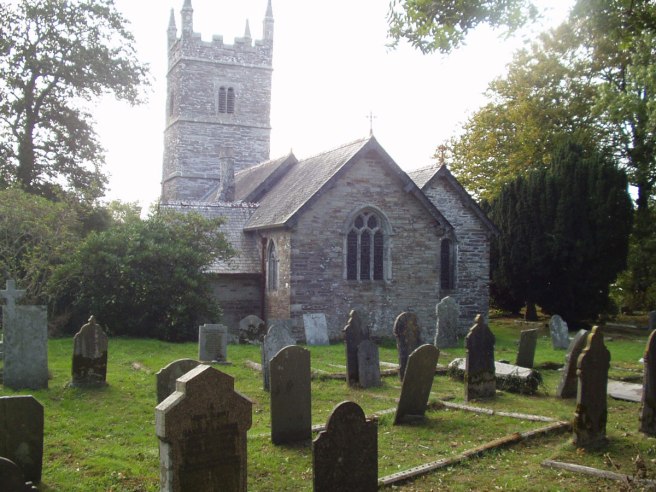




 Trying to remember some of the things I have read, Alan Bennett’s latest ‘
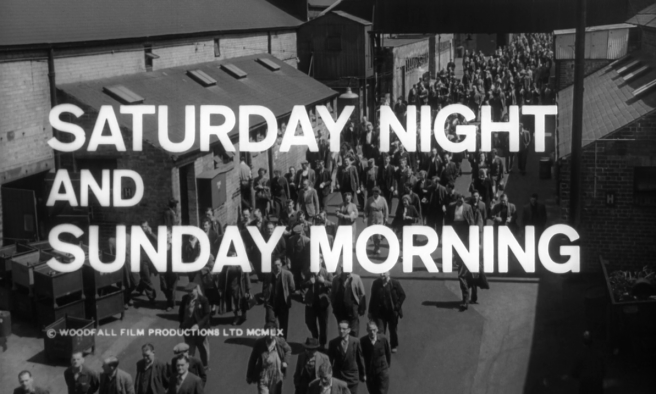
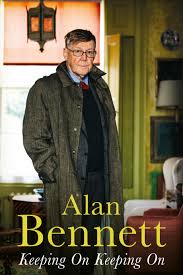 ’, his ‘People’ and Alan Sillitoe’s ’Saturday Night and Sunday Morning’. The very large diary and thoughts and play excerpts, ‘Keeping On’. was rather a lot to get through but on the whole highly enjoyable. I say on the whole because Alan is getting to be even more of a Moaning Minnie as he gets older and older. To be fair he realises this himself, and very often his targets are well chosen. The title comes from one evening when he was passing through to a theatre to give a talk, and one of the attendants said “ I see you’re still here then! Keeping on?”. I forget but it sounds like a Northern comment. Alan was quite taken aback as he is feeling his age. The Introductions to the plays were particularly enjoyable, and led me to purchase ‘People’ where he takes on the sacred cow that is the National Trust. His thoughts are like those of a lot of us I suppose……the NT Guides ‘ assume that one wishes to be informed about the room or the furniture and pictures, which I don’t always’. The play has some important underlying messages about lack of funding of the Arts in general, and how should we maintain our historic buildings with families intact. Lots of pathos, nostalgia and humour especially when the Porn Film crew take over the South Yorkshire country house……Talking of nostalgia, what could have pre-possessed me to pick up ‘Saturday Night and Sunday Morning’? Well it must have been talking to our great friends Julia and Allen about their trip to Mallorca. They stayed near Soller and I asked if they had done the walk over the mountains to the extremely beautiful Deia. We had, they hadn’t. But we did it on the recommendation of the great man himself Alan Sillitoe who did a stint for us at Warwick Words just before he died. Whilst we were escorting him to the talk, he told us how he used to live in Soller in Mallorca and often did the walk/bicycle ride himself to visit his great friend Robert Graves who lived in Deia. Much was drunk, and often he had to leave his bicycle there as unable to get on it! He mentioned a farm half way across the walk where you could get fresh orange juice (and needed it), and it still exists ….to our great relief… the juice from the farm was unsurpassed. We searched in the cemetery for Robert’s grave, but despite much effort we didn’t find it. Luckily we caught the last bus back to Soller. Now in its day of course, the early Sixties, the book ( and film with Albert Finney and Rachel Roberts) swept the boards…controversial, explosive ….a novel of today with a freshness and raw fury that ‘makes ‘Room At The Top’ look like a vicarage tea party’ as the Telegraph of the time put it. Re-reading, the grip and pleasure and feel of the times were very, very powerful, and I can honestly say I haven’t enjoyed a book as much for a long time. Set in the midst of the working classes in Nottingham with the hero or anti-hero (who knows?) working by day chained to the lathes at what was obviously Raleigh Cycles (obvious to me as I almost became Distribution Manager there), and by night taking on the world and his mates’ wives, it was/still is writing at its best. What a privilege to have met Alan Sillitoe if only briefly.
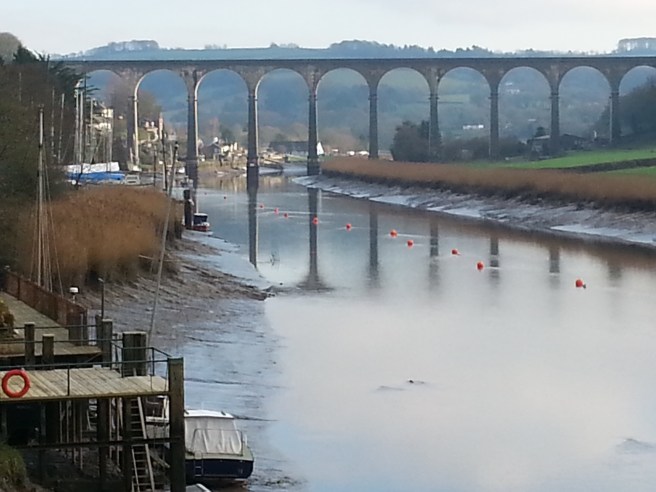 Another visit to Cotehele House where we had to pick up our vase bought from the shop there and which we had returned for damage inspection. Popped in to the Hall to see the Christmas Garland for the second time….quite impressive, lots of people viewing it again, but not what I would call spectacular. On this occasion we walked down the hill alongside the marvellous valley gardens (which we must visit in Spring for the Azaleas and other spring shrubs). Plenty of daffs pushing through the jet black soil, and TV reported some in bloom somewhere in the UK on this day…..earlier and earlier. At the end of the garden we took the path to the river and walked to
  were
were 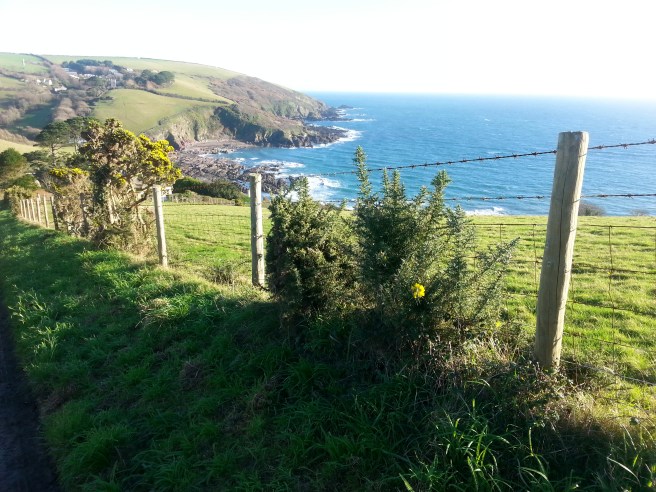
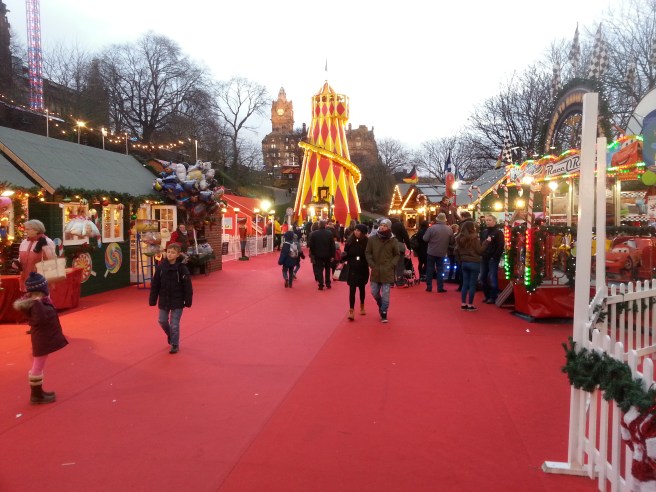
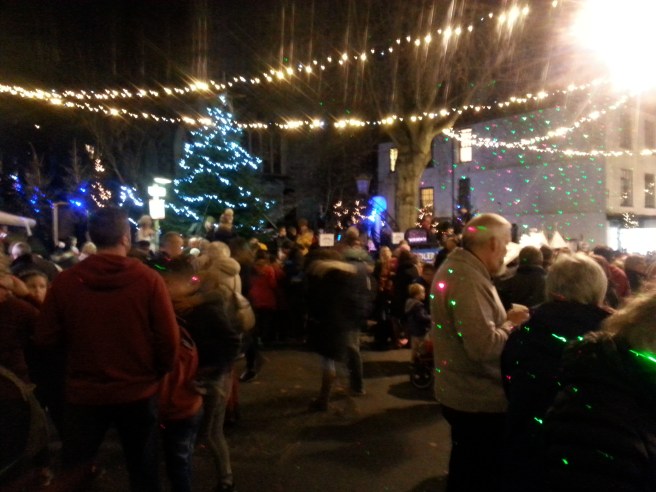 In the evening we drove to Fowey ( my great favourite after St Ives ), to see the Christmas festival and lantern procession. Very nice atmosphere and the christmas market was surprisingly rather good with nearly all local Cornish firms taking stalls. We bought rather a lot!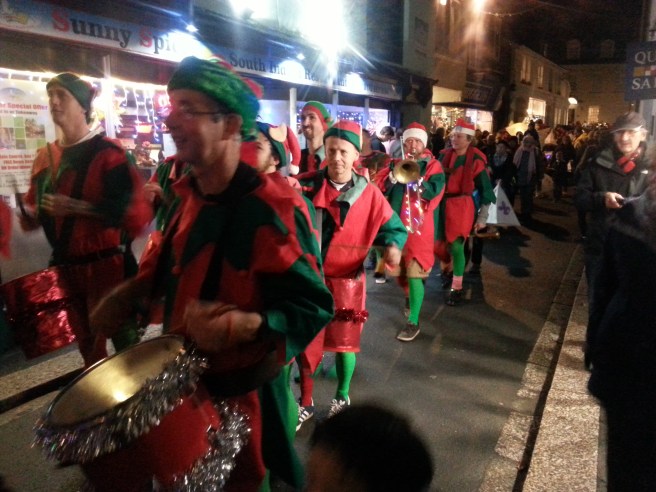

 there then. I have also re-visited Morse, reading again all of those engaging novels. Much too complicated for me but highly enjoyable. I got so involved that I bought a couple of books on ‘Morse locations’…I always find this sort of stuff fascinating and in this case the surprise (to me) is that so much of the Morse, Lewis and Endeavour series are filmed outside of Oxford. I have also read lots of books on Cornwall (and Devon as we are only 20 miles away, and somehow I always have this uncomfortable feeling that I would rather be in Devon (where we lived once) than Cornwall. I now have quite a local library including the
  Bradt ’Slow’ series for Devon and Cornwall which are interesting reads in their own right but also never fail to come up with things to do which perhaps one wouldn’t have thought of (kayaking for instance, of which more later).
 Enjoying Cornwall...