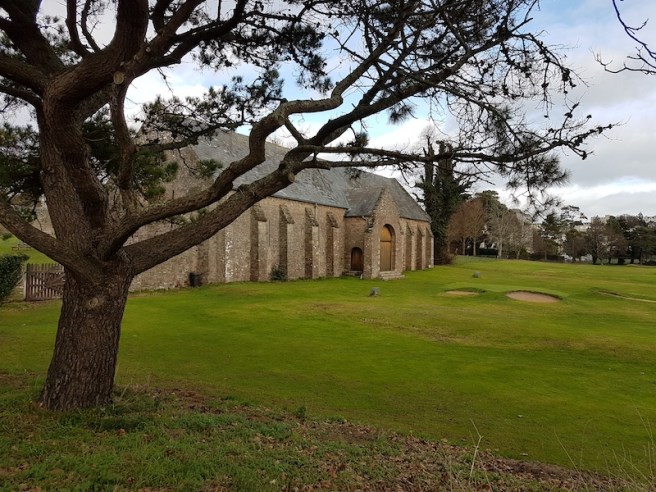
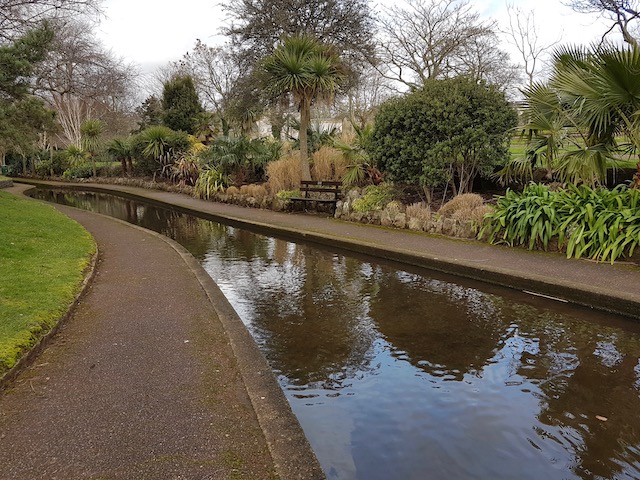
 Torre Abbey in Torquay was our destination in January last year but we were very much looking forward to returning. Two buses and an interesting enough journey in the daytime. Then a short walk through a delightful park to get there….
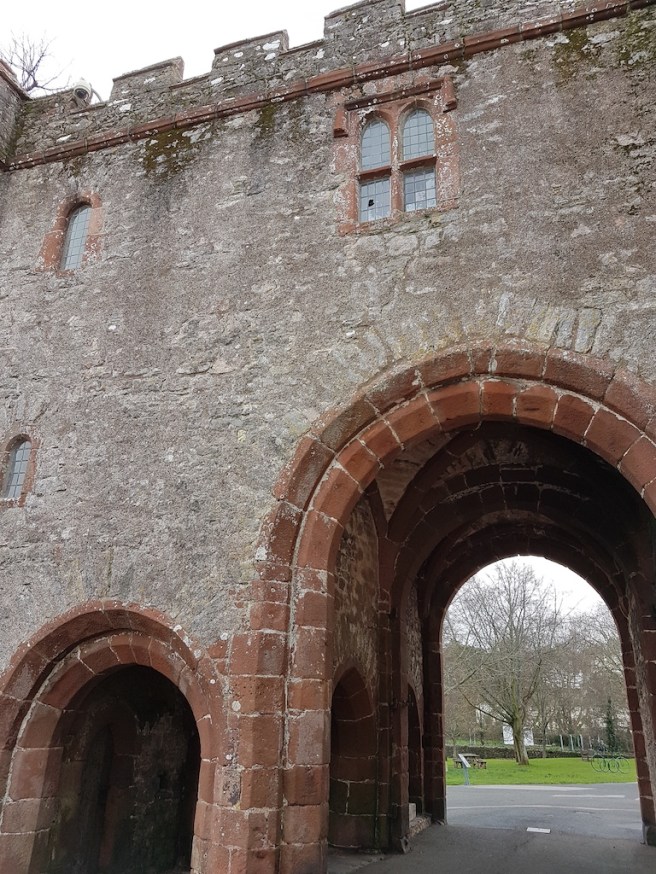
 The thirteenth century gatehouse is a fitting introduction to this originally medieval abbey complex…..
 and inside there is a fascinating exhibit about the stone used in the building and where it came from….a lot of it from the nearby headland.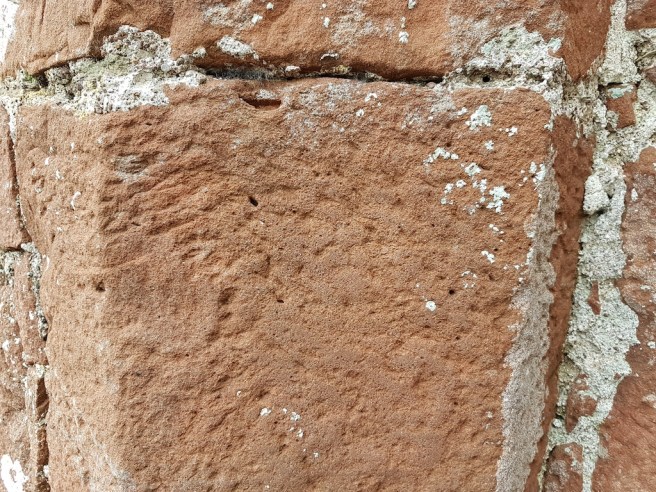

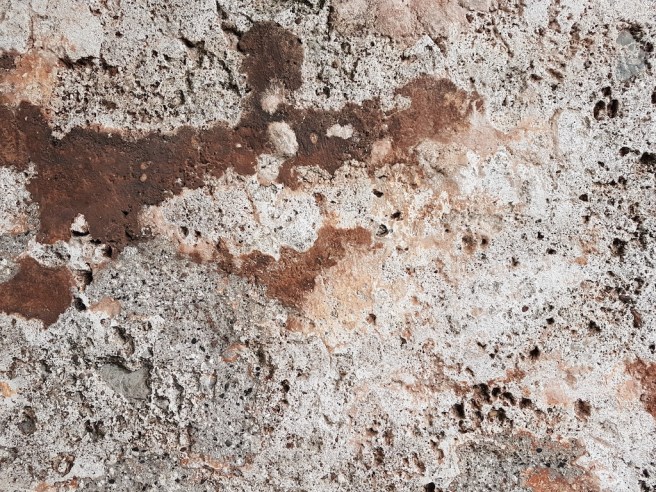 Although the abbey was developed into a residence after the Dissolution, the first thing you see is the medieval undercroft which is very atmospheric.
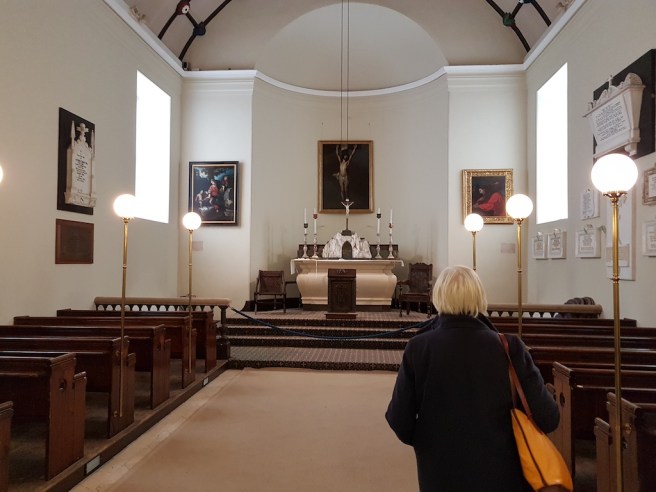
 Once inside we visited the chapel which we did not see last time. The chapel exhibits an unusual ‘barrel vault’ ceiling dating from the 15th century. Prior to being converted into a chapel by the Cary family it used to be the Guest Hall.
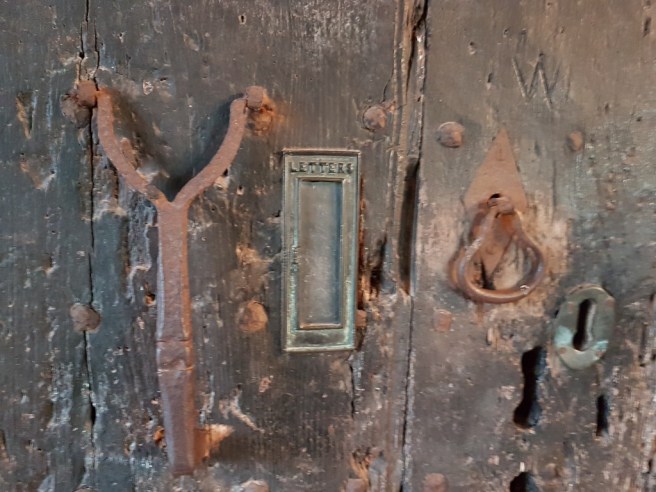
  We also saw inside the gatehouse with an original knocker on the medieval door,
  and we could clearly see how the abbey buildings had to have a defensive purpose – in fact a licence to crenellate (erect fortified defences) was granted by Edward III in 1348.
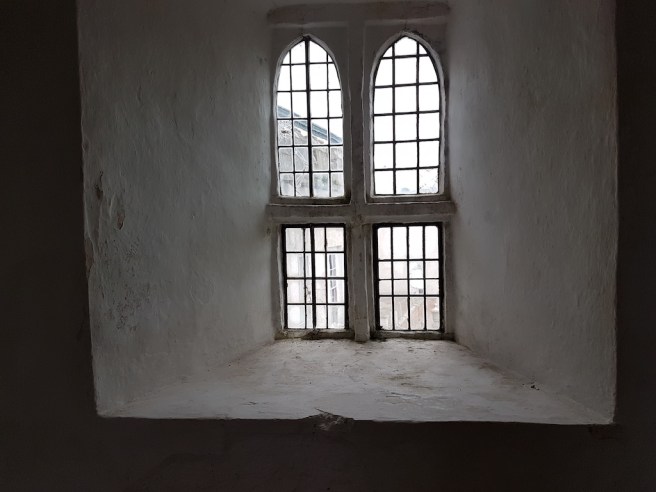
 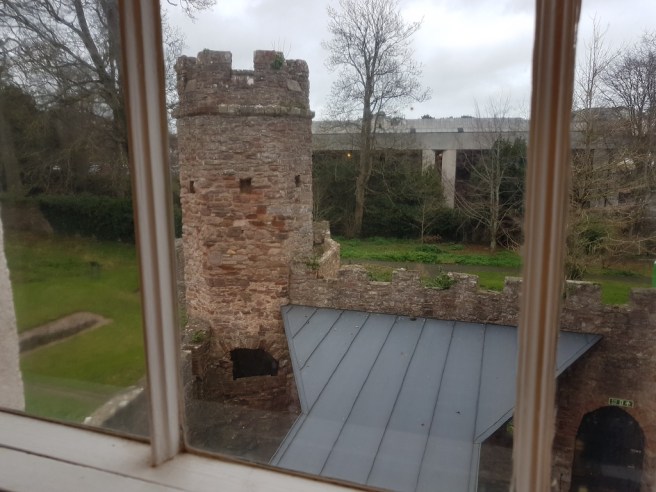 What really astounded us was the thickness of the walls, easily six feet, and amongst the deepest I have ever seen.
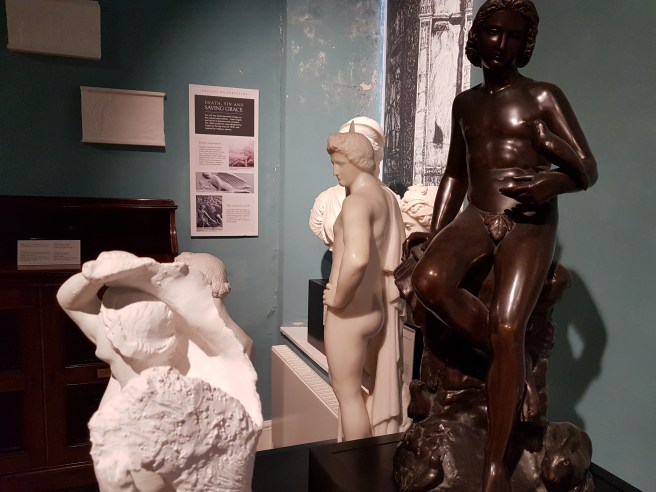
 The Thrupp Collection draws art lovers from all over the country, as it’s the most extensive collection from the studio of a Victorian sculptor. It includes statues, busts and bronzes as well as plaster reliefs. Magnificent………
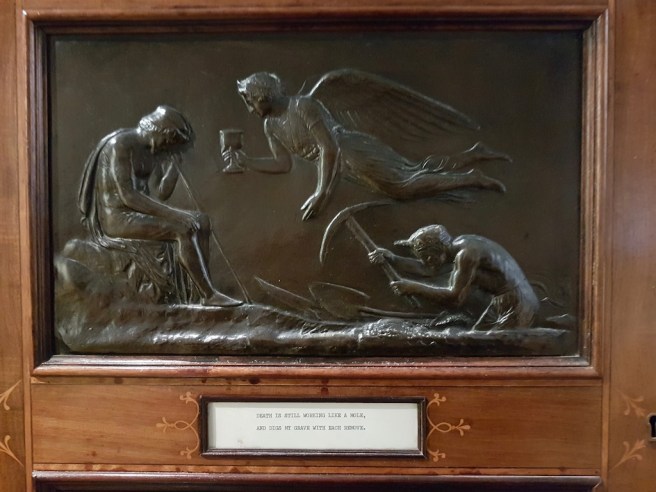
 and I liked the furniture panels by him which reflect a George Herbert poem (I studied Herbert as one of the Metaphysical Poets at school).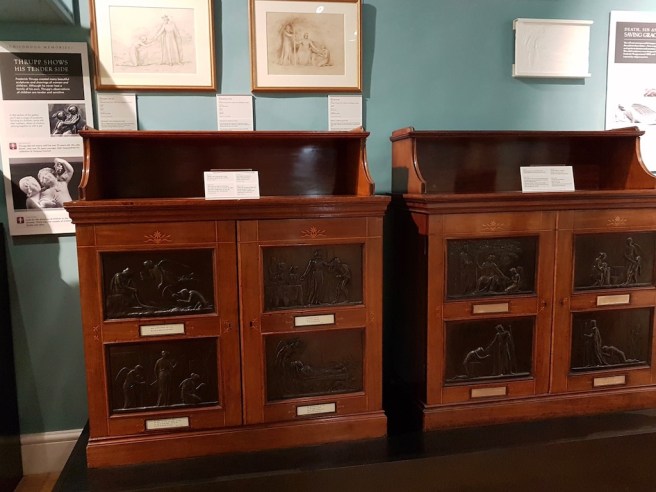
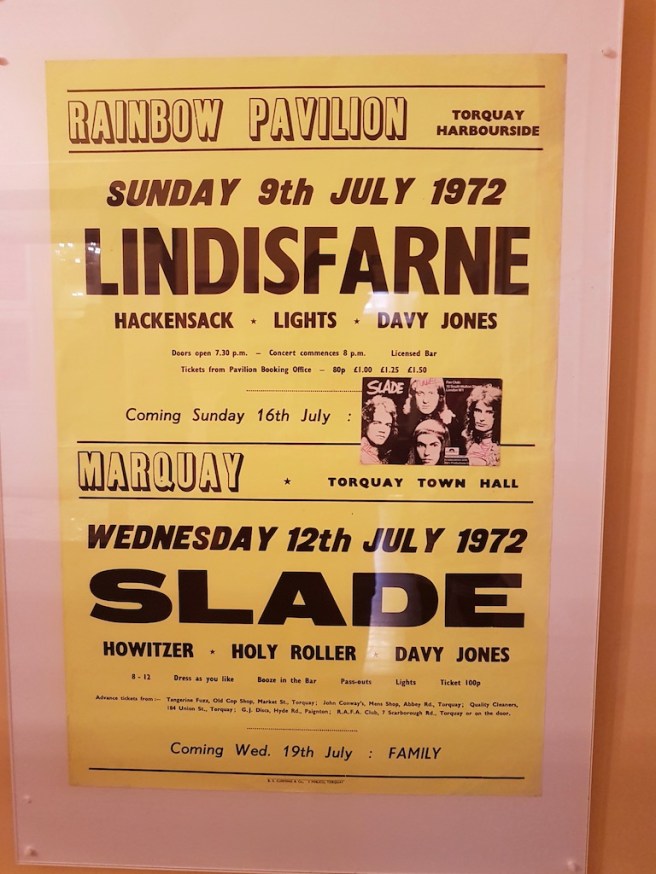
 Proceeding, we were diverted very briefly by an exhibition called Torbay Rocks which was memorabilia, mainly posters, from the 60’s and 70’s music scene. It didn’t really have much interest for me I’m afraid.
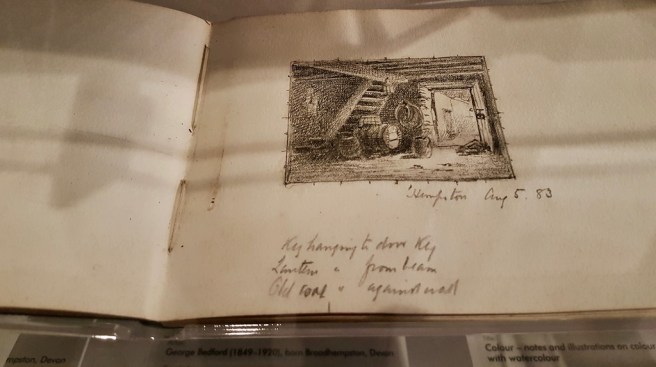
 I mentioned last visit the superb way in which the museum puts together how art is made……with artists’ sketchbooks……
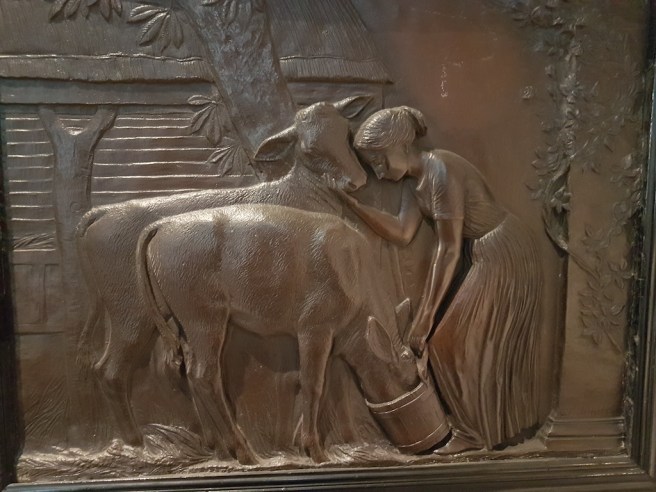
 and before and after like this plaster cast with its bronze finished article. The standard of the museum’s displays is exceptionally high and never patronising.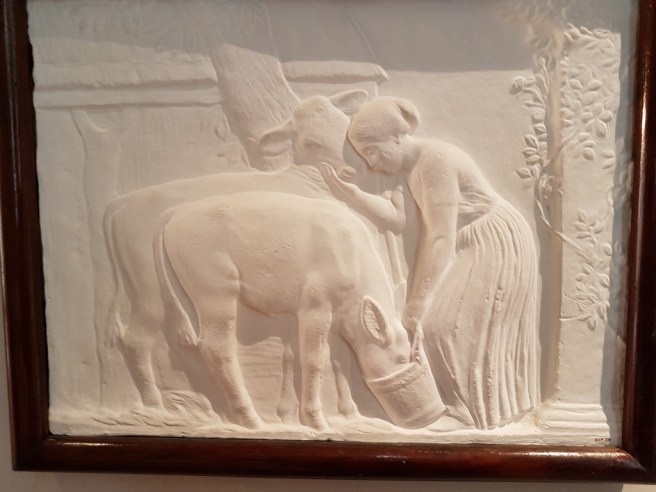
 I do like this watercolour of Torquay with its castle on the hill. This was knocked down in the 60’s. Architects and town planners in the 60’s and 70’s have a lot to answer for! This painting also shows the hilly terrain on which Torquay spreads itself out. In fact it is built on 7 hills – just like Rome!
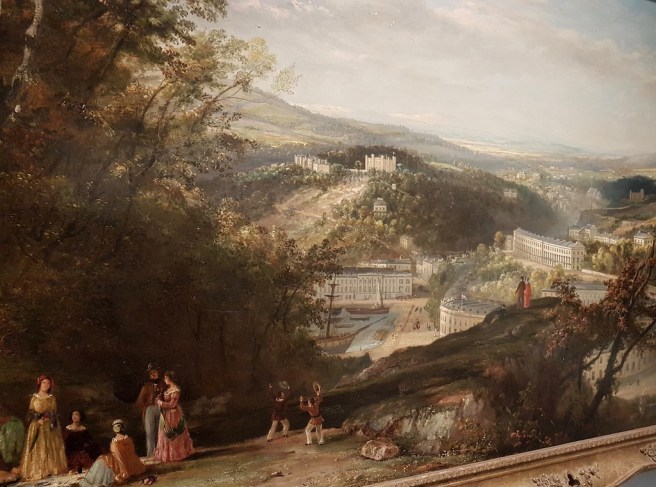 The abbey is a real maze over several floors and without a plan you never know where you will find yourself next, but throughout there are paintings everywhere.
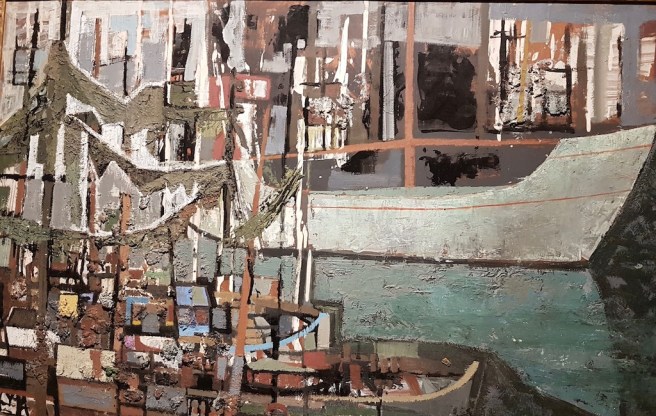
 Here rather a nice marine oil…….
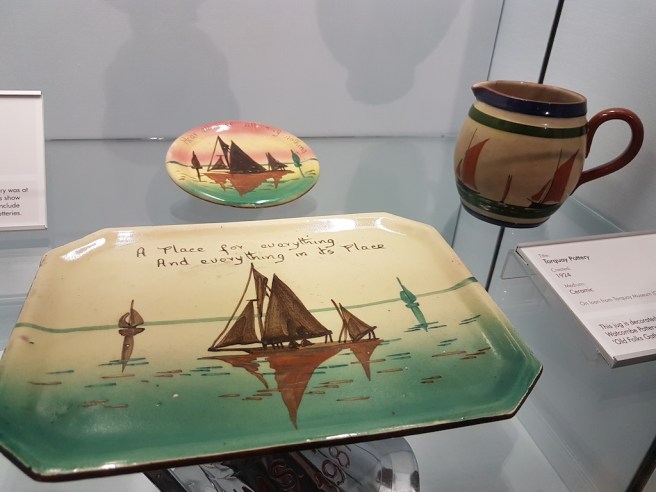
 I knew nothing of Torquay Pottery but it was widely made in its day……’‘Torquay Pottery’ has become the generic term covering the numerous potteries that made Art Pottery and later souvenir/household pottery, from around 1860 until the late 20th century, mainly using local sources of red Devon clay. These potteries were based within about 5 miles of Torquay, in Devon, but also include a few other West Country potteries which copied the Torquay style. They were usually established by craftsmen who had learnt or practised their skills in Torquay.’ Some made for the tourist market…….
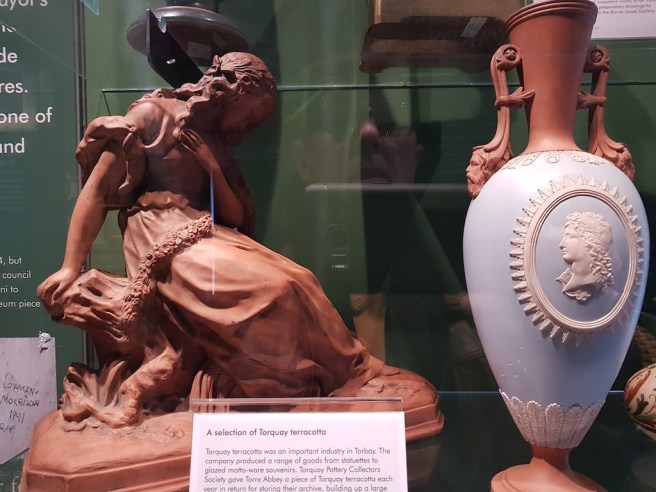
 and some for the more genteel collectors….
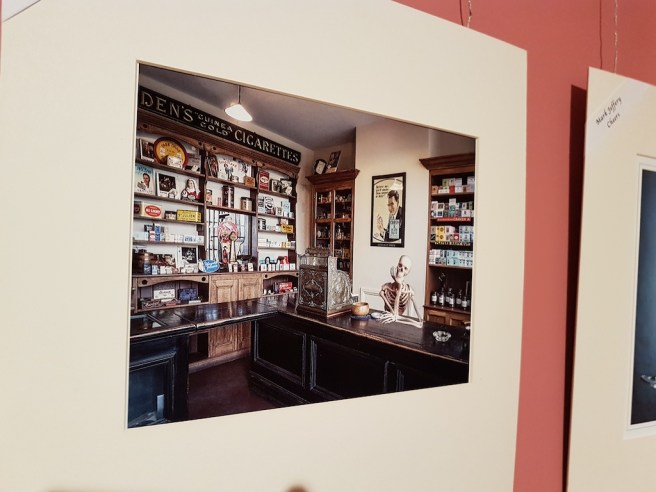
 This time there was a display by local photographers in one room…the tobacconists with skeleton shopkeeper was amusing,
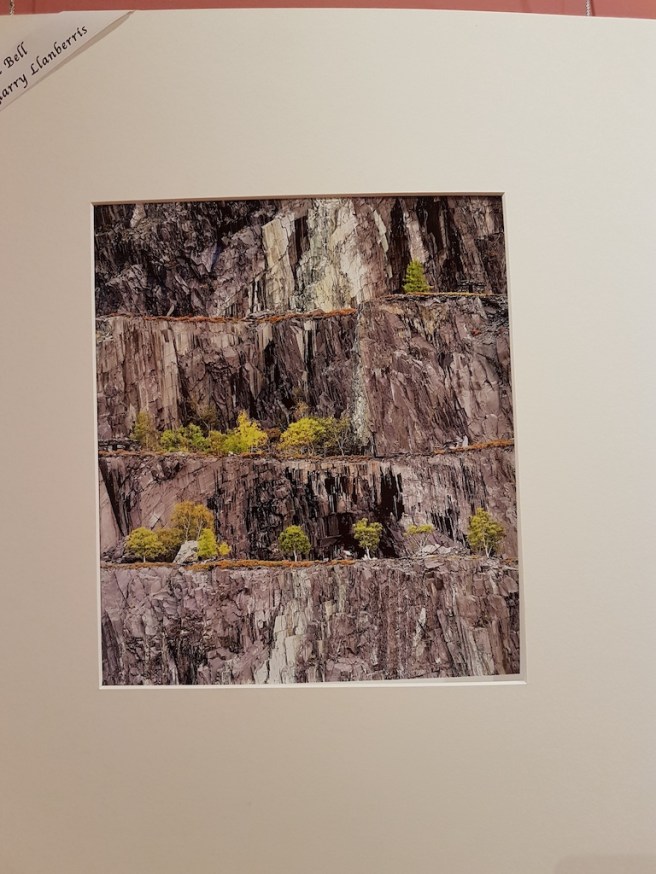
 and this disused quarry at Llanberis was spectacular…being reclaimed by Nature already…..
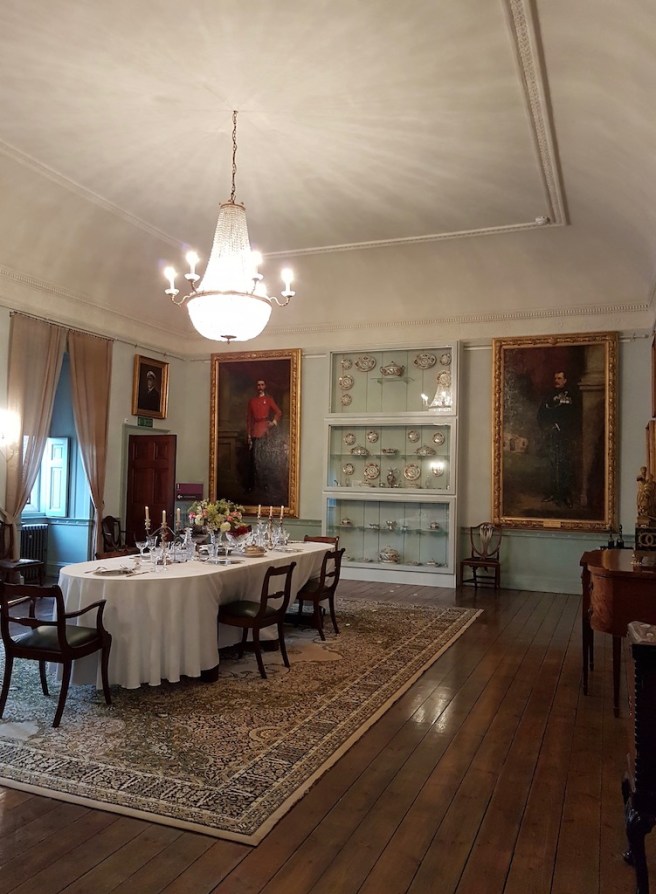
 There is plenty to maintain your interest everywhere including some of the rooms used by the Cary family which owned and occupied the house from 1662 to 1930.
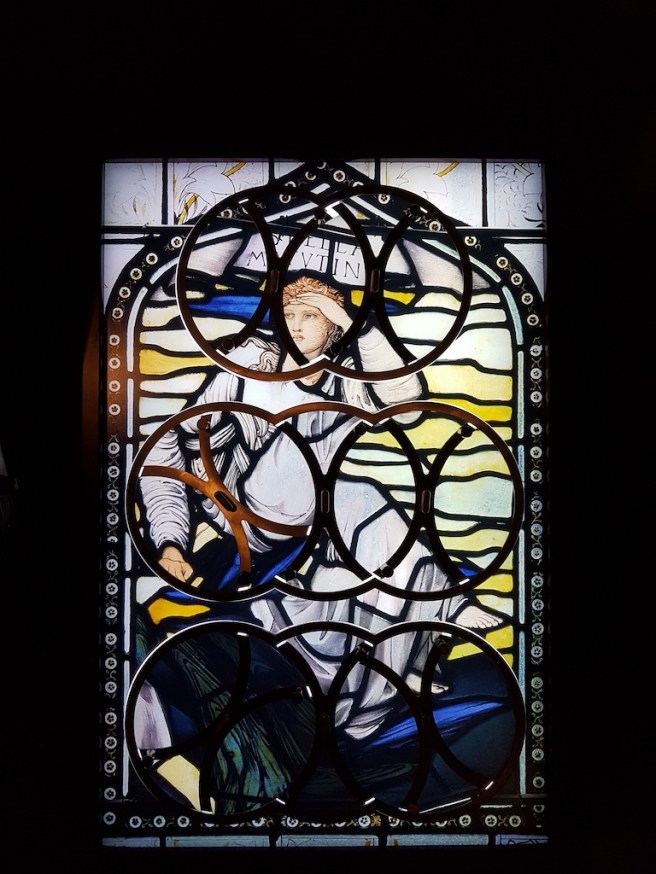
  Burne-Jones was one of the most influential and successful artists of his time and supported the ideals of the Pre-Raphaelite Brotherhood. He is credited with single-handedly reviving the medieval tradition of stained glass in the United Kingdom. Torre has some good examples but only one original.
 As elsewhere, not all Torre Abbey’s collections can be displayed in its galleries. The Behind the Scenes Gallery on the first floor was interesting as it houses a number of paintings on a racking system. This allows visitors to see how paintings are stored and gives access to some great paintings.
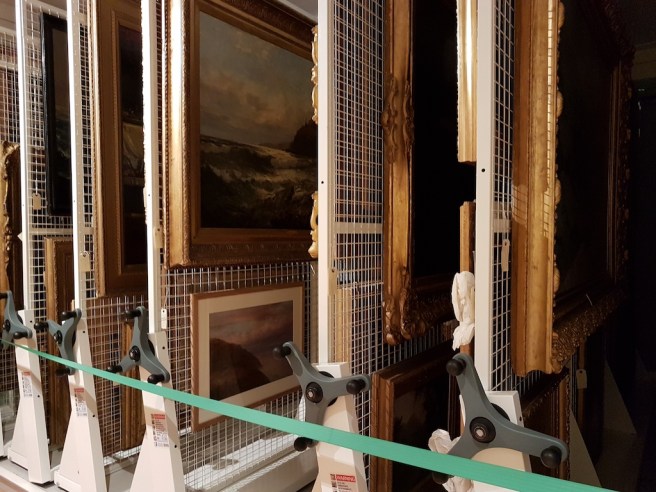 After having our fill of culture we wandered out into the extensive ruined sections of the original abbey……
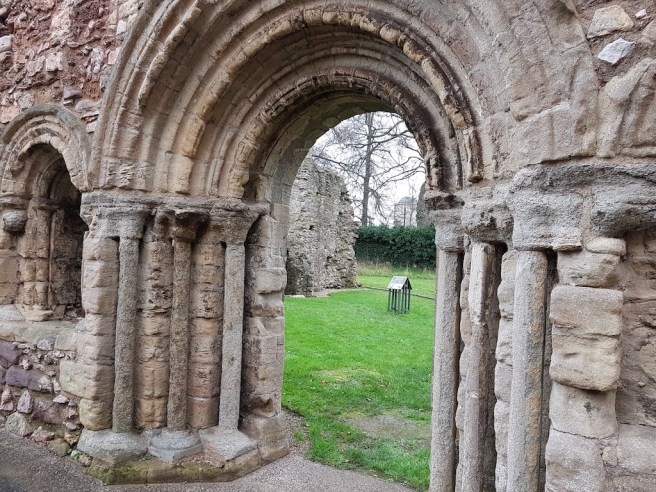
 through the gardens…..
 and to the palm house which is always good when it’s raining….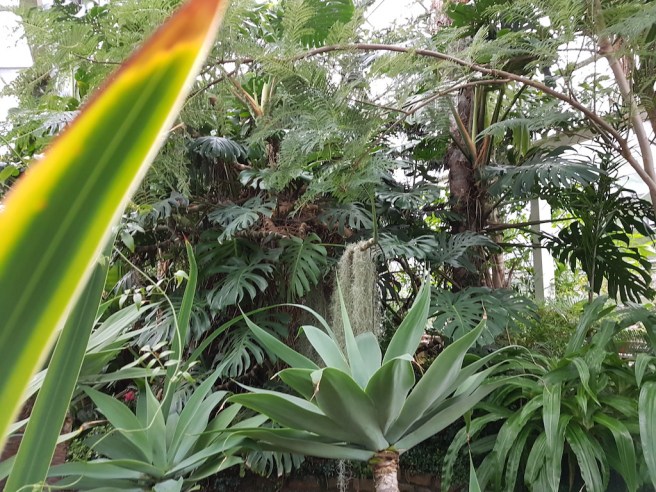
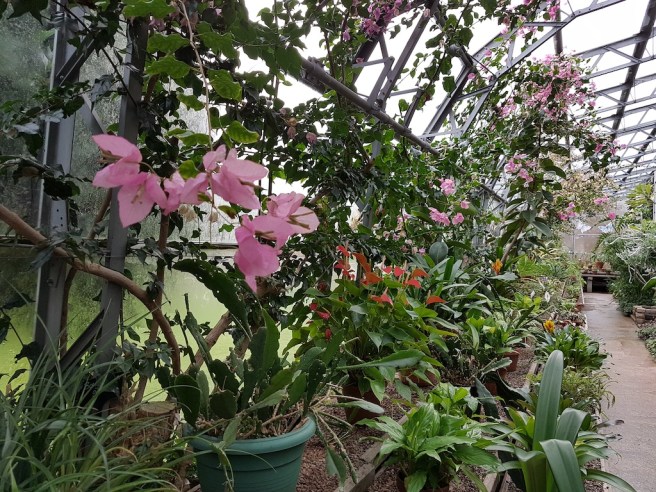
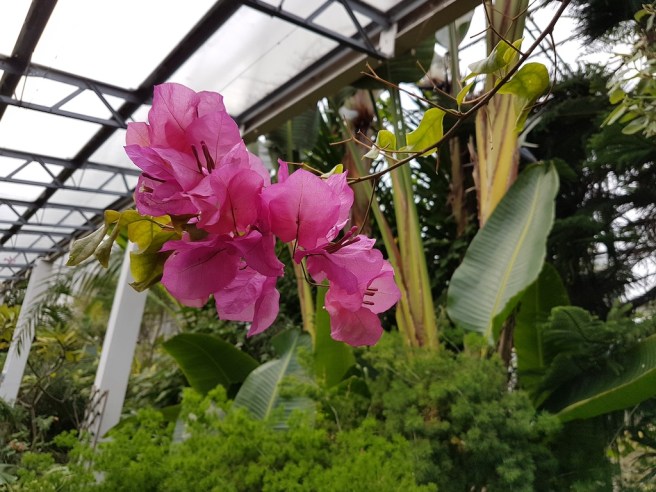
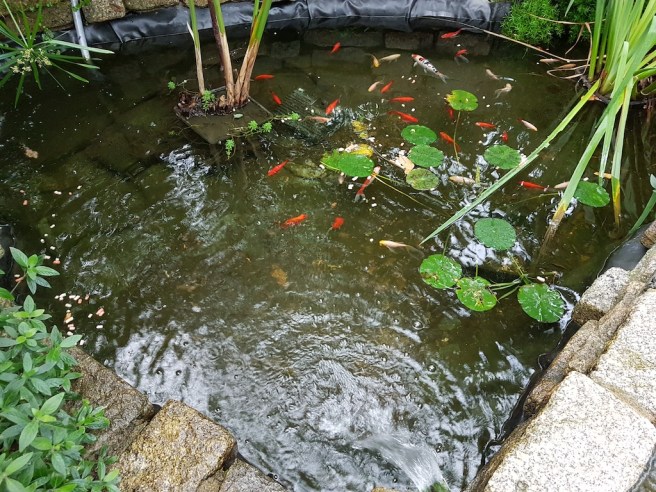 and just as we were exiting the grounds I noticed the door to the ‘Spanish Barn’ was ajar. I had asked about this building and was told it was only open when exhibitions were in there……luckily someone was preparing for one and didn’t mind us having a quick look.
 Rather than wait for our bus in the cold we went into the Grand Hotel for a pint for me, and tea for F. Good hotels – this is 4 star – are always a good bet for the odd drink as you have luxury surroundings for the price of the drink. The brasserie menu looked good too. We could spot the bus passing on its way into Torquay and knew then when we would have to leave the hotel to catch it on its way back. A nice end to a very good day.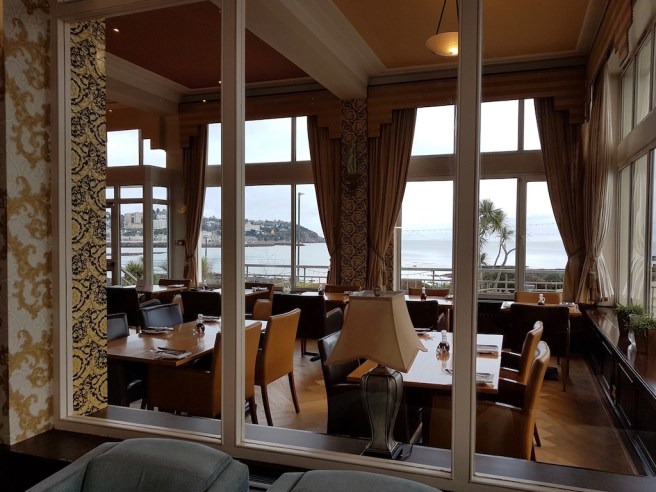
 ‘Thomas Cromwell : the untold story of Henry VIII’s most faithful servant‘ by Tracy Borman is a splendid history of the man and his times. It is amazing, and indeed reassuring how closely all of this ‘real’ history follows Hilary Mantel’s novels. As with all well written and researched histories Tracy’s book flows, and is almost like a Crime novel in that you want to keep turning the pages to see what happens next. And believe me a lot does happen. Cromwell, who I studied at school and Uni as a great administrator is a man of his times. A great administrator yes, but also a philosopher, a well-read man of huge intelligence, a deeply religious man, a brutal and cunning and ruthless but loyal politician who right up to his last few days in the Tower knew how to manipulate the King and his Council, many of whom looked down upon a man risen from the gutter just as they had looked down upon his predecessor Wolsey a butcher’s son. It is no wonder that King Henry lived to regret his decision to cut off his head. As I say, this biography is absolutely compelling reading. The only little criticism I can make is that Tracy Borman, when no other sources are left to her, is willing to use the same ambassadors’ letters home (the Venetian and Spanish ambassadors particular) that she criticises in another breath as being difficult to give too much credence to. Having said that, I so much enjoyed getting to know Thomas Cromwell, and didn’t want the book (or his life!) to end………
 new copy of the hardback ‘The Complete Great British Railway Journeys’ priced at £40 for just £4. Amazing! The book is a compilation of ‘Great British Railway Journeys’ and ‘Great Victorian Railway Journeys’ and based on the very enjoyable BBC programmes fronted by Michael Portillo with those names. It is really for dipping into but I read it straight through, over a few weeks admittedly, and really loved all the insight into the ‘history, landscape and people of Britain’ that it gave. Partly a reflection of how much things have changed since the publication of Bradshaw’s Guide to the lines in question, but also a celebration of how much has survived and the progress that has been made, I found such a lot to interest me and so many references to subjects new to me. From the Victorian find of the Bronze Age Gristhorpe man, still on display in Scarborough, to the Preston cotton mill riots (I was born there, opposite a cotton mill) and the establishment of the Temperance Movement in Preston, I was surprised at my lack of knowledge. Great, and very satisfying, to remedy a few gaps.
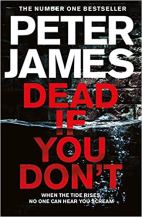 With her Christmas present of a National Book Token, F. bought 4 books when we were out the other day and I have already finished one of them. In truth it didn’t take me long. It was so good. It was the kind of book you would walk around the house reading not wanting to put it down. I rationed myself to bedtime reading mainly, and there followed a few nights of reading till well past 1am. ‘Dead If You Don’t’ is the book in question and the author Peter James stand at the pinnacle of Crime writing. His DS Superintendent Roy Grace novels are set in Brighton where he lives, and where he has astonishing contacts with the Police and others and which means all the procedural stuff is spot-on. This one is about a kidnapping and about the Albanian criminal fraternity living in Brighton. It is also about many other things including the corruption of wealth, the dangers of gambling, and of course about the personal interactions of Grace with family and friends. It is taut, well written and exciting. Can you praise a Crime novel more?

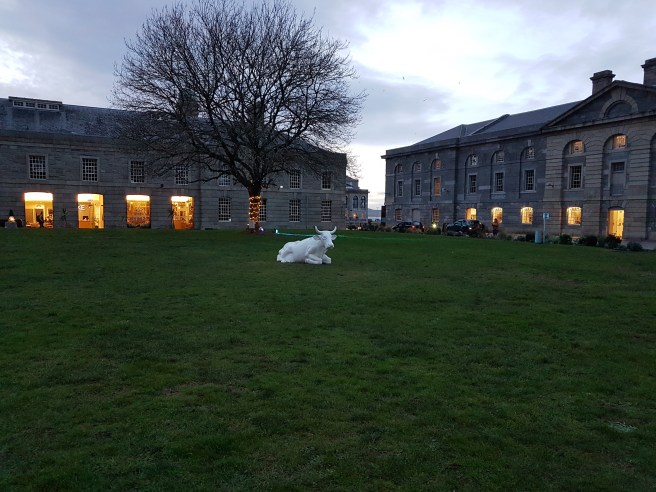
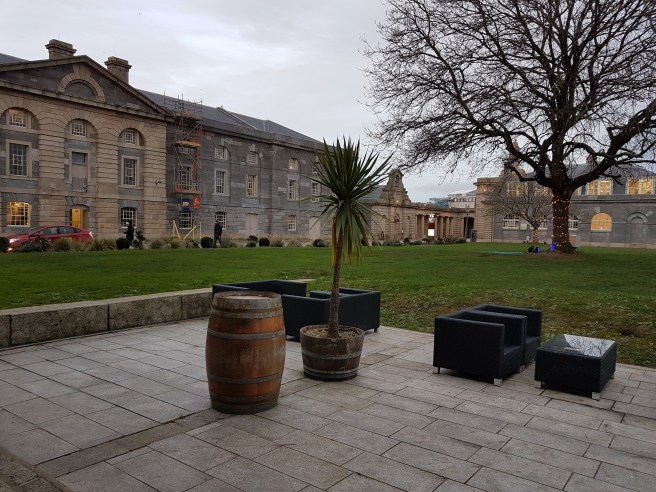 …………..an historic piece of Plymouth restored with sensitivity but very grand. Constructed between 1825 and 1831, Royal William Yard is in fact considered to be
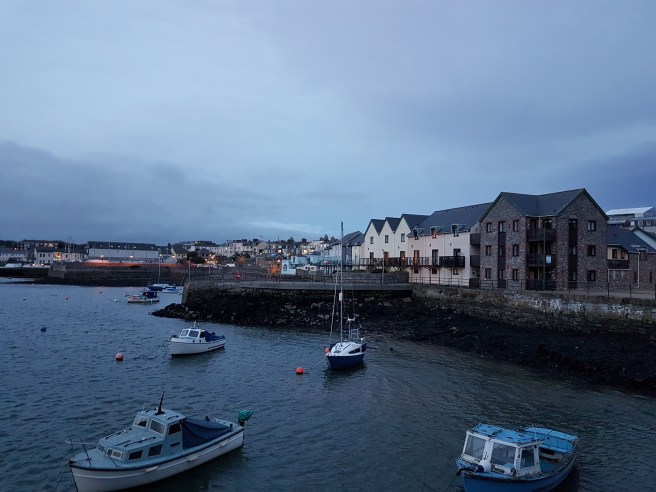
 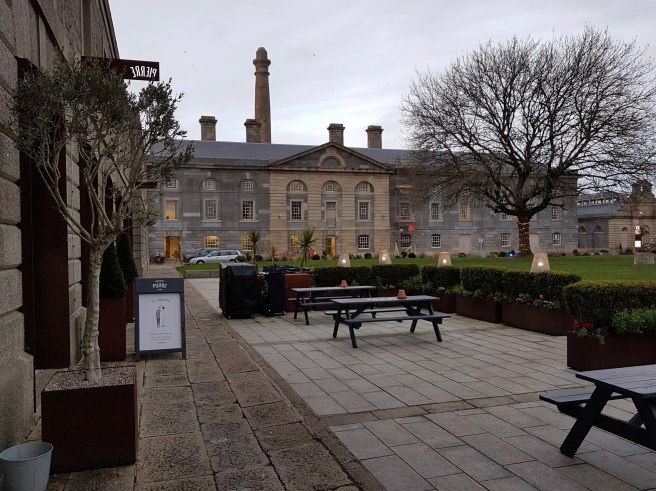 Described as the grandest of the royal victualling yards, ‘in its externally largely unaltered state it remains today one of the most magnificent industrial monuments in the country’. Released by the MOD as recently as 1992, Urban Splash have transformed the buildings into mixed-use restaurants, shops and flats, and it is all pretty special, although you do get the impression that it is not as well-visited as it ought to be.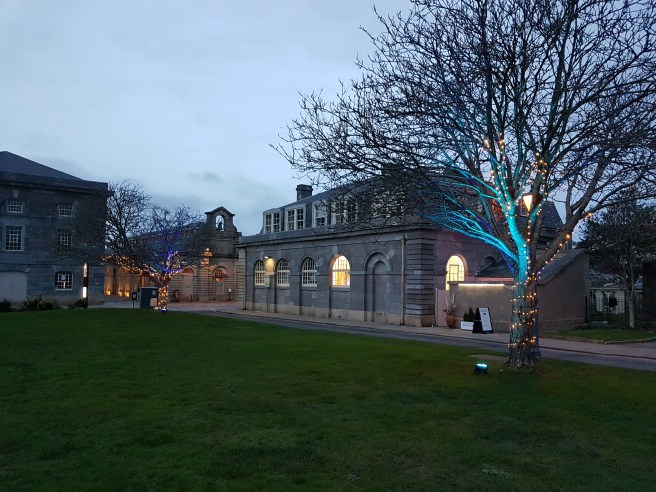
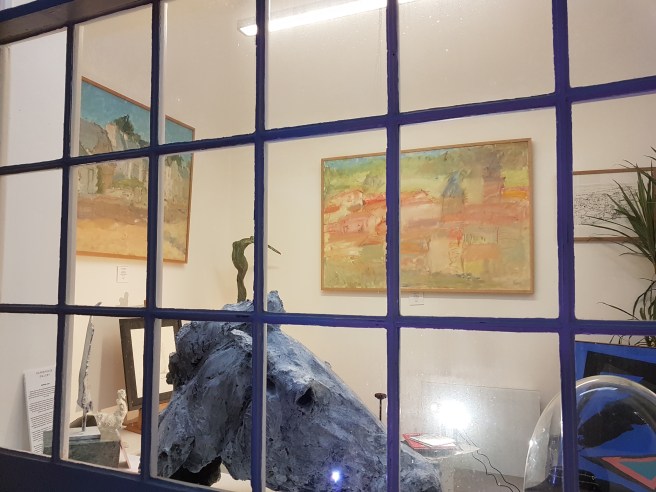
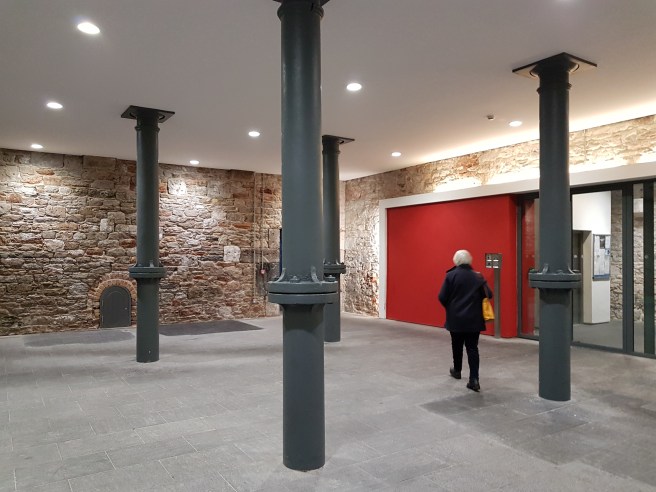
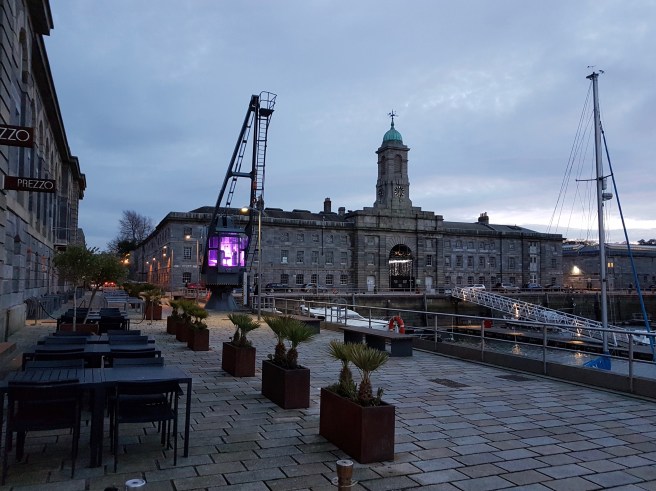 Bistrot Pierre where we had our coffee was pretty good too, an excellent looking menu, and they have just opened two of the buildings across the square as hotel rooms. They look swish.
 Yesterday back to Vue Plymouth this time to see the film
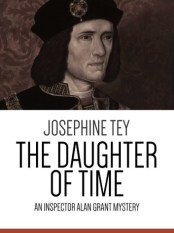 During our recent visit to Edinburgh I found this ‘The Daughter of Time’ on my daughter’s shelves. I had already read it but was anxious to do so again as I got terrific enjoyment the first time. I don’t think by any stretch of the imagination you could call Tey a great writer….I have read other of her titles and been immensely disappointed, but this is something else. A detective recovering in hospital, flat on his back most of the time, comes across, amongst the gifts friends and colleagues have been bringing in, a portrait of Richard III. He asks himself…is this the face of a man who could commit the murder of his two nephews in the Tower, an event heinous even then. His detective brain starts whirling and he is soon loaded down with serious histories, copies of documents and more trying to sift the evidence looking for clues as to who did actually ‘commission’ the murders. A brilliant tapestry of the times is woven as he refuses to accept the history written by the winners, in other words the Tudors, unless there is factual back-up. Although a Lancastrian myself, and a historian, I have always had a soft spot for Richard III and thought him ill-used by History. Although this is a novel it grips as real history always does. My two favourite subjects, History and Detectives, and this is part History/part Detective. I really couldn’t ask for more.
 things out of there, including many books. Noticing one of these, ‘Shakespeare’s Restless World’ I picked it up and started idly leafing through it. I saw immediately that this was only part-read so I resolved to start again. I am so glad I did. It is so well-produced with clear text and beautiful images, and so well-written by ex-Director of The British Museum Neil MacGregor, that it is sheer pleasure. Neil has chosen 20 objects (not only from the BM) to illustrate various aspects of what Shakespeare’s world was really like. These range from the failed attempts of James I to put together a joint flag for the Great Britain he wanted to be a reality, to a woollen apprentice’s cap in absolutely remarkable condition, to a pedlar’s trunk complete with contents, to a brass-handled iron fork lost at the Rose Theatre, the ownership of which was a sign of absolute sophistication. And he uses the objects to telling effect, delving deeply into the full range of Shakespeare’s work. So, my other favourite subject History/Shakespeare is well catered for in this splendid book.
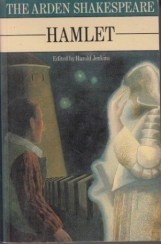 Which leads me on to saying that, having aroused my interest in WS once again, I could not forgo the immediate and absolute pleasure of reading again for the umpteenth time the play ‘Hamlet’ which for me represents the height of literary achievement. It was something I studied in great detail for ‘A’ levels. I have seen the play a few times. I have seen a couple of films. For me it never palls. I read this time round the Arden edition which has copious footnotes and explanatory material, but I must admit that I am easily distracted by these and actually found all of this tiresome as the Editor Harold Jenkins seemed to be engaged a lot of the time in scoring points off previous editors and commentators. Hamlet is too good for this. Best just to read it straight through and make your own sense of it.
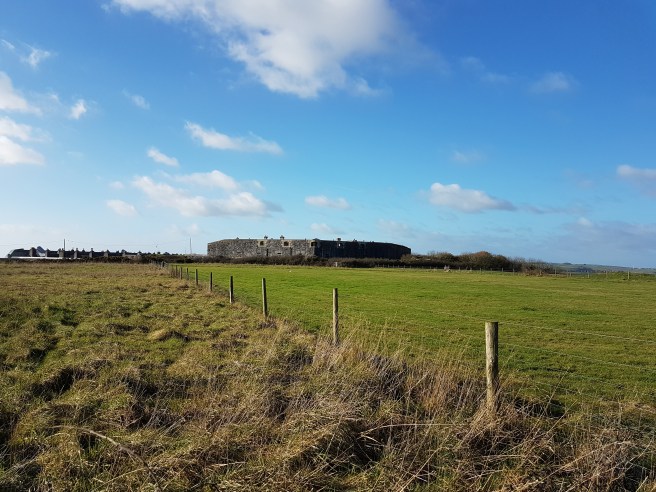 Sometimes you believe you are surrounded by a landscape of water with the sea on one side and numerous creeks and inlets to the side, in front and behind…
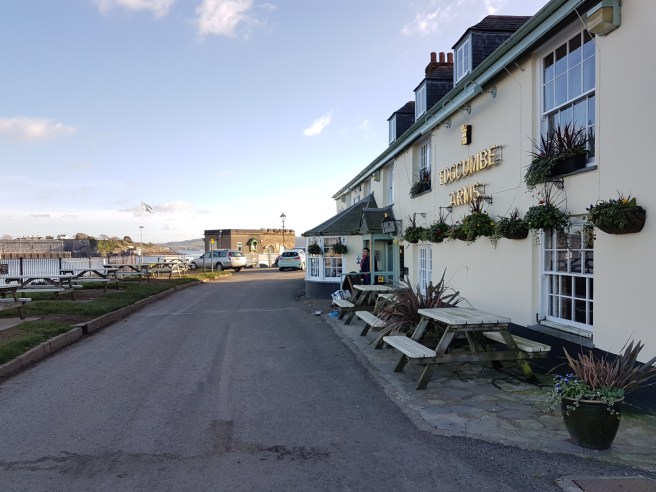
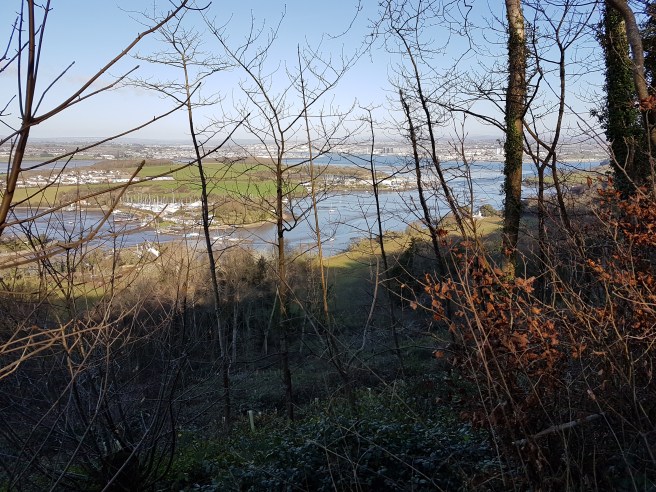 We started off at the bottom end of the Edgcumbe estate with a drink in front of the fire at the Edgcumbe Arms. This then steeled us to face the cold but beautiful day.
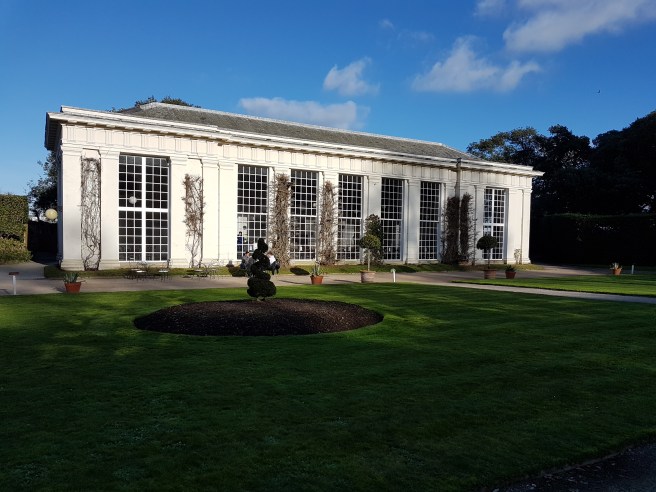
 First stop the Orangery…
 We then made our way along the coastal edge of the estate taking in various temples and follies….
 One of the gun batteries showed how strategically placed Edgcumbe is – looking out over Plymouth Hoe, and one of the many very good information boards showed the location of an amazing number of shipwrecks in this part of the Sound. I would have thought that when you had made these waters you were safe – but apparently not!
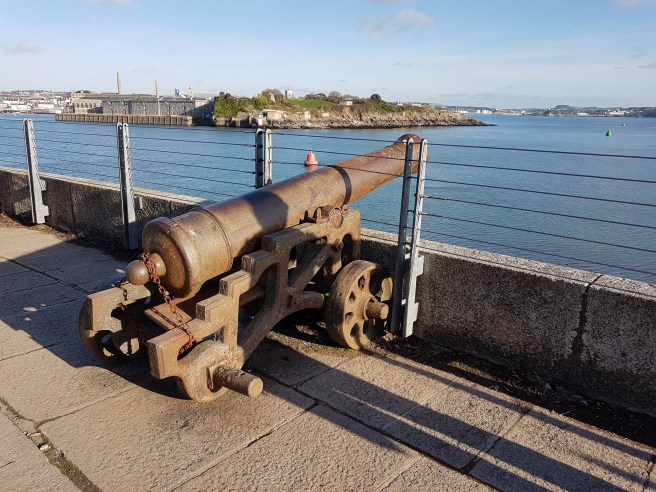 The path took us through various parts of the garden which we hadn’t seen before…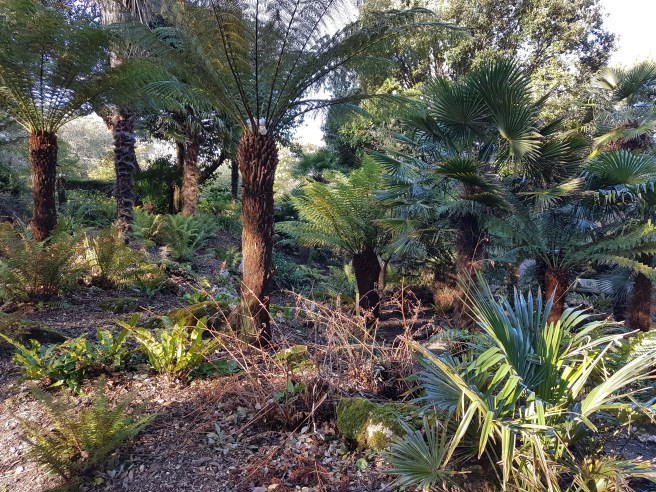
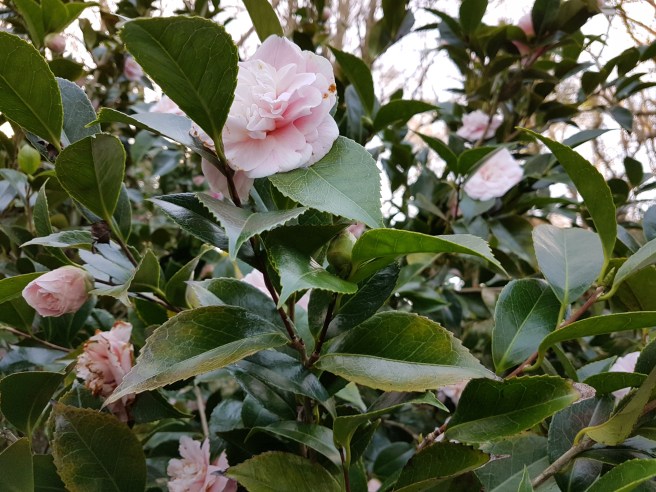
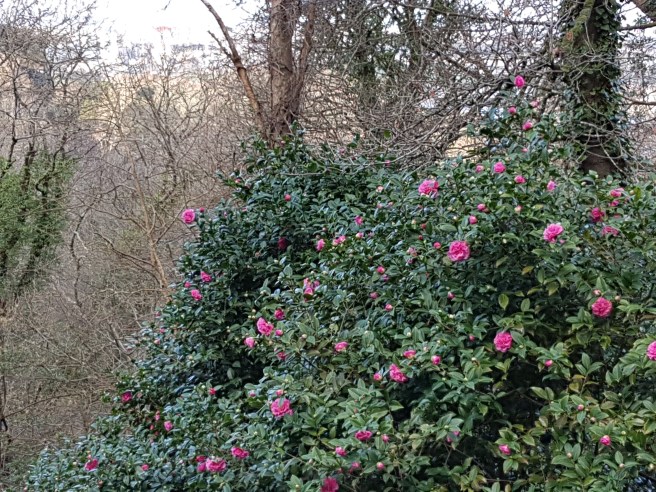
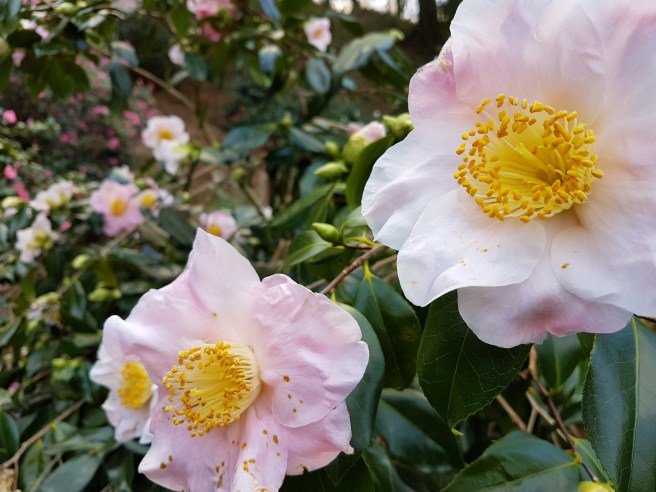
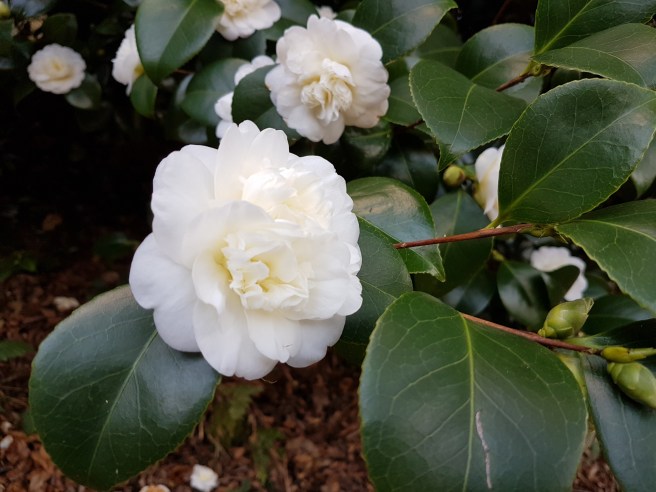
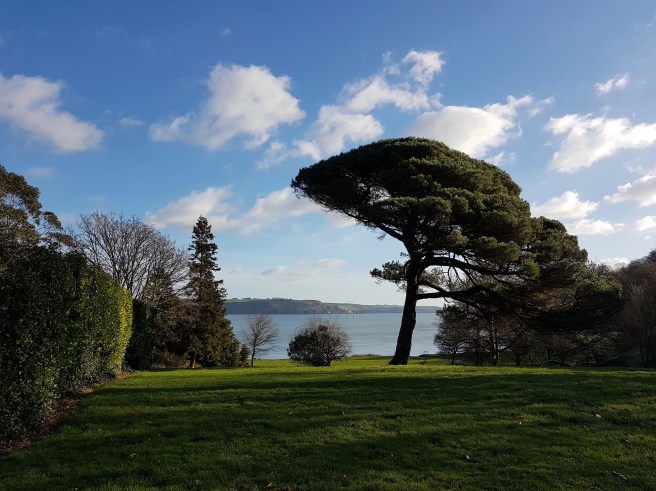 and we noticed our first burst of Camellias….
 This is ‘Milton’s Temple, c. 1755 – a circular Ionian temple, with a plaque inscribed with lines from the poem
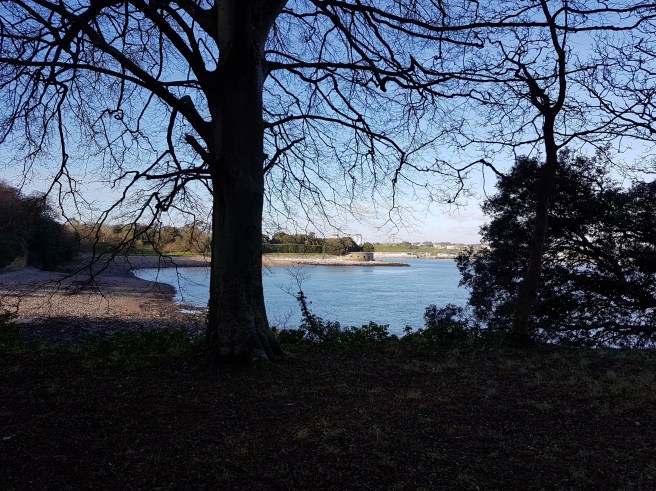
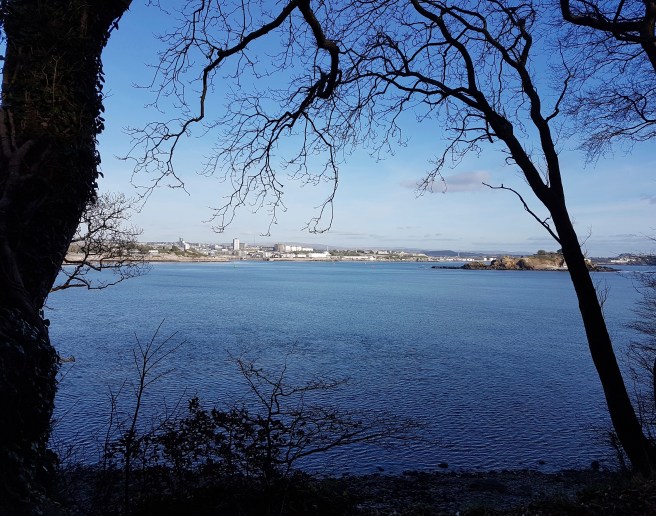 The walk was not without its efforts, but all very worthwhile and we saw very few people indeed which was good.
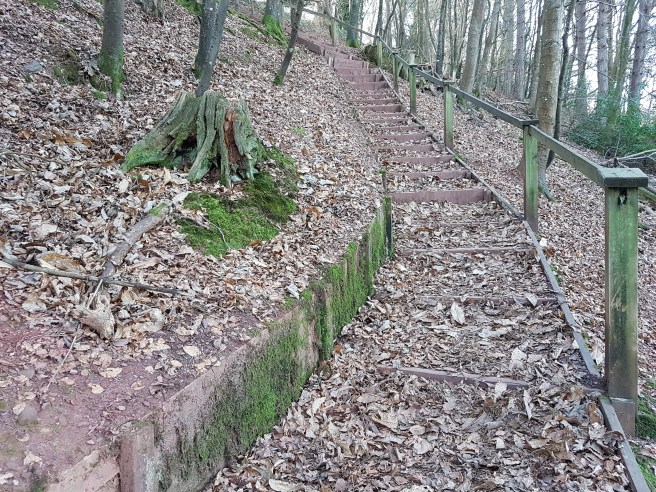 I intended to climb this folly I think for the views but on approaching it I noted some very serious snogging going on at the top level, so I left well alone!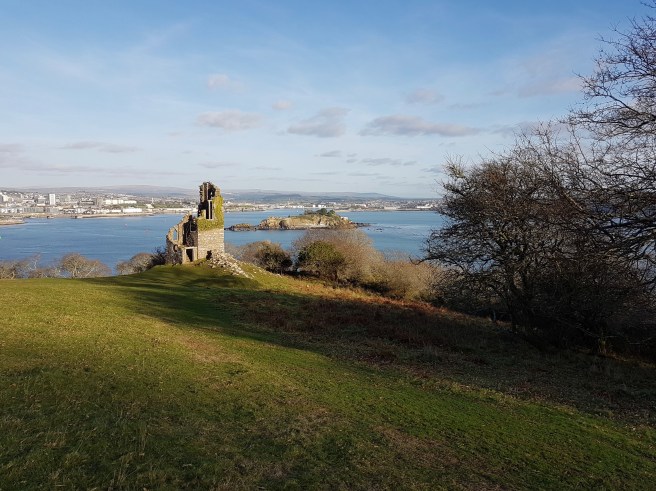
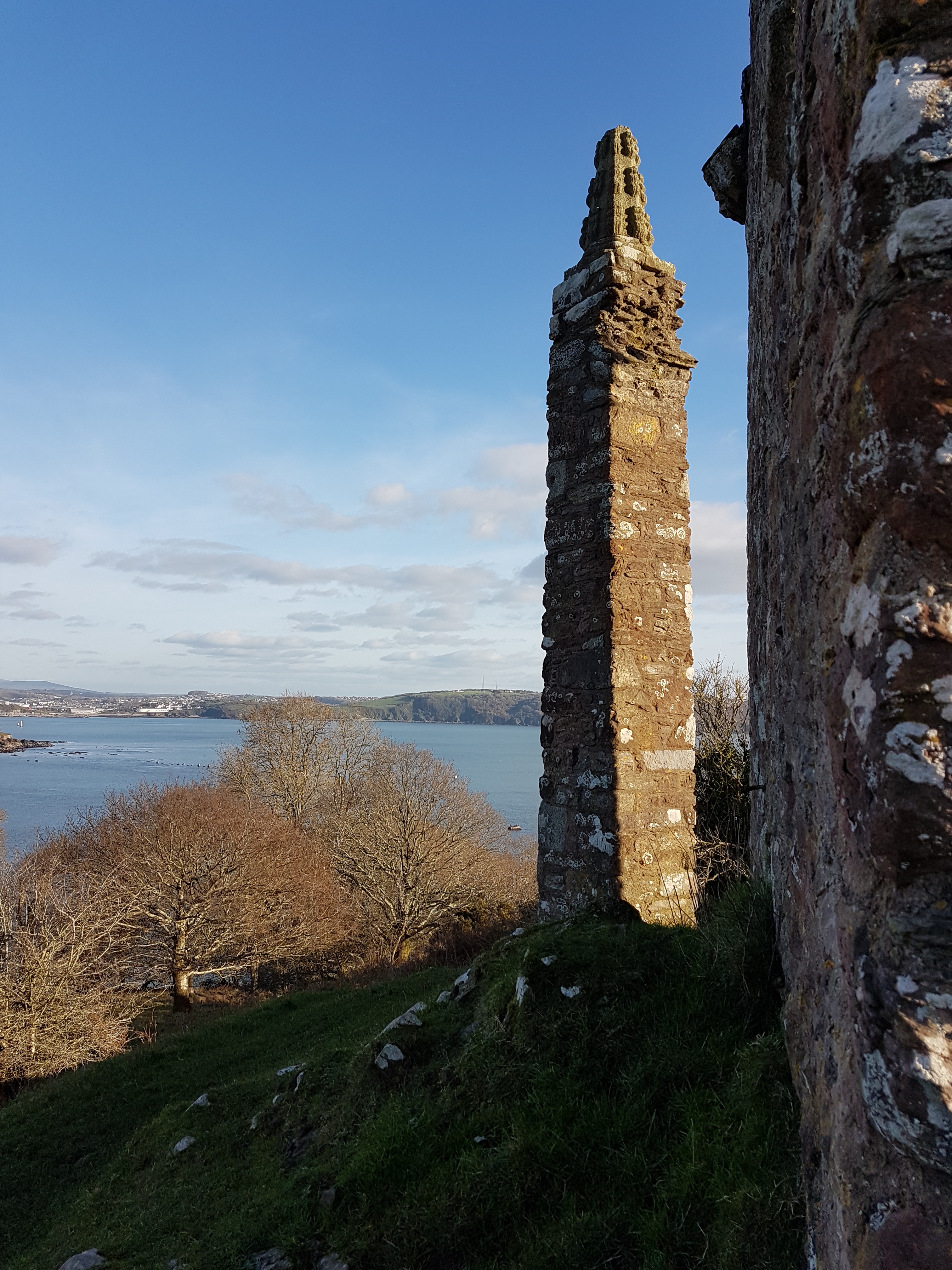 From here I tried out my panorama mode….not too bad……
 and it was just past here that we noted that the grounds do contain the National Camellia Collection….what a cheering sight on this winter’s day……..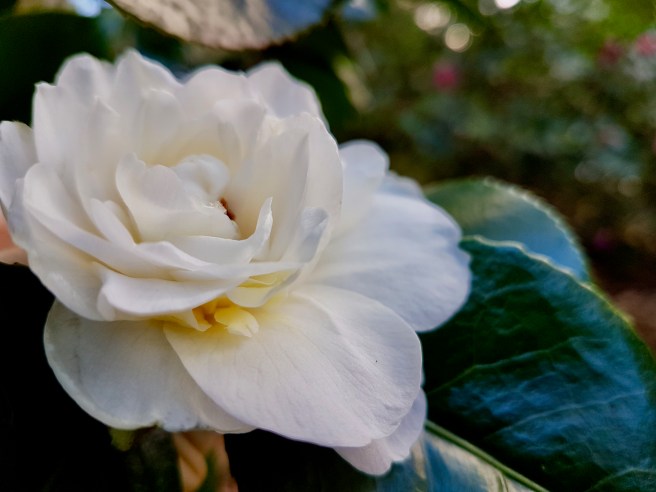
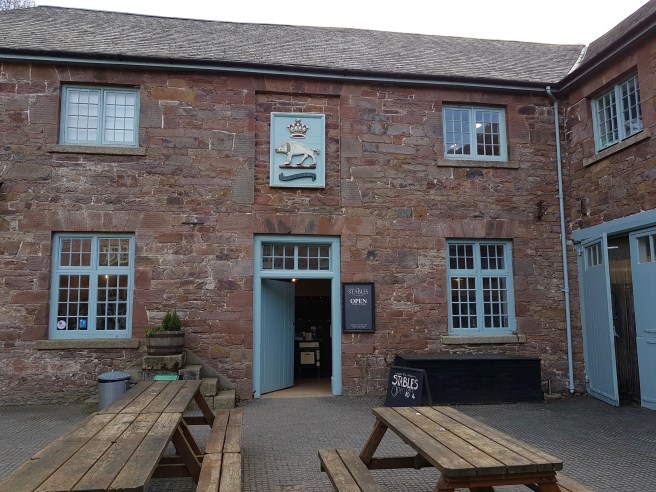
 Back at the house we visited the Stables area where all the trades used to be located – the blacksmith, wood turner and so on, all the buildings now used by independent crafts people……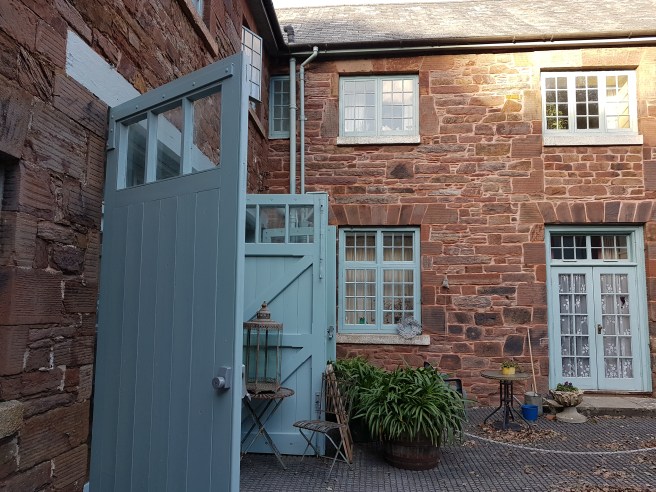
 The house itself is not open until April….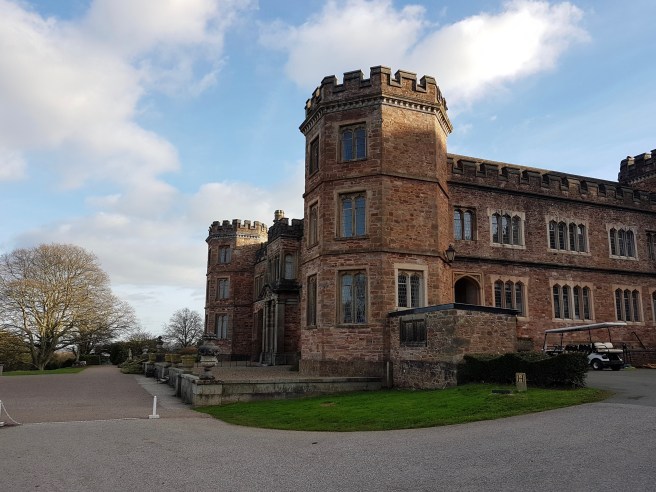
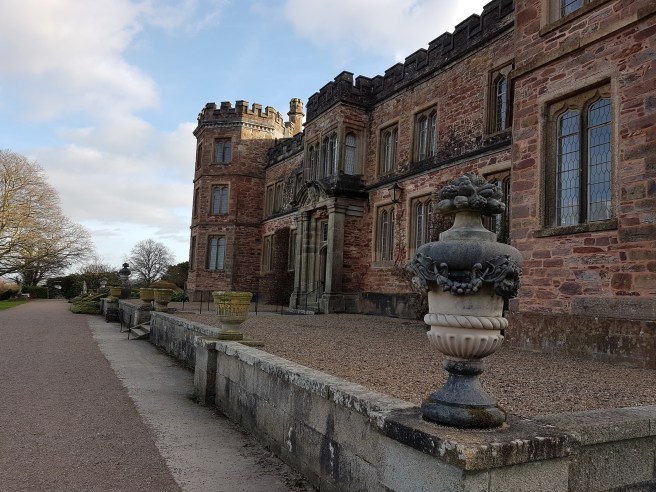 We made our way back to the car along a splendid avenue of trees……..
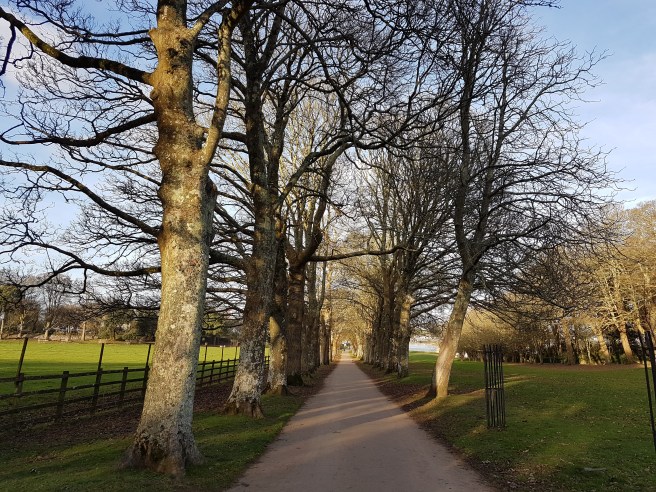 Days like this, cold and clear, remind us of winter days in York……they should be enjoyed to the full.
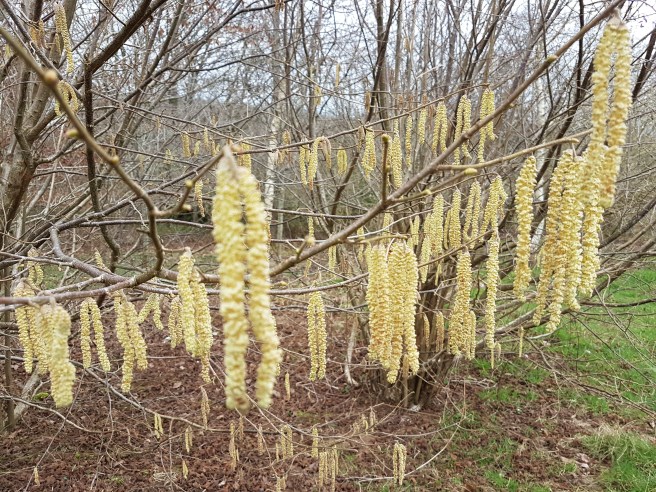 Looking at our local map we saw that there was a potential new walk from Duloe, the next village to us. It did have some rather sharp contour lines, but looked promising. There are no public footpath walks from St Keyne, our village, which is a shame, although we do constantly walk along the lanes. Anyhow, off we set. First of all there were some rather lovely catkins decorating a few trees at the start of the walk. Then, after crossing the dry bed of a little stream….
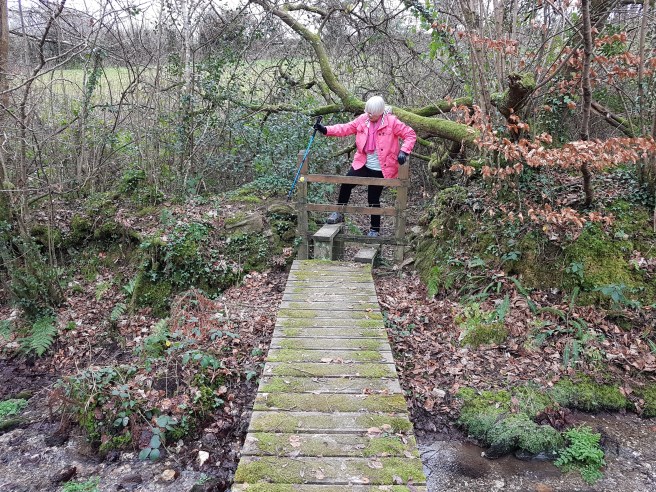 we walked through an orchard which belongs to
 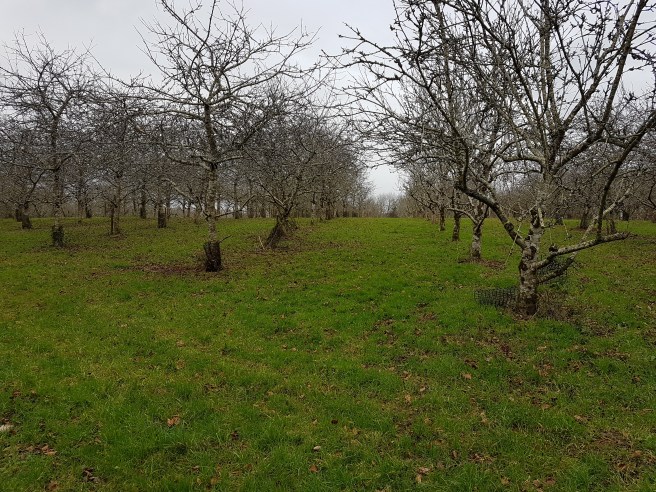 We descended sharply to the valley bottom through
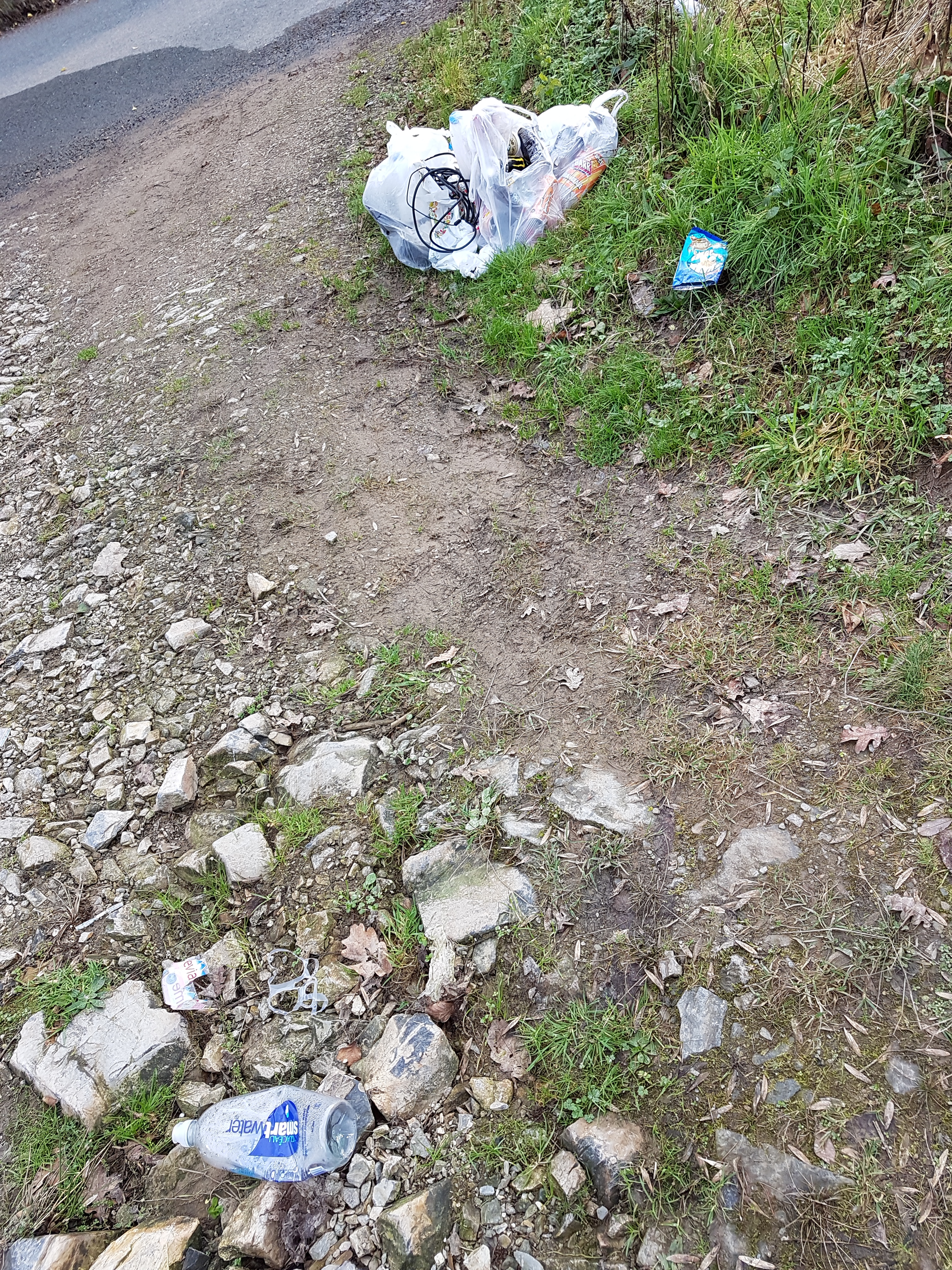
  …….someone yet again had blighted the landscape with uncaring dumping of litter. Who are these people? Well, on the way back up to Duloe on the lanes I noted a discarded outer of Carling Lager, and scattered for a mile or so along the hedgerow I counted about 10 cans of Carling. Idiots all these people.
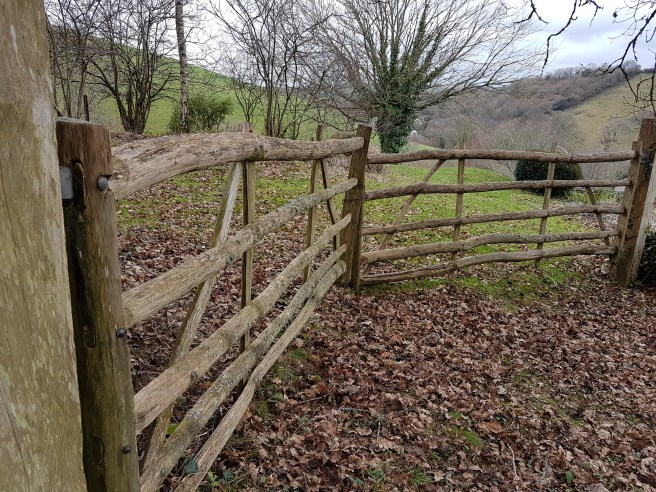
 There was a rather nice cottage on the way up which had a lovely rustic gateway which added to the view…..I do so like the gates and stiles and crossing points you see on country walks and often take pictures showing the huge differences in regional styles (not a pun!). I really would like to write a booklet for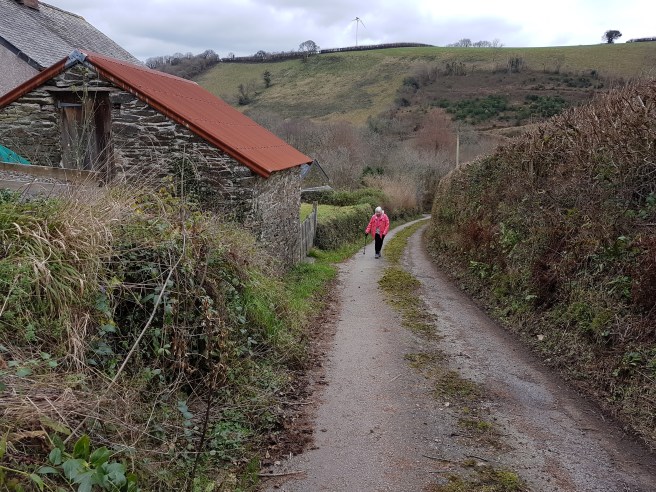
 We noted some wildflowers in bloom, and when we had finished our walk I drove to the edge of Duloe…….
 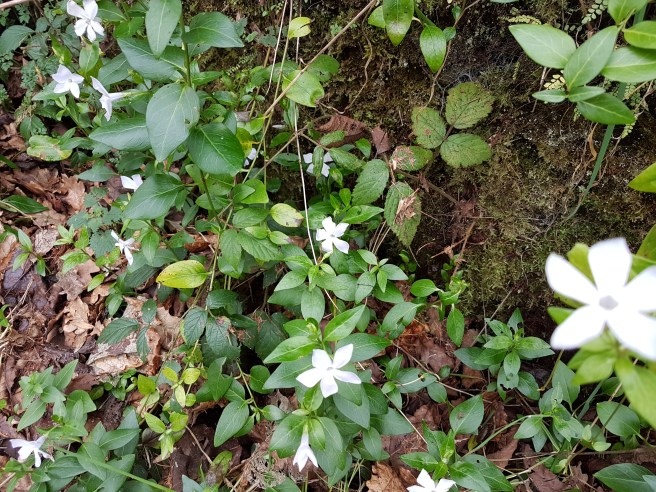 to take a picture of a clump of daffodils that have been in flower since December…..this bank where they are is full of daffodils in Spring, so I am frankly amazed at this one clump with no sign whatsoever of any others….perhaps a very early variety anyhow.
 Other things are blossoming at this time in Cornwall…here a camellia and……
  ….in our own garden this azalea has been in flower since at least early December, probably November.
 Well, we did our 8000 steps, but I don’t think we’ll be in too much of a hurry to do the walk again. It was a little uninspiring……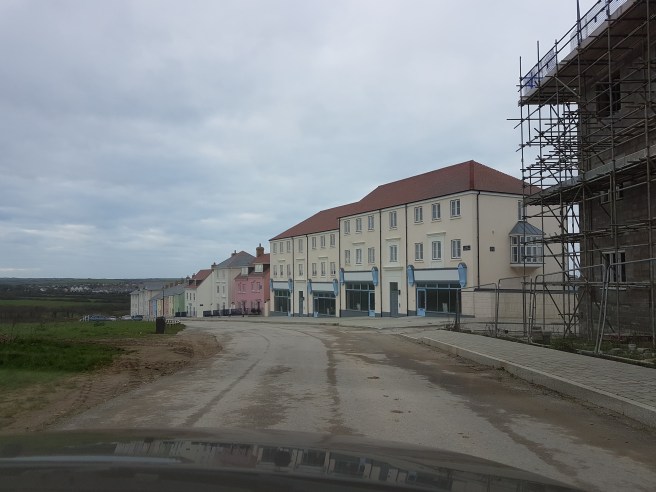
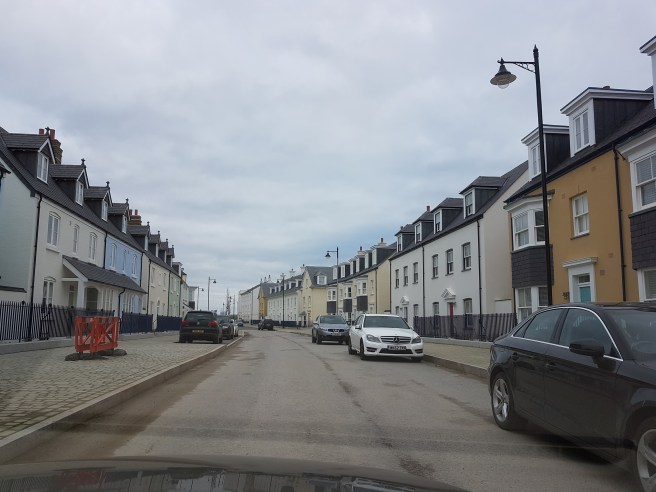 Leaving the outskirts of Newquay, we had another chance find – Lusty Glaze beach ‘which is situated in a natural ampitheatre of 200ft high cliffs. Smaller than its more expansive neighbours The beach benefits from a degree of shelter from the prevailing wind. Although privately owned the beach is fully open to the public at no cost.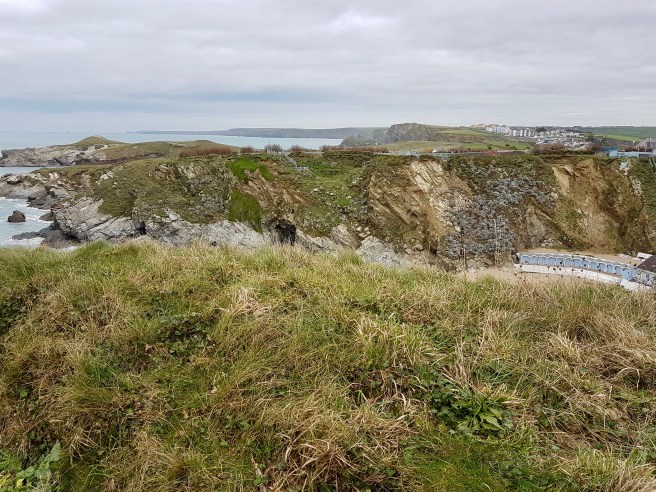
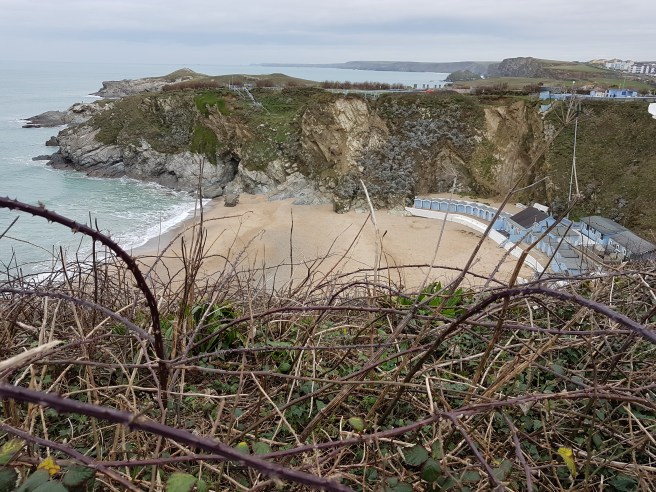 Having looked at a number of familiar beaches, we decided not to start a walk on any because it was the point of high tide and walking distances were very circumscribed. Instead we took a long almost deserted road to a NT carpark at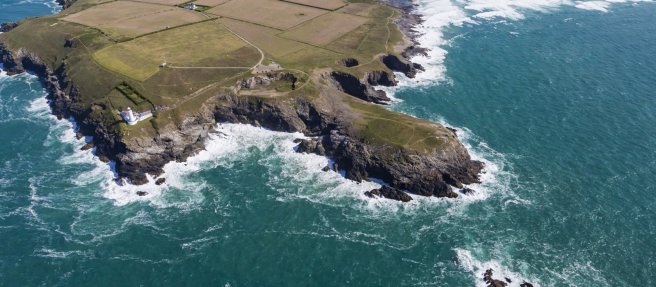
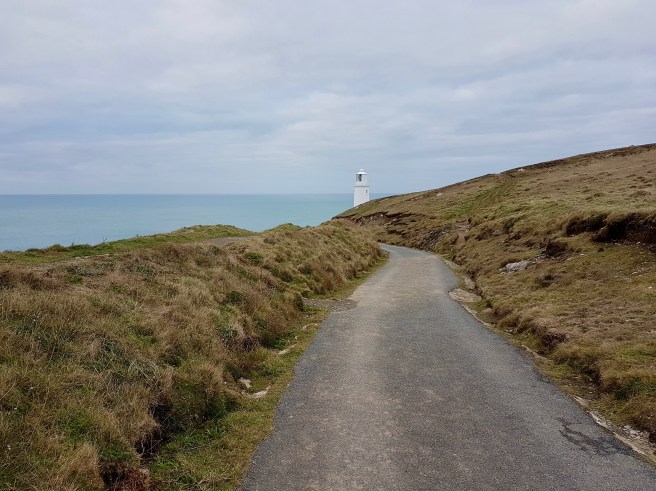
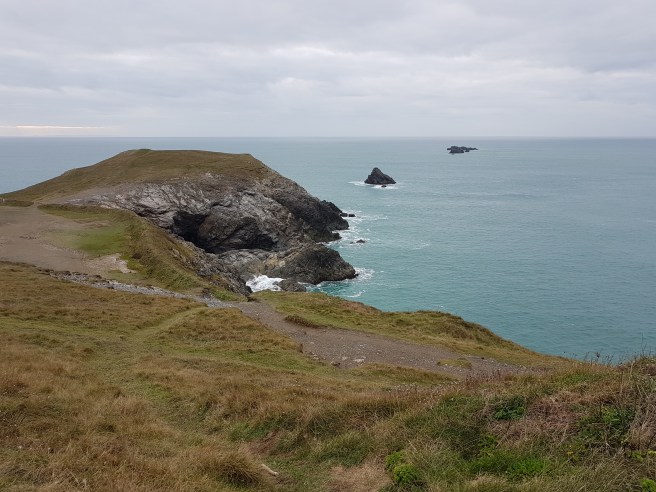
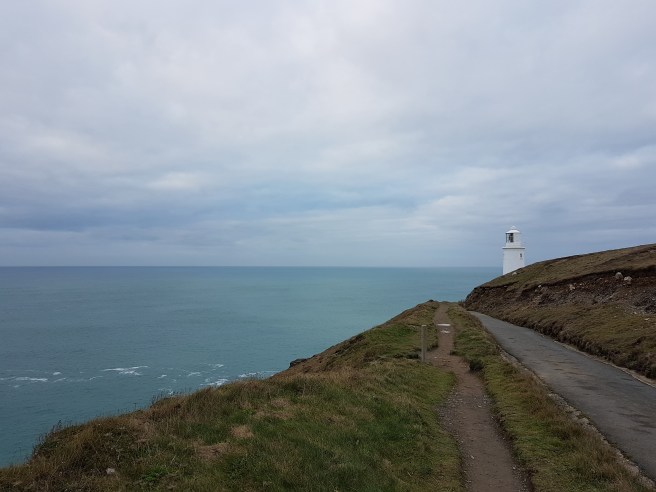
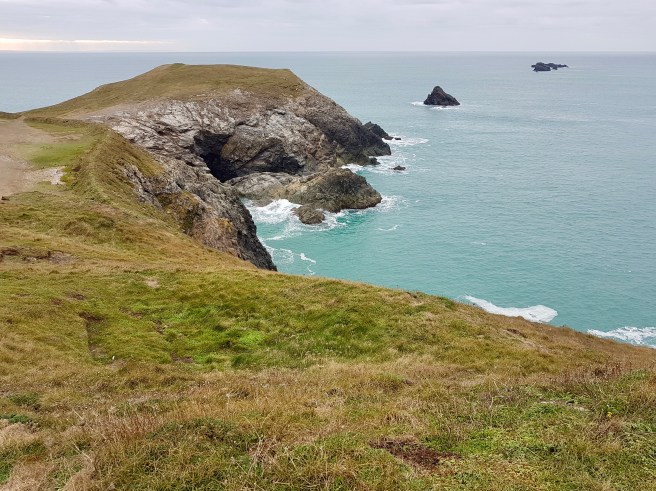
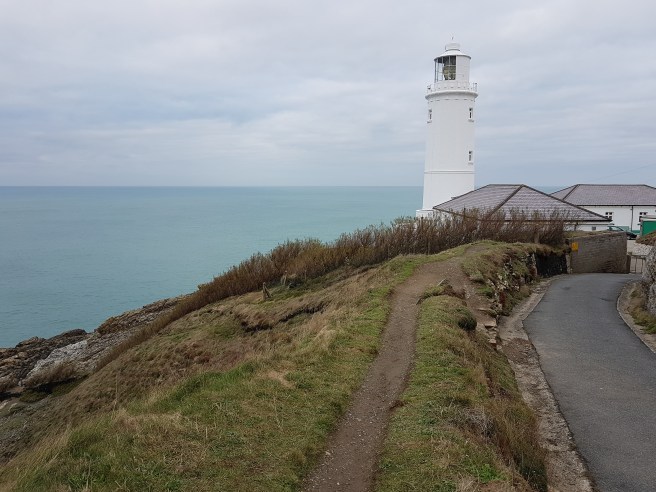 The sea around the headland had that beautiful green-blue colour which is so reminiscent of say the South of France even though not a particularly nice day.
 Requiring toilet facilities we adjourned to nearby Padstow where I thought we might get a glimpse of their Christmas lights. The town was surprisingly busy.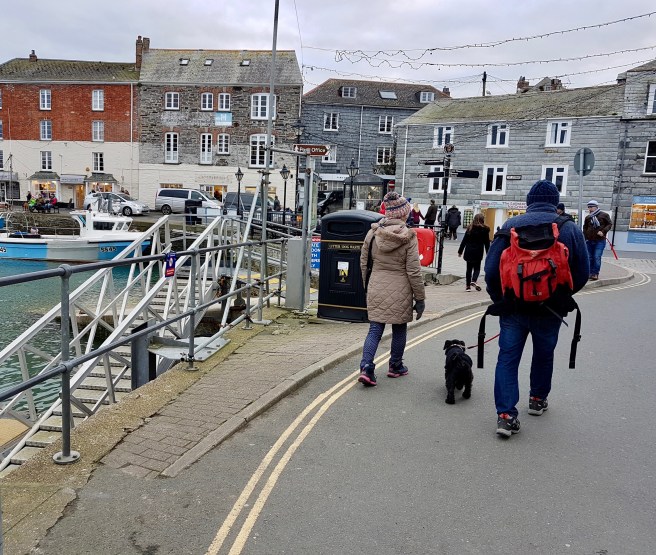
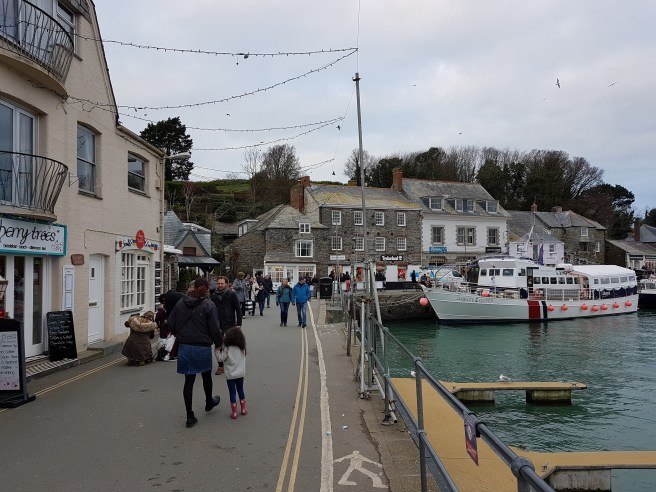 We did our usual walk up the hill to the War Memorial and then down to St George’s Cove. Normally you can walk much further around the headland here but as it was high tide – not. We really should consult our tide tables more often!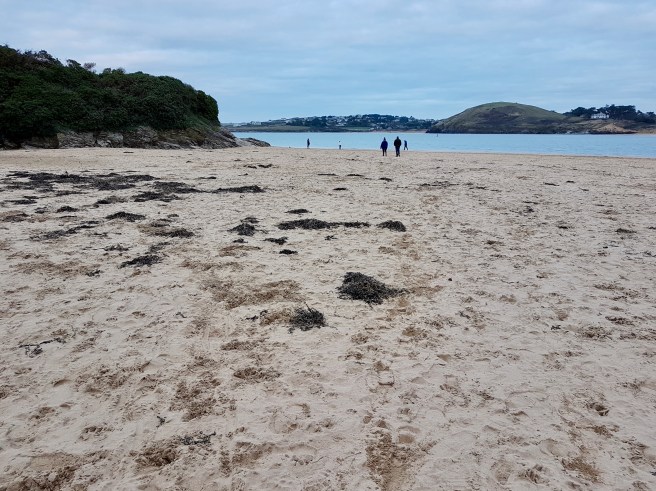

 same speaks volumes. Having finished my trilogy I moved on to ‘The Girl Who Takes An Eye For An Eye’ which I have to say was one of the most boring reads I have had for a long long time. Stieg Larsson’s original books were sensational and have been made into excellent films of course, but this…..considering it is supposed to be a thriller there was not one iota of excitement in all of its too many pages. if this is the best that can be done the franchise has certainly had its day. I won’t bore myself any more by talking of the plot….there wasn’t one!
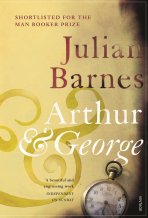 Over Christmas I happened to mention to my son-in-law the novel that Julian Barnes put together based on how Sir Arthur Conan Doyle took up the case of a Birmingham half-caste solicitor George Edalji who was imprisoned as the guilty party in the so-called Great Wyrley Outrages where animals were savaged in the Midlands locality where he lived. A shocking miscarriage of justice about which Conan Doyle created a huge fuss in real life is subsumed in a gripping story which relates the development of the two main characters into the people they were and then their inter-reaction. A literary masterpiece, shortlisted for the Booker, it should surely have won. Anyway I shall be posting it off to Nasar and hope he enjoys it as much as I did for the second time.
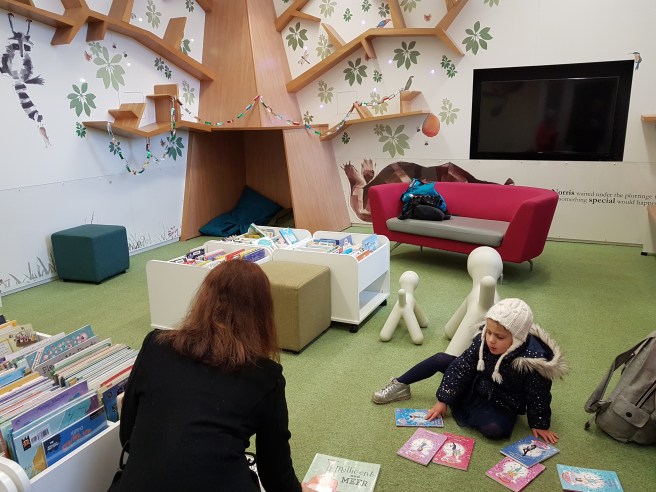
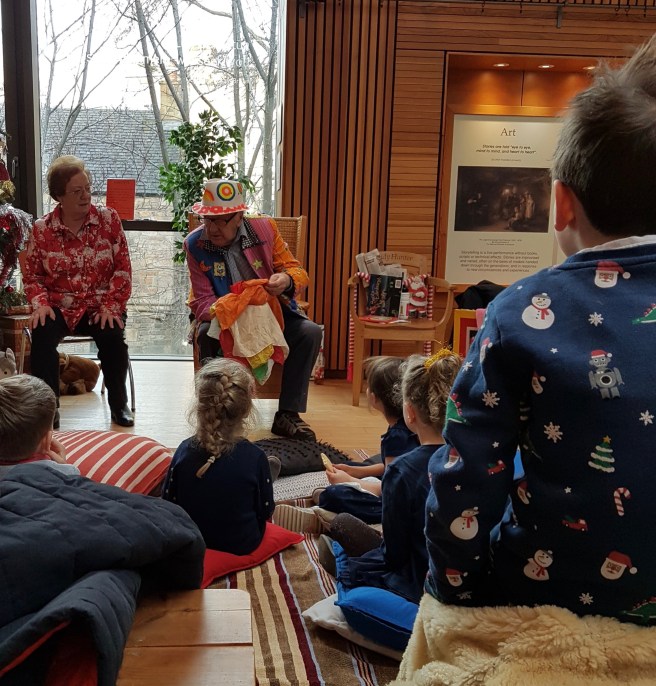
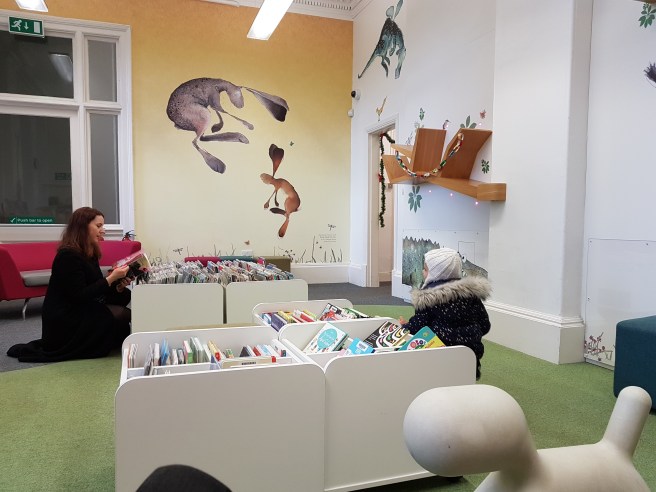 and then on to a special story-telling which was very well done and captivating almost to the end…..the only dodgy bit was that in one of the stories small presents were pulled from a sock for a few children, but at the end of the story they were collected back…mean!
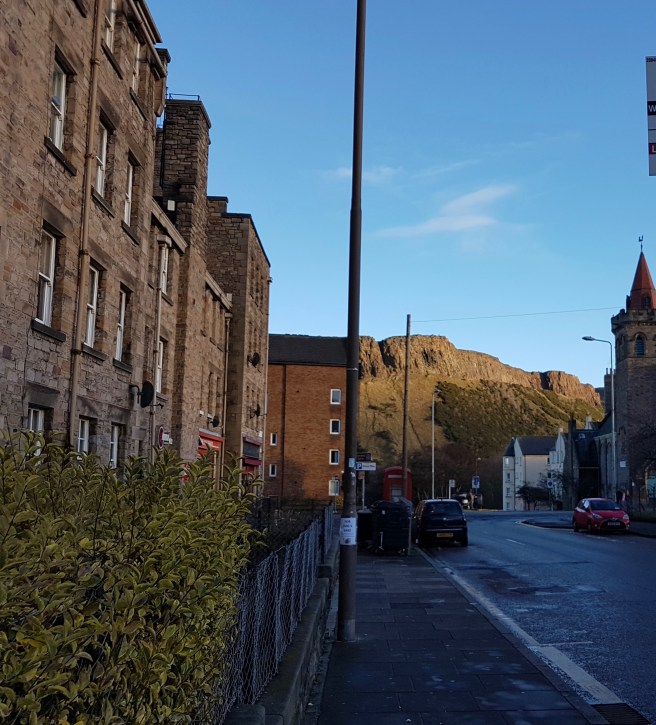
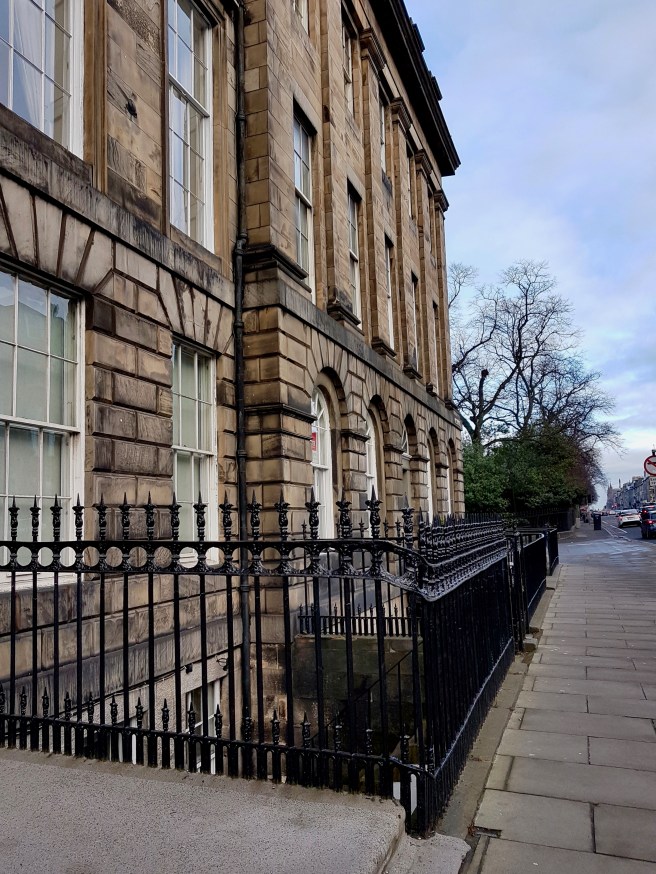
 A bit of shopping in town, and a chance to admire fine buildings…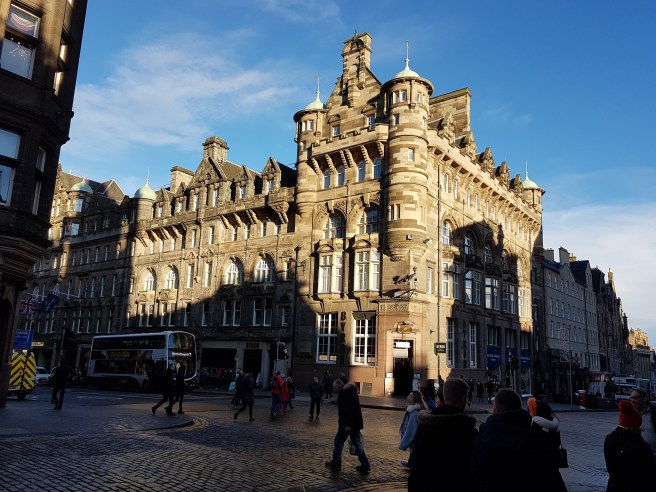
 A busy day was completed at the Commonwealth Swimming Pool for a Christmas party and adventures in the soft-play area….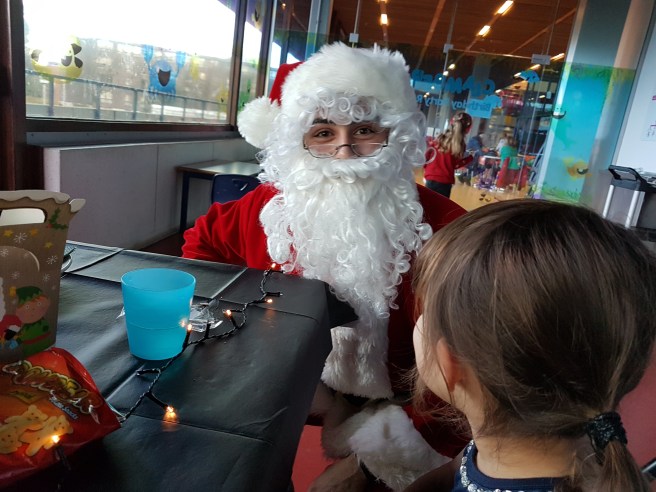
 The next day we had a very nice stroll down through New Town to Stockbridge, an area I like very much for its ‘village’ atmosphere and shops.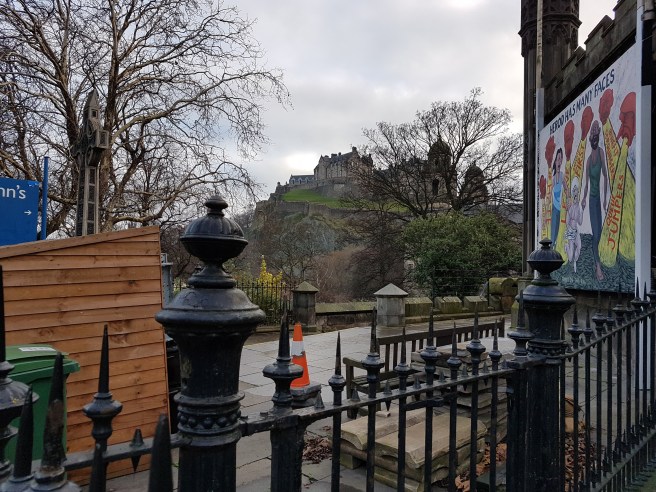
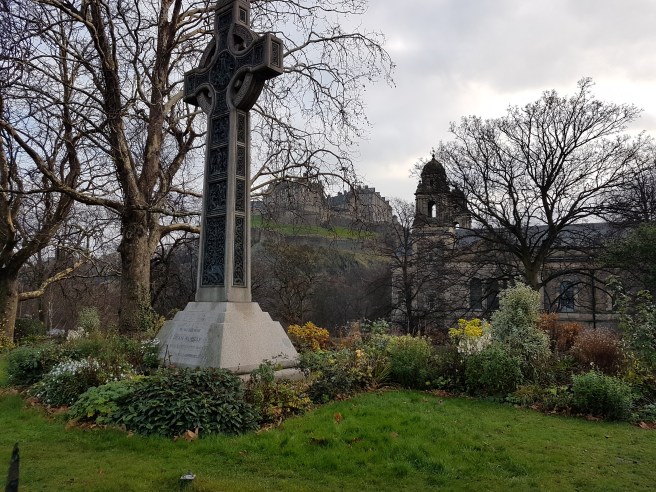
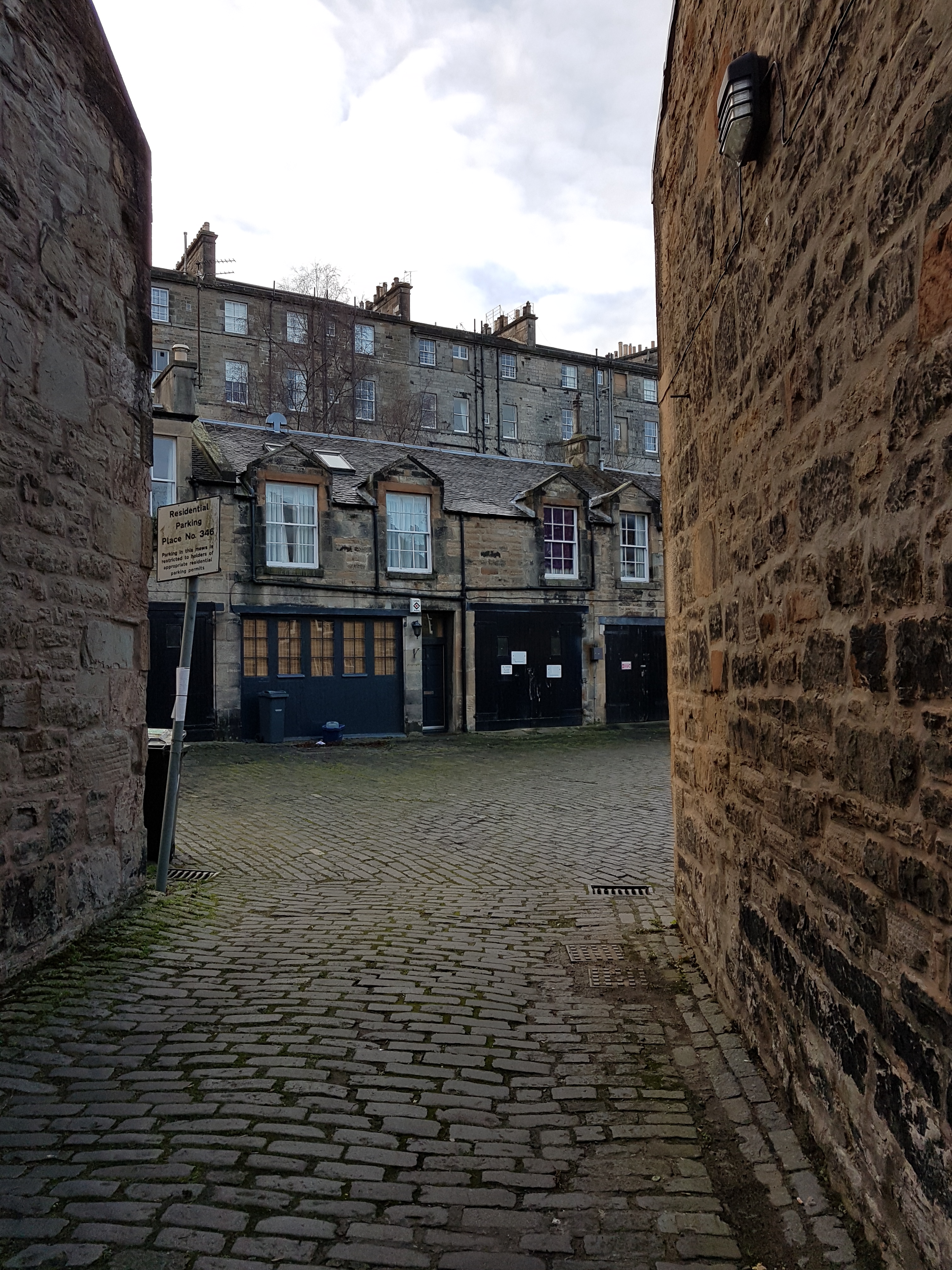
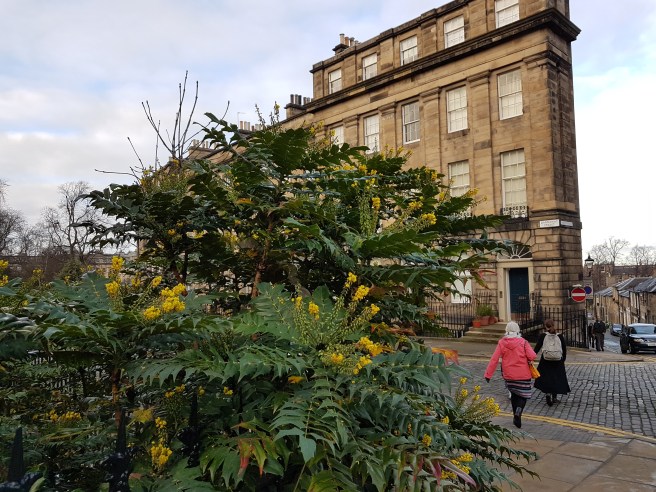 the backs of the big houses are mews converted to rather interesting dwellings…
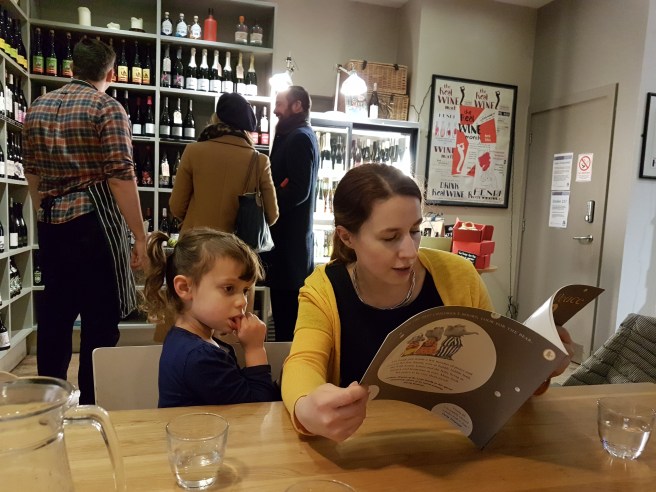
 Our task was to buy some fresh fish from the excellent fishmonger which I was to use for sole with beurre noisette. Lunch in the local Deli was great.
 On Christmas Eve we went to the Princess Gardens fair which always has a nice family atmosphere, unlike some fairs I could mention…
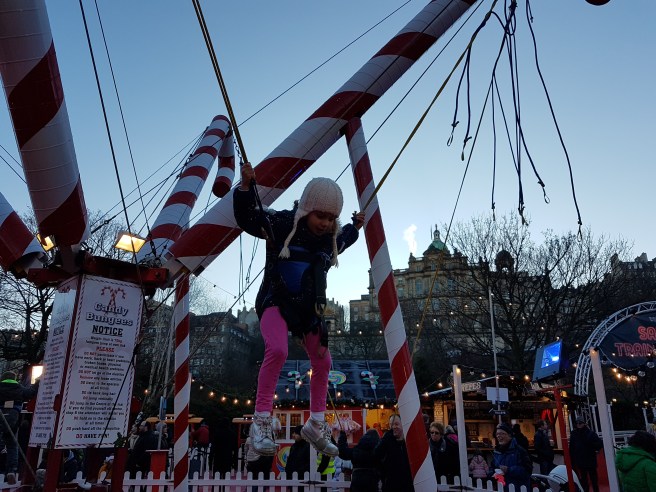
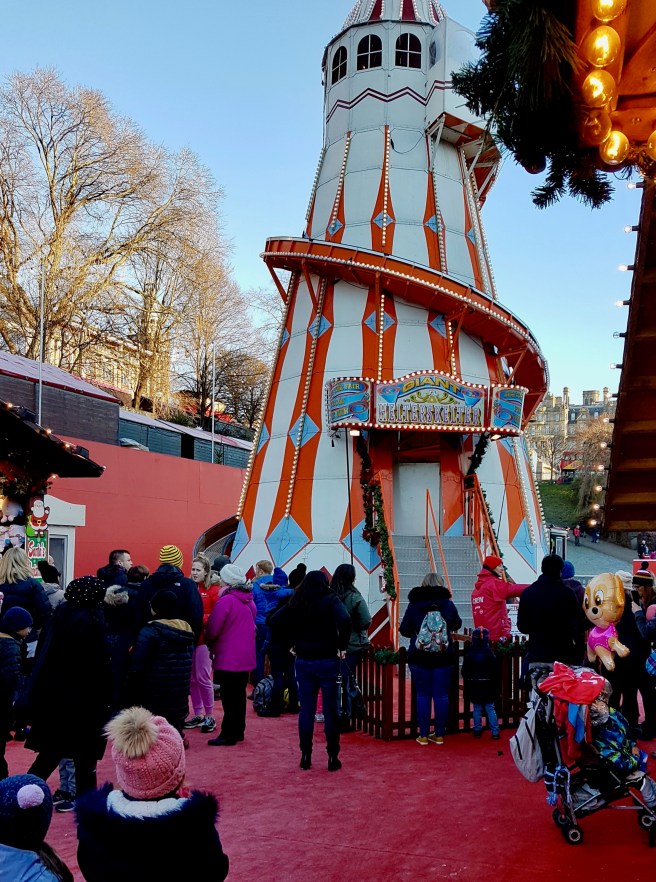
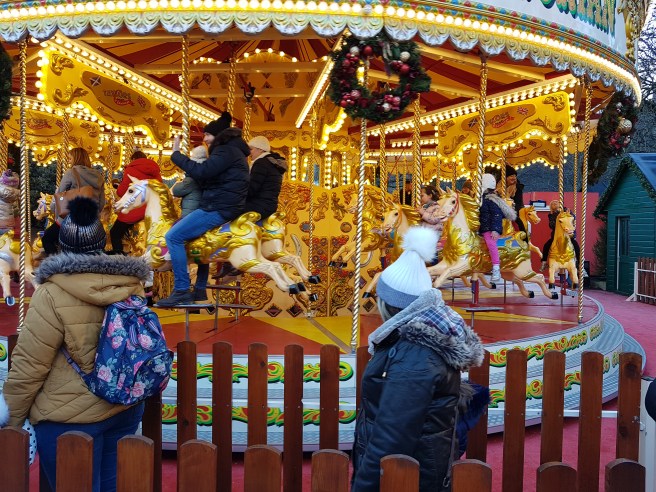
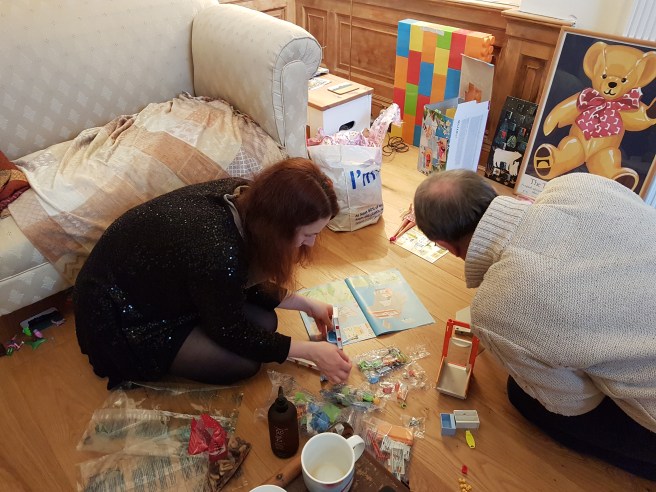
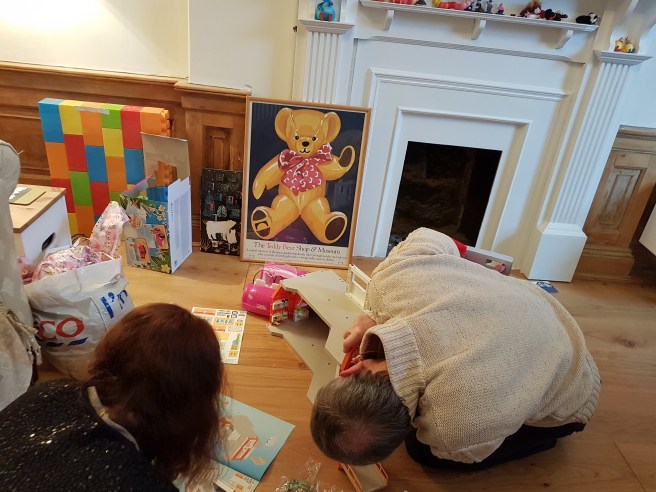
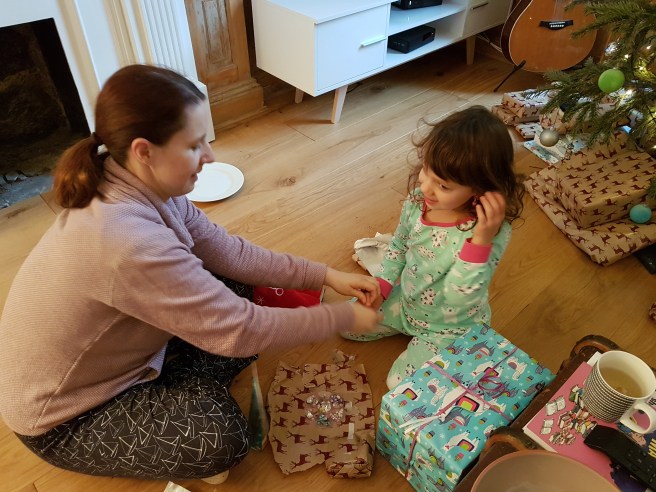
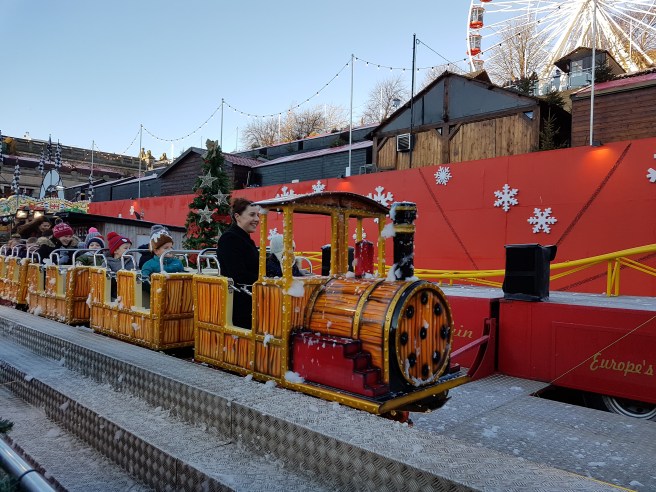 Christmas Day was excellent (and busy). I think it took two of us sometimes three of us about 3 hours to erect the Playmobil hospital…still that’s what parents and grandparents are for…..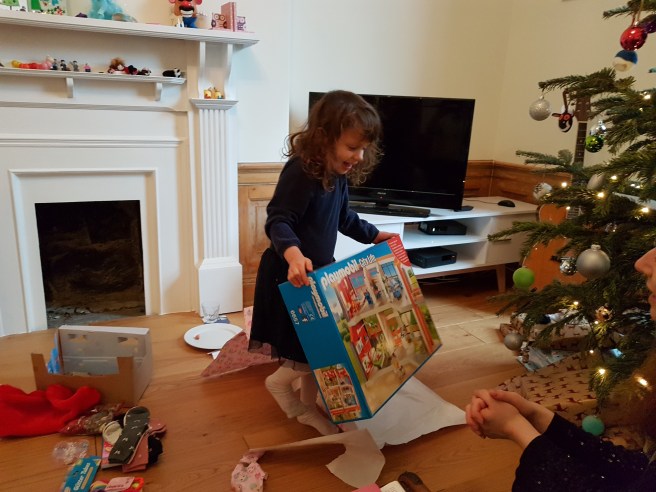
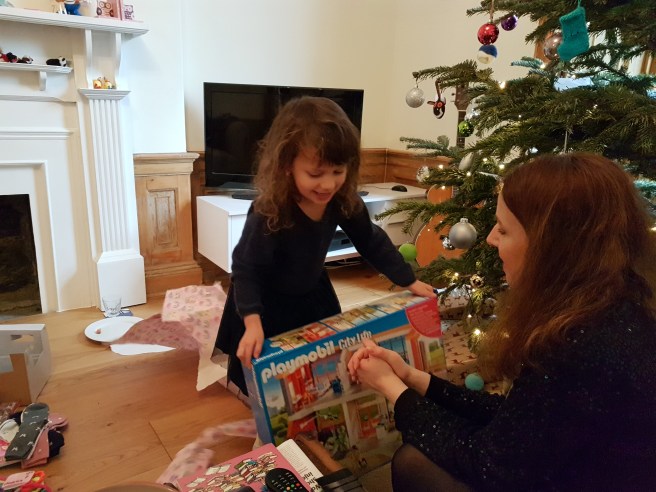
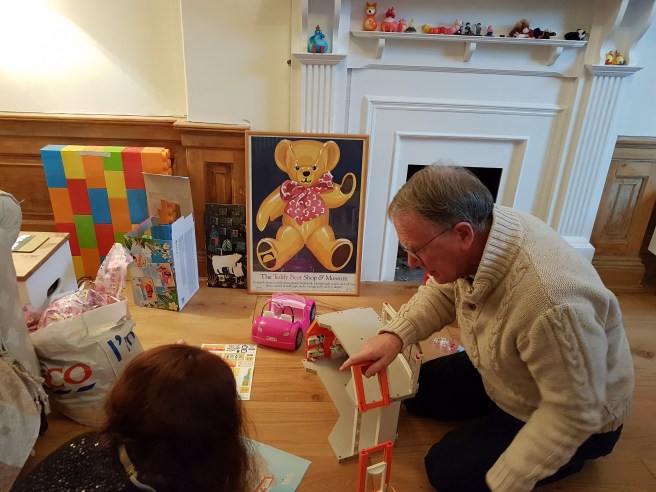 but there were lots of other presents too, so many that Nasar negotiated an agreement whereby quite a lot of existing toys had to be put on one side for Charity before the new ones could be put away!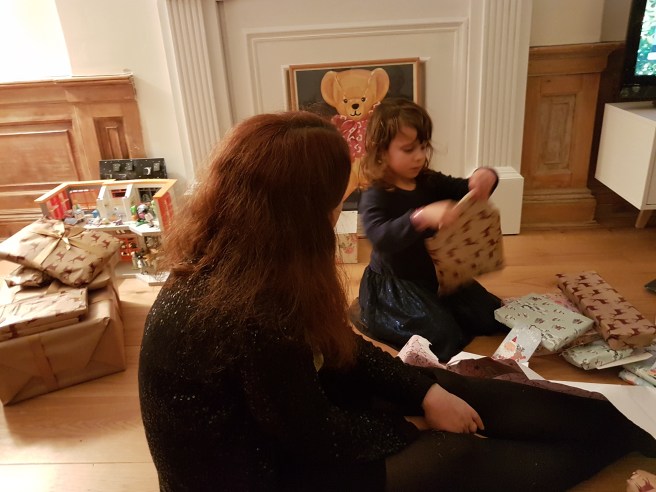

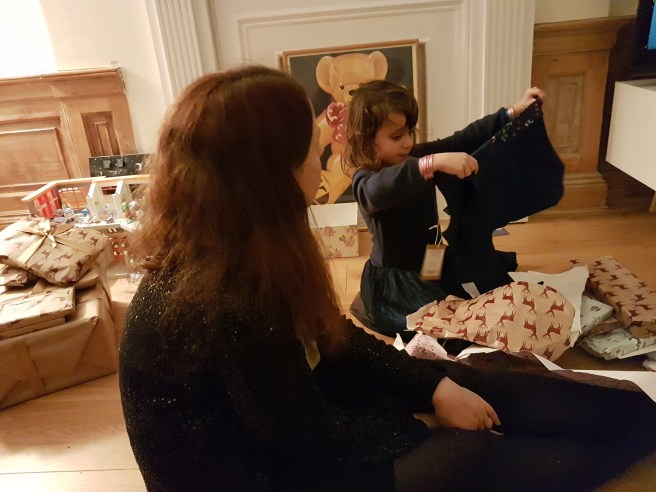
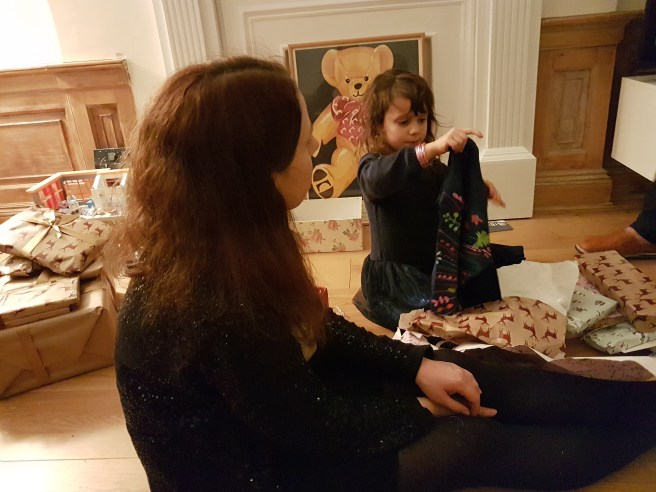
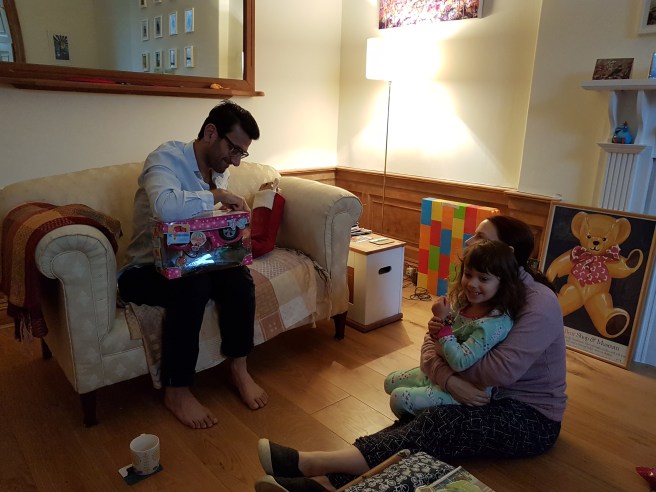
 Nasar’s favourite toy, and mine, was the remote control car which could run on walls and ceilings as well as the floor……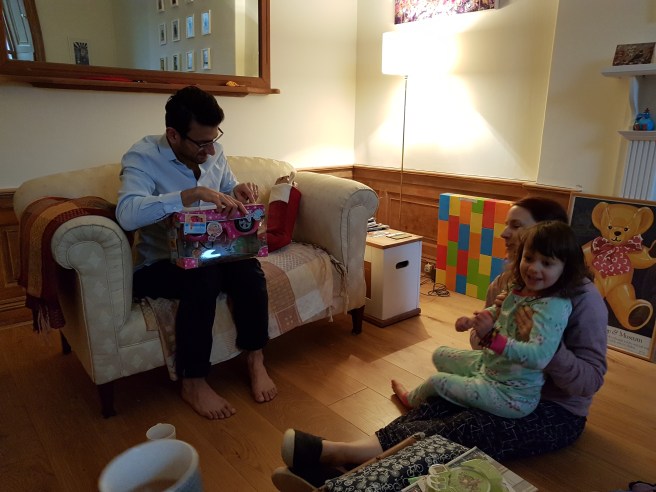
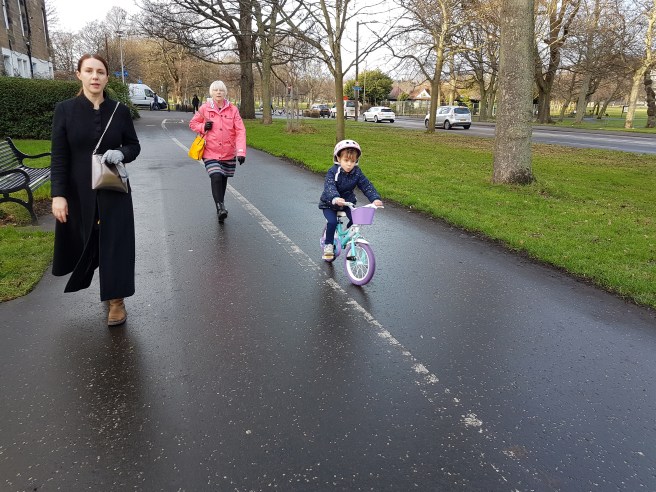
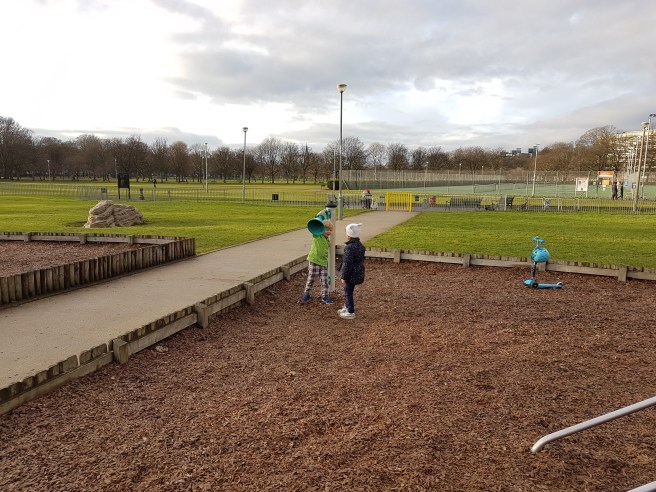
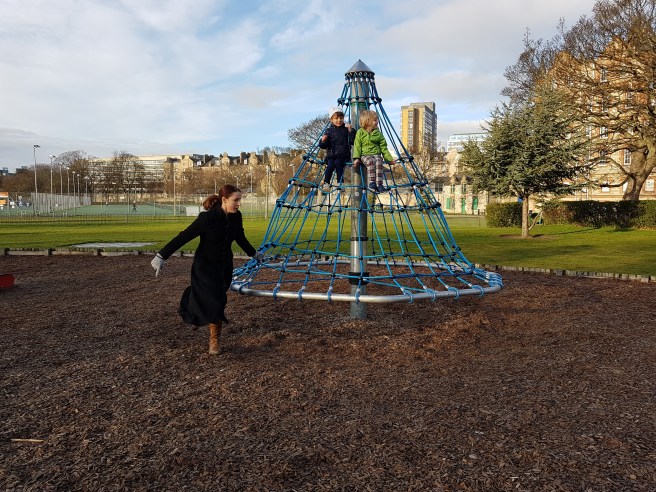
 After Christmas and Boxing Day it is always good to get out and about, here on The Meadows where Aiisha demonstrated how good a cyclist she is now…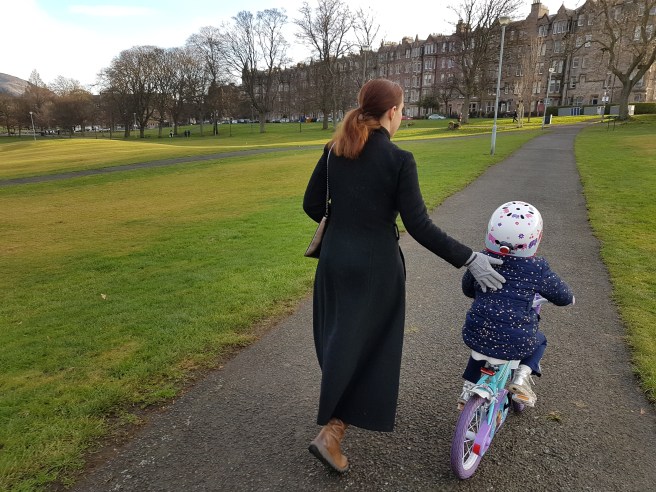
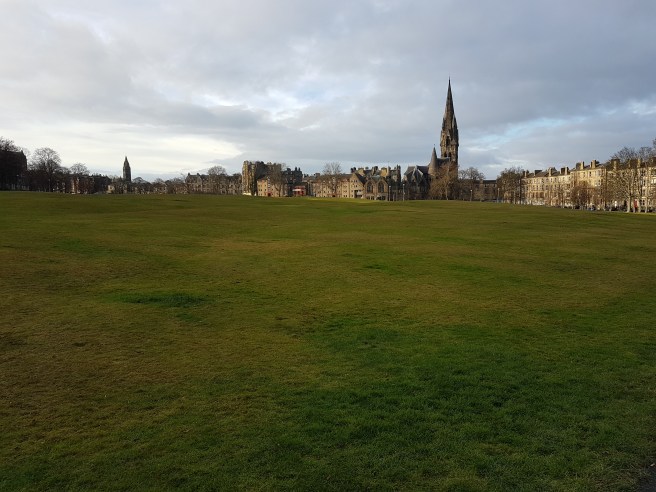
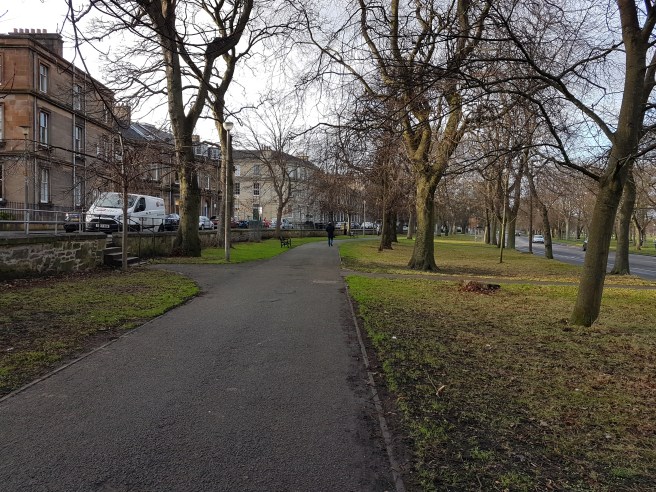 A little friend from Nursery whom we met by chance made the play area doubly enjoyable. The Meadows is a terrific facility to have on your own doorstep with everything including a golf course and a lovely cafe/deli where we had coffees and, for me, a small Portuguese tart.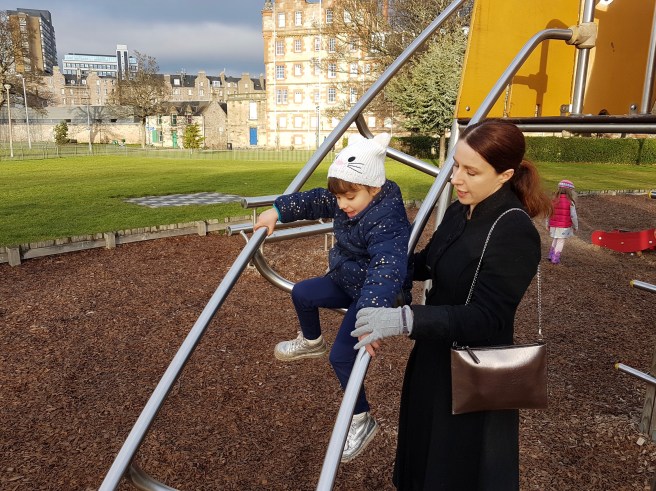
 What a nice Christmas….
 Enjoying Cornwall...