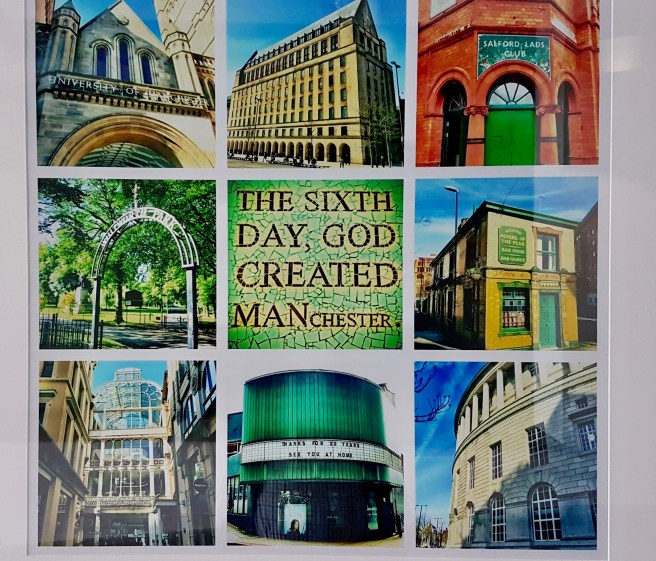
 Manchester is me. Born in Preston but raised in Manchester I have been wanting to visit for some time now just to see whether it was now as good as I still imagine. So off we went for 5 days to see whether it would be the sort of place we might want to live – eventually. Cornwall is great, but there isn’t much culture. Yes I know it has got culture, but nothing like Manchester with its history, industrial monuments, historic buildings, theatres, cinemas and restaurants. Also our village has no pub and no public footpaths…two big drawbacks. Anyway our first stop, after a five and a half hour drive, was Altrincham which is on the Western fringes of Manchester and almost into Cheshire, a lovely County. I particularly wanted us to have lunch in the converted Market Hall which sounded very much like a smaller version of the one in Lisbon we had so recently enjoyed. First impressions were good.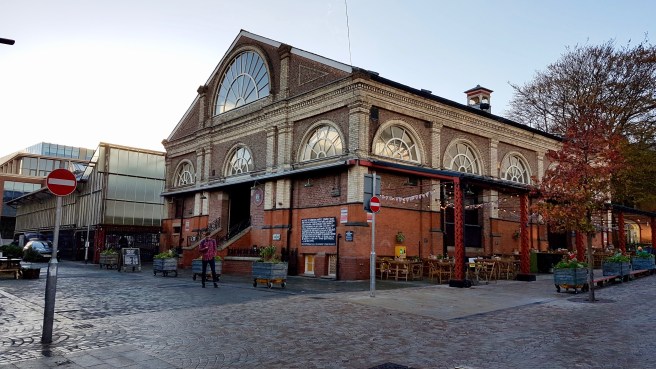
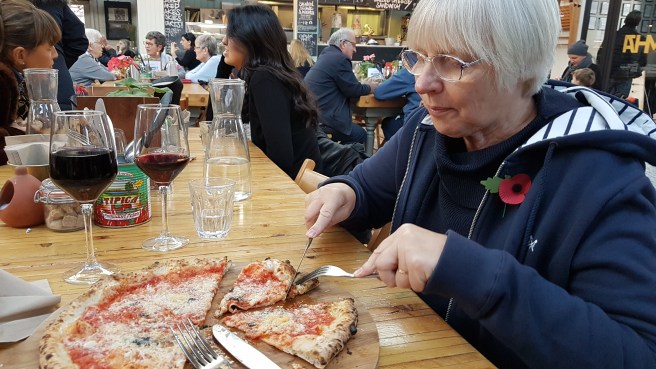
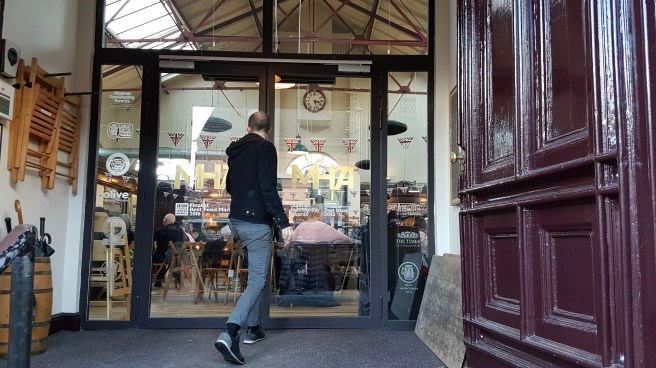 We wandered around the stalls on the outside and then the interior where, like Lisbon, there are food booths and eateries all around the perimeter. And they were all selling local and ‘artisan’ foods (and beer and wine). F. ordered a wood-fired oven pizza whilst I went to the wine shop where I was able to sample before ordering, a nice touch. One red was an Austrian on the stallholder’s recommendation…excellent. Large tables are set out in the middle of the Hall and you find yourselves a seat. Normally I don’t like this kind of ‘sharing’ set-up, but here it was fine.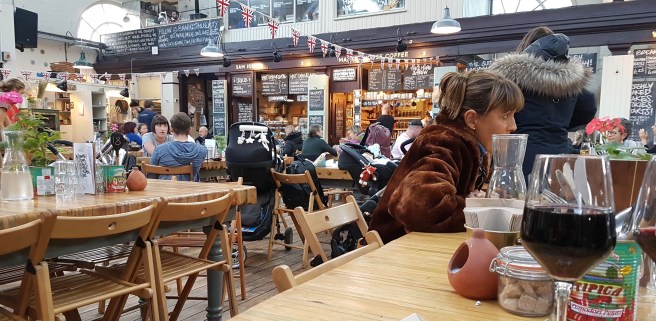

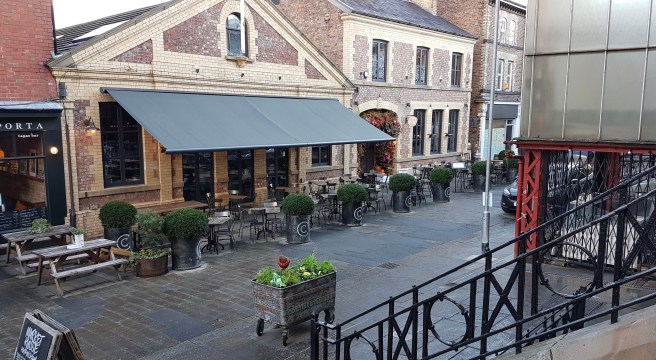
 Away from the Market Hall there were a good few restaurants as well. And Altrincham looked to be a nice pedestrianised shopping area, pleasant to be in. Yes, the sort of place we would live. However, unlike in my youth, the average house price is around £430,000 – way above our means. Interesting.
  Having booked into our apartment at CitySuites which was all we could have wished for – clean, city-centre, roomy, good city views from the 13th floor…….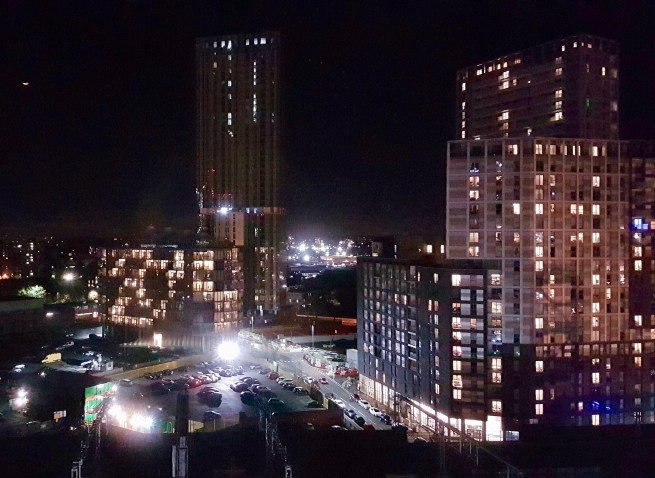
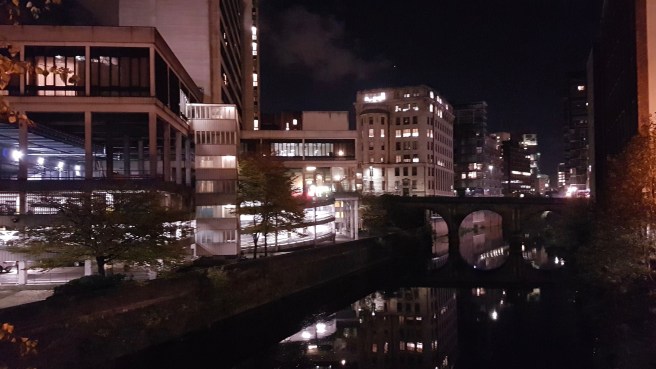 we decided to have a little explore on foot on a circular route of the centre I knew well. I don’t think anyone can fail to be impressed by the quality and impact of some of the buildings from the city’s heyday in Victorian and Edwardian times. The streetscapes are very like a mini London.
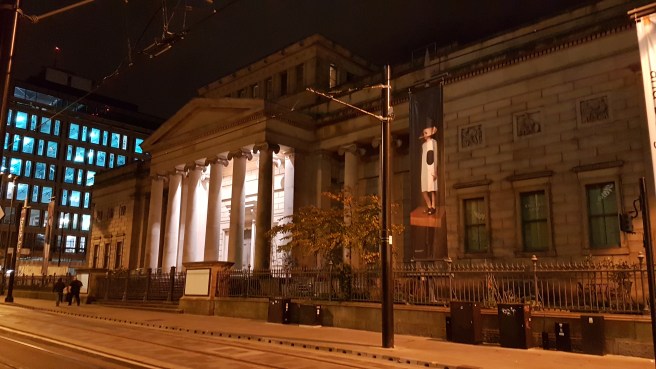
  Here the Art Gallery…..
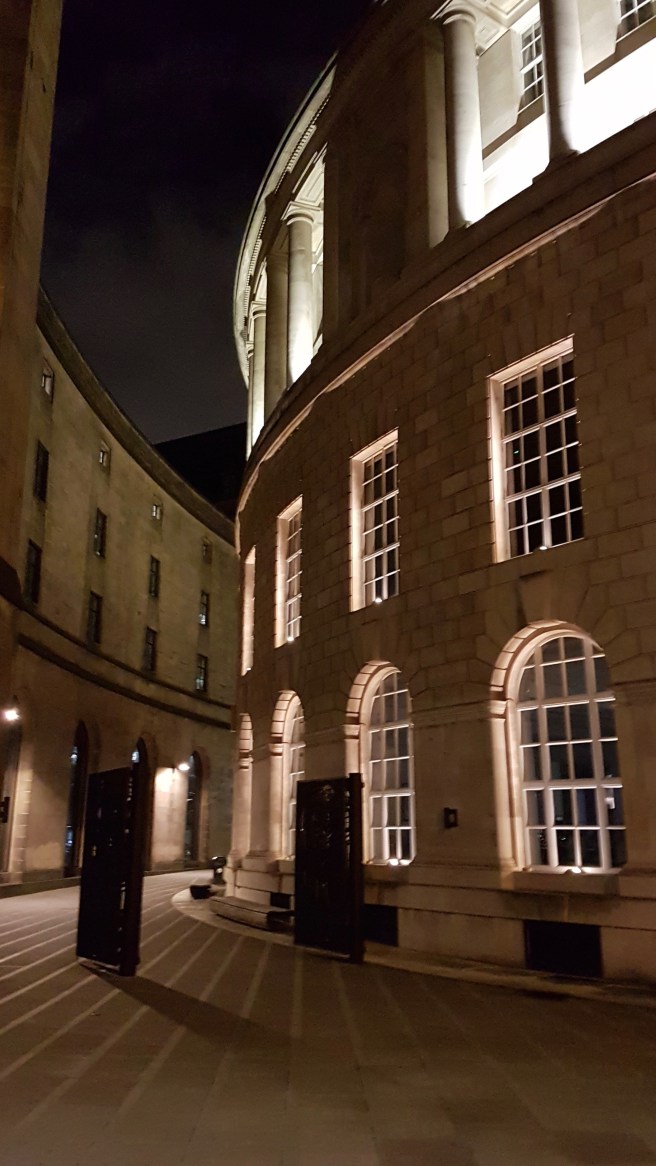
 and here the Central Library fronted by the amazingly good tram system (so unlike Edinburgh).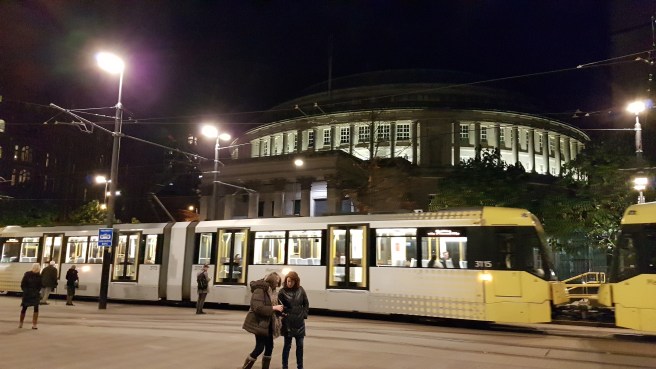
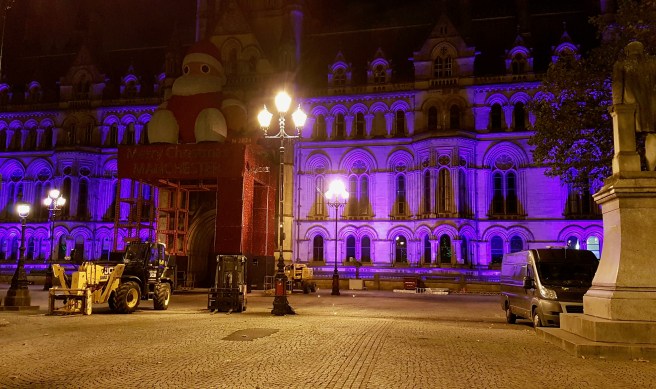
 The Town Hall featured Santa as preparations were made for the lights switch-on, but very unfortunately this terrific Alfred Waterhouse building is shut until 2024 whilst renovation takes place. We’ll be dead by then!
  We got a glimpse of one of the arcades off Peter Street, and then as we were passing by Pep Guardiola’s new restaurant Tast we decided to call in…….
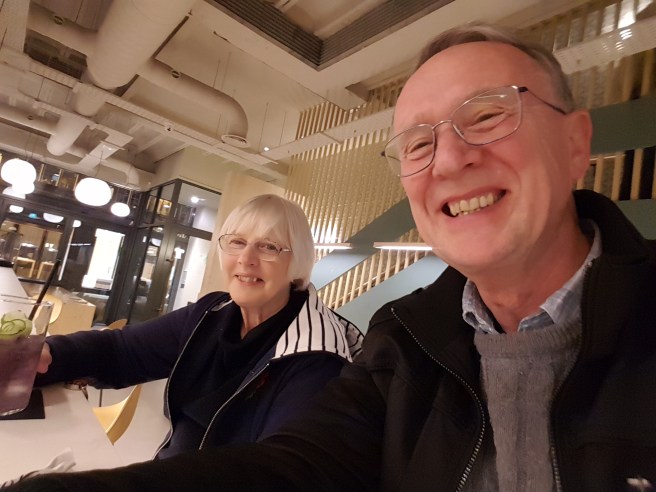
 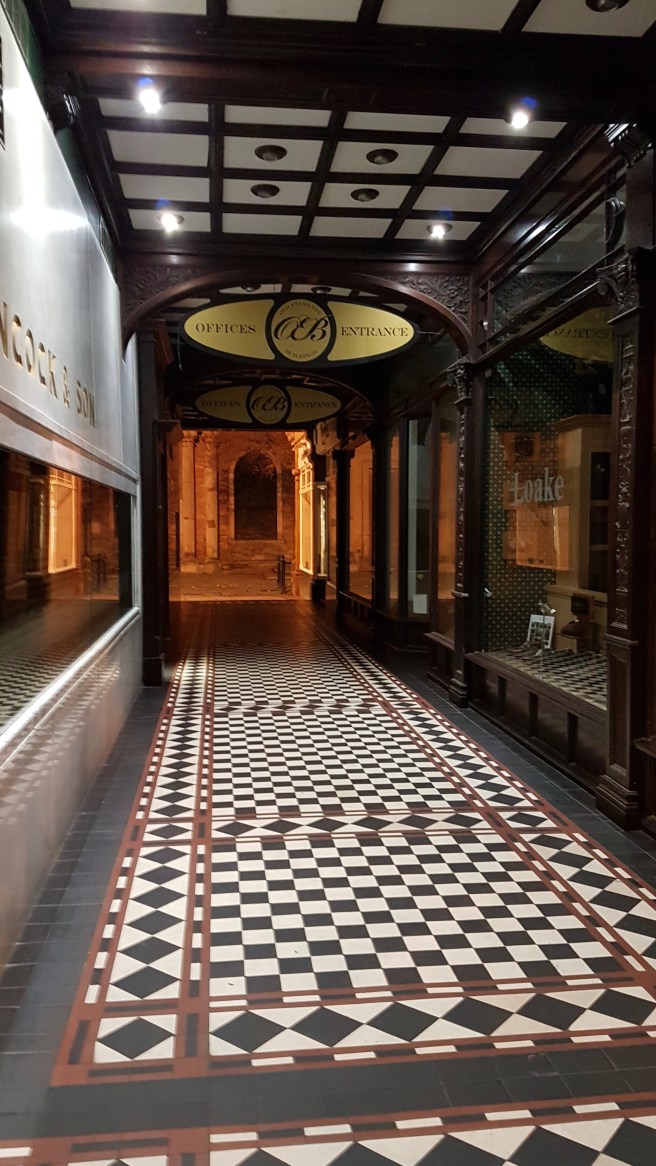 and had a very pleasant time sitting at the ground-floor bar, and making a booking for the next night.
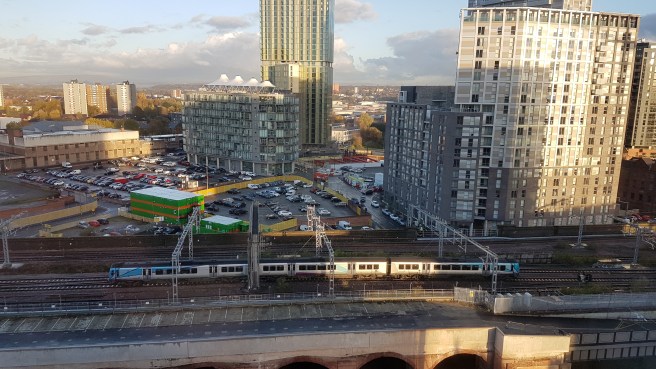
 Next day the view from the 13th floor was very urban, but what was striking, and we marvelled at it throughout our visit, was how much building and development is going on in Manchester. Everywhere you look there are cranes and building plots, and buildings of all shapes and sizes being worked on.
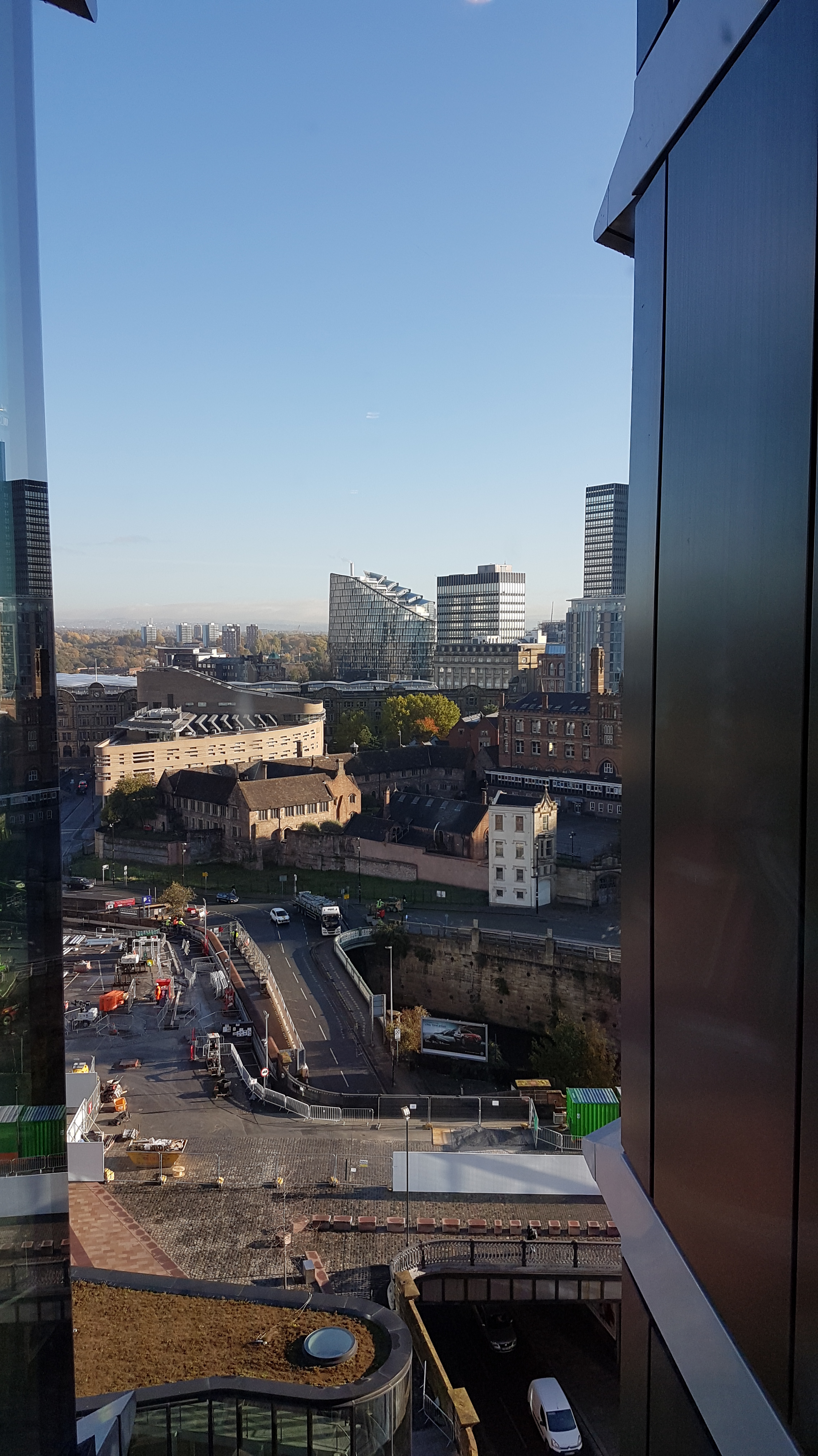
 And there is a very strong juxtaposition of old and new. From our window we could see, beyond the building site below, the medieval Cheetham’s Library complex and in the background the brand new half-triangular shape of the National Football Museum.
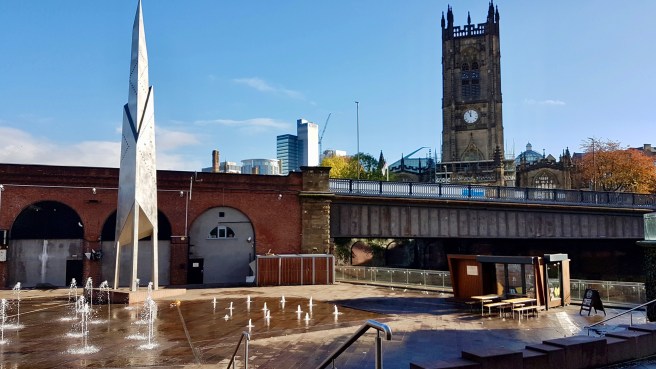
  And as we crossed from Salford to the city of Manchester itself the cathedral, which we were making for, became apparent….
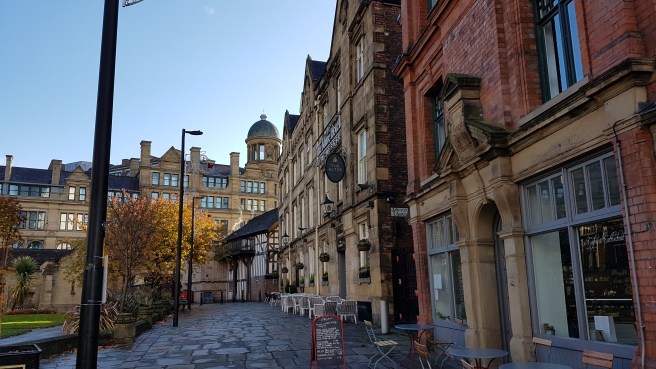
 and it was surrounded by beautiful buildings of all ages…..
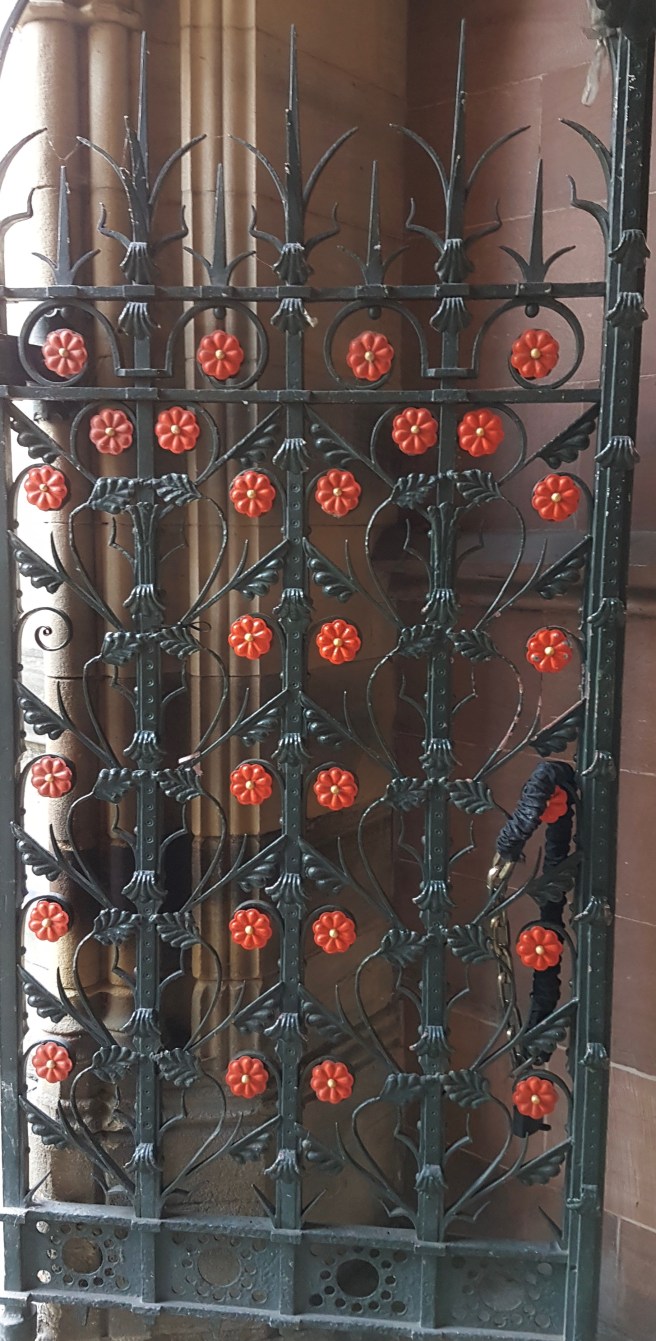
 The gates to the cathedral were clad with the red rose of Lancashire which was very heartening to a rabid Lancastrian like me….
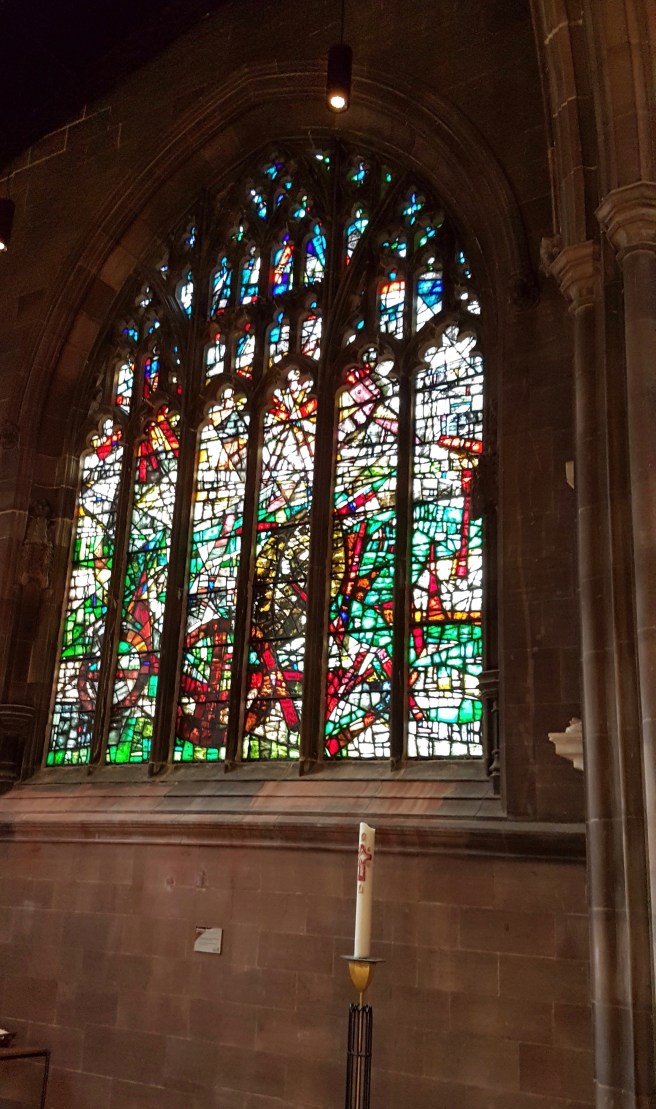
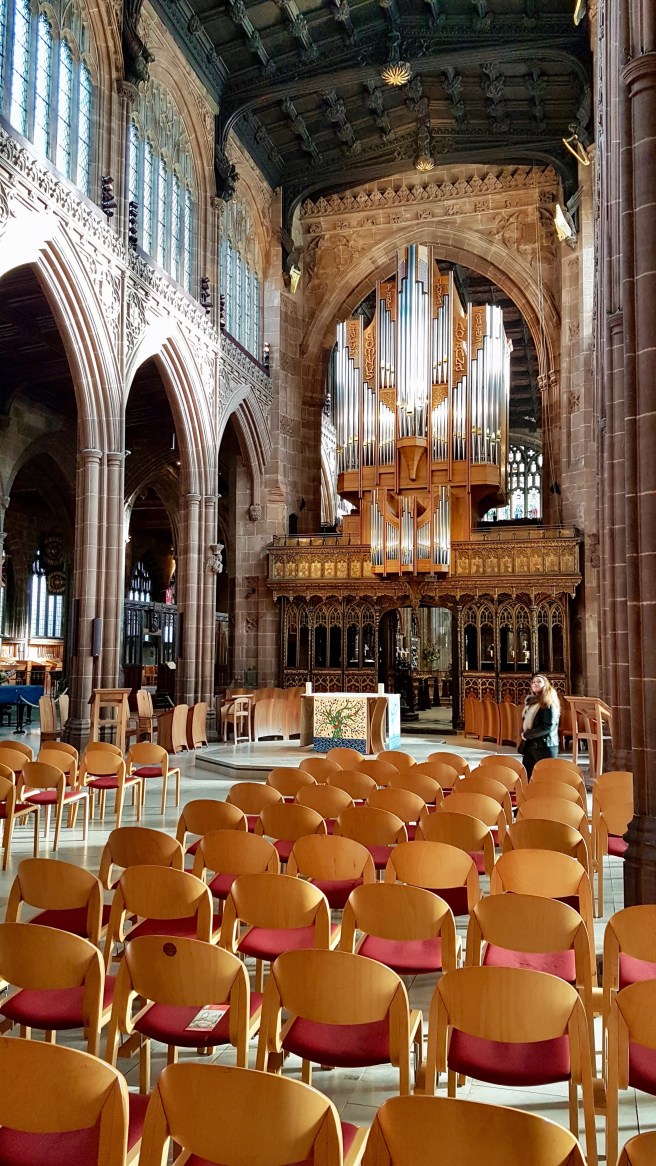
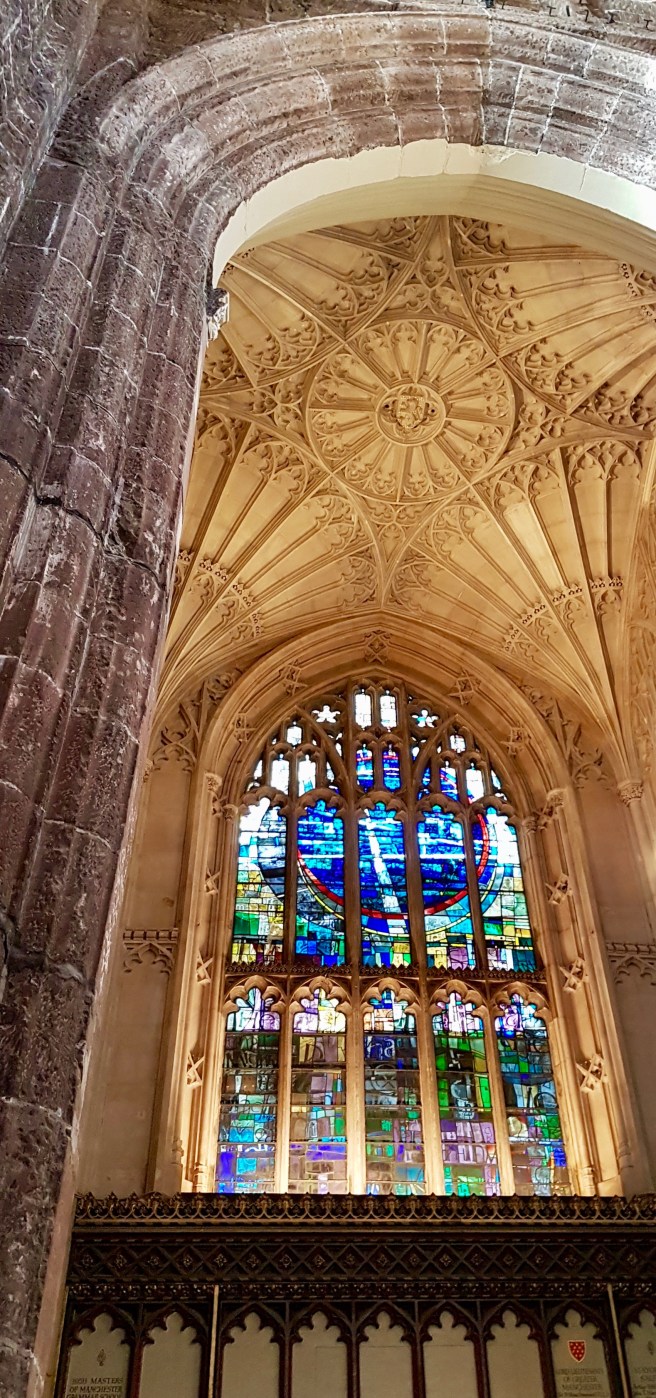
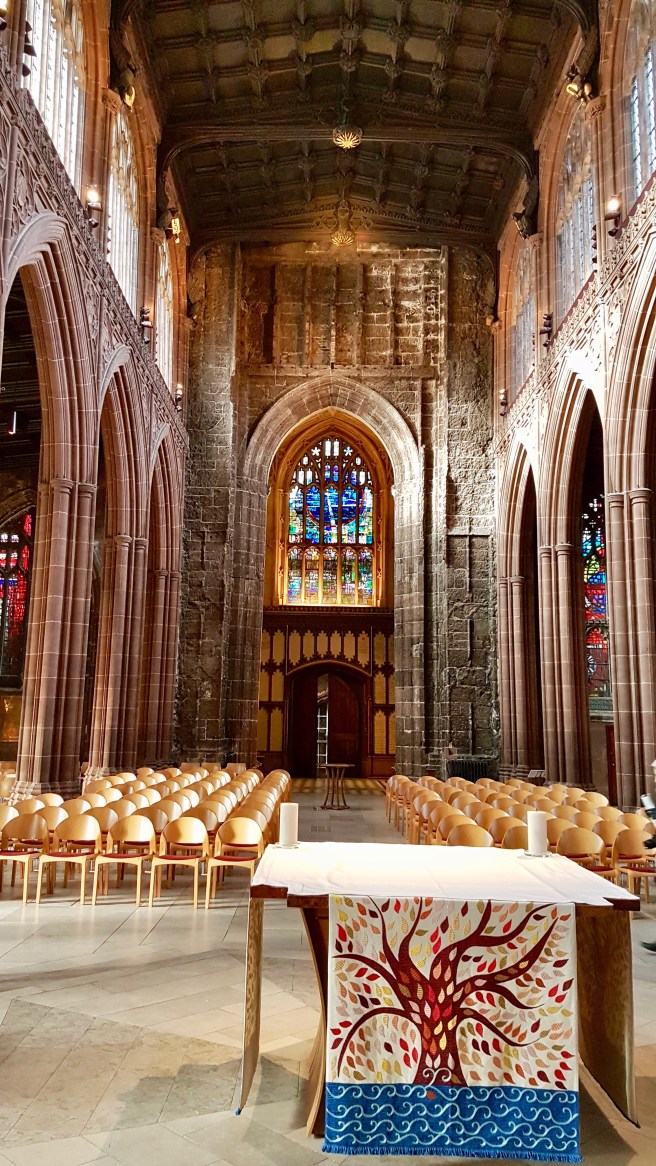
 and once inside we were struck with the marvellous quality of the modern glass (presumably, as Manchester was the worst affected cathedral after Coventry in the War, the originals were all destroyed).
 When we think about cathedrals we generally think of places like York, Westminster, Salisbury and so on. It was really a great surprise to us therefore how impressive Manchester cathedral is, and how historic. Granted a lot of the stonework is Victorian restoration, but at its heart is a medieval building which is quite the equal of many better known cathedrals.
  Some of the fabric in the tower predates 1421, and the tower arch itself is 800 years old.
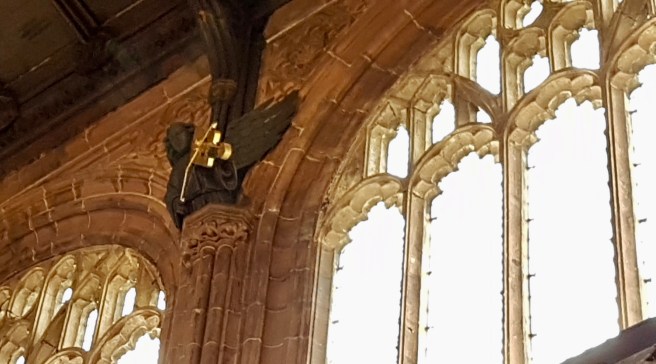
 The late 15th century carved wooden angels all with gilded musical instruments were quite a sight….
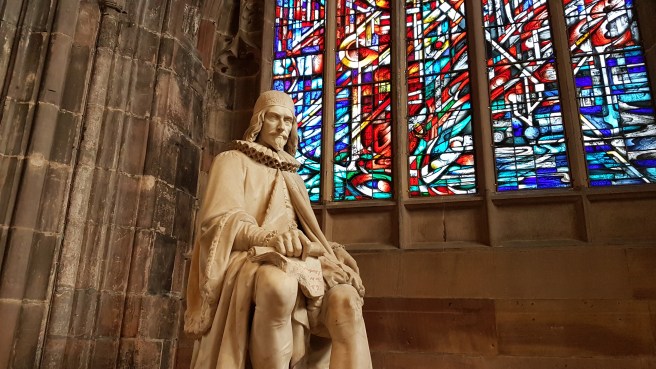
 and I was interested in the statue of Sir Humphrey Chetham (1580–1653), the most successful gentleman merchant of seventeenth-century Lancashire who was educated at my school Manchester Grammar or as it is more correctly known The Manchester Grammar School.
 In the Quire we couldn’t resist lifting up all the seats and seeing the wonderful and often amusing 16th century carvings on the misericords. I tried one out and I have to say that it served its purpose well. It was quite comfortable standing up but leaning on the support. Indeed these seats are held to be some of the finest carving in the whole of Europe at the time.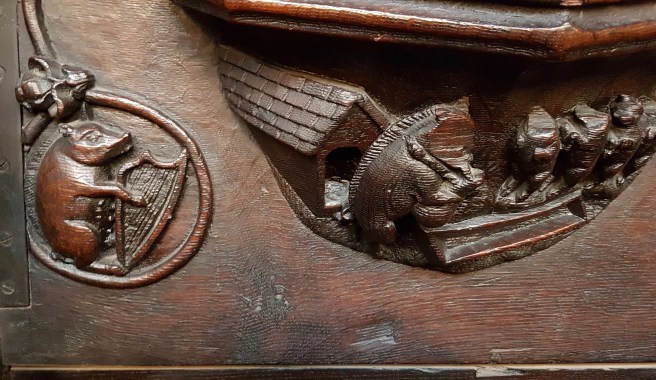
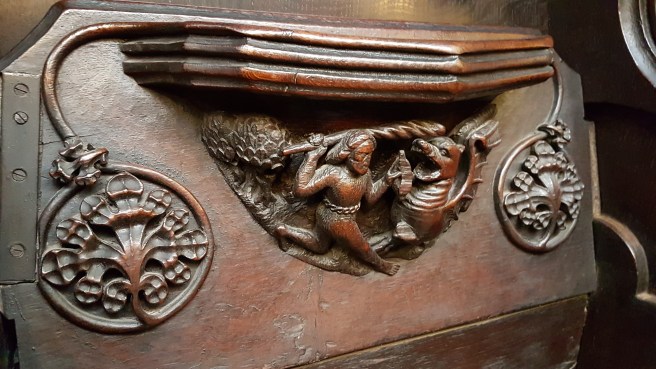 The various higher clergy stalls were magnificent, and the detailed work exceptional.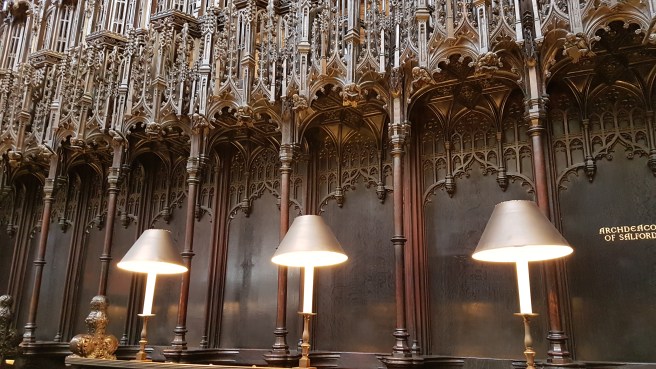
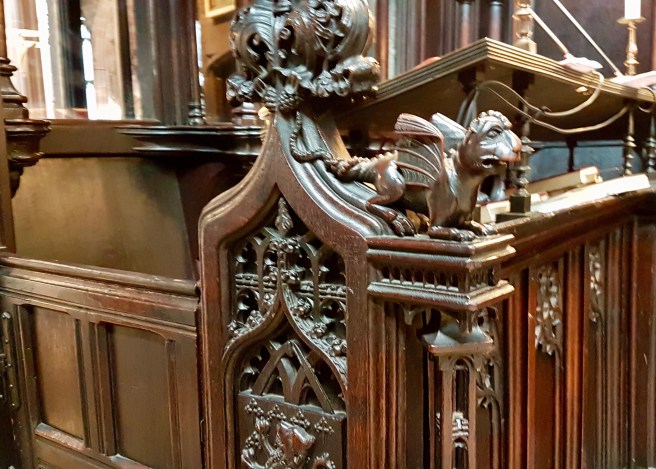 It was also, as you might expect from Manchester, a very open and friendly church, not at all oppressive in the way of some of our historic buildings….
 I have not, in any other building, seen the precious charters associated with the building all out on display as here. This is one granted by Elizabeth 1.
 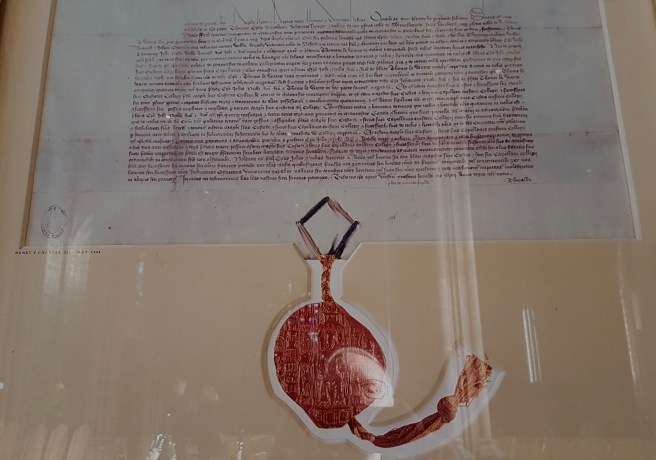 …..and here the 1421 charter of Henry V. I do hope this is a safe environment for them….
 Outside we quickly came across the Corn & Produce Exchange which, following the IRA bomb in 1996, was renovated and was a modern shopping centre till July 2014. The building was recently sold however and has been re-developed into a dining destination with 17 food outlets. Very nice too, although how successful the outlets are I do not know.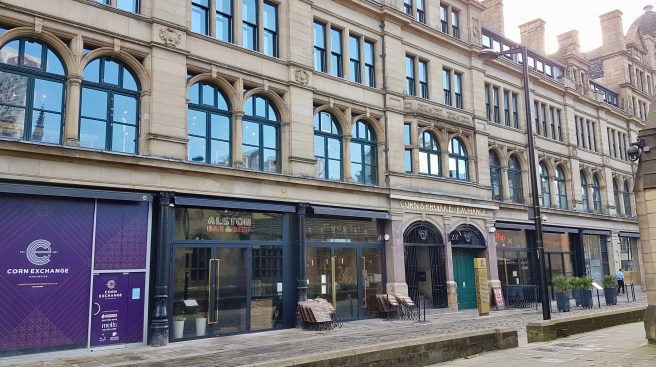
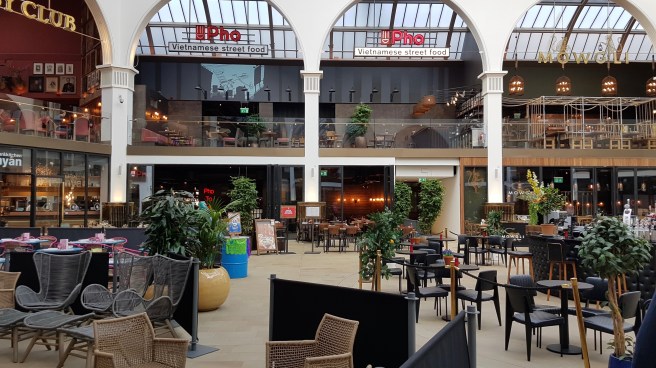
 Medieval and Edwardian together is a very nice mix I think…..
 and in Manchester now there are very many modern buildings with great visual impact…..here obstructed by the preparations for the ubiquitous ‘German’ markets.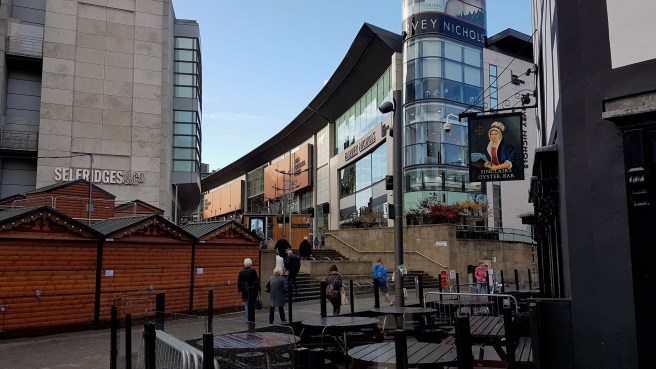
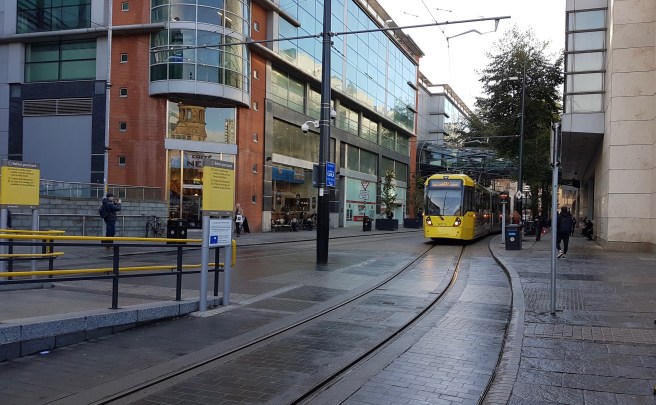
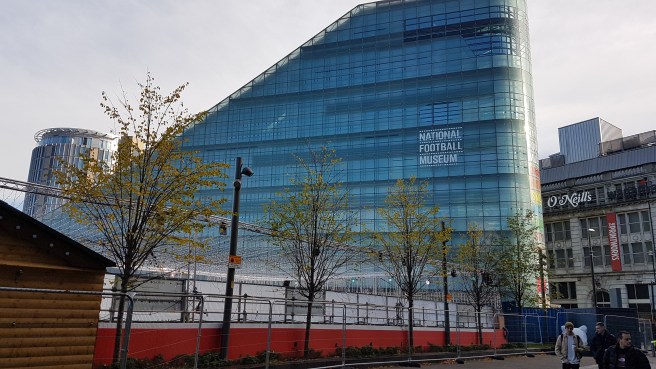 We were very impressed indeed by the Manchester Metrolink which is the tram/light rail system which has 7 lines extending widely to all compass points. In the city centre it is nowhere near as intrusive as you might think, unlike say Edinburgh, where the trams intrude into the cityscape quite badly….
  Our next stop was the Art Gallery where we saw some interesting paintings eg this of Albert Square Manchester by Lowry’s teacher Pierre Valette …the smog just as I remembered it from the sixties!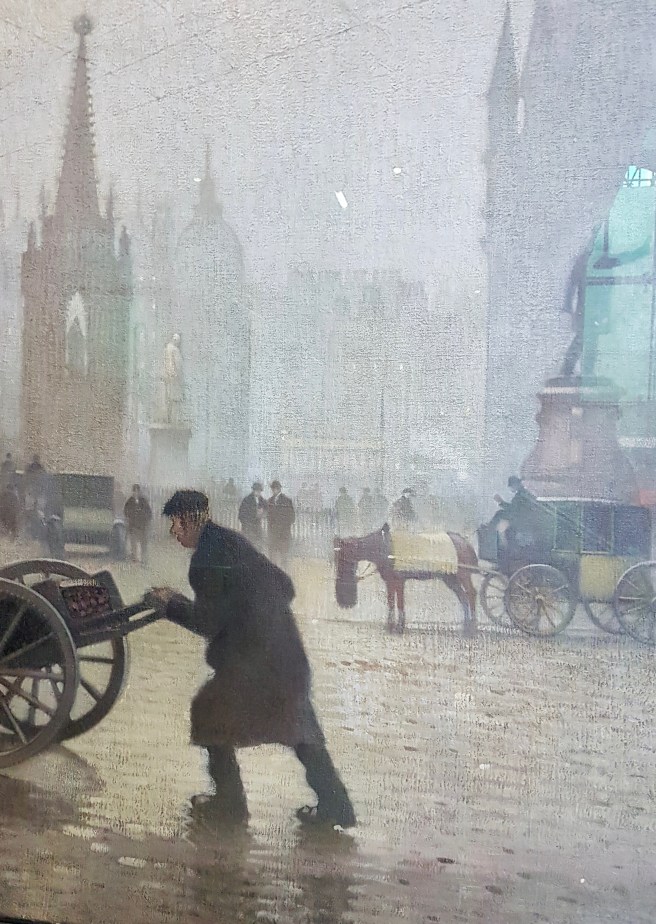
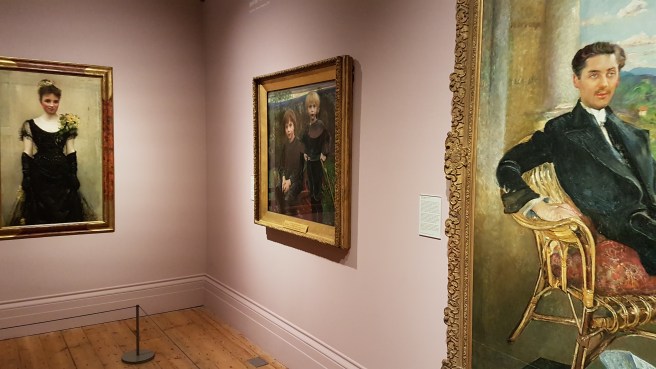
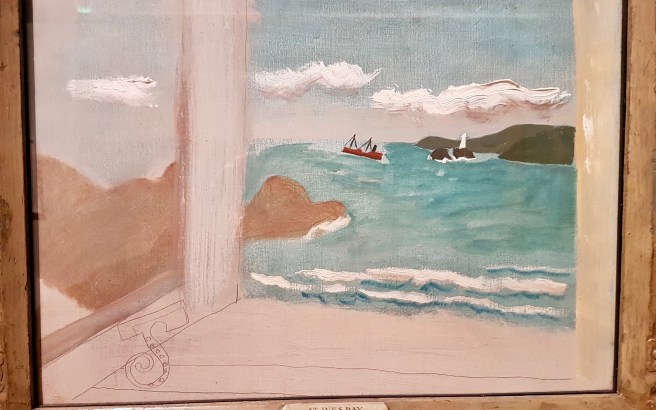
 And we came across this painting of St Ives by Ben Nicolson…..
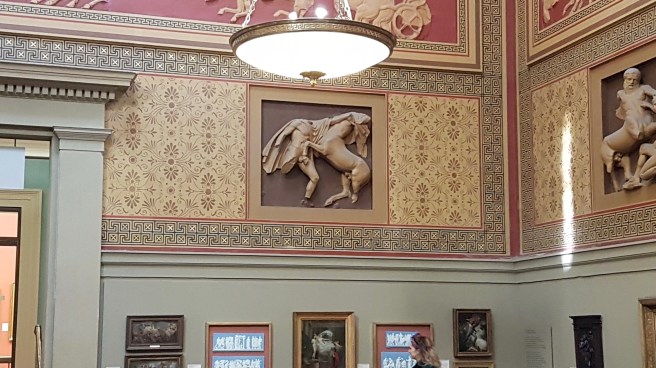
 but by and large a lot of High Victorian kitsch…I suppose this could have been expected of Manchester whose heyday this was….
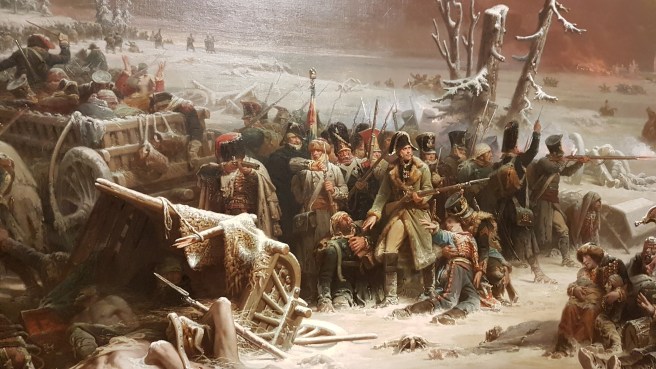
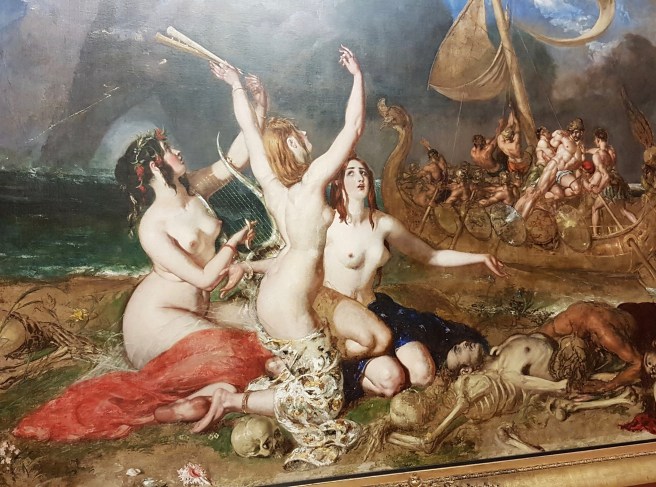
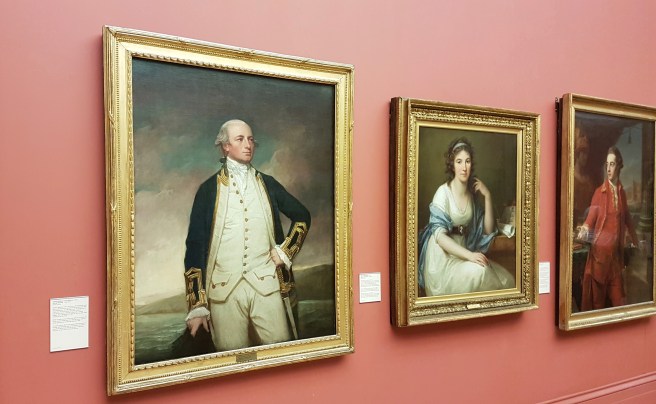
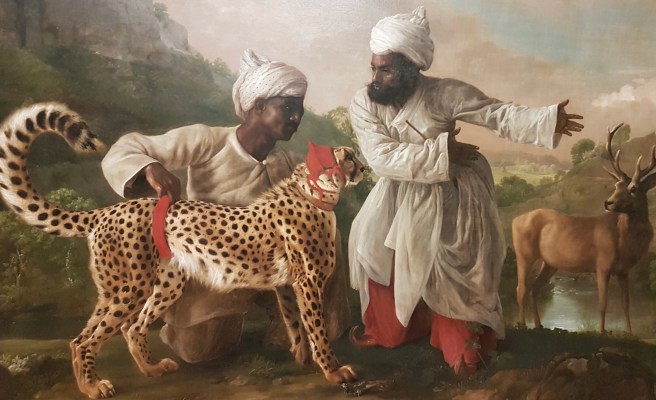 There was the odd bit of modern interest such as this Banksy…….
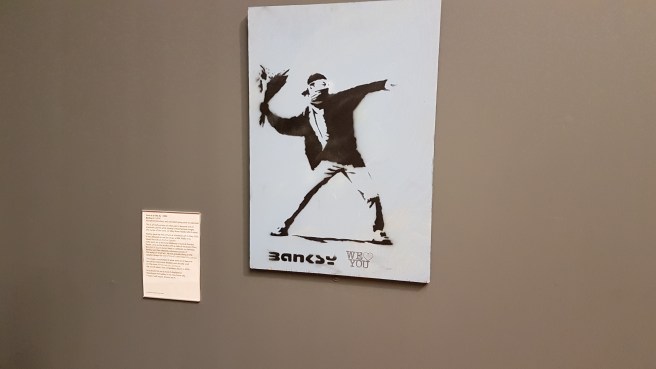 Next by tram to Didsbury one of the more affluent suburbs. It had some interesting restaurants…..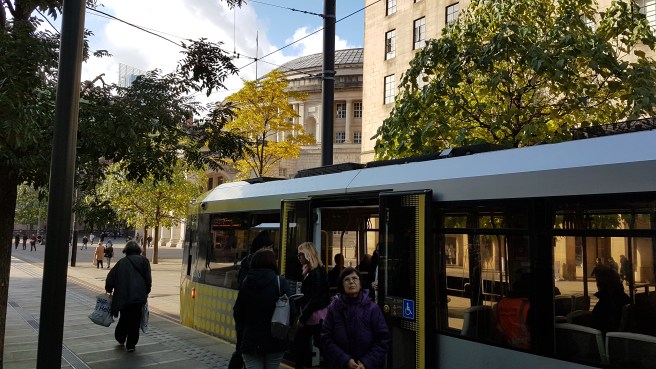
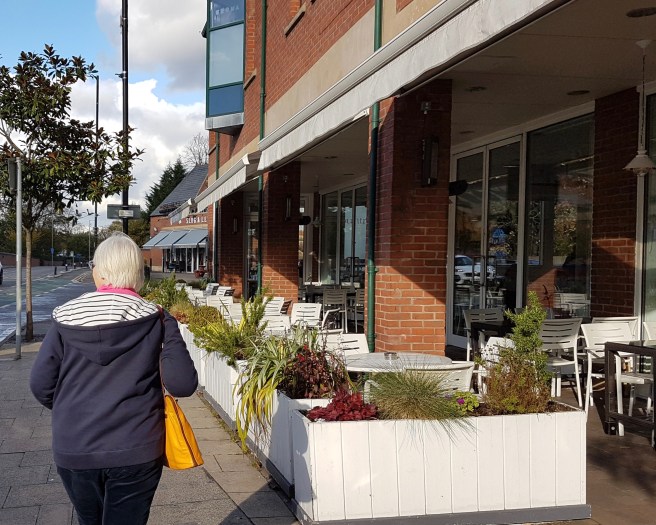 and shops…….
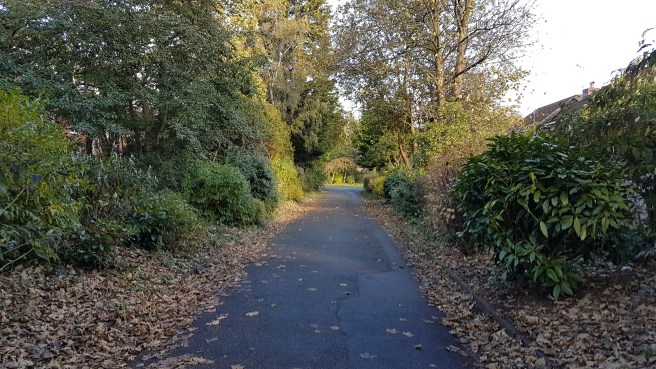
 and parks…..but felt very ‘suburban’ rather than ‘flash Manchester’ as it is supposed to be….
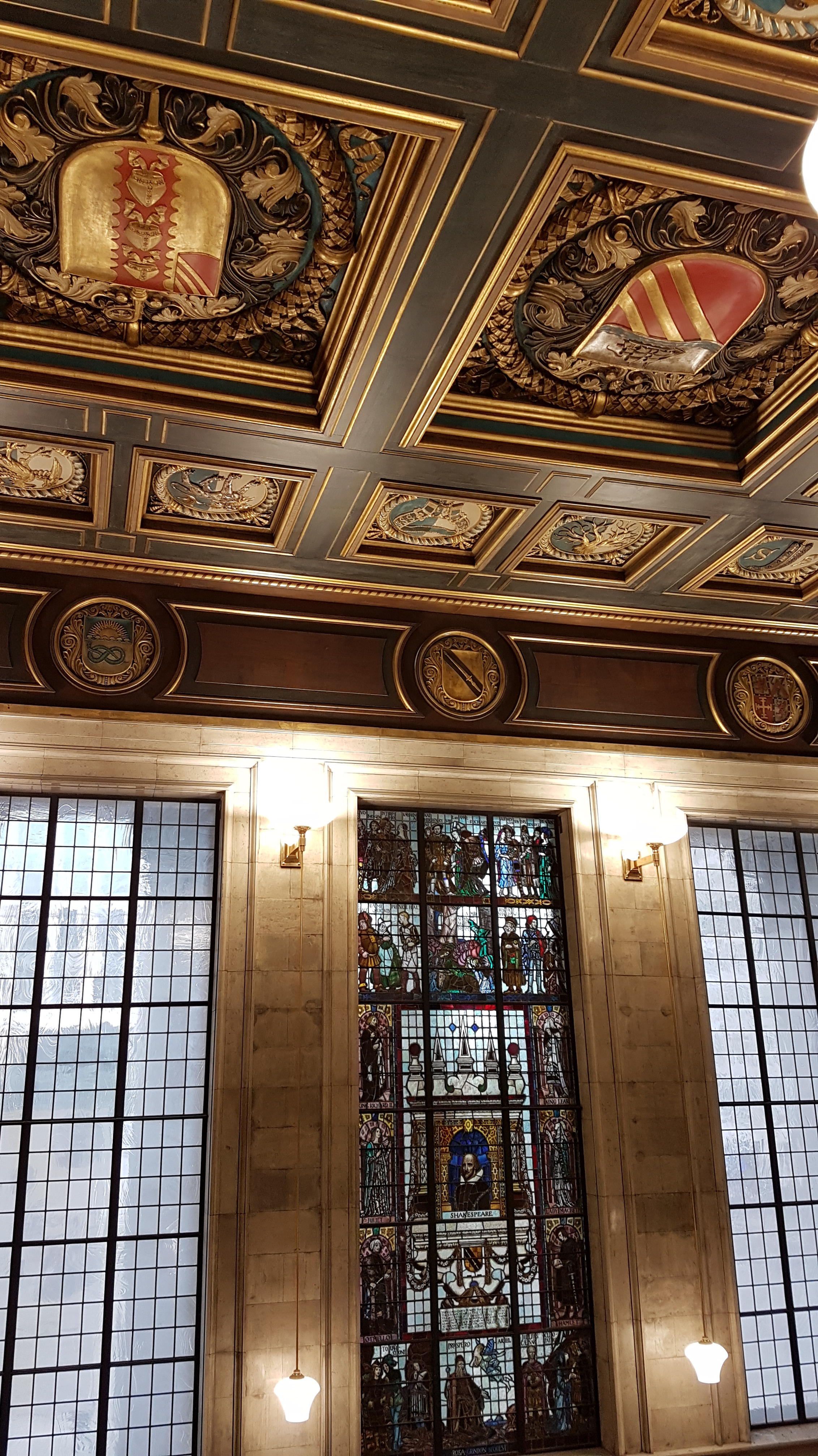
 Back to the centre of Manchester where we visited the impressive Central Library…..with its magnificent reading room…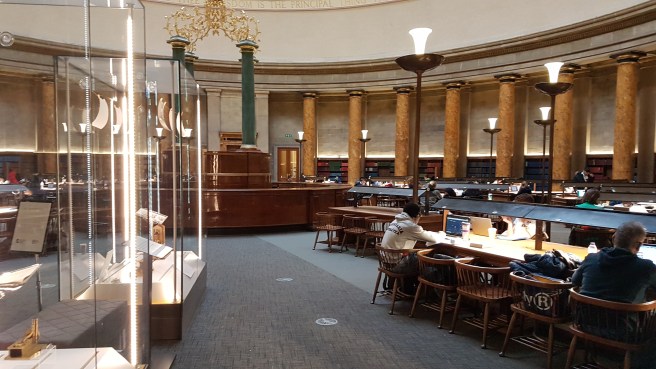
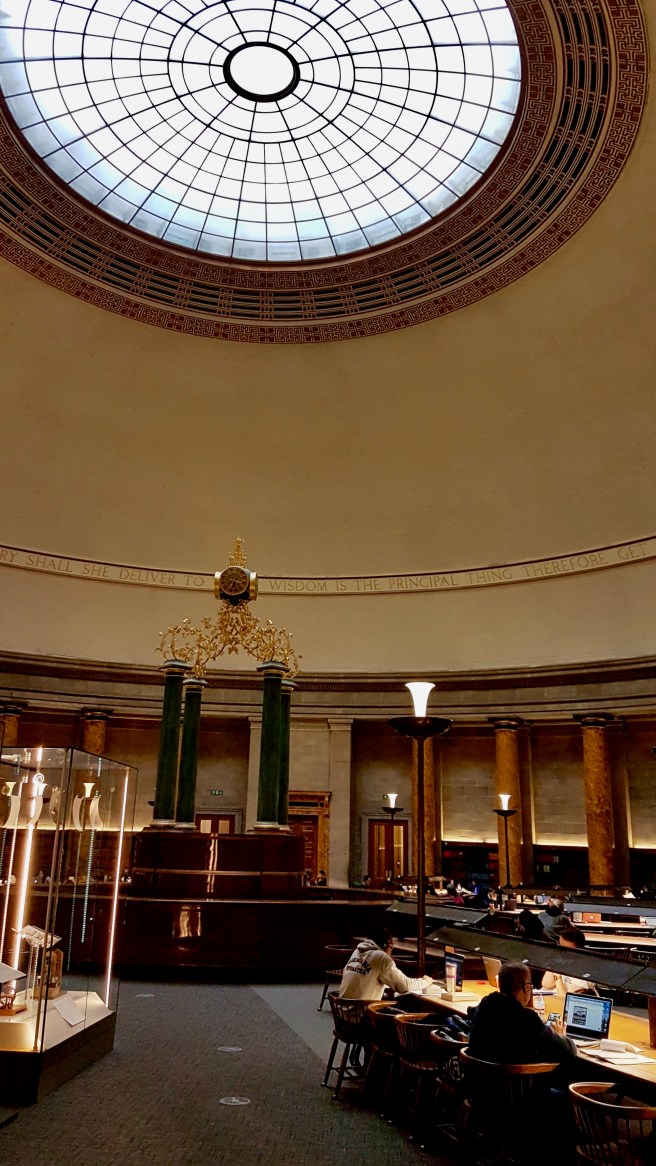 and we were struck by this memorial to the men and women of Manchester who fought in the Civil War against fascism from the grateful citizens of Barcelona…Between 1936 and 1939, 130 men and women left Greater Manchester for Spain to join in the fight against General Franco and his army of fascists. Like the rest of the International Brigade, they were appalled that a democratically-elected government had been overthrown and believed correctly that Fascism was on the rise in Europe. 2000 people in all left from Britain for Spain (including George Orwell of course) of whom 500 were killed….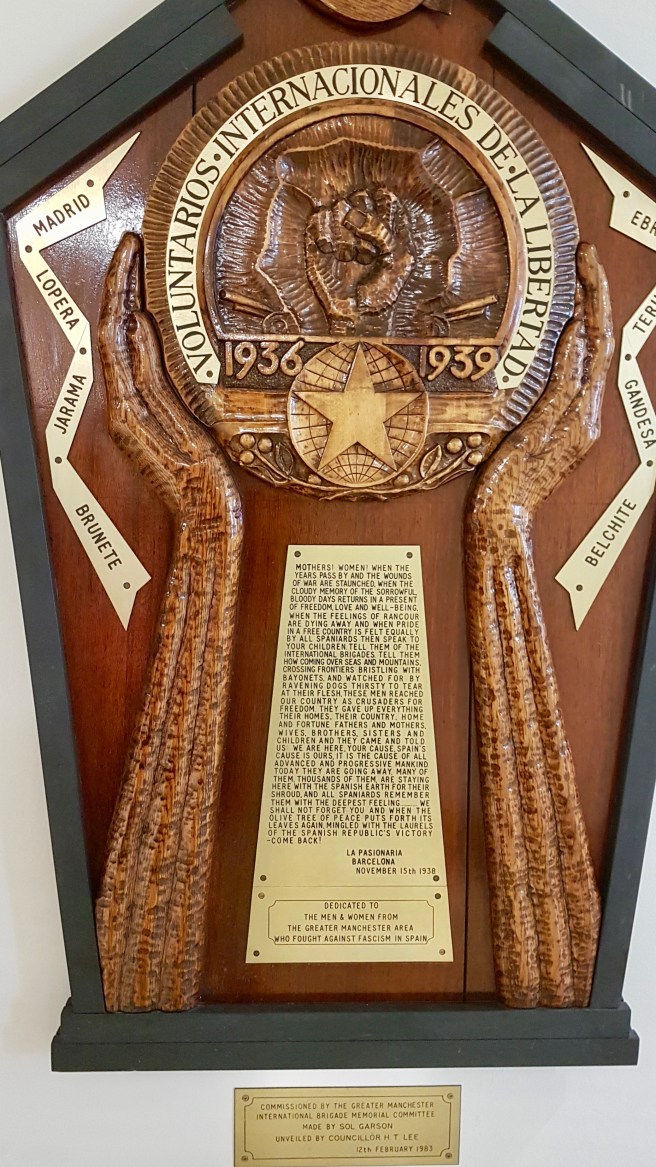

 I had seen some very nice houses for sale in Bury during my researches so off we went on the tram…our first view was of the statue of Sir Robert Peel our first Prime Minister who was MP for Bury…a brief look round the centre showed some fine buildings but the overall impression was of a town on its uppers…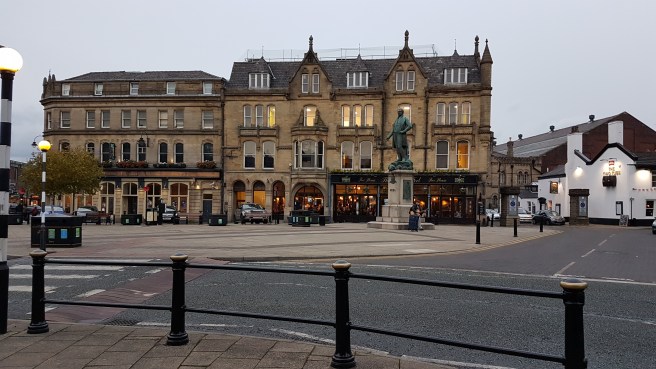
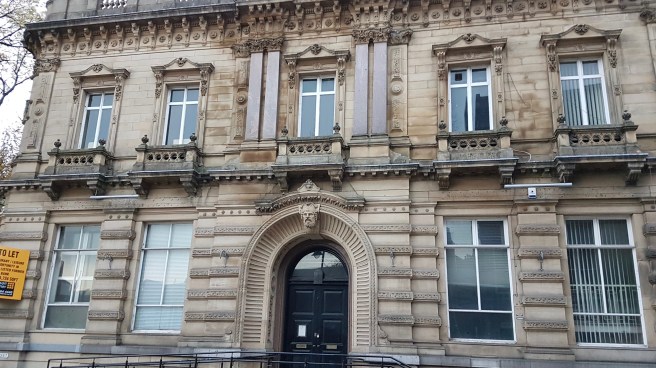
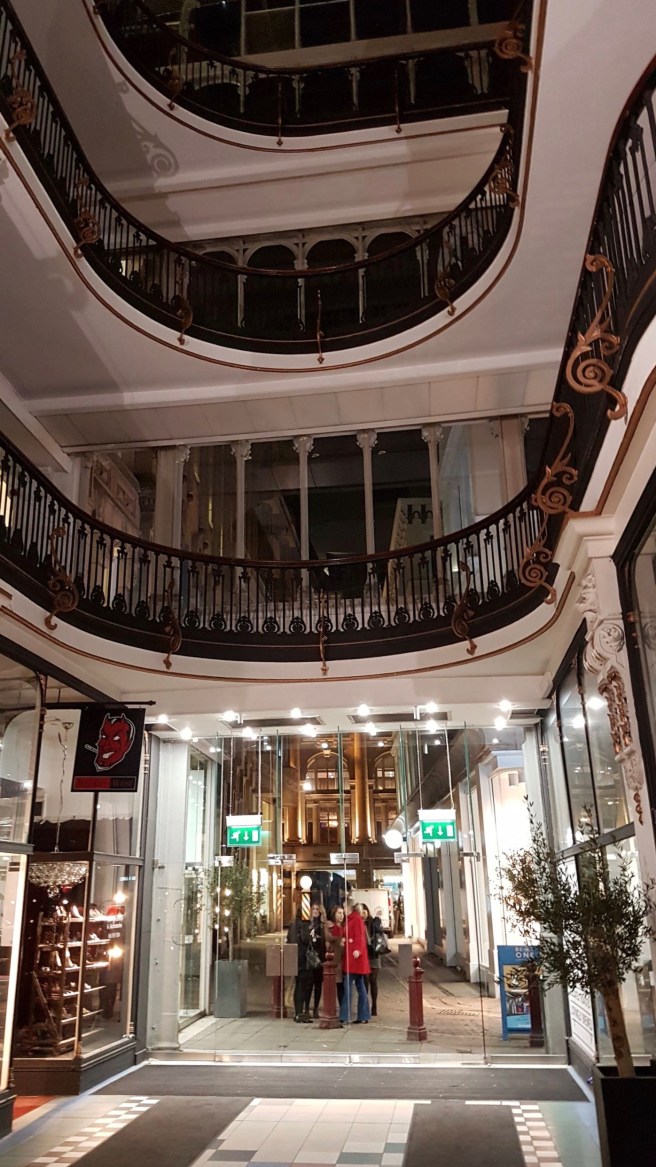
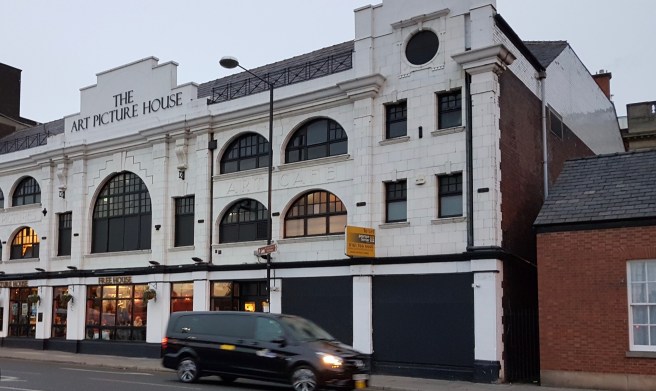 So back to Manchester with its shopping arcades….
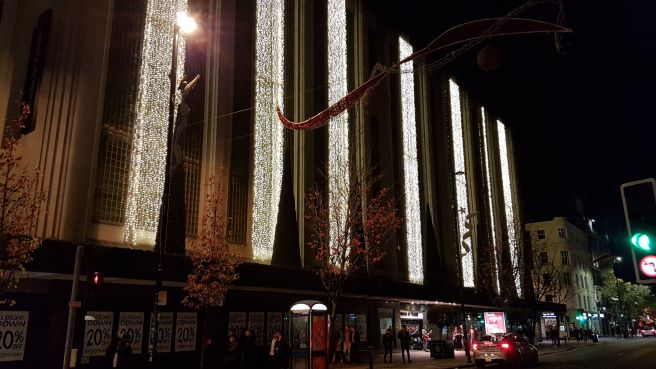
 big department stores…..
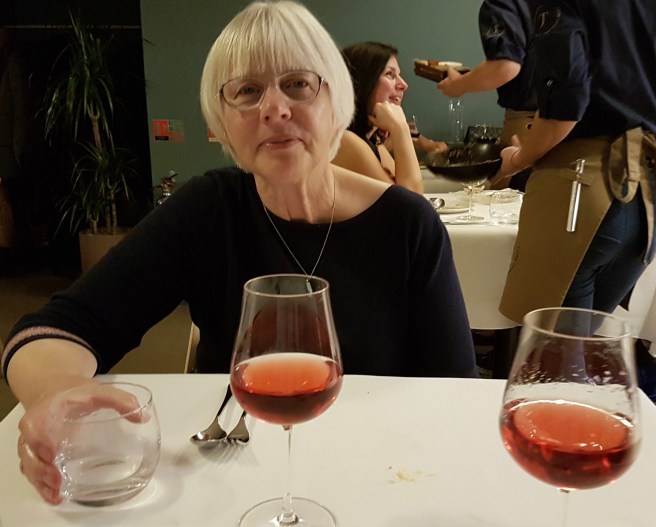
 and at last Tast for dinner….the menu was great, very reasonable, and the food excellent, and service from Edna of Barcelona impeccable…we really enjoyed ourselves here. A true taste of Catalonia from a Catalan masterchef, and opened by the one and only Pep Guardiola to make himself even more at home (he loves Manchester..)………even the amusing Giles Coren was quite impressed (for Manchester)….his review for him was positive…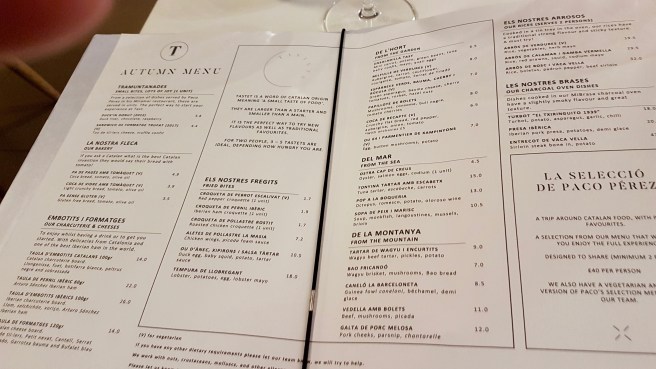
 Sunday we went off to Cheshire to have Sunday lunch and visit the NT’s Lyme Park. The trees all over Manchester were absolutely amazing in their Autumn colours as we drove through the suburbs and it seemed like the whole of Manchester was one big park.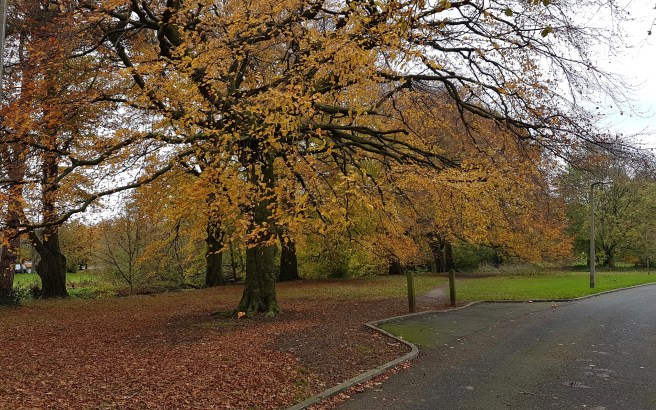
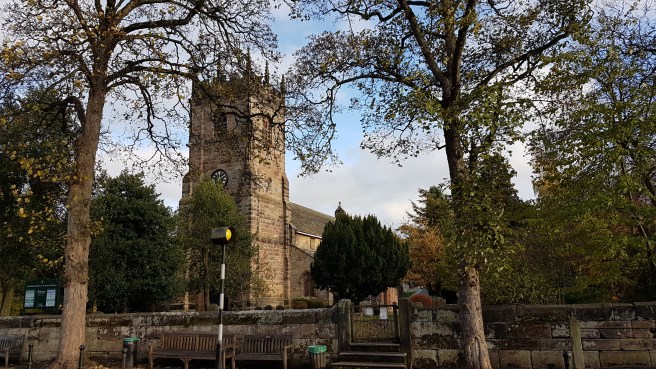
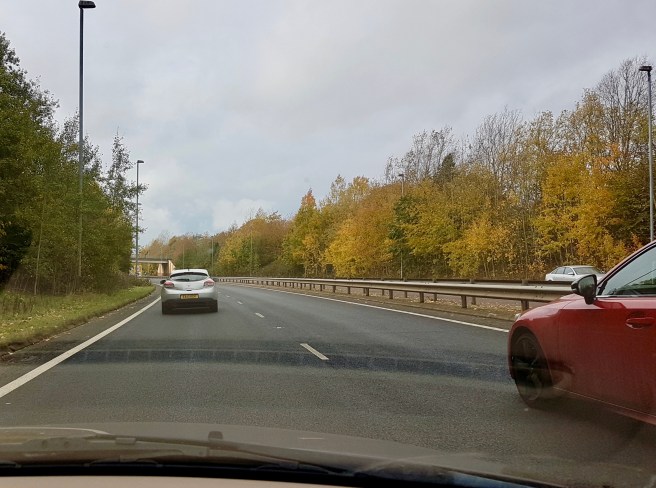 As we reached our destination of Prestbury the scene became more refined with lovely trees, immaculate gardens and huge houses mostly hidden from view. This was footballer territory.
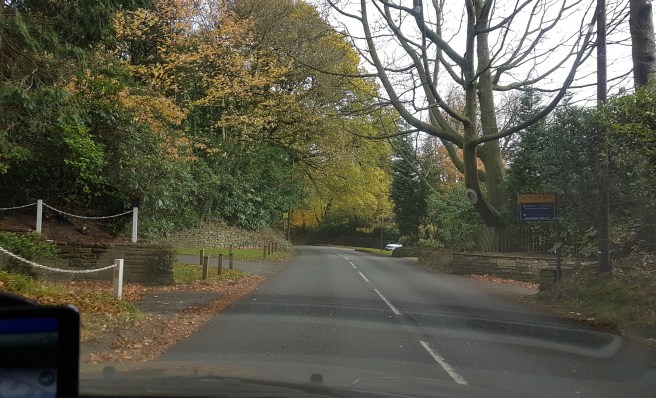 And what a lovely place Prestbury proved to be.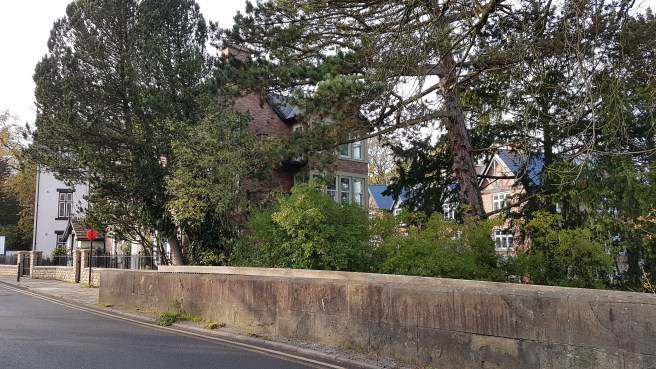
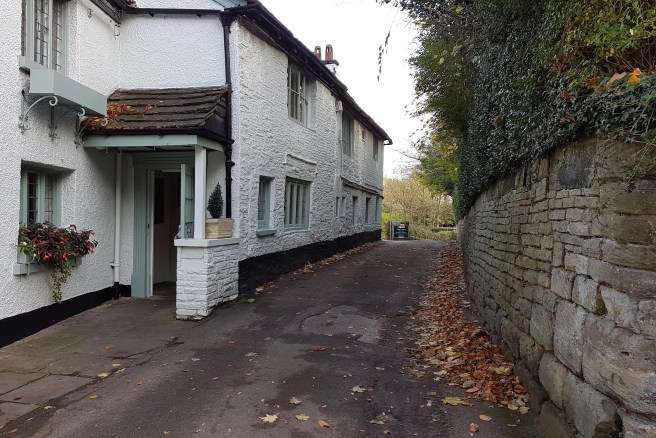
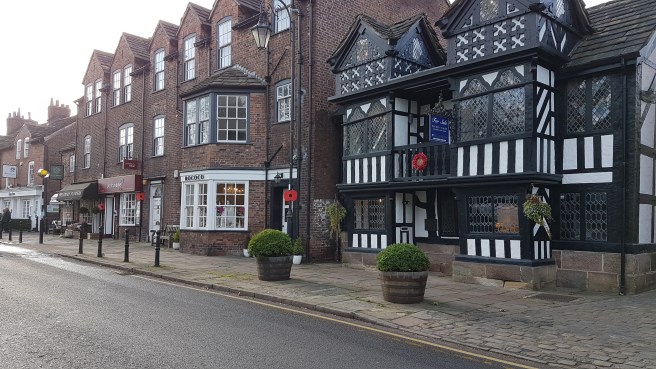
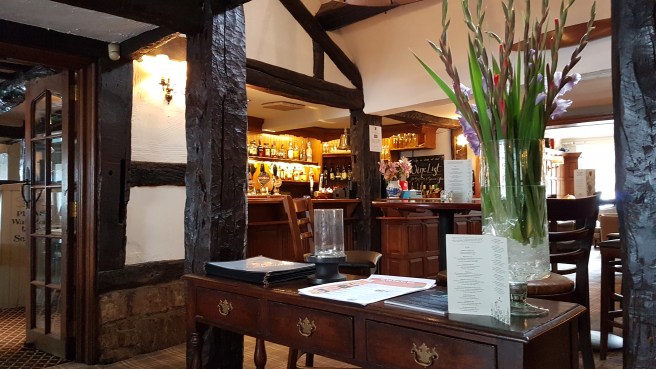
 And the pub where we had lunch was just great…the Legh Arms or as it used to be known The Black Boy. Traditional pub fare done very well and good ales.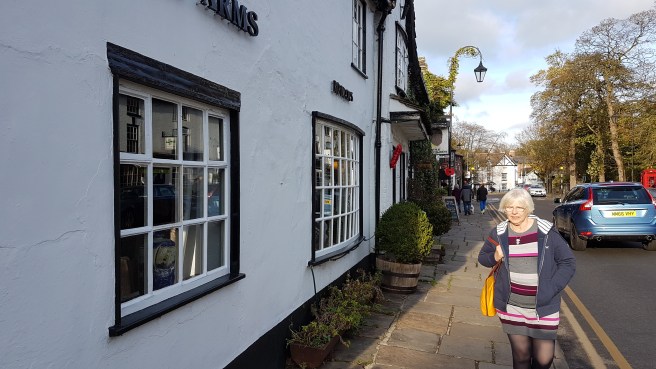
 We then just had time to drive around the area…Bollington, where a friend of mine from University lives, was pretty and with an interesting past. As its website says….’It is a town borne of its rural origins with the industrialisation of the area beginning in the mid 18th century and rapidly developing in the 19th when several large cotton mills were built, coal mines were opened and stone quarried. The opening of the Macclesfield Canal in 1831 provided important industrial development incentive as did the railway that followed in the late 1860’s. In modern times the mills have been replaced by, usually, smaller businesses although there remain two large paper coating mills, our biggest industry today.’ This mill still operates in the paper industry.
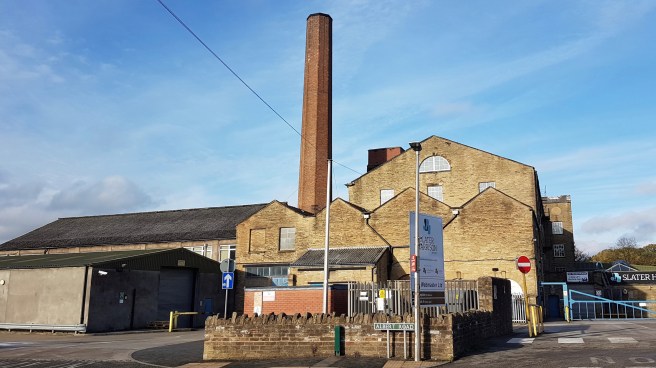 But no wonder the residents know Bollington as Happy Valley….rural like Prestbury but just a little more workaday….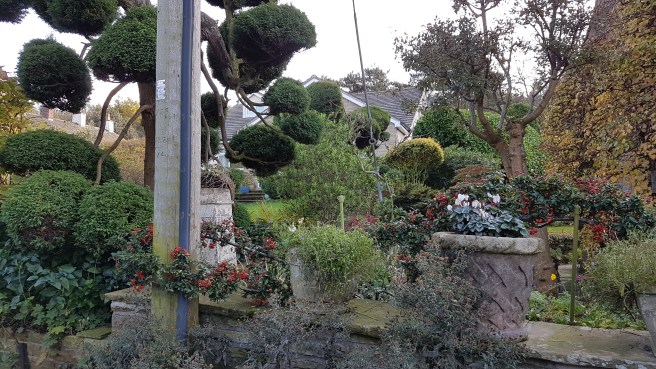
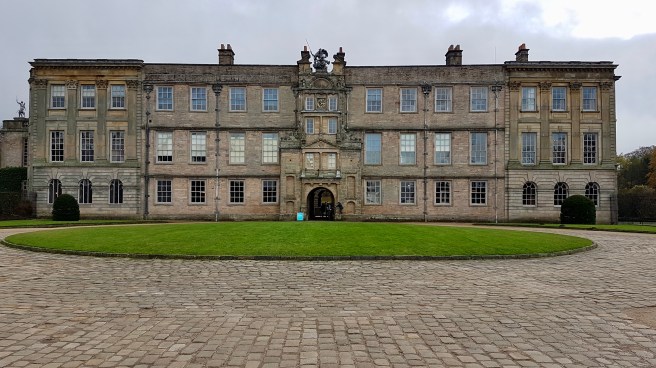
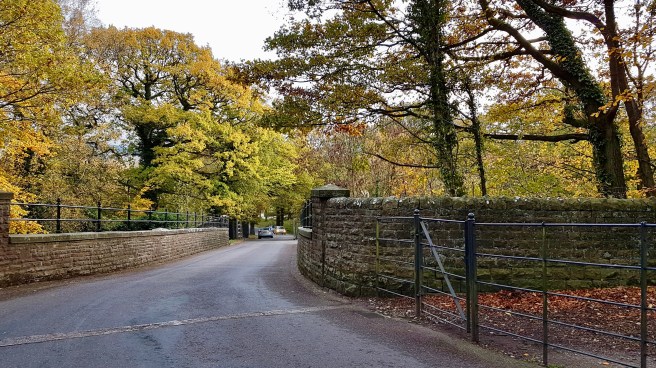 Final stop, where we were the last visitors to get in, was Lyme Park – backdrop of course to the BBC’s ‘Pride and Prejudice’, a short drive away. I always remember it from my many visits as impressive, and so it proved.
  Whether it was the rooms….
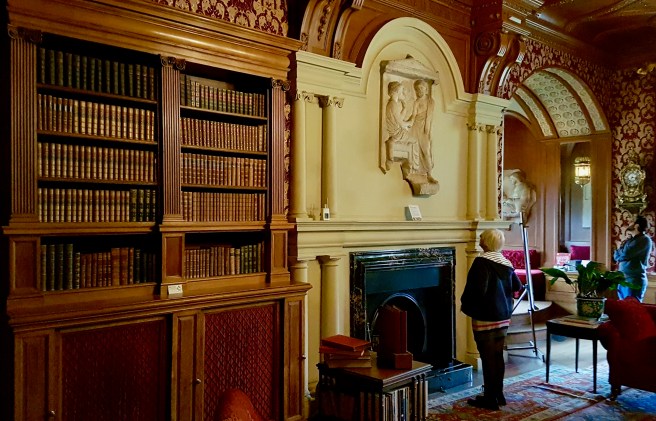
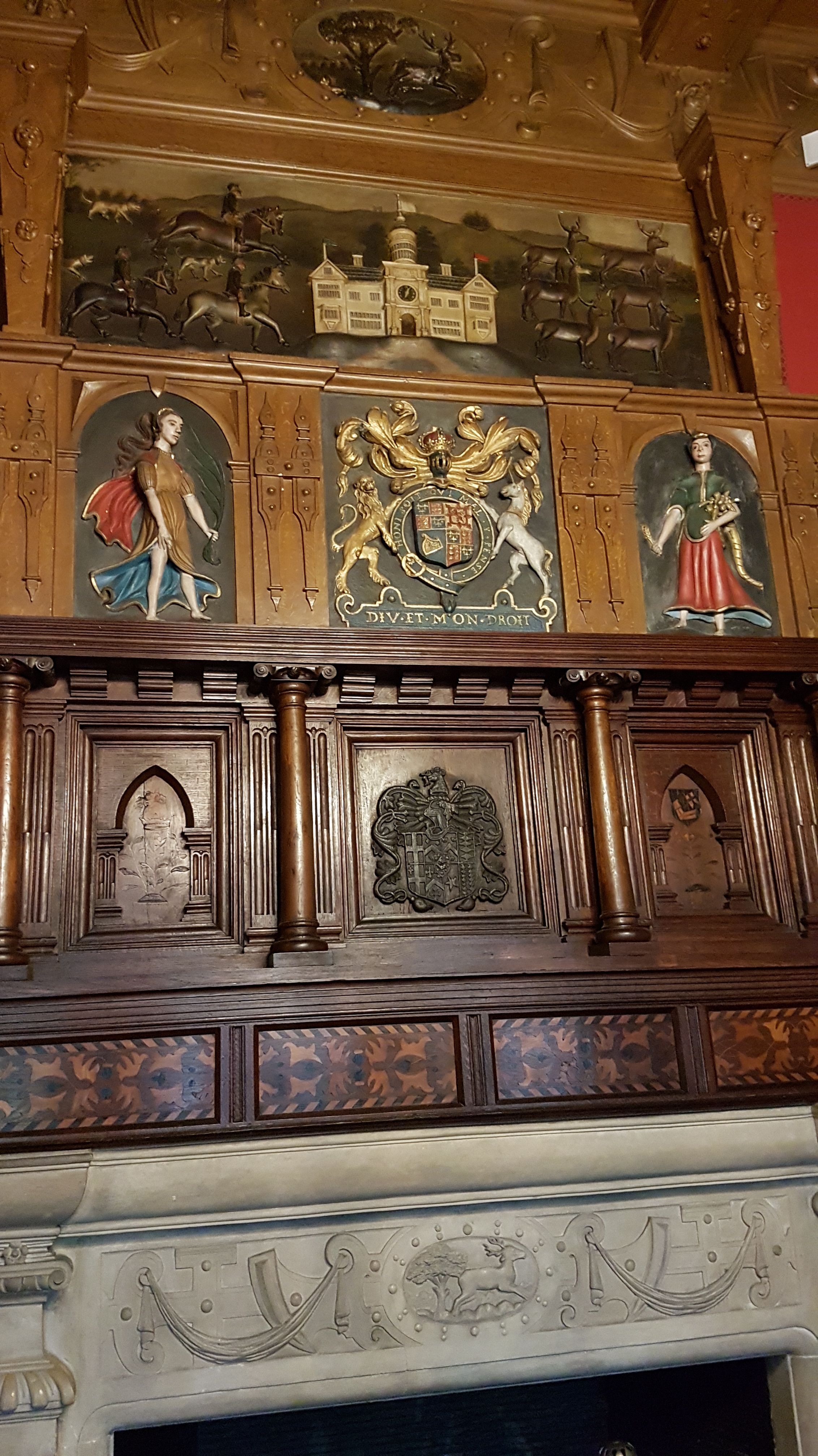
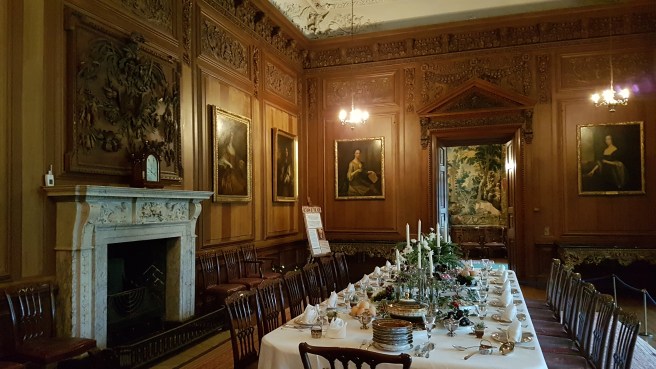 the fireplaces…..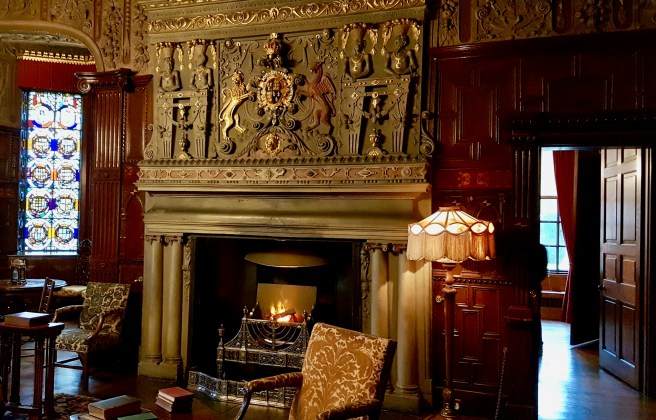
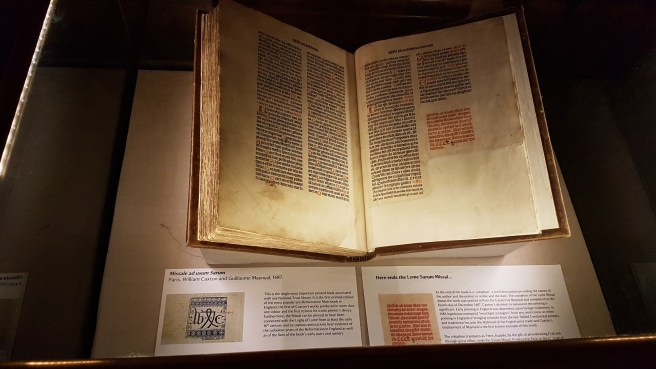
 or the unique Lyme Missal or Sarum Missal. Handwritten copies of the Sarum Missal were commonplace in early modern England. The text of the Mass was broken up into sections, each major book opening with an illuminated letter and individual verses with a blue coloured letter. The body of the Mass was written in different coloured inks, fonts and sizes. Priests could then use this to navigate through the sections, without which the text would lose much of its meaning. The version on display at Lyme, however, was the first copy to be printed. It was produced in 1487 by William Caxton in conjunction with the printer Guillame Maynyal in Paris. It is deemed the most important printed book in the National Trust, which is indeed saying something.
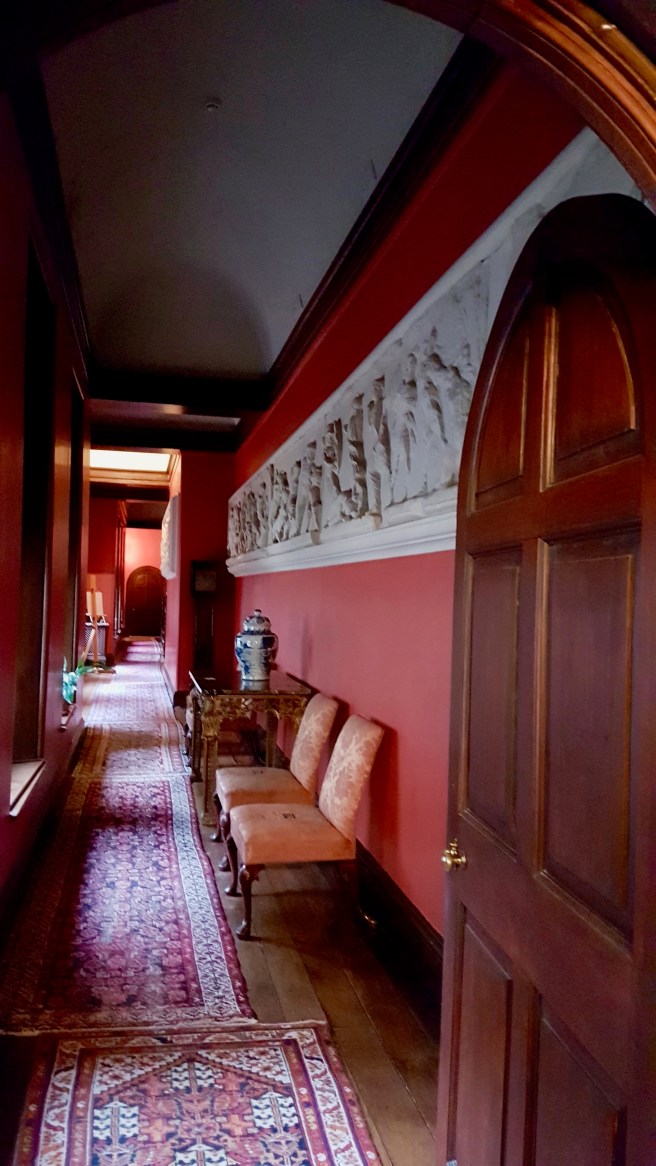
 There were enfilades (suites of rooms with doorways in line with each other)……
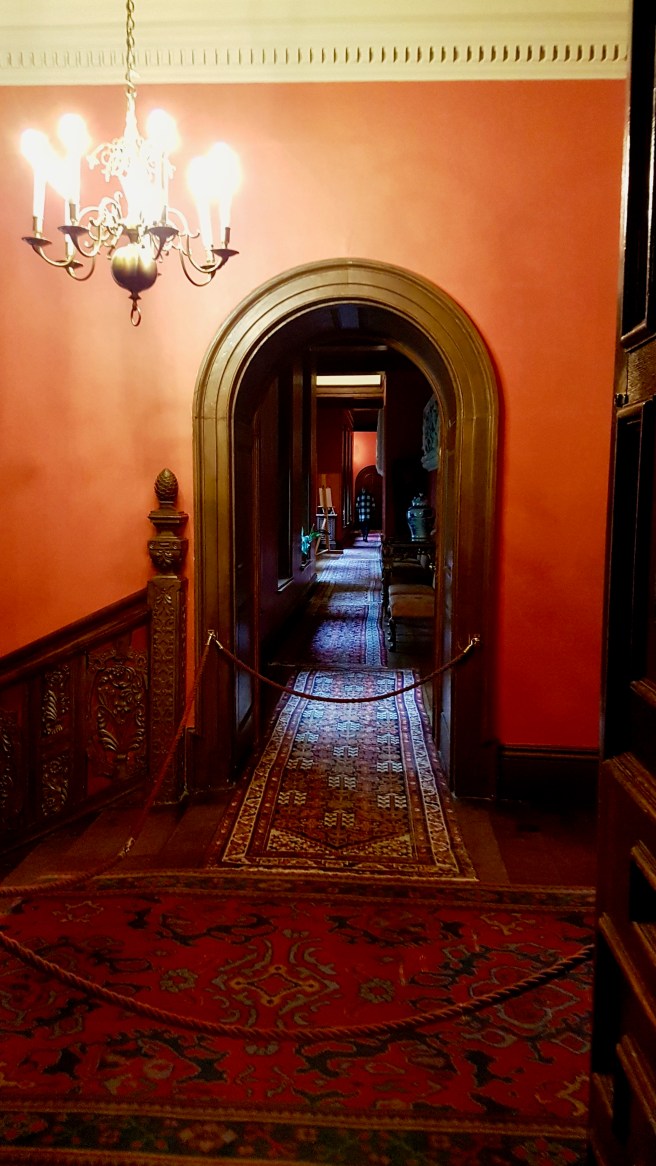 some with the Ancient Greek stelae or funerary monuments (there are many) which one of the Leghs filched on his Grand Tour…….how attitudes have changed!
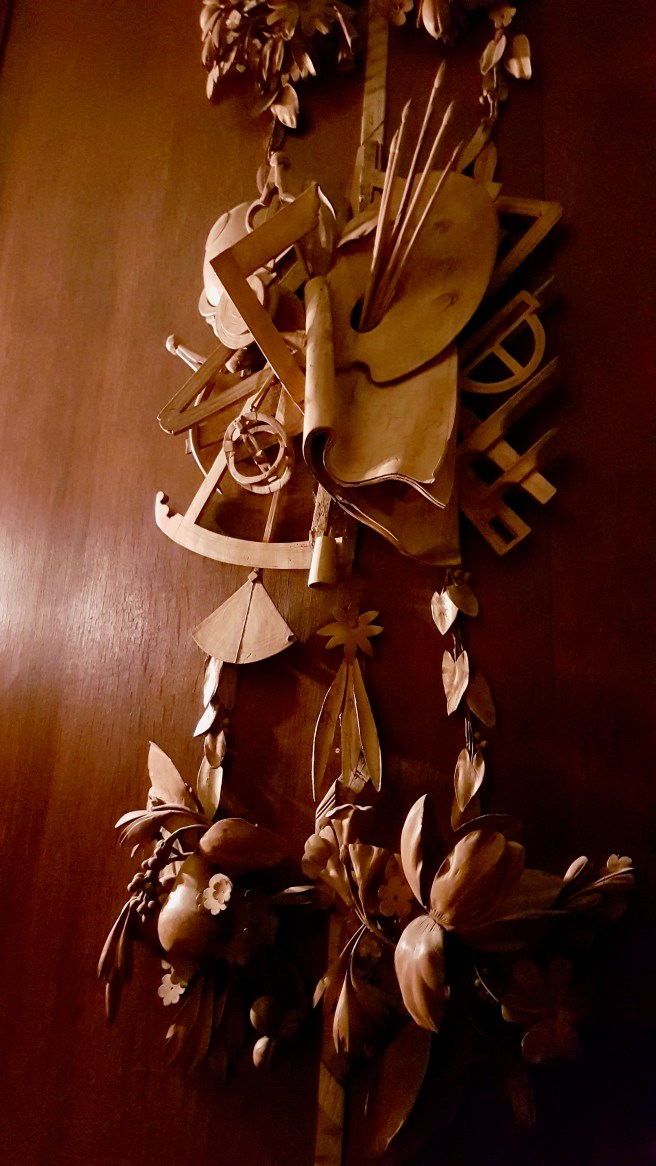
 The wood carvings by the ultimate master carver Grinling Gibbons was of course stupendous, and Lyme has some of his best work….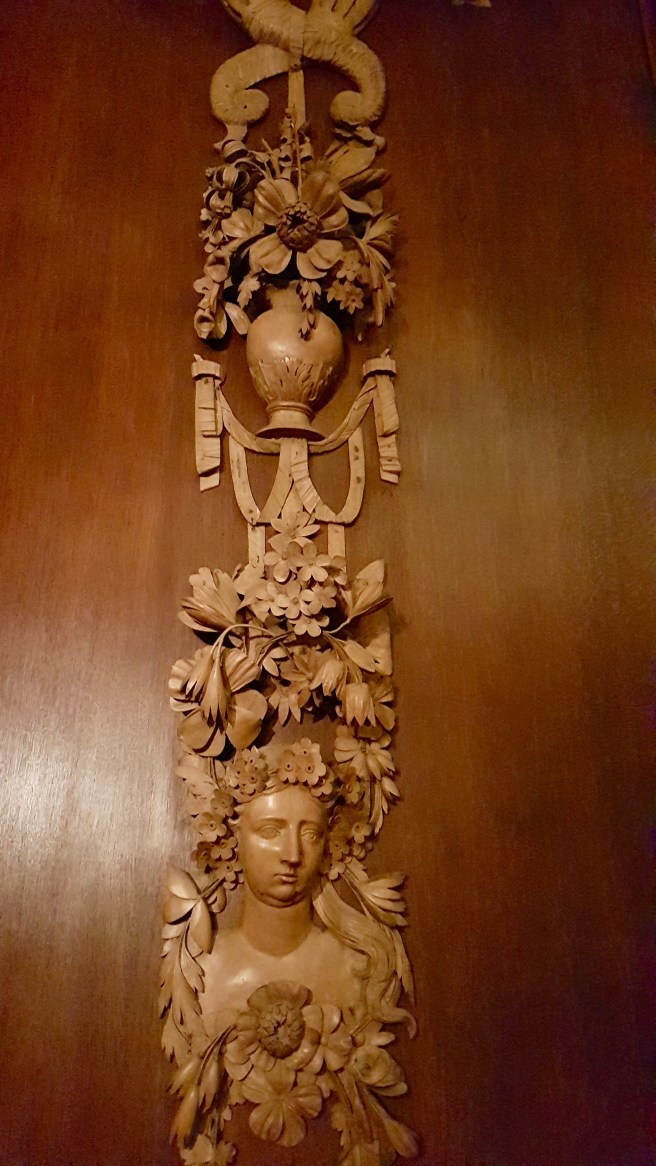
 The extensive grounds are a delight which we will have to see on another day….
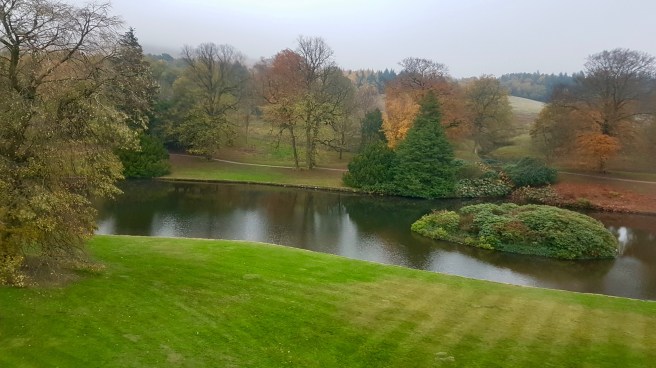 and by the time we got back to Manchester the Christmas Lights had been switched on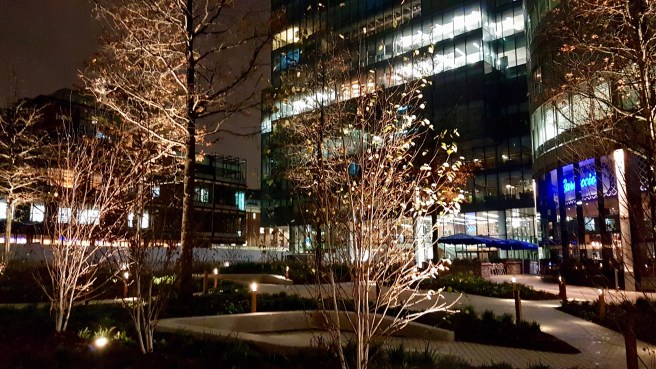
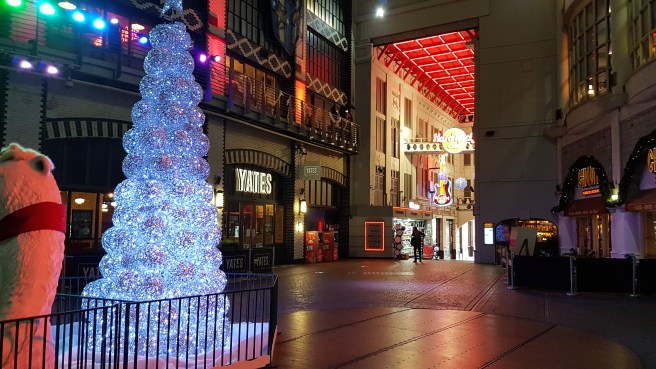
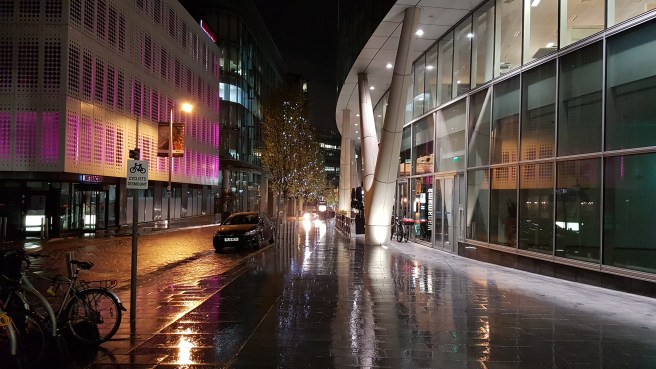
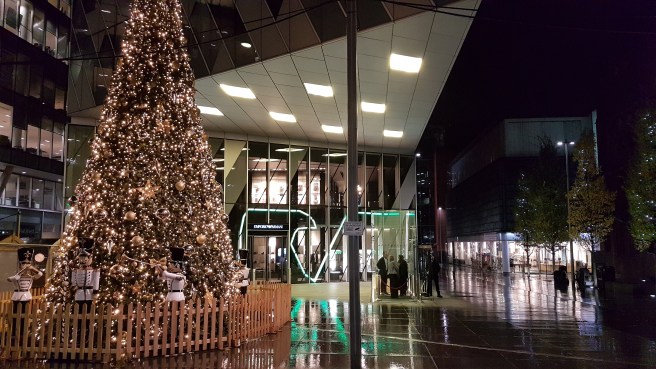
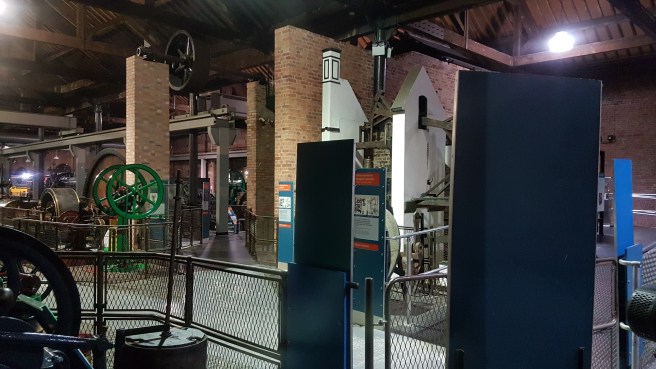
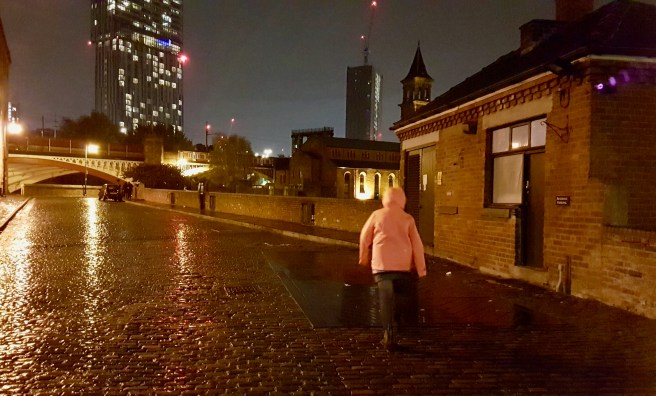
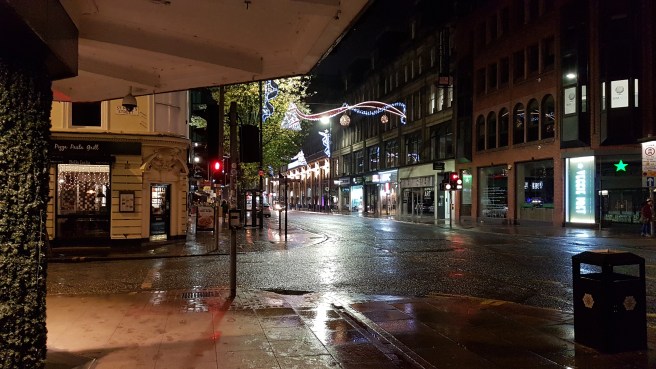 We then were off to the Castlefield Canal area which has a character all of its own, and on our way we passed the entrance to the Science Museum where we glimpsed ‘Rocket’ where it should be in the North of England rather than the Science Museum in London…….it was of course built for, and won, the Rainhill Trials held by the Liverpool and Manchester Railway in 1829 to choose the best design to power the railway……
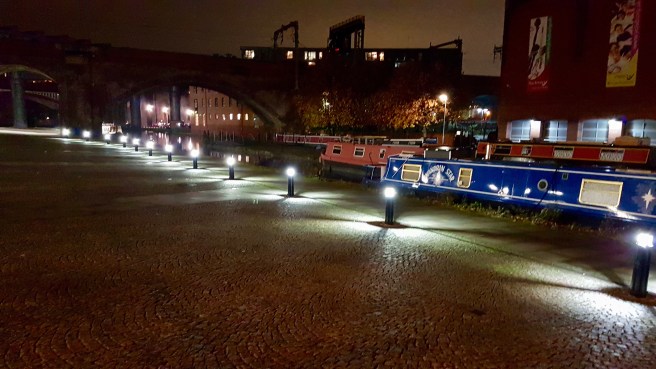
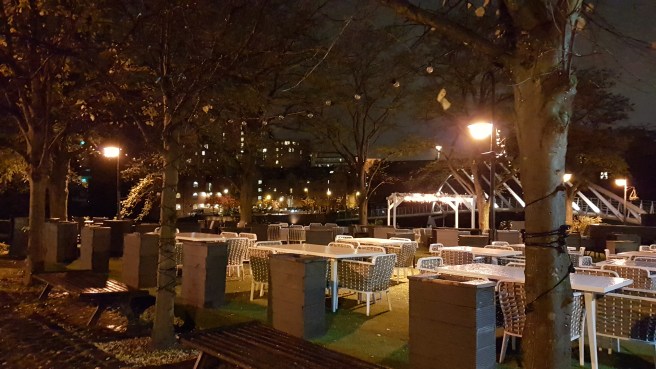
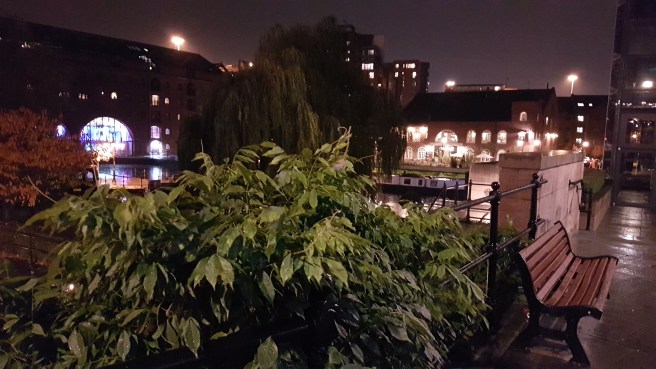
 The exhibition and events square overlooking the canal basin, with canopy all along one side, was an exciting area, and the venue for great music events apparently….and although wet outside (but atmospheric!) we did enjoy a drink in one of the big canal-side bars….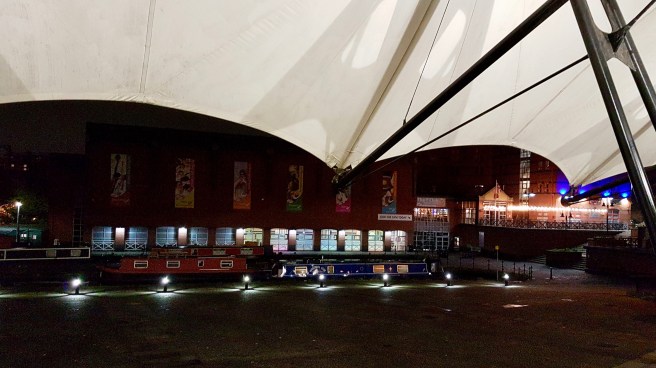
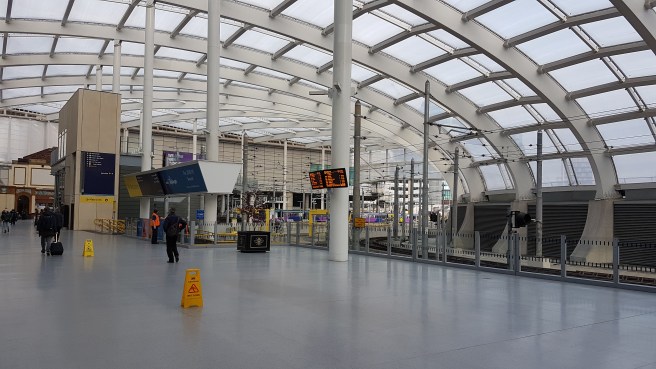
 Next day, and our last, we made our way to Chetham’s Library via the old Victoria station whose facade is carefully preserved, but whose interior is transformed into a combined mainline train and tram interchange which is very impressive…when I was a boy, trainspotting here, Platform One ran across the bridge from Victoria for 670 metres into Exchange Station making it the longest railway platform in the world.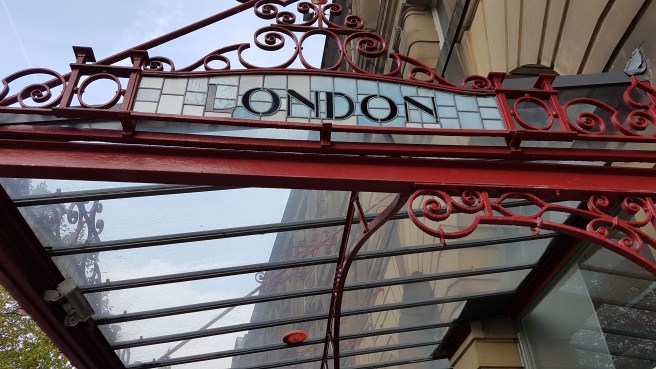
 The Co-op has always been big in Manchester, and here is just one of 10 sites it operated from…
 Still on our way to Chetham’s…. what I call enjoyable architecture….
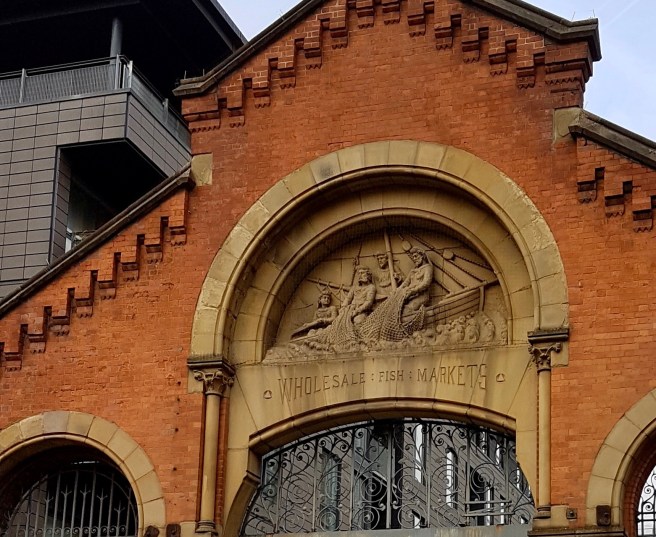
 We then passed yet another building site where the facade had been protected….in this case the Wholesale Fish Markets….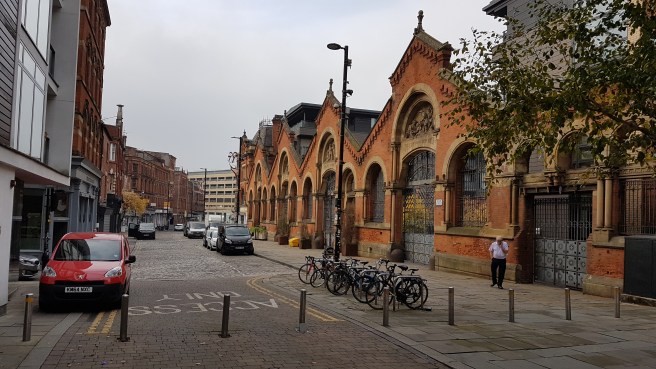
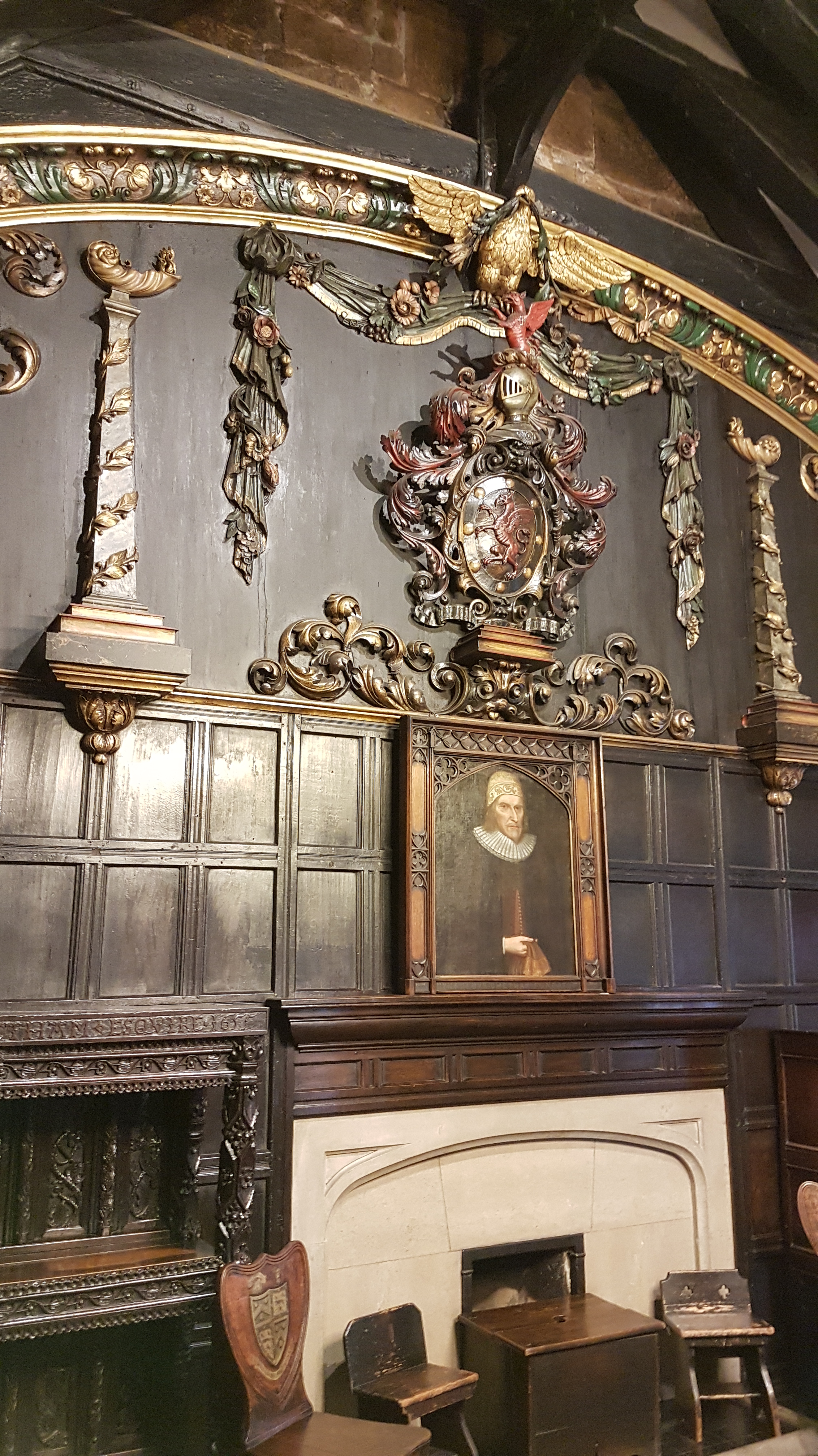
 We were now at Chetham’s ready for our guided tour of the ancient library. Chetham’s is now a world-famous (and infamous) music school, but the library is run separately. The coat of arms is that of Hugh Oldham founder of The Manchester Grammar in 1515 which used this site until 1931…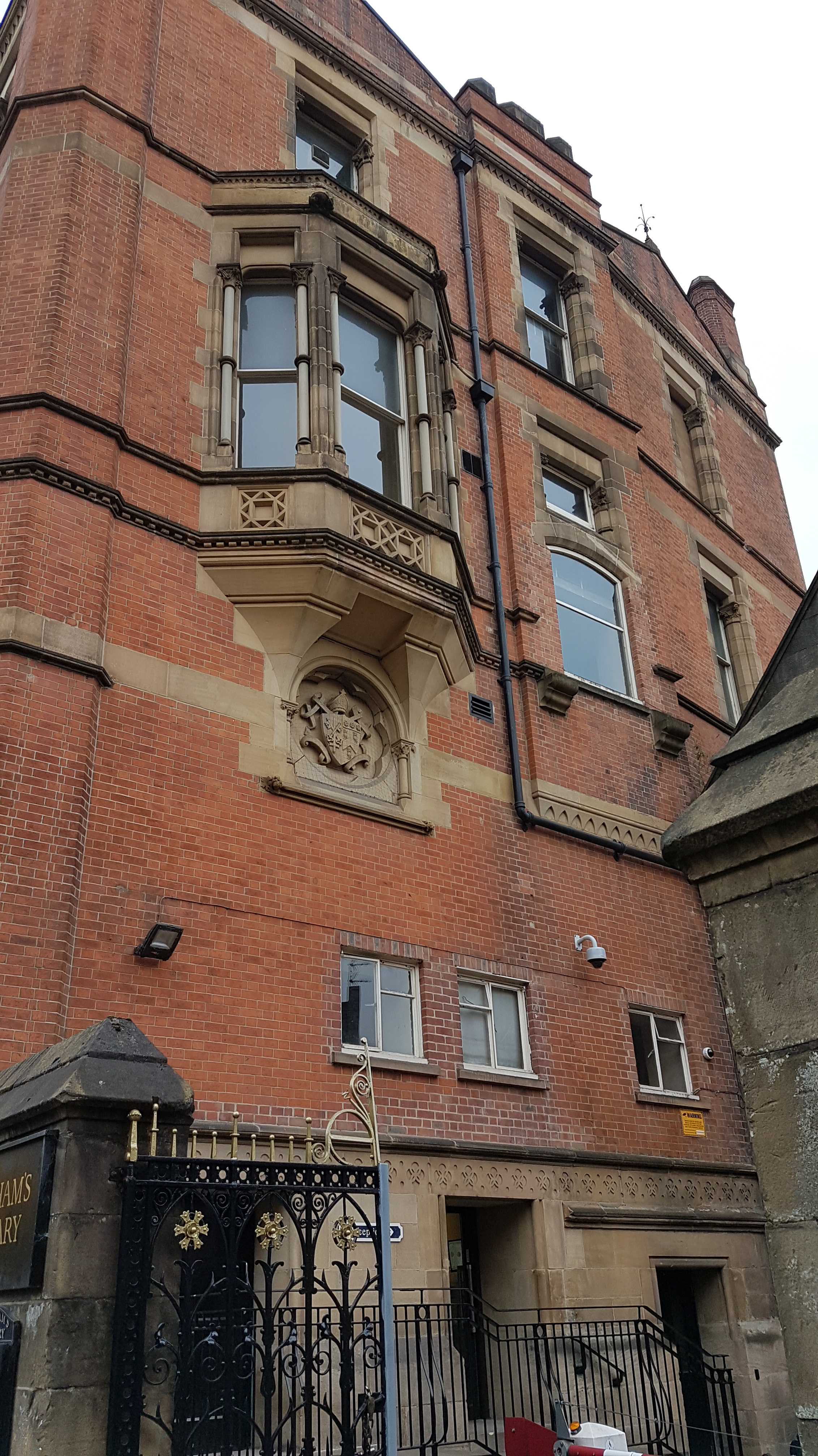
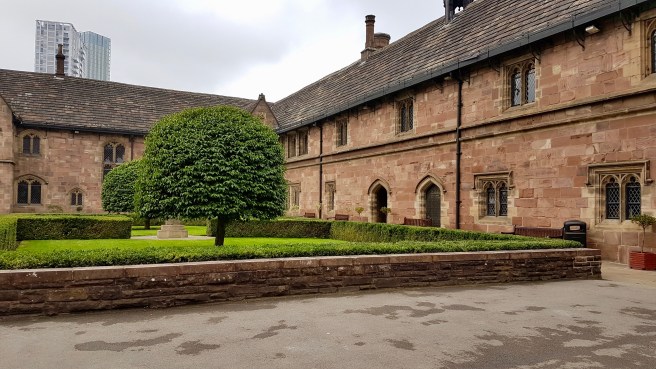
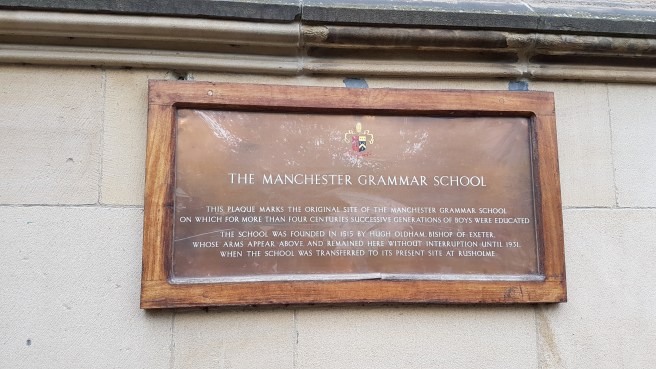 Anyway, the tour. First through the medieval quadrangle…..the buildings, which continue to house Chetham’s Library and the Baronial Hall, were built from 1421, on the site of the manor house of Manchester, as a college for priests connected to the neighbouring Manchester Cathedral. They survived through the religious tumult of the Tudor era and the experiments of its famous 16th century warden, Dr John Dee who was a noted alchemist.
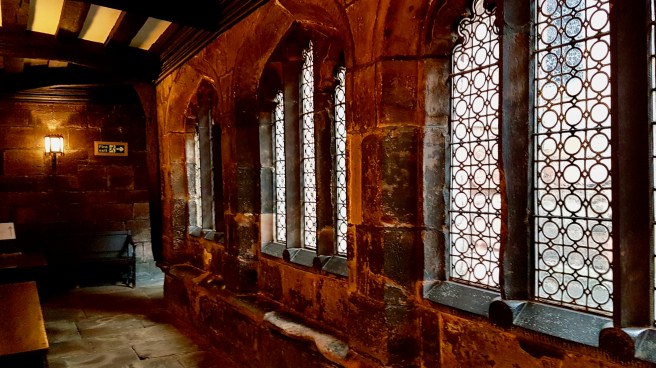
  Inside, the corridors now enclosed would once have been the doorways to the priests’ individual cells.
  The baronial hall is a wonderfully preserved example of the timber halls found in the north west of England, and is comparable in size with Ordsall Hall, Salford, and Rufford Hall, all in Lancashire. The magnificent open timber roof once accommodated a louvre opening to allow the evacuation of smoke from a hearth in the centre of the room.The purpose of the screen was to keep out draughts and to conceal the entrances to the buttery and pantry situated at the back of the hall. At the top of the hall an impressive oak canopy projects over a raised dais, where the warden and visiting dignitaries would have dined at high table. MGS pupils never stopped complaining how cold it was to have lunch here….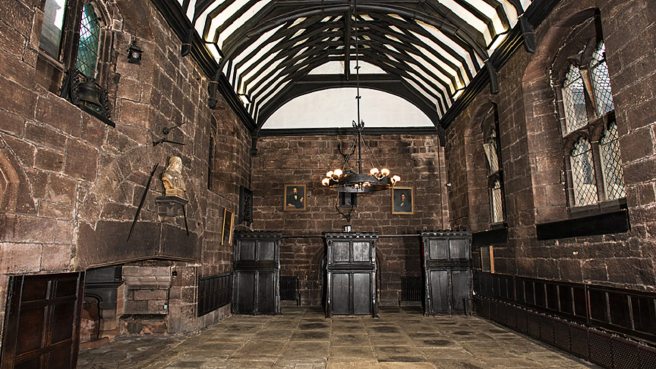
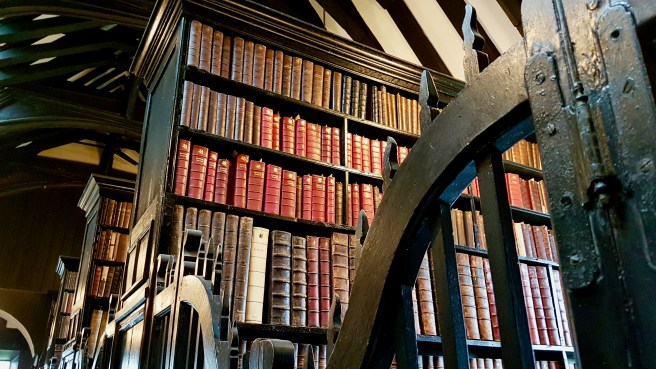
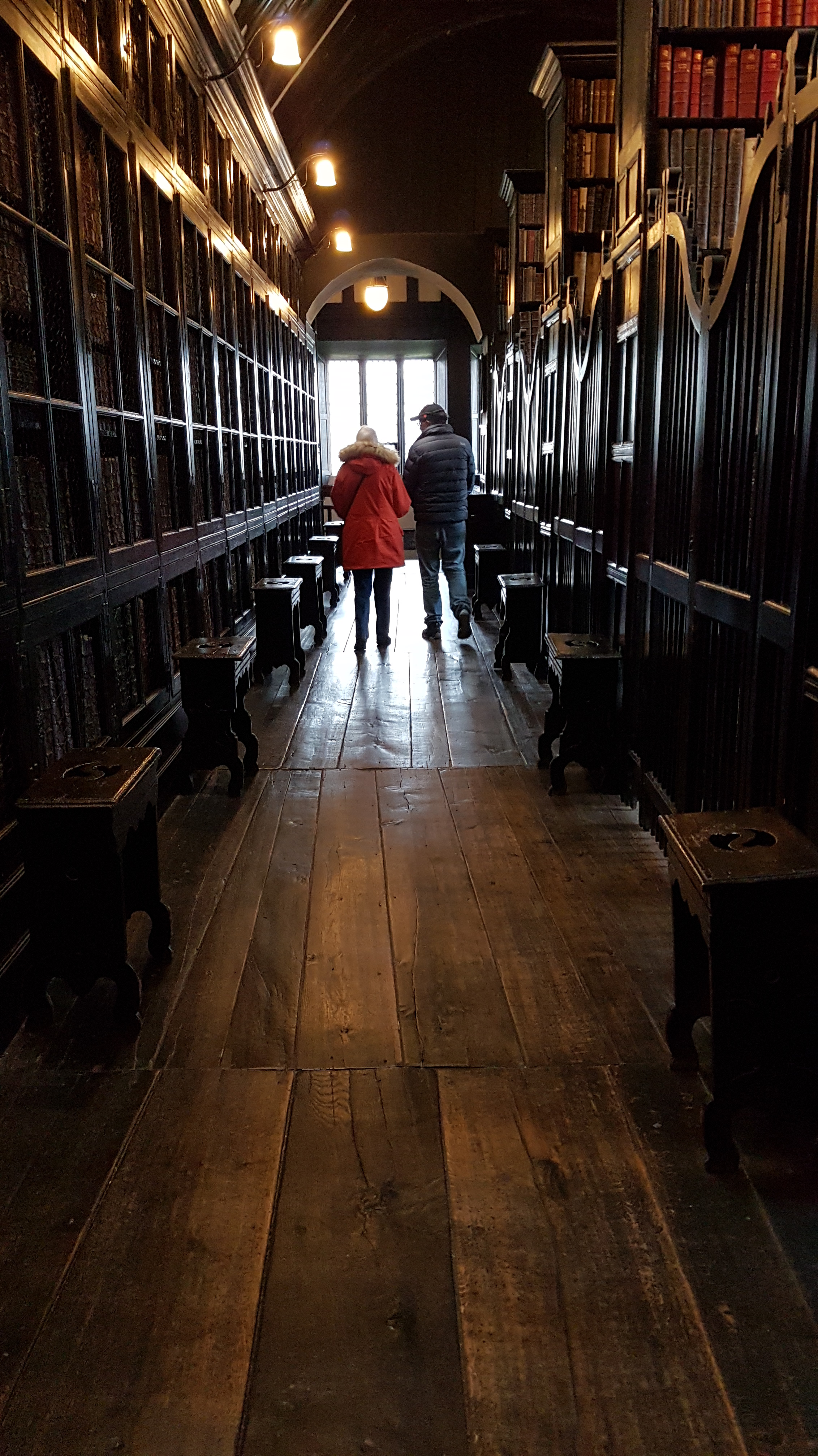
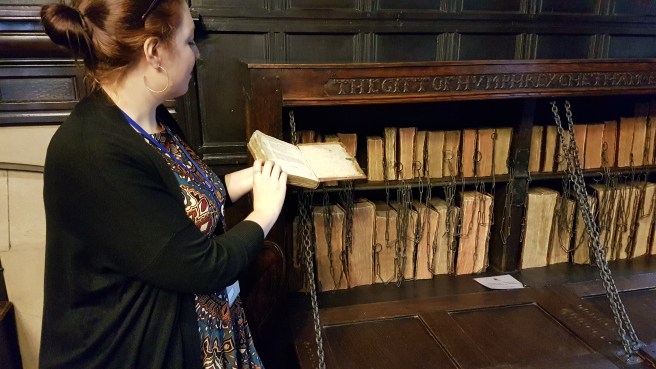
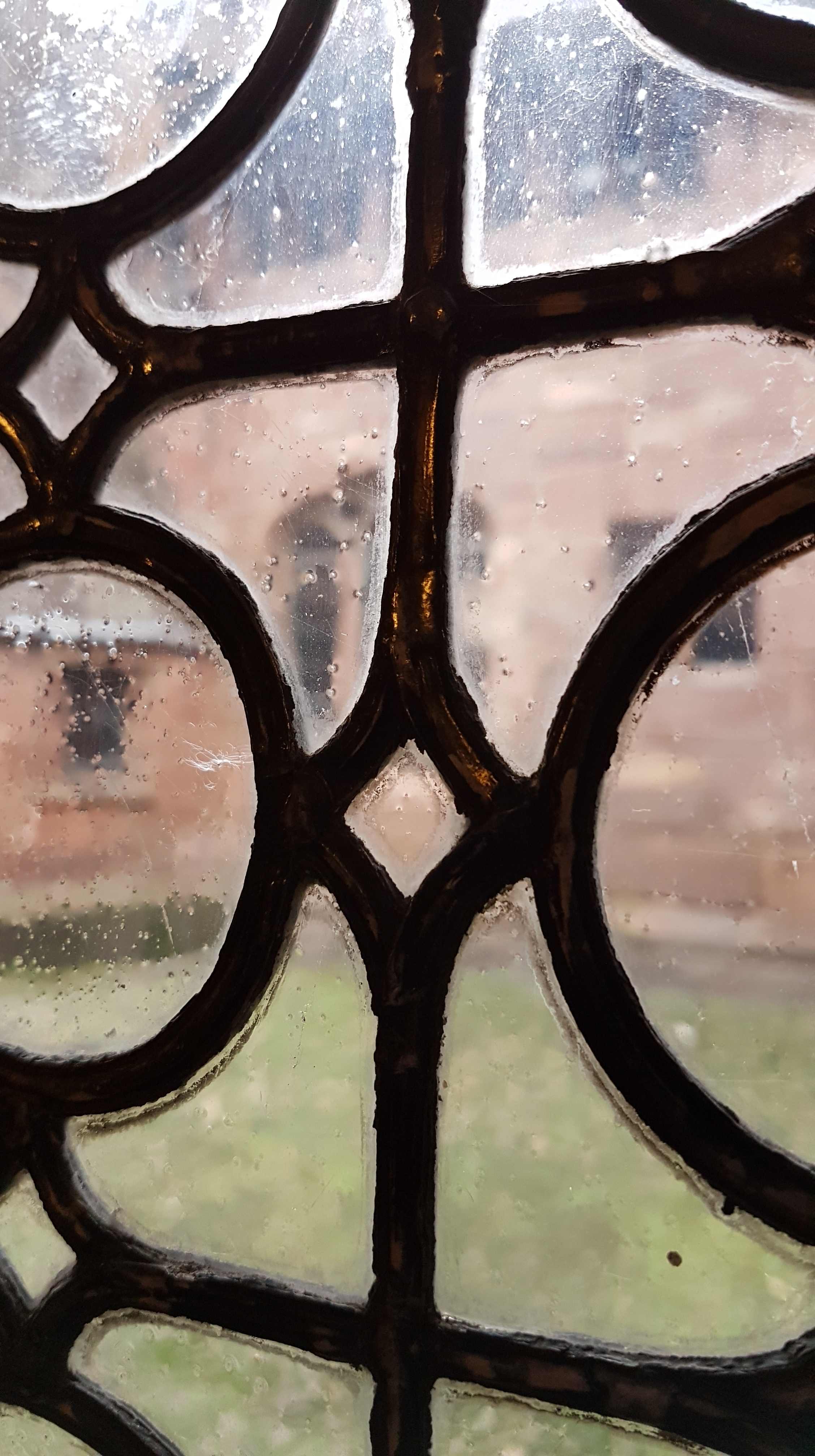 The library is absolutely amazing and reeks of its age. It was founded in 1653 and is the oldest public library in the English-speaking world. It can still be used by anyone….I wish I was here to make use of its facilities.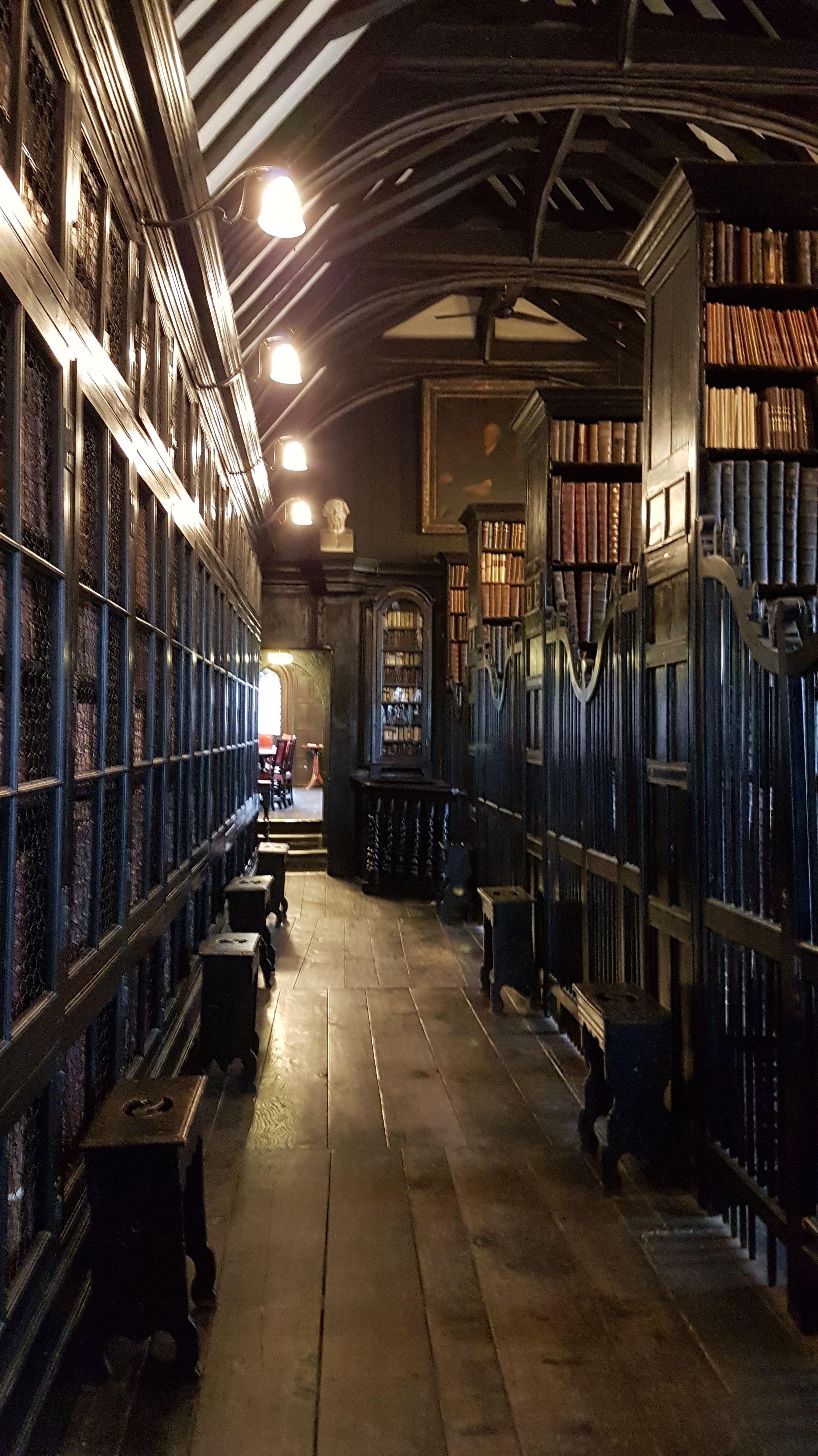
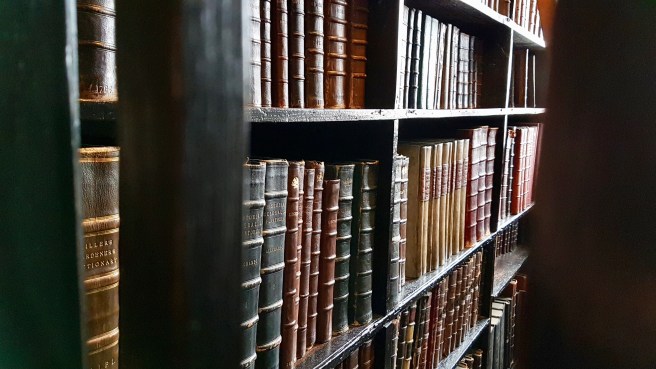
 But I was anxious now to see the Reading Room…..where we soon were after looking at a very old printing press which had been used until recently…..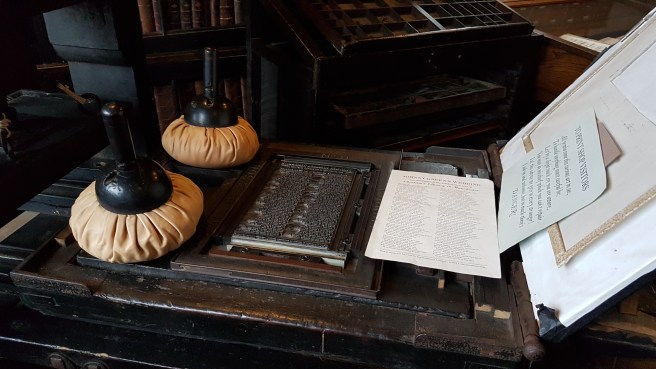
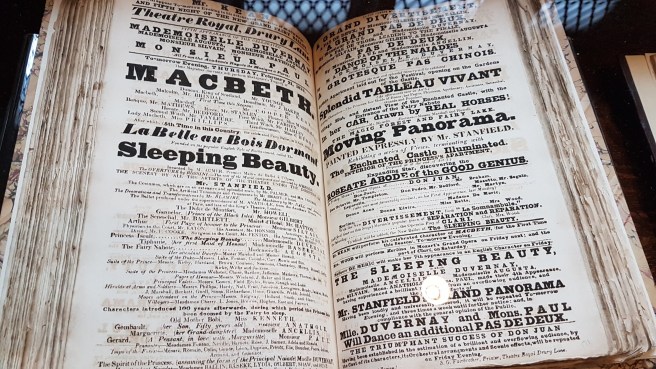
 and in here is not only the library of chained books…
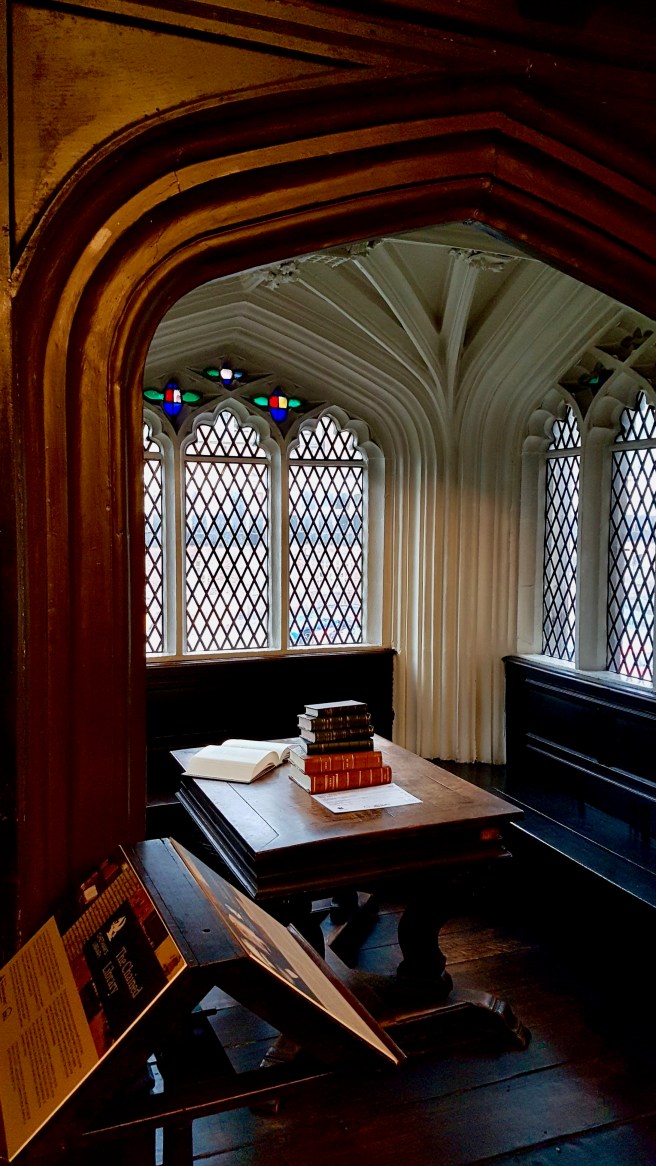
 but also the internationally famous alcove and desk at which Marx and Engels worked…here is the story..
The German industrialist and Marxist philosopher Friedrich Engels lived in Manchester in the early 1840s and was employed by his father’s cotton thread manufacturing firm in Weaste.
During his time in Manchester Engels made many detailed observations leading to the publication of his influential work The Condition of the Working Class in England.
Karl Marx, who lived in London, was a frequent visitor to Manchester, and in the summer of 1845 he and Engels developed the habit of studying together at the table in the alcove of the Reading Room.
Evidently the Library made a strong impression on the two men. Writing to Marx many years later in 1870 Engels commented: “During the last few days I have again spent a good deal of time sitting at the four-sided desk in the alcove where we sat together twenty-four years ago. I am very fond of the place. The stained glass window ensures that the weather is always fine there. Old Jones, the Librarian, is still alive but he is very old and no longer active. I have not seen him on this occasion”.
Apart from the stained glass windows, which were damaged by a storm in the winter of 1875 and replaced by plain glass, the desk and alcove remain unaltered. The books which the two men studied are still held by the Library. And the facsimiles of these were available on the desk for us to consult. Fascinating material, a lot of it investigations into poverty at prior periods. I do wonder why this ‘shrine’ to Marx and Engels is not better known. It significance can hardly be over-estimated.
 A real privilege to visit this great institution. I shall be back.
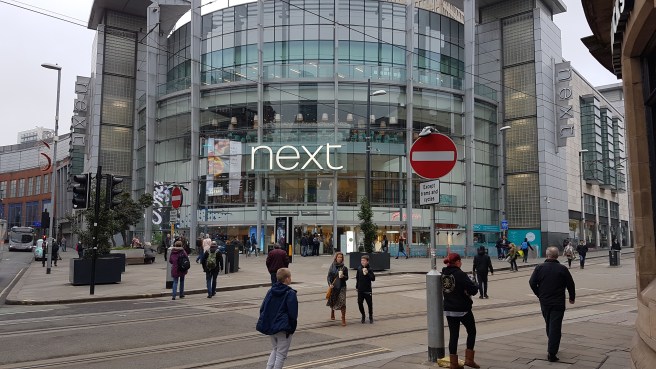
 A coffee was called for and from the Costa windows we had a nice view of some of Manchester’s modern architecture…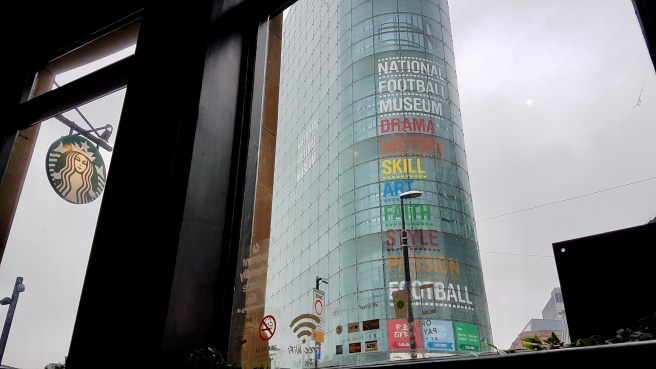
 Off then on the tram to Salford Quays. An interesting journey through much residential reconstruction….
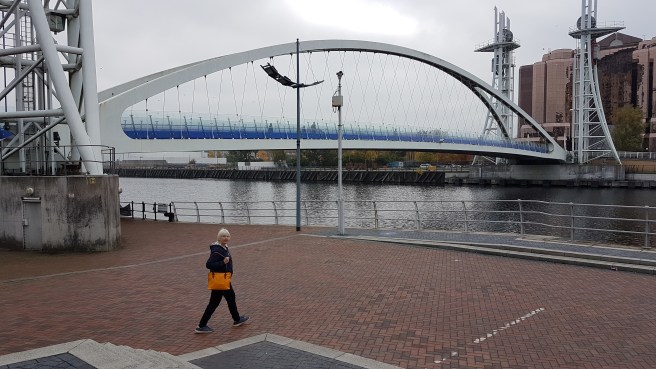
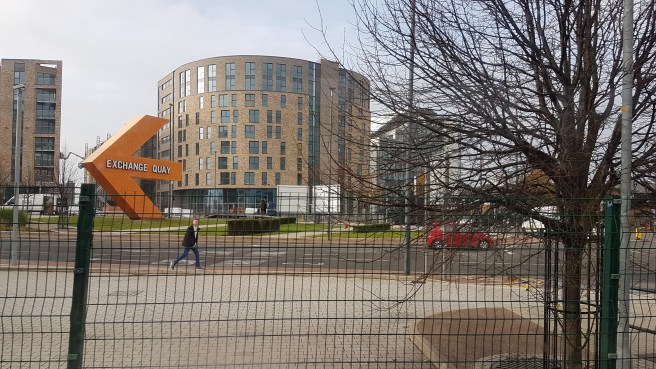 and a landscape very much of the twenty-first century when we got there…..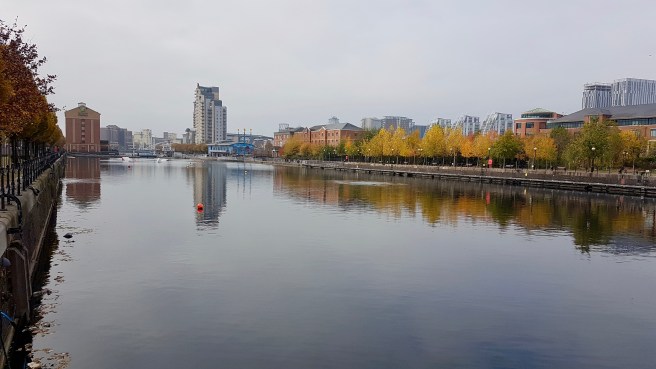
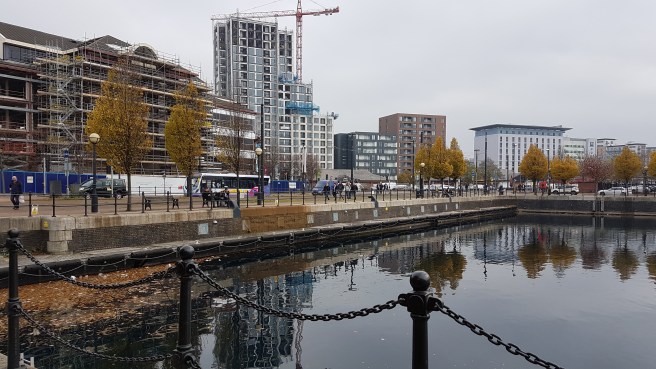
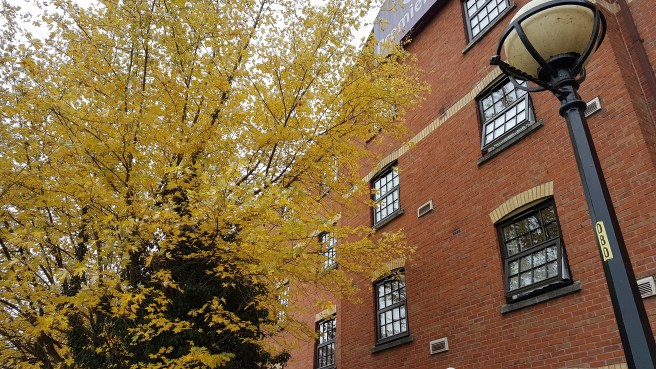
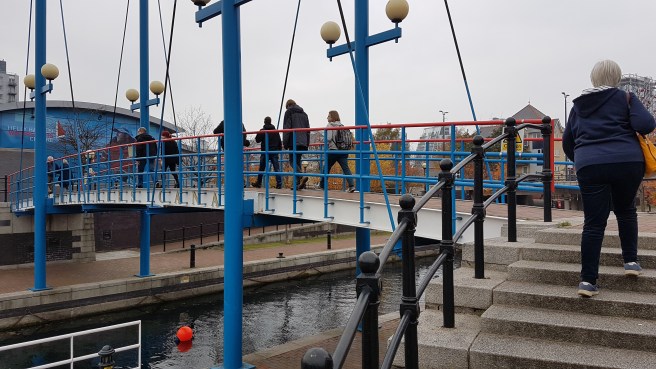
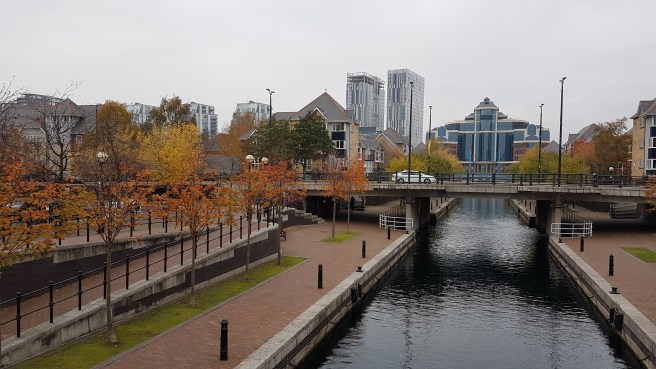 and, thank God, Salford hadn’t forgotten some of the softer landscaping…
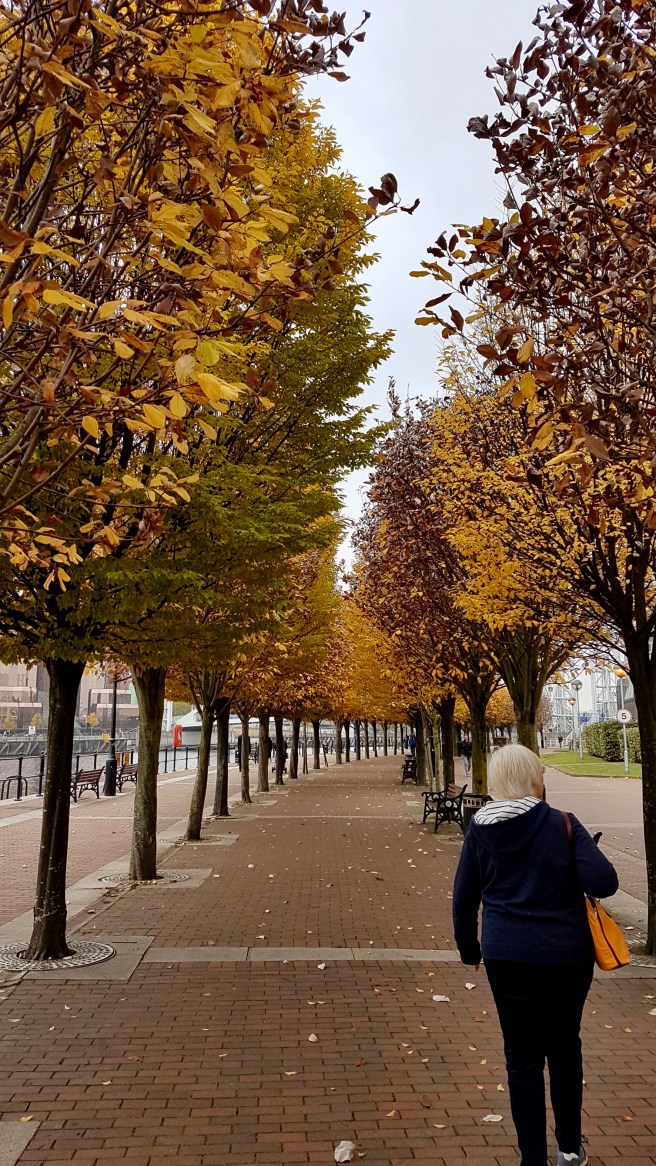
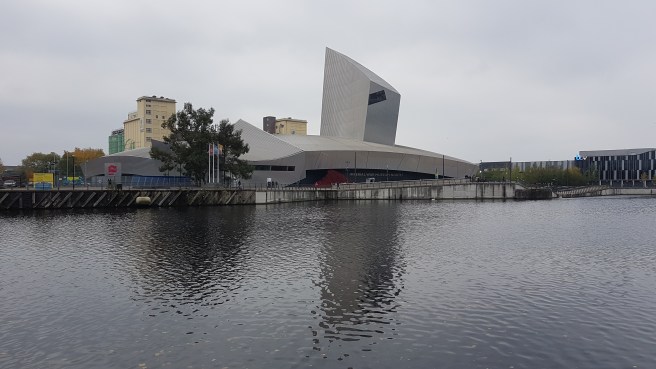
 A quick look across at the Imperial War Museum North..the first building in the UK designed by the internationally acclaimed architect, Daniel Libeskind, and built on a bomb site in Trafford Park where my Mum and Dad used to work, the first planned industrial estate in the world, and still (apparently) the largest in Europe.
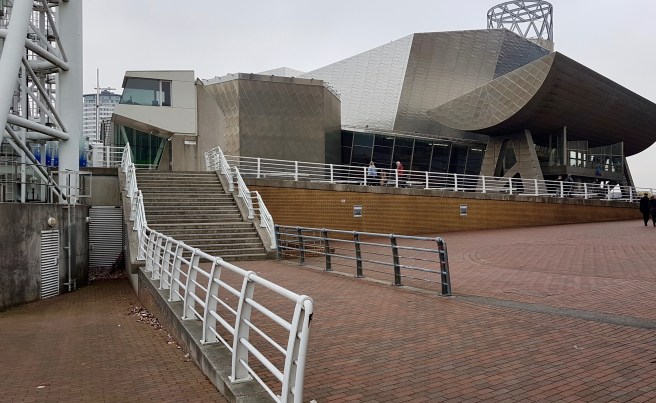
 Then we arrived at the Lowry..designed by British architect Michael Wilford as part of the regeneration of this once heavily industrialised area. It doesn’t just hold the Lowry painting collection but three theatres and much else besides…but not many artists have a building named after them.
 We were greeted by a painting of Lowry himself by a friend and then….
 a very interesting display indeed on painters who influenced Lowry..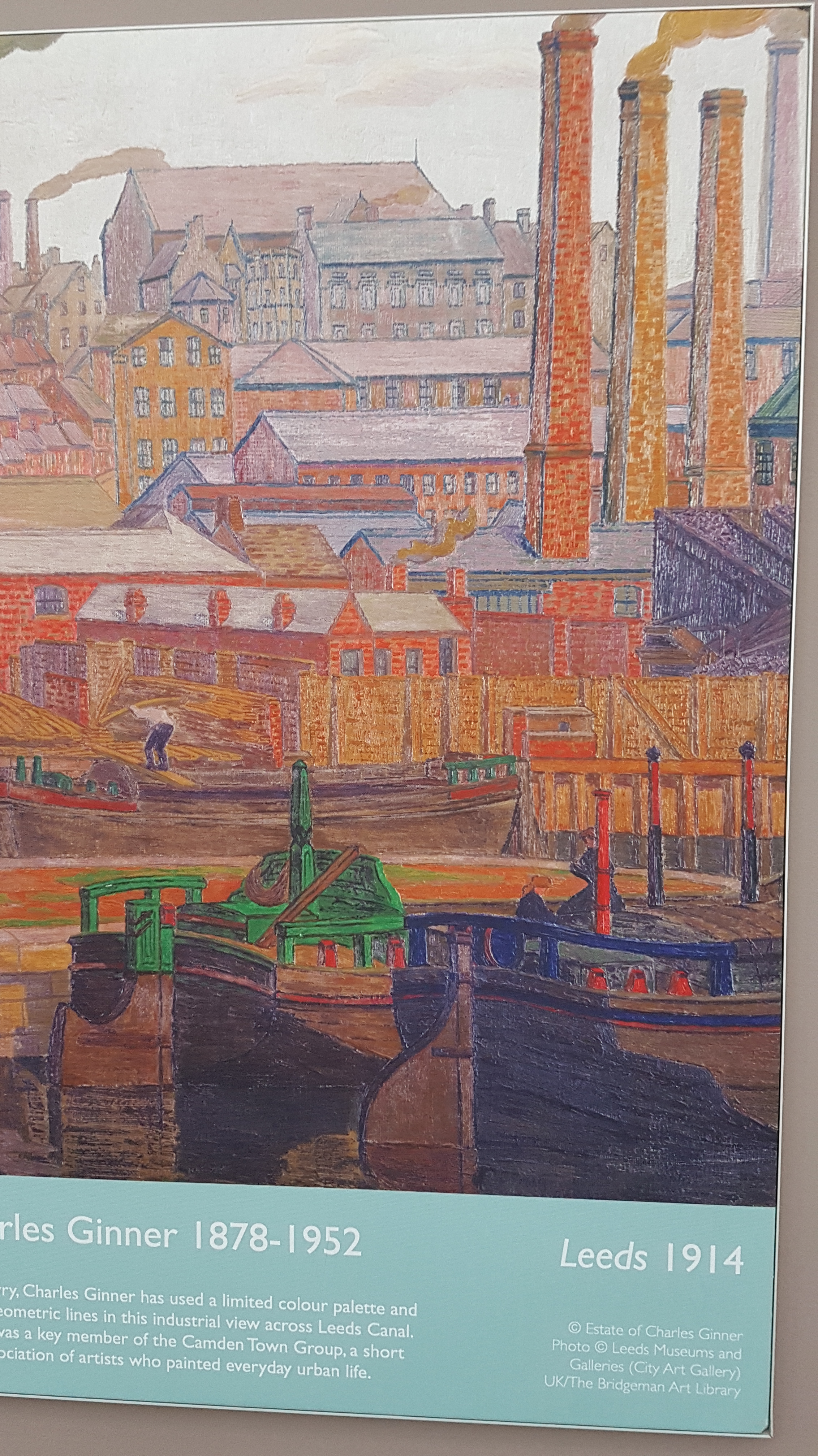
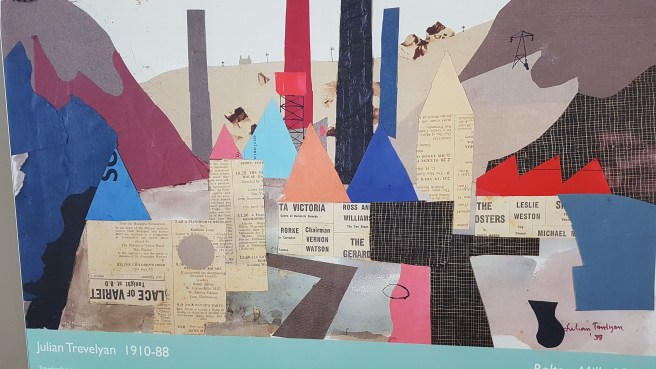
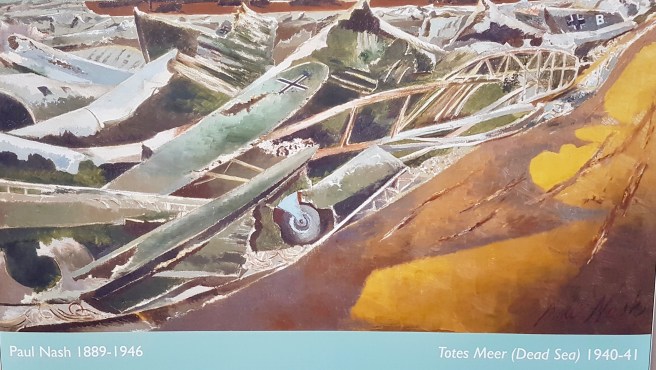
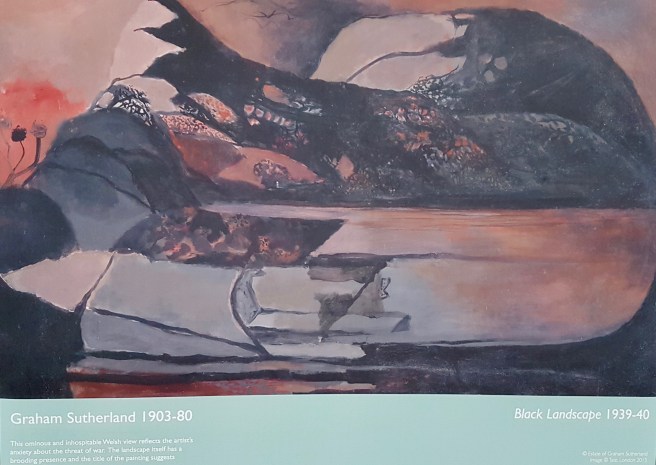
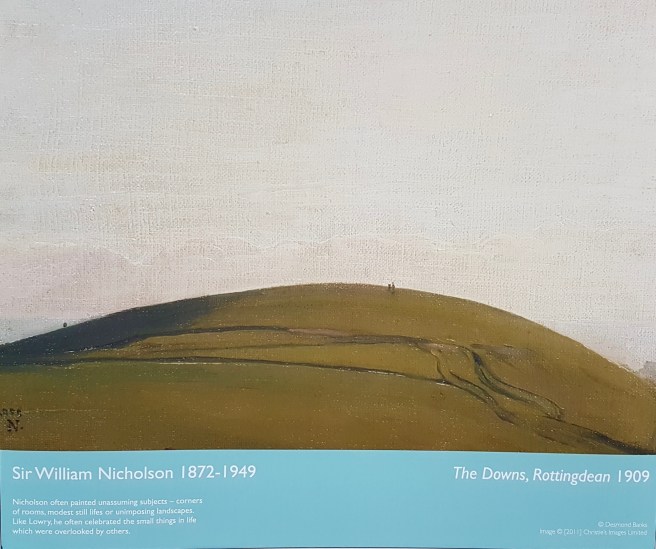 followed by an absorbing history of the areas Lowry often painted…
 Oh, and I forgot, a perceptive documentary film interviewing him and those who knew him well…..before the paintings proper there was one more thing – a televisual presentation on ‘before’ and ‘after’ scenes of some of Lowry’s better known paintings…which I loved…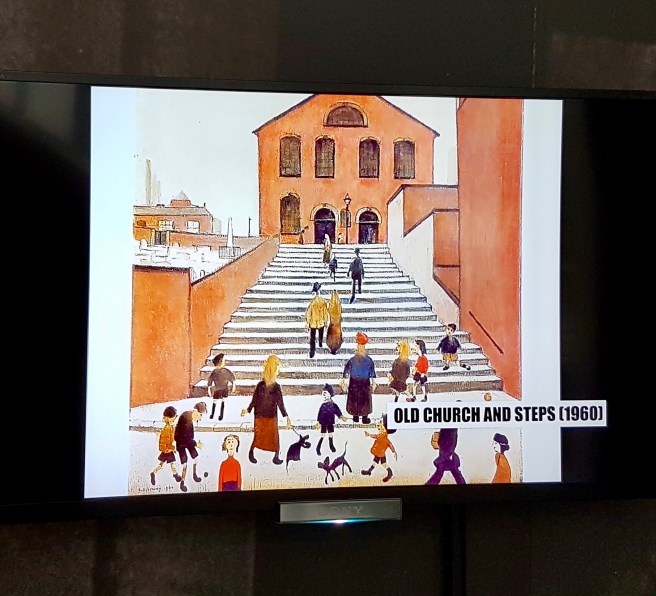
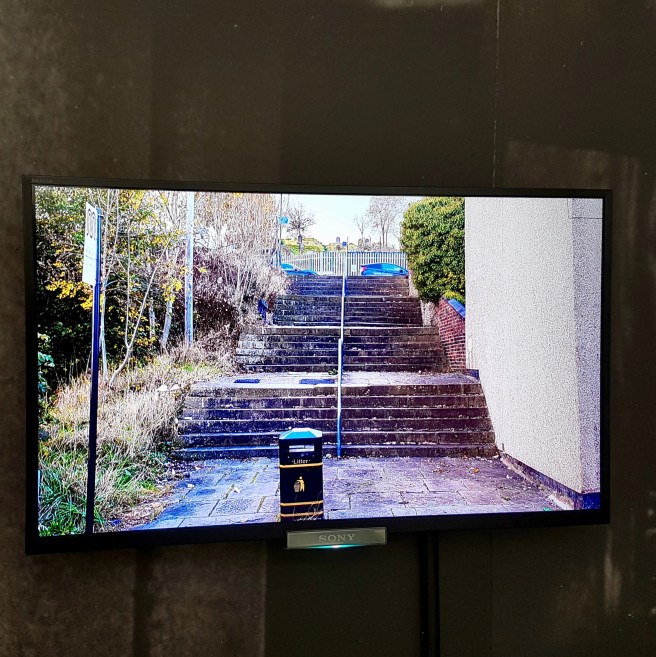

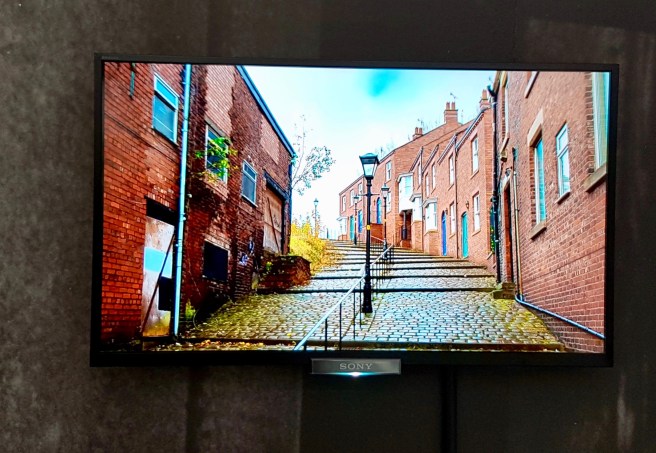 I only recorded one painting as I was told off for using my camera (in a very friendly Mancunian way of course)…..
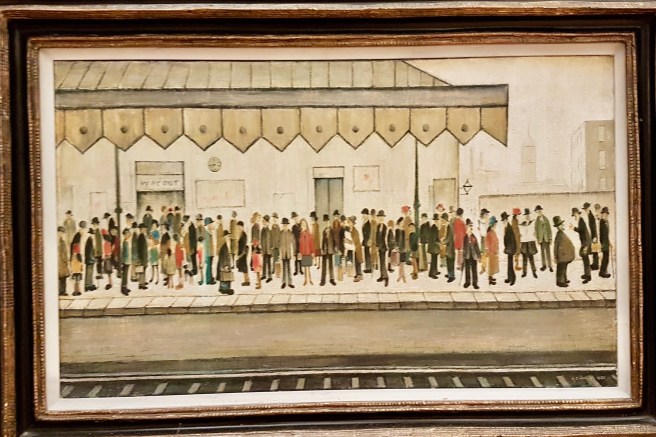 But the thing about his art is that it is not at all just about industrial scenes and matchstick men. He was very fond of seascapes and these impressionistic paintings I liked more than anything. There were also some of his extremely good portraits. Lots of children in today with their teachers which was great to see. A really worthwhile visit (our second)…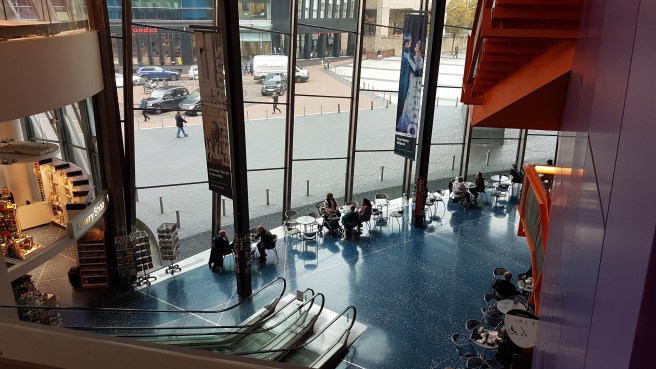
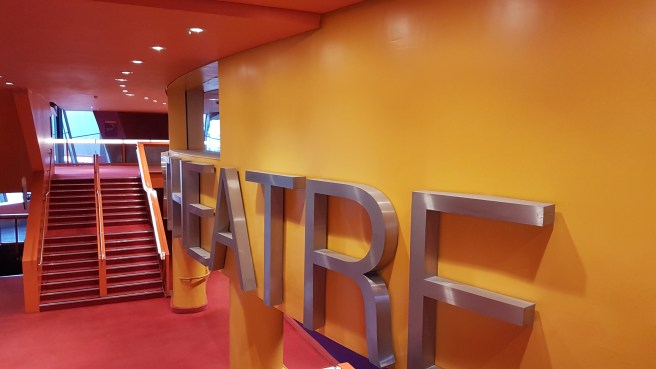 As I was now parched (you can after all only take in so much Art at one time) we headed quickly back to Manchester on the tram and made for the old Refuge Assurance building of my time which is now a magnificent hotel. Here we sat in comfort over a pint and admired the conversion in all its glory….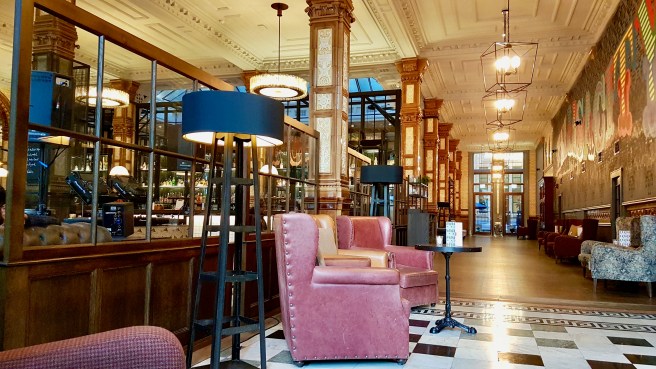
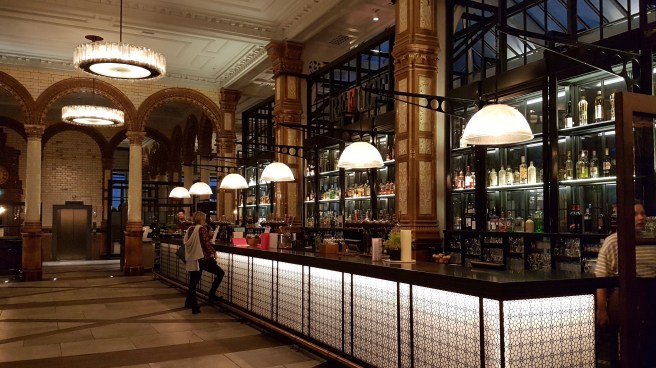
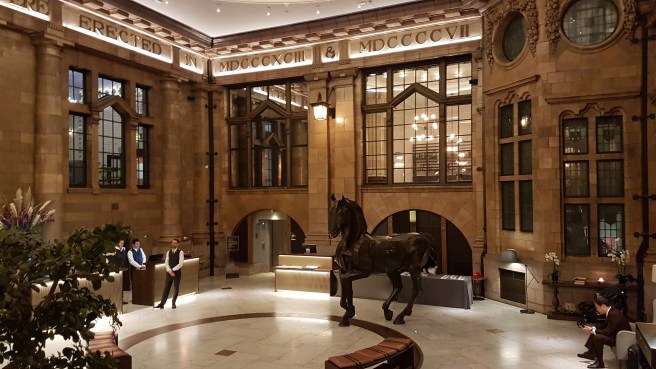
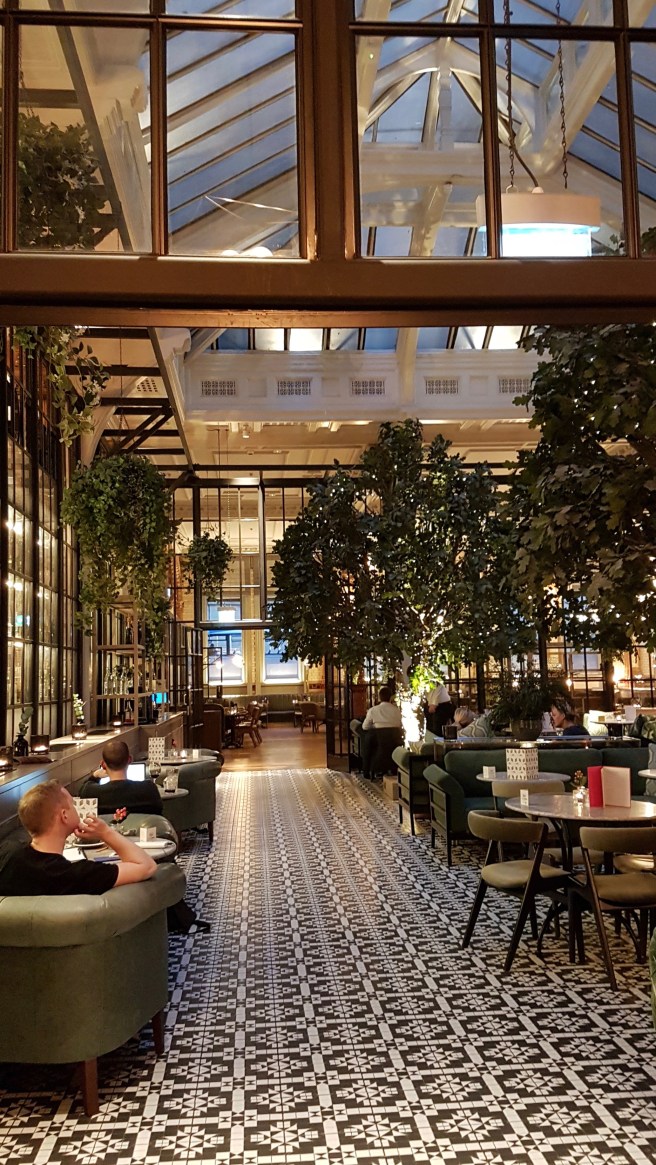 Bent on more of the same we then called in to the palatial Midland Hotel where we had a very nice chat over a drink with the duty manager…..
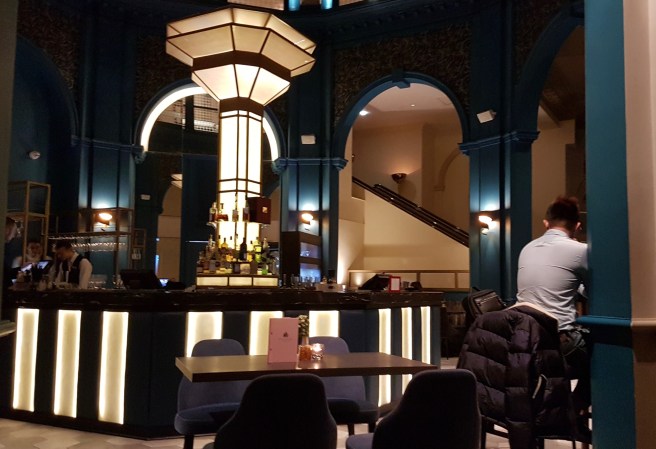 before ending up at the new hotel created out of the Free Trade Hall…in the Japanese bar of all places…..and remembering what I said about the building being named after Lowry here is a quote from one of my favourite historians A J P Taylor..’Other great halls in England are called after a royal patron or some figure of traditional religion. Only the Free Trade Hall is dedicated to a proposition………..’ (!!)
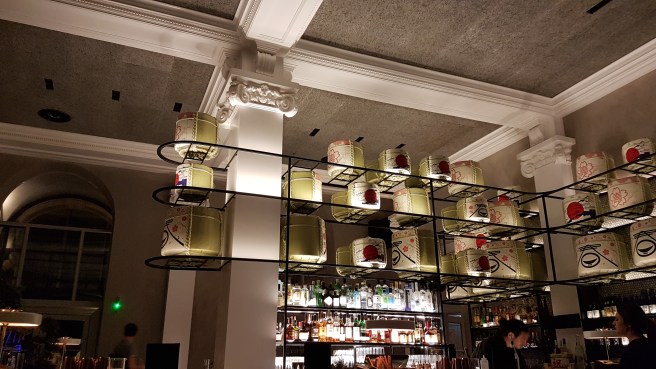 A slow walk back to our hotel. We had done over 18,000 steps today. Tourism is hard work.
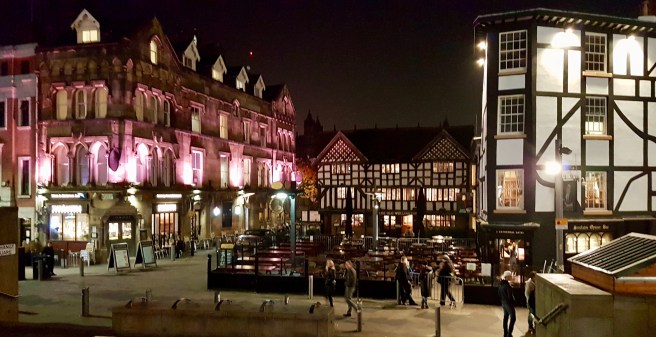 So what did we make of Manchester? I thought it was magnificent, I loved the juxtaposition of old and new, and I thought all the development (really an incredible amount, more than anywhere we have seen) was very exciting. F. was not so sure. She thinks too much is being lost, and that there is a manic sense of building anything anywhere with seemingly no overall plan. It was certainly dirtier than Cornwall (although nowhere near as dirty as London of course) and there were too many homeless people, a huge indictment on the authorities….F. noticed that Manchester people seemed very proactive in helping these people and she became a giver herself rather than an ignorer. As for places to live, we both were disappointed in the suburbs which ironically were too suburban for us. I had been led to believe there was a village atmosphere in places like Didsbury and Altrincham, but that passed us by. However, it would be delightful to live on the very outskirts in somewhere like Prestbury with easy access to everything there is to do in central Manchester. Food for thought. As for Manchester’s woeful weather (a myth), we had mostly sun whereas we were greeted in Cornwall by storms, hail and absolutely torrential, almost tropical rain…….

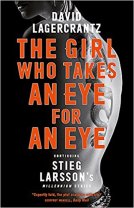 same speaks volumes. Having finished my trilogy I moved on to ‘The Girl Who Takes An Eye For An Eye’ which I have to say was one of the most boring reads I have had for a long long time. Stieg Larsson’s original books were sensational and have been made into excellent films of course, but this…..considering it is supposed to be a thriller there was not one iota of excitement in all of its too many pages. if this is the best that can be done the franchise has certainly had its day. I won’t bore myself any more by talking of the plot….there wasn’t one!
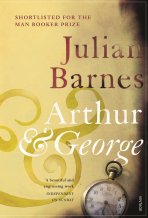 Over Christmas I happened to mention to my son-in-law the novel that Julian Barnes put together based on how Sir Arthur Conan Doyle took up the case of a Birmingham half-caste solicitor George Edalji who was imprisoned as the guilty party in the so-called Great Wyrley Outrages where animals were savaged in the Midlands locality where he lived. A shocking miscarriage of justice about which Conan Doyle created a huge fuss in real life is subsumed in a gripping story which relates the development of the two main characters into the people they were and then their inter-reaction. A literary masterpiece, shortlisted for the Booker, it should surely have won. Anyway I shall be posting it off to Nasar and hope he enjoys it as much as I did for the second time.

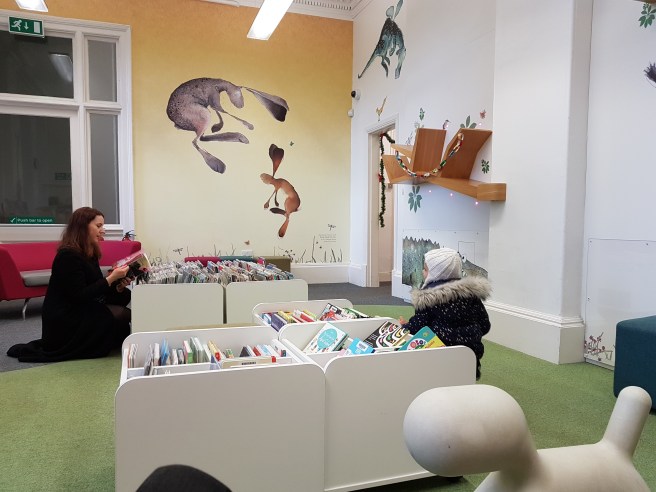 and then on to a special story-telling which was very well done and captivating almost to the end…..the only dodgy bit was that in one of the stories small presents were pulled from a sock for a few children, but at the end of the story they were collected back…mean!
 A bit of shopping in town, and a chance to admire fine buildings…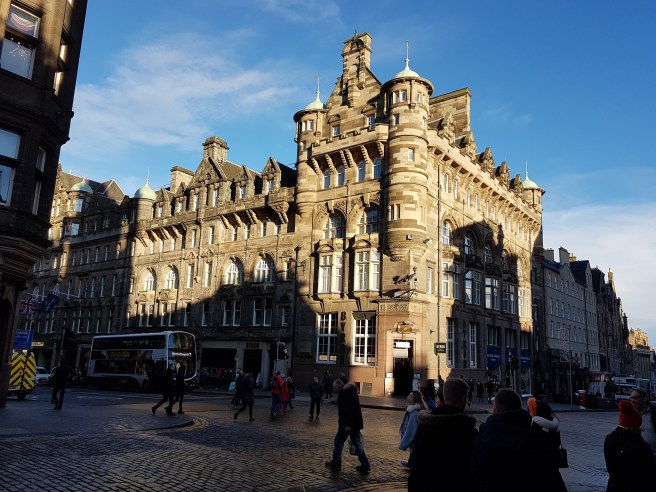
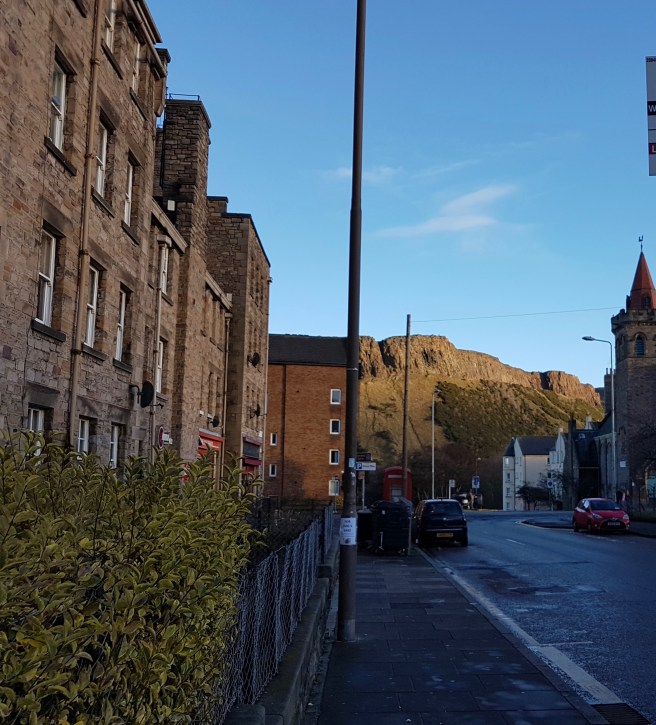 A busy day was completed at the Commonwealth Swimming Pool for a Christmas party and adventures in the soft-play area….
 The next day we had a very nice stroll down through New Town to Stockbridge, an area I like very much for its ‘village’ atmosphere and shops.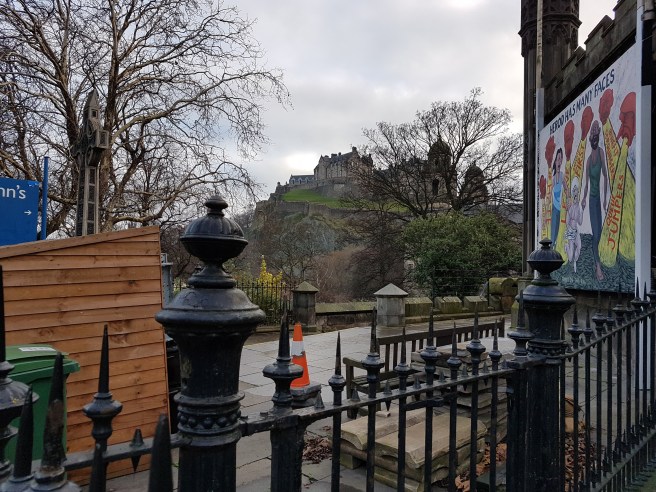
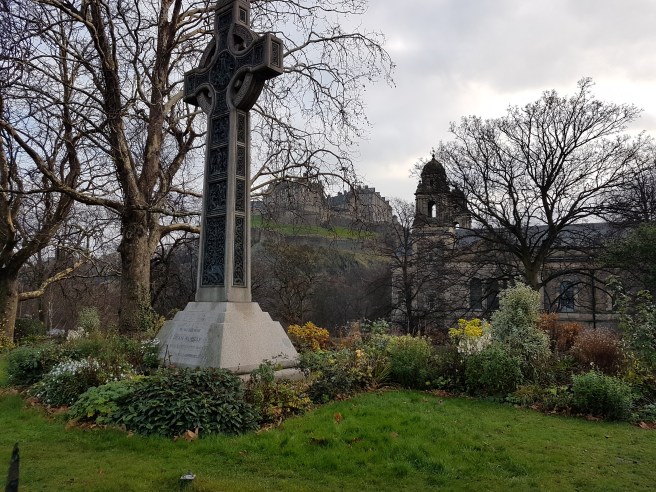
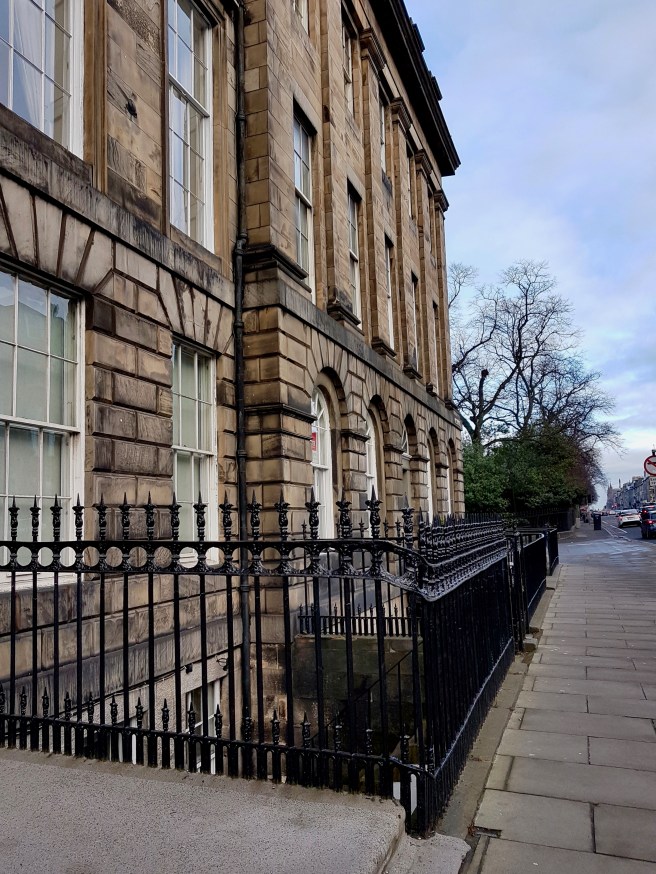
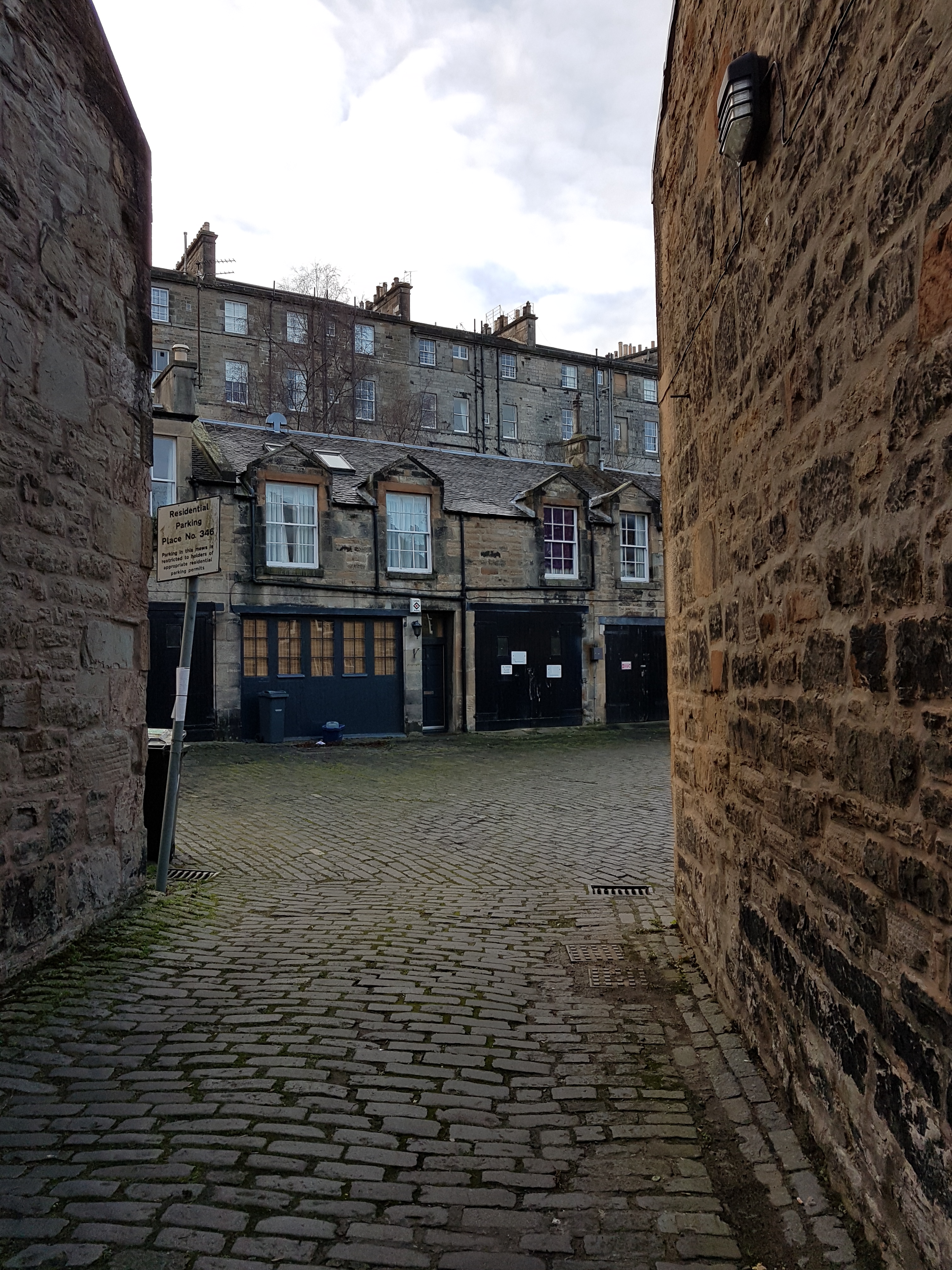
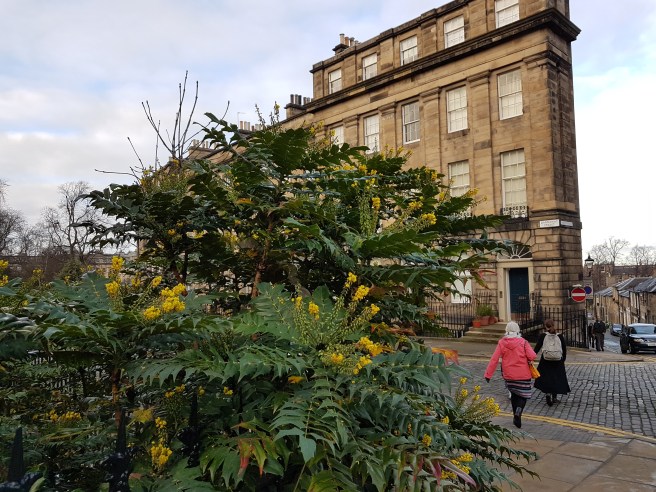 the backs of the big houses are mews converted to rather interesting dwellings…
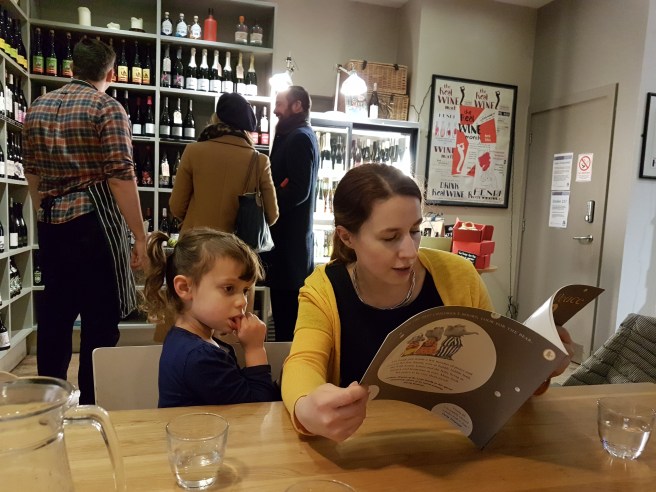
 Our task was to buy some fresh fish from the excellent fishmonger which I was to use for sole with beurre noisette. Lunch in the local Deli was great.
 On Christmas Eve we went to the Princess Gardens fair which always has a nice family atmosphere, unlike some fairs I could mention…
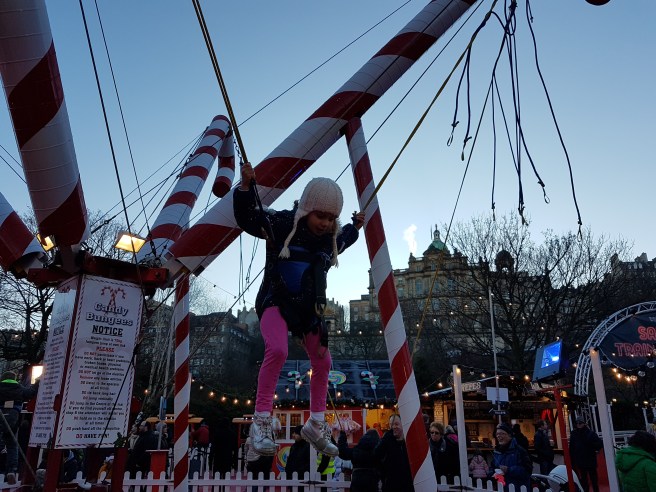
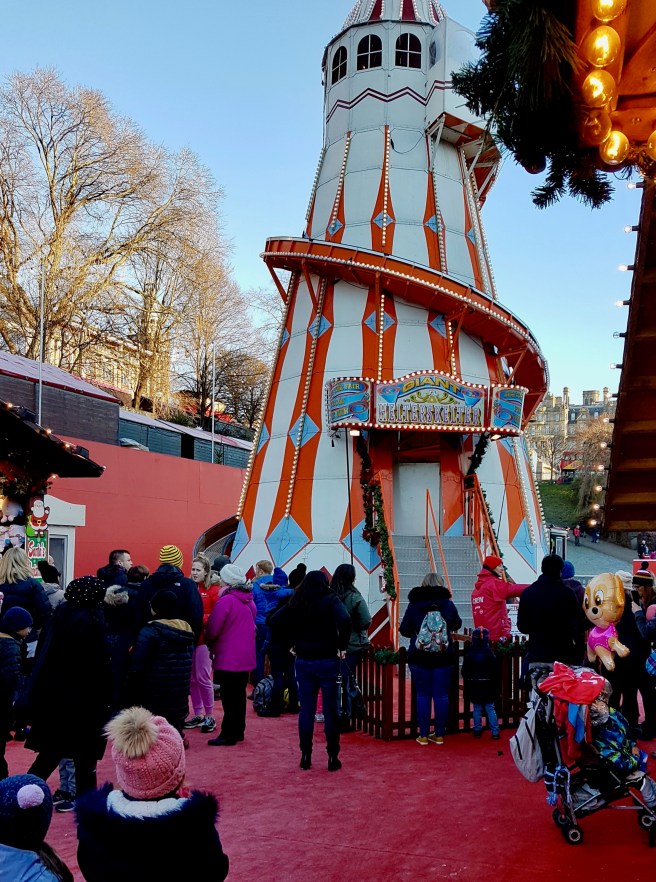
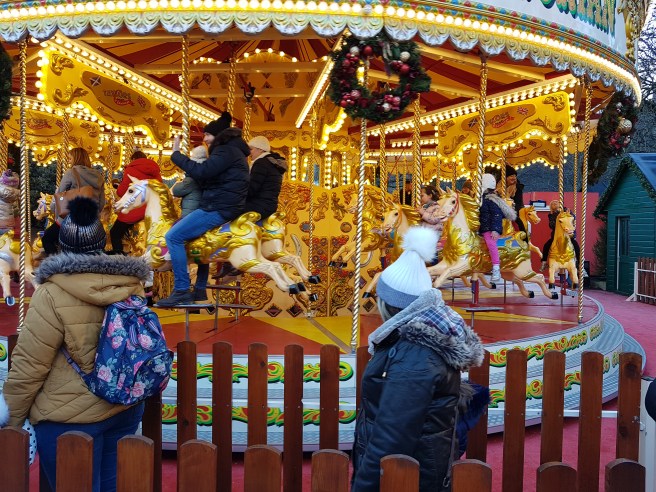
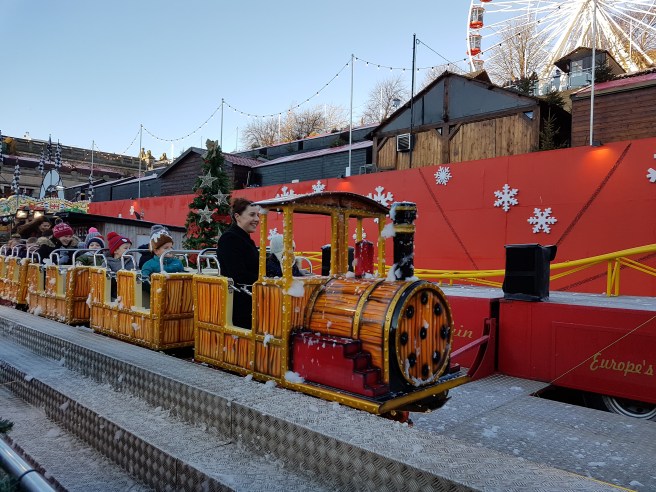 Christmas Day was excellent (and busy). I think it took two of us sometimes three of us about 3 hours to erect the Playmobil hospital…still that’s what parents and grandparents are for…..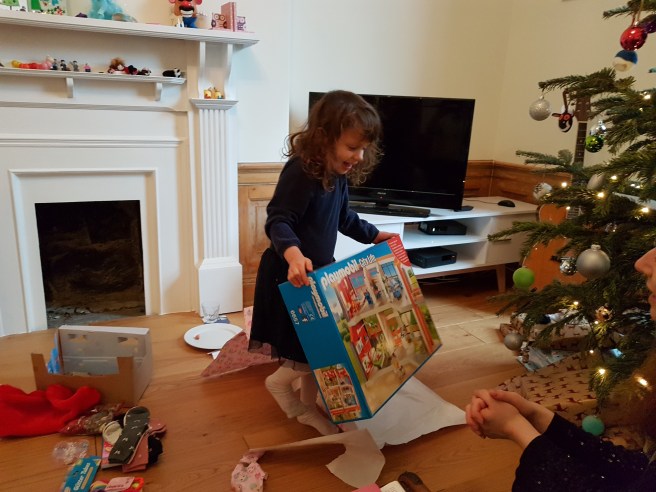

 but there were lots of other presents too, so many that Nasar negotiated an agreement whereby quite a lot of existing toys had to be put on one side for Charity before the new ones could be put away!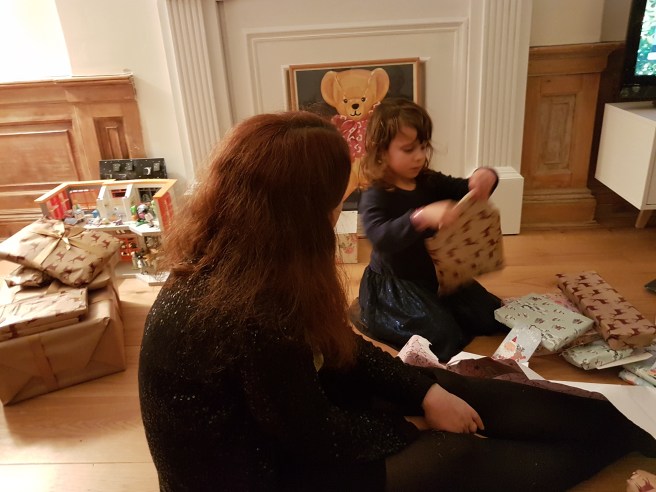

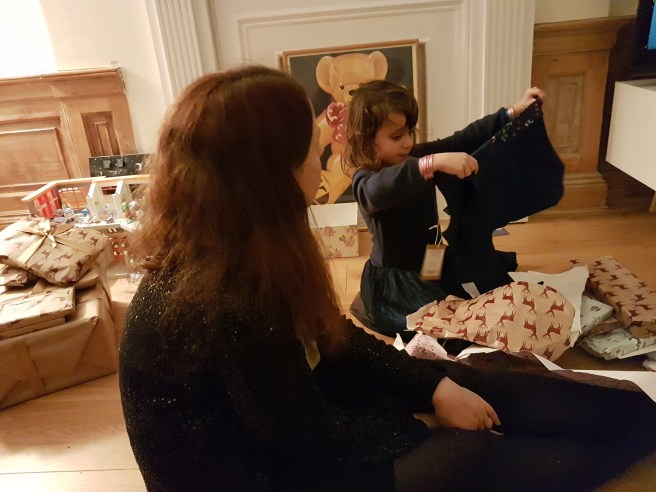
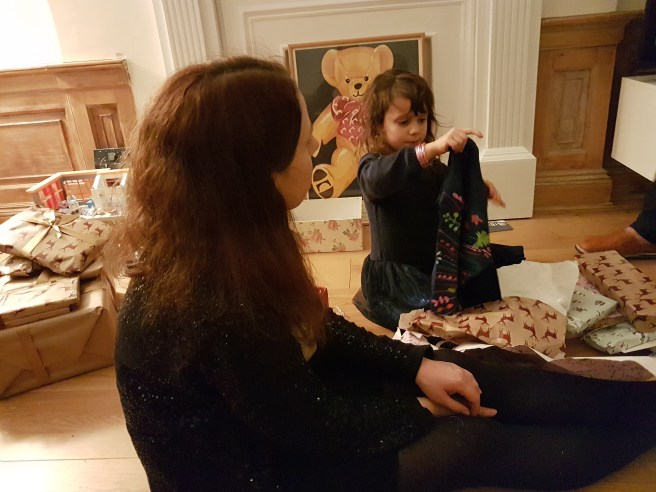
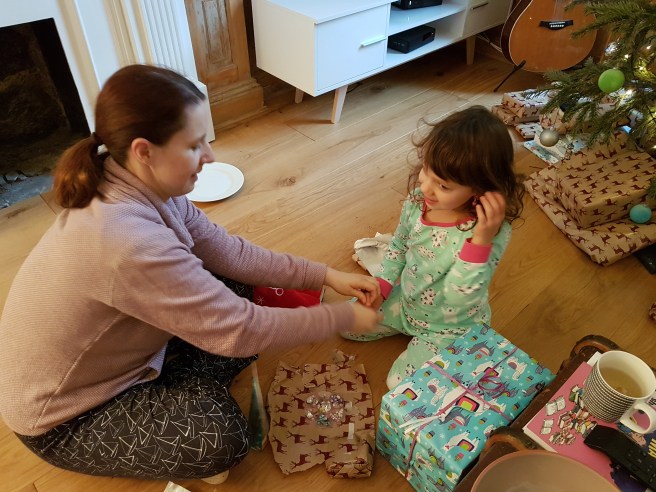
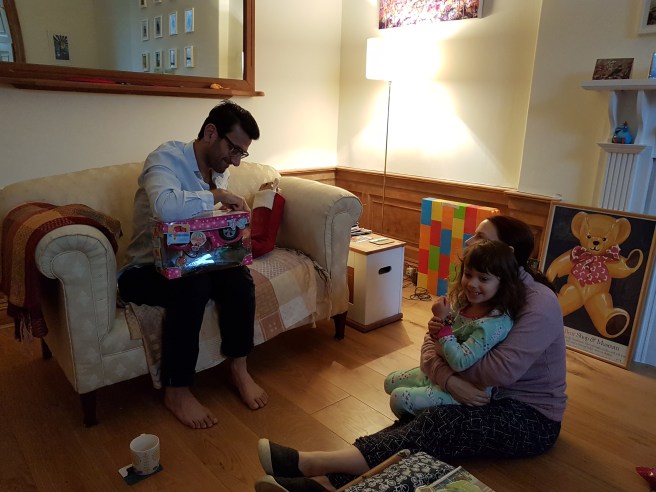
 Nasar’s favourite toy, and mine, was the remote control car which could run on walls and ceilings as well as the floor……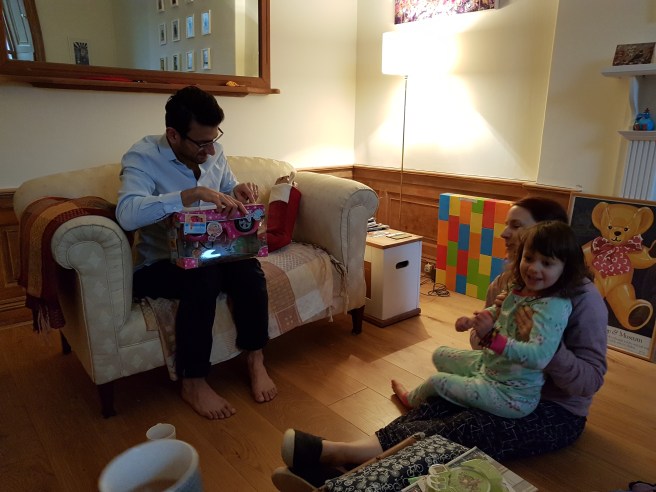
 After Christmas and Boxing Day it is always good to get out and about, here on The Meadows where Aiisha demonstrated how good a cyclist she is now…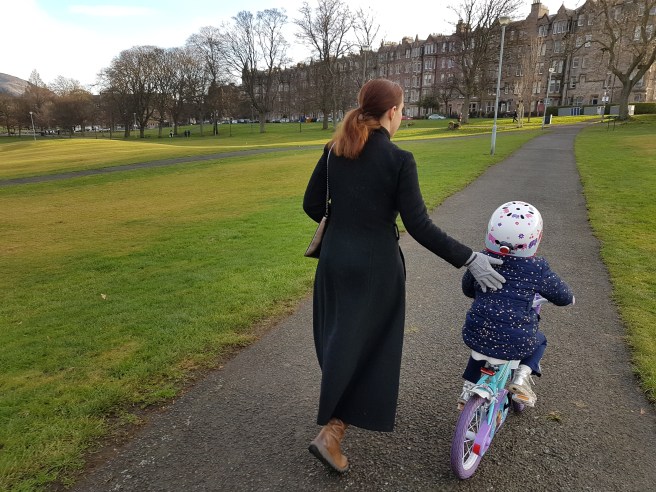
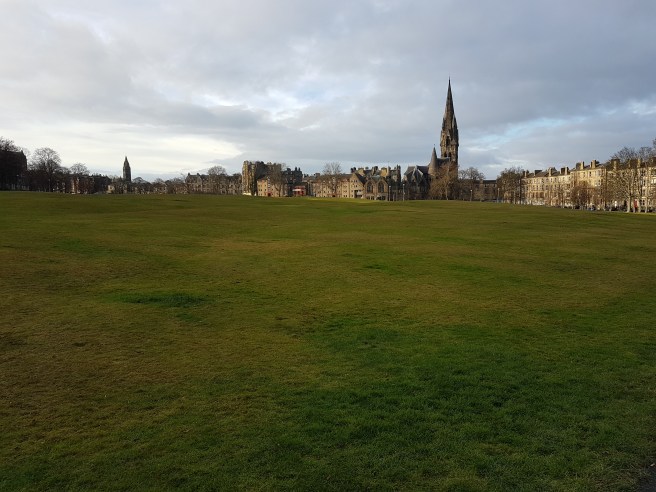
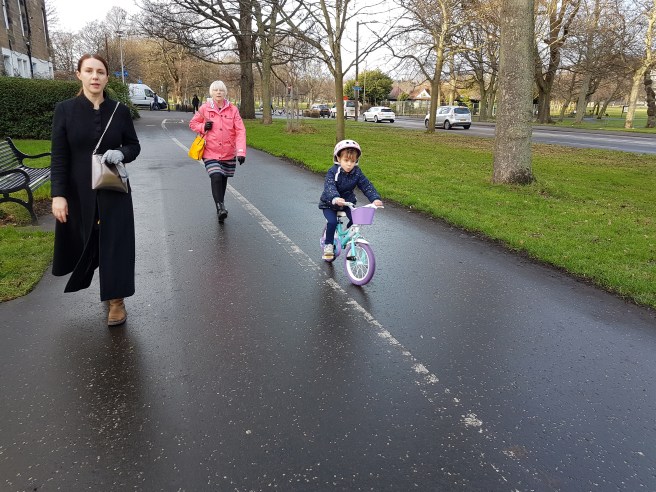
 A little friend from Nursery whom we met by chance made the play area doubly enjoyable. The Meadows is a terrific facility to have on your own doorstep with everything including a golf course and a lovely cafe/deli where we had coffees and, for me, a small Portuguese tart.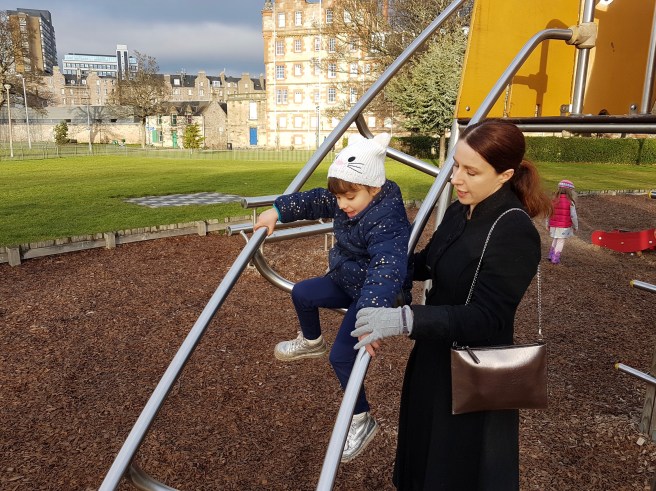
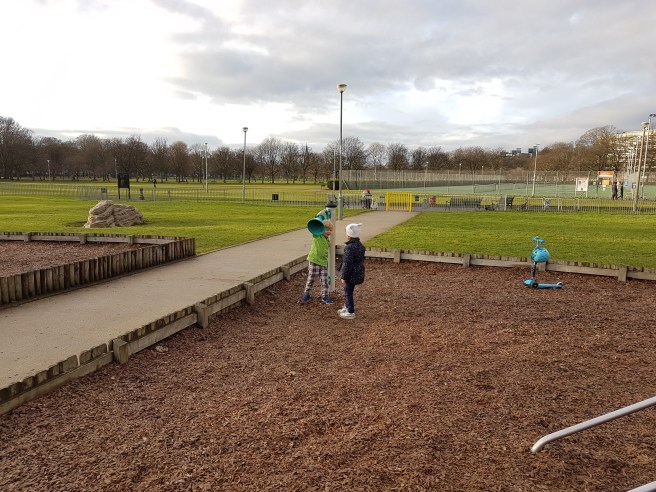
 What a nice Christmas….
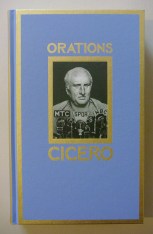 Another Folio read from my collection – this one still in its cellophane wrapper, unopened for, what, 15 years, and what a find. Apart from the moderniste illustrations which I disliked intensely this was an amazing read. Basically it is Cicero’s speeches in court usually for the defence. The florid language and the egotistical approach are to the fore but the content is mind-boggling. Apart from the fact that the extensive notes in this issue take you right through Roman history up to the first Emperors, the speeches themselves take you right into the heart of what it was to be a Roman. I studied Latin to A Level and have always liked reading about Roman history, but this was something else. You really felt you were there in the Senate or court house listening to someone who has always been regarded as one of the greatest orators of all time. And the daily life described, and the political machinations, so like what we know ourselves. These people, apart from obvious differences, were human beings with human foibles who could be living next door to us now. What a privilege it was to read (over a period of several months) these extremely detailed accounts of what was going on in the late Republican era. Unlike modern court cases Cicero’s defences usually rested on the question Crassus apparently alway asked ‘Who stands to benefit?’, and thereafter minute dissection of character. So they were hardly objective, but that all adds to the spice. A book to lose yourself in….
 Wood’ is a wonderful thing to have. I just love the beautiful language of Dylan and his over-fertile imagination. The nearest thing I can think of is Homer with his ‘wine-dark sea’. No-one but no-one else could have written this, and the fact that his life was, in a sense, so tragic and cut short is to be heavily regretted. Peter Blake the famous British artist spent 28 years on a labour of love drawing and painting all of the characters and imaginings from the story/poem and this is now a wonderful accompaniment to the text. It just adds an extra dimension. Having spent some time living and working in South Wales which I always remember fondly, I do find myself reading with a Welsh lilt trying to replicate Richard Burton. As if!
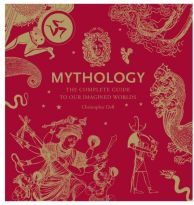 Now here’s an interesting book. I have never really bothered with it, thinking it to dwell in the realms of the astrological, which is not for me. However, having dipped into it I find that, far from that, it takes pains to examine the great stories of Myth in all the main cultures and religions. ‘Here, from every corner of the globe, are tales of the world’s creation, undying love, the Sun and the Moon, gods of the weather, tricksters, terrible monsters, the afterlife and the underworld, and more.’ Christopher Dell shows how many myths share common patterns, and this is the really fascinating thing about it. I found it, to be honest, quite astounding how stories in one religion are very nearly exactly the same in another. So, just as the ancient Greeks, when dead, crossed the river Styx so the Japanese crossed the river Sanzu. Or take honey. The OT is full of references to honey, suggestive of sweetness and leisure, and one of the chapters of the Koran entitled ‘The Bee’ describes it as ‘a cure for men’. In Hinduism honey is used in worship or as a sacrifice. To us the most famous example of flooding comes from the OT where Noah builds his ark to save every species in The Great Flood. In the Mesopotamian Epic of Gilgamesh Utnapishtim is advised by the God Enki to build an ark before his brother sends a great deluge. In Greek mythology, Zeus decides to flood the world too…..Prometheus however forewarns his son who prepares a chest of provisions in which he and his wife float around for 9 days. In Hindu myth the human Manu is warned of the flood by Vishnu and is able to save himself in time. One can only imagine that a lot of the Myths had a common source, and that in turn leads to lots of philosophical questions. I’ll leave those to someone else!
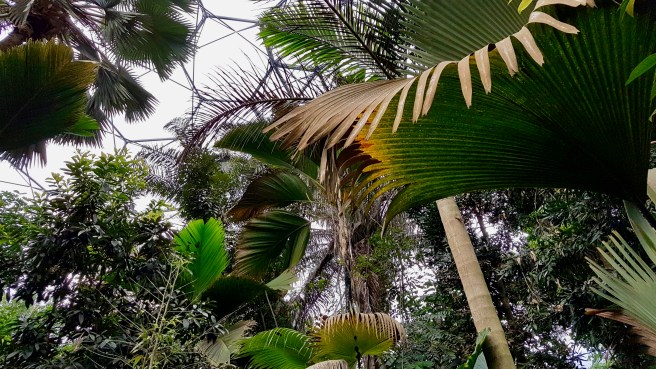
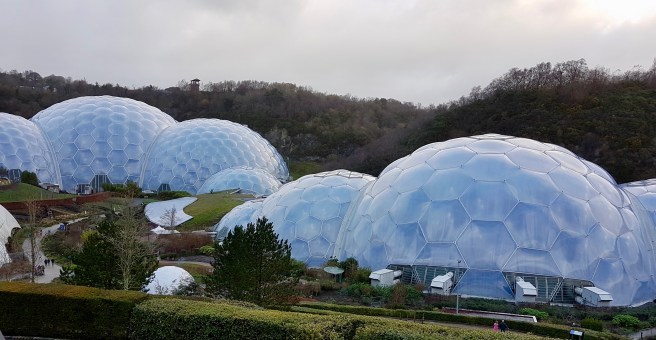 We started out in the rainforest which goes from one type of rainforest to another – Tropical Islands, Southeast Asia, West Africa and Tropical South America in sequence as you ascend the long route through the biome. And this is the world’s largest indoor rainforest so it is quite spectacular.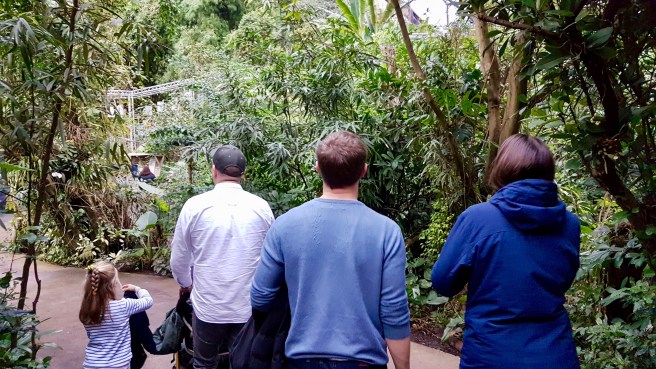
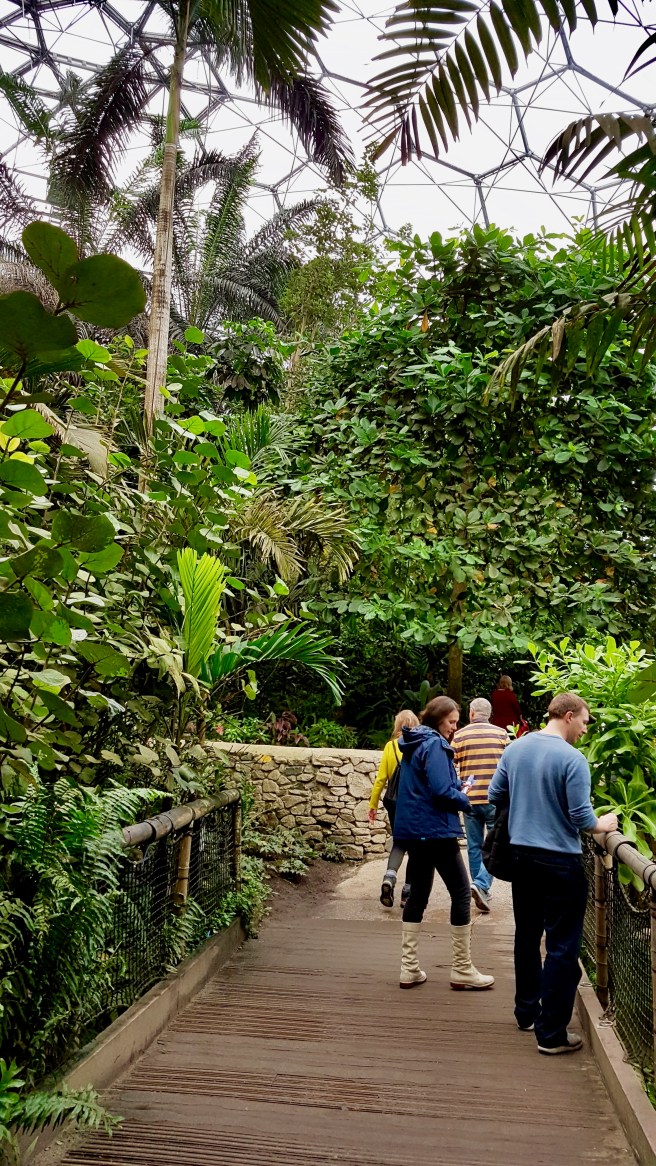
 The Malaysian house I always find interesting as it comes complete with vegetable plots and paddy field……
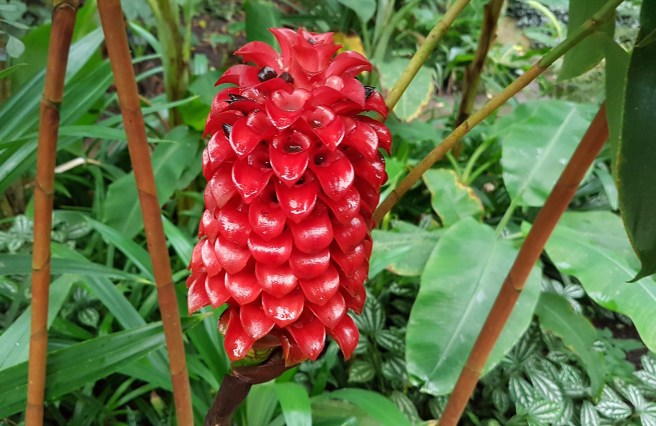
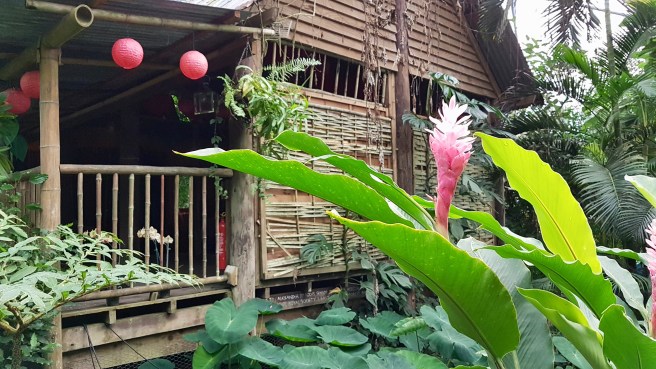 The pineapple ginger’s flower is amazing….
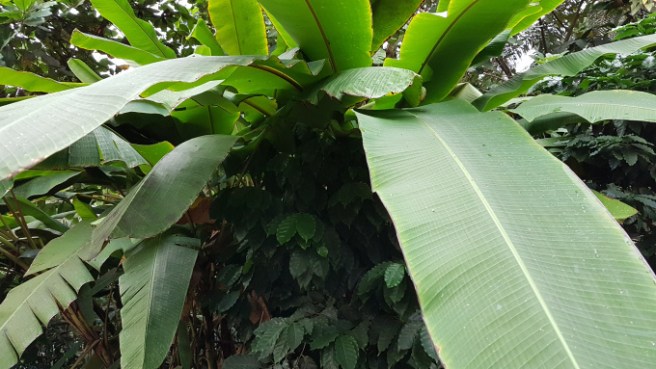
 But then so are lots of things including the stupendous foliage…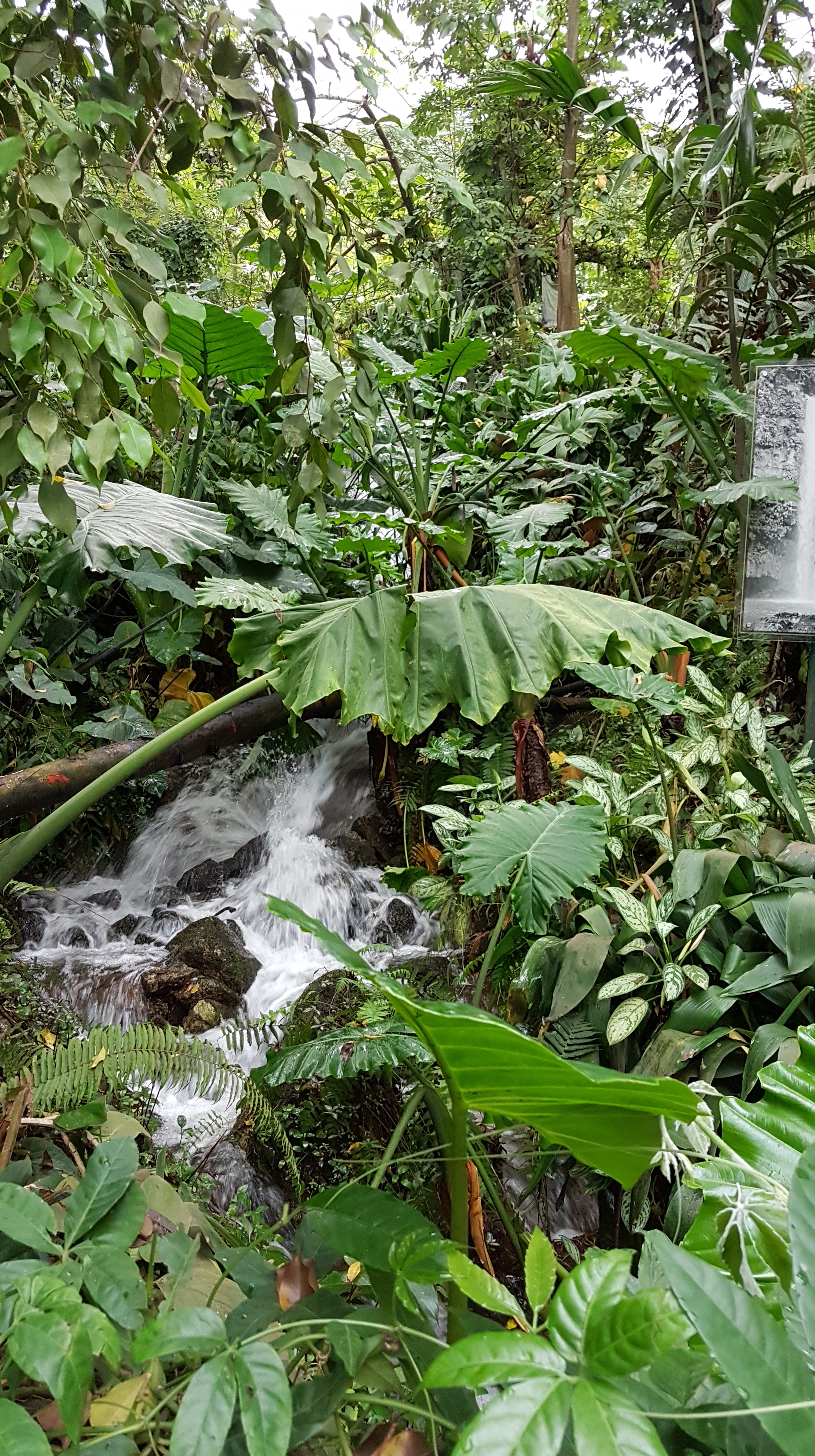
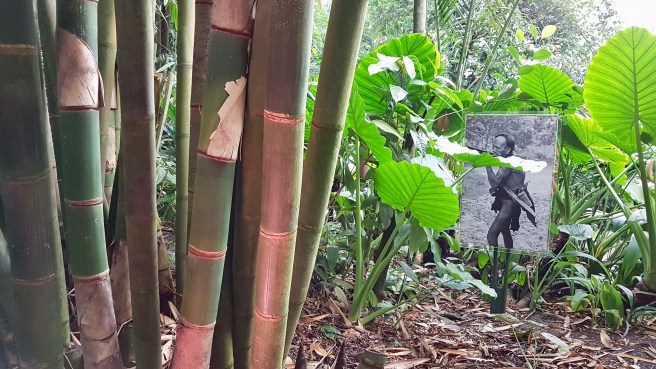 The Miracle fruit below is grown largely in Ghana and produces a protein which acts as a defence against pathogenic organisms. It is 2000 times sweeter than sucrose and has the remarkable effect that, when eaten, it causes sour foods (such as lemons and limes) subsequently consumed to taste sweet…….
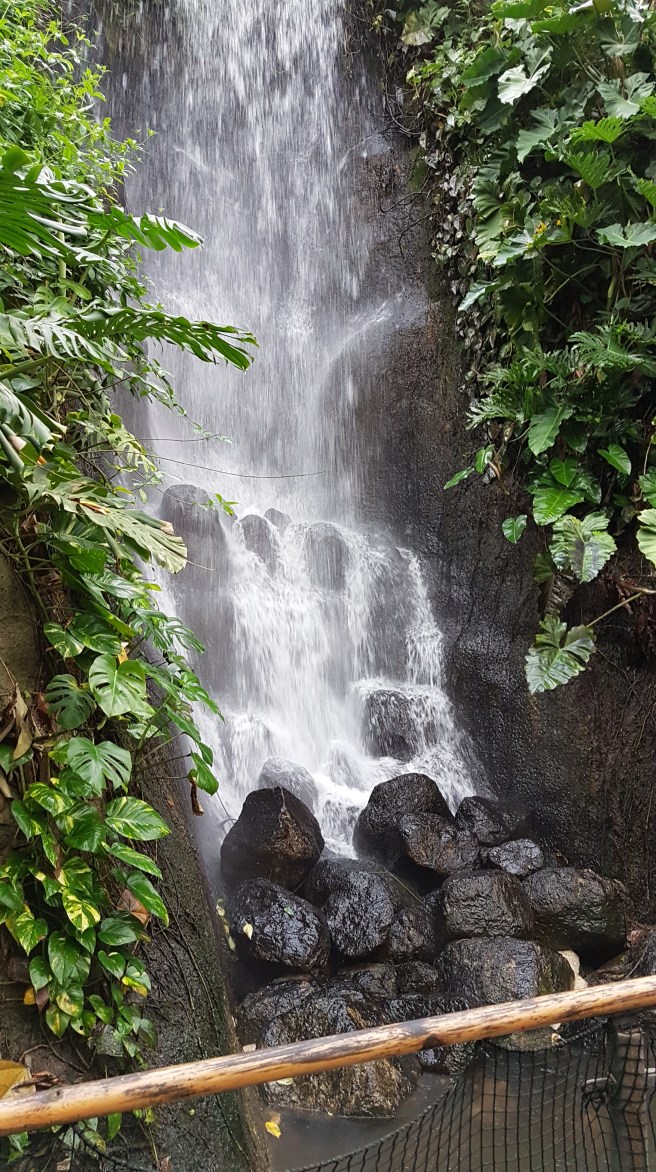
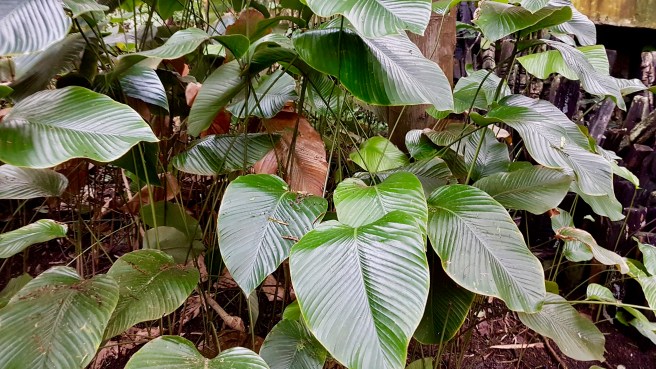 Plenty of special effects such as mist and rain…..
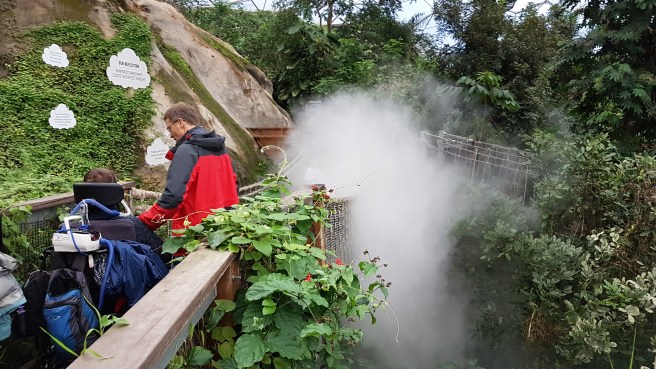 The rope bridge is an interesting experience as, once over to the other side, I felt all the hard surfaces underfoot wobbling for some time afterwards. Like being on a rolling ship and coming ashore I suppose.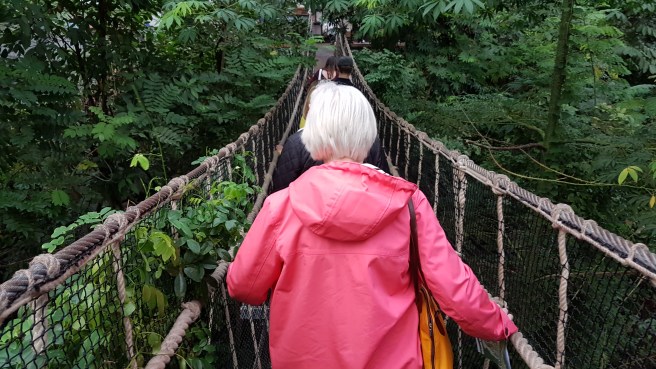
 One fantastic addition since last time is the aerial walkway which leads to a viewing platform. After reading all the warning notices about people with heart conditions (me) and fear of heights (me), I left the queue and am rather glad I did. David confirmed it would not have been for me! D and J enjoyed the views from on high….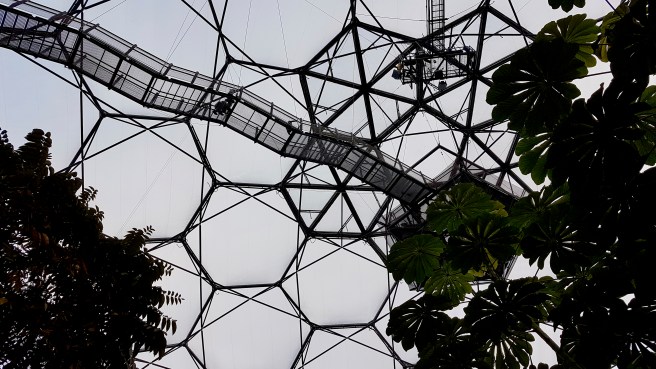
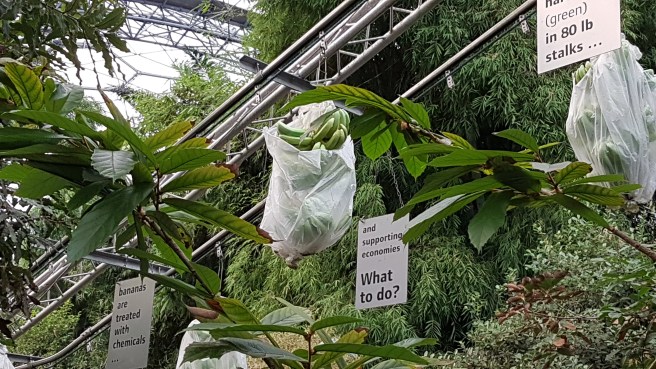
 The banana production unit is great….
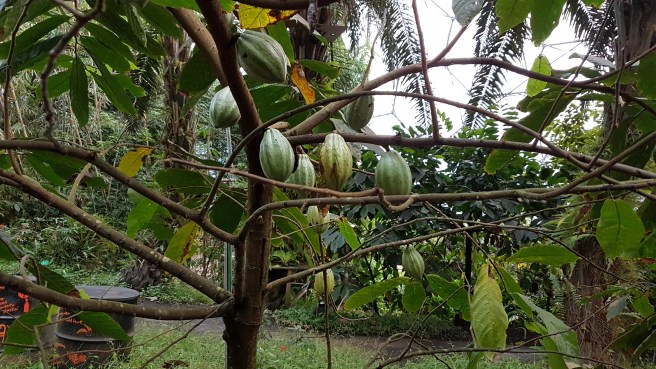
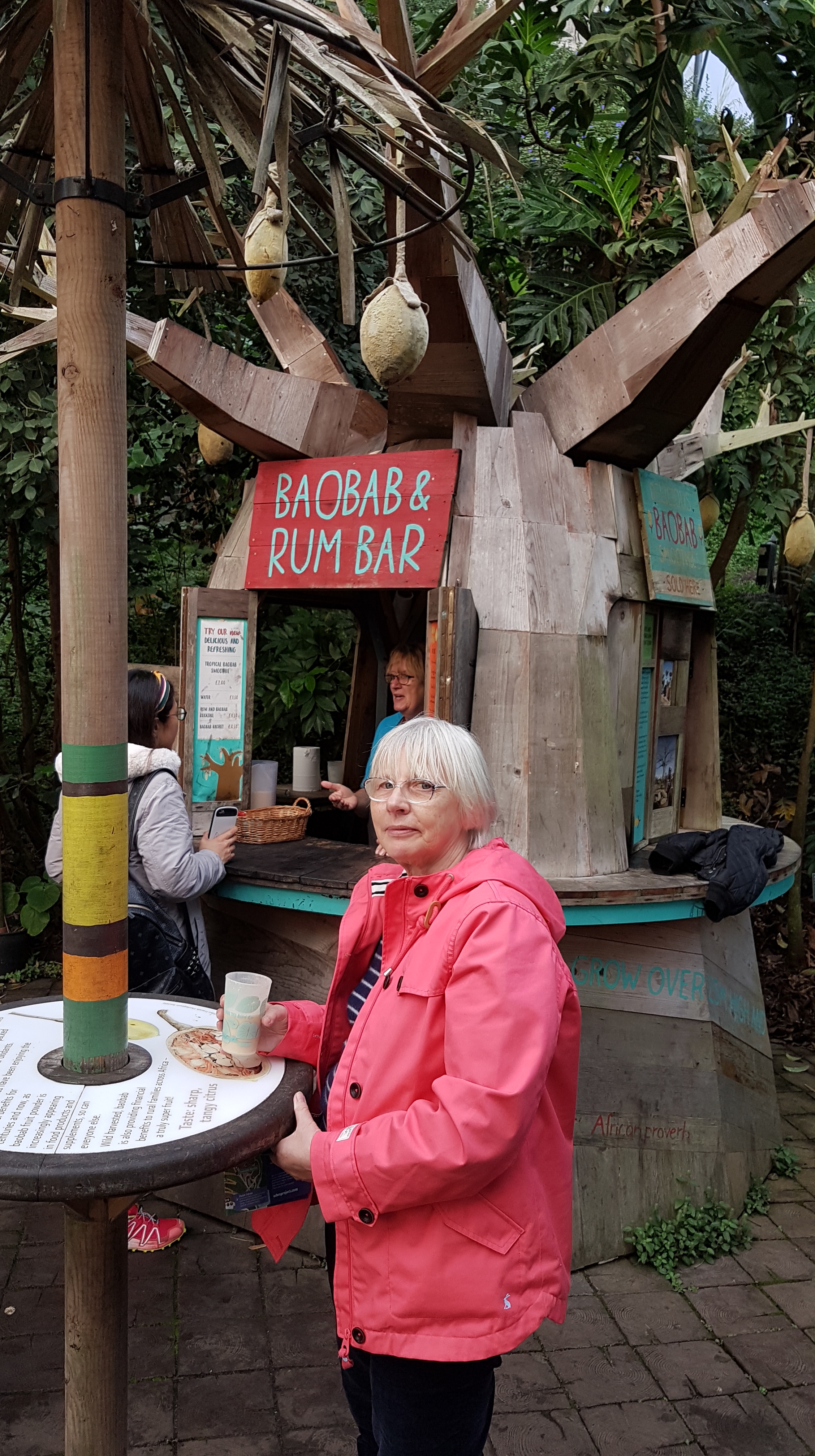
 and good to see the Baobab trees….
 and drink their bounty….
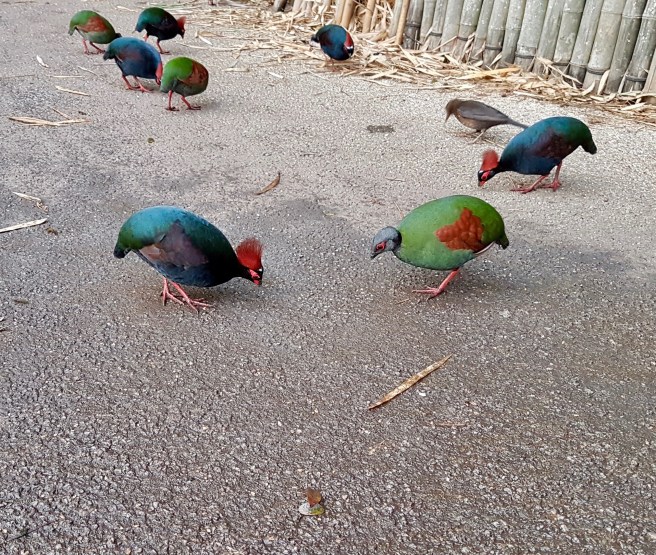
 Near here there were some very friendly and quite lovely roul-roul partridges …..
 and shortly afterwards amazing orchids….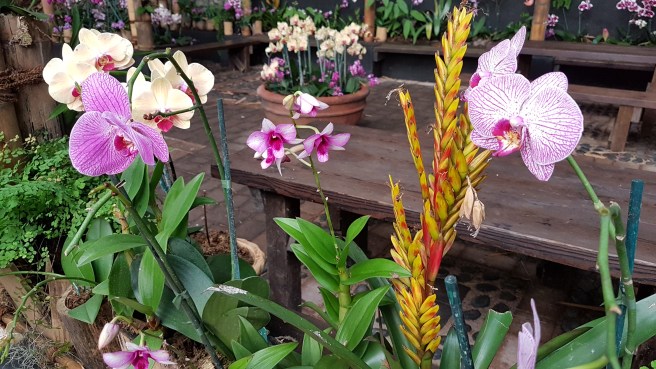
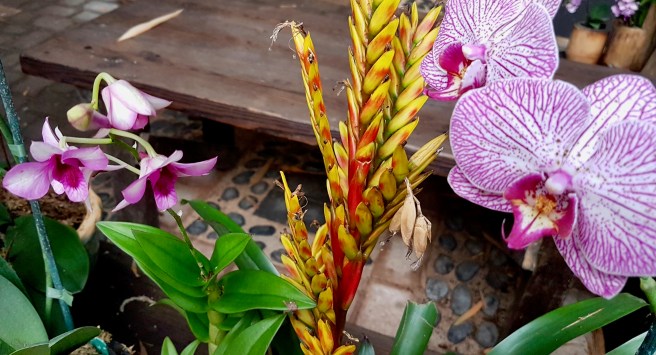
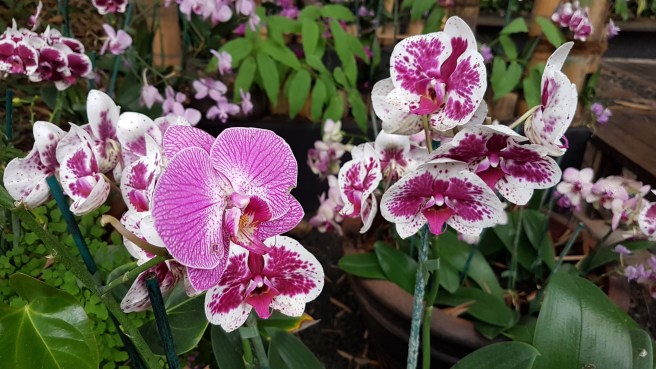 and one very unusual powder-puff bloom as we reached the lower levels again…..
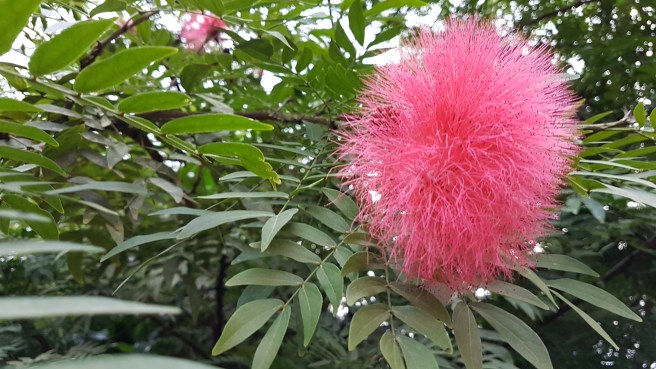 We did visit the Med but probably better in Spring/Summer when we shall return….and talking of returning we did return just 2 days afterwards in the evening for the so-called shadows and light experience (it being Christmas). I do have to say after seeng terrific displays of lights in Edinburgh last Christmas this was surprisingly very disappointing – very low key, and mirrored by the rather amateurish bands….Eden should seek out Edinburgh Botanical gardens for advice on how to do a light show really well.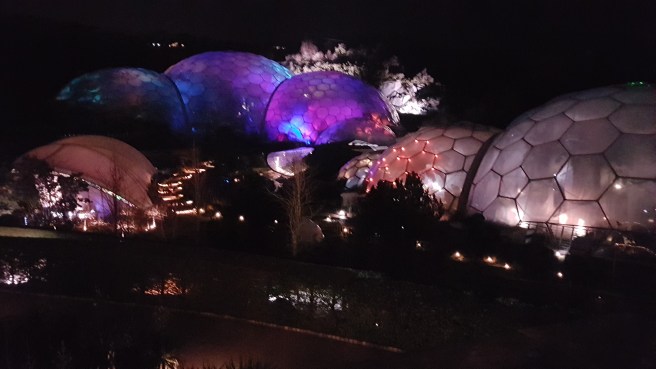
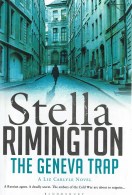 Stella Rimington makes use of all her history and knowledge as Director General of MI5 in her series of novels about her alter ego Liz Carlyle. I hadn’t read one of her novels for some time but having picked up this at a good price it was to be my bedtime reading for some nights. However ‘The Geneva Trap’ was so good that I couldn’t resist delving into it during the daytime too. It was a great read from beginning to end. Basic outline of the plot from Bloomsbury (terrific publisher)….’Geneva, 2012. When a Russian intelligence officer approaches MI5 with vital information about the imminent cyber-sabotage of an Anglo-American Defence programme, he refuses to talk to anyone but Liz Carlyle. But who is he, and what is his connection to the British agent?
 Yesterday we went to Vue Plymouth to see the latest Scandi-Noir film – ‘The Girl In The Spider’s Web’. Now I have read the book (an unfinished script by Stieg Larsson) which I enjoyed, but the reviews of the film were what you call mixed, so I wasn’t anticipating a great afternoon. However I really enjoyed our outing to the cinema (so much more of an experience than sitting at home watching on a small screen, as I have said many a time). And the lead was just great. We had seen both Swedish and American versions of ‘The Girl With The Dragon Tattoo’, both with good lead actresses, but the Swedish version infinitely superior, so I was really apprehensive about seeing Claire Foy (recently, I hear, good as Queen Elizabeth II / Princess Elizabeth) in the demanding role. I regarded her as a somewhat conservative actor. She was absolutely marvellous here. The film itself was a bit James Bond-like with massive action, chases, gadgetry and all the rest, the plot obviously implausible. But that mattered not at all. You sank yourself into the adventure and went along with it. The only annoying thing? Film scheduled for 1.15pm, didn’t actually start until 1.50pm after all the adverts and previews. Far too long.
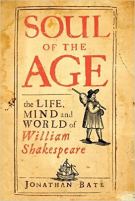 Bate, subtitles ‘the Life, Mind and World of William Shakespeare’. An incredible piece of work, almost a lifetime’s work you would say (except that Jonathan is still young). David Crystal concludes ‘completely fresh and full of surprises…’. It is certainly that. And Simon Russell Beale..’bursting with new idea and crafty analysis…’. I just wonder whether Jonathan is at times, quite often in fact, too clever by half. His knowledge is certainly immense. From the early stages when he talks of Lear’s fantastic garland
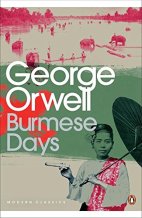 This book has been at the back of my mind for some reason, so I dug it out for a re-read after, what, 40 years or more. It is one of George Orwell’s most powerful and best novels. Let’s get it clear, I am one of those currently politically-incorrect people who believe the British Empire did far more good in the world than critics (who tend to concentrate on single events or themes) would have you believe. And in any case, as a historian, I would argue that it is absolutely impossible to set huge infrastructure improvements, educational and civilising influences, the keeping of the peace world-wide for long periods, etc etc against slavery in the early stages of the Empire, and various unjustifiable (in today’s terms) massacres and ill-treatment of subject nations. The Empire was of its time. It was what it was. However this novel by Orwell is a very, very powerful rebuke to people like me and an antidote to any positive reading of the ‘benefits’ of Empire. I was surprised to find out that this was Orwell’s first novel. It certainly doesn’t read like a first. Basically it tells the tale of a minor English player in Burma in the waning days of the Empire, how he lives and loves, how he reacts unsuccessfully to the embittered views of other members of the Club in the little town in Burma where the story is set. The story doesn’t have a happy ending, and the protagonist’s life and death are perhaps a metaphor for Empire itself. It is based actually on Orwell’s own experiences, he spent five years from 1922 to 1927 as a police officer in the Indian Imperial Police force in Burma. In a letter from 1946, Orwell said “I dare say it’s unfair in some ways and inaccurate in some details, but much of it is simply reporting what I have seen”. It was dynamite in its day and only published in the States at first, and it’s not hard to see why. In my opinion a great read.
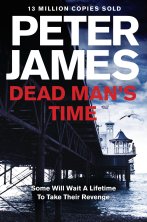 signed hardback ‘Dead Man’s Time’ for £6, not bad. It has been my bedtime reading. As always Peter has interesting characters including his protagonist DS Grace. But all the major and minor actors are well-drawn. And as always there is a slightly unusual story line. In this case a 95 year old wanting revenge for something that happened in his childhood, and revenge for the recent torture and murder of his elder sister. The plot is interesting and takes lots of turns. Brighton doesn’t feature quite as much as in some of his novels…a shame as I like a strong ‘Place’ element. But with the plot capturing you and lots of small chapters (ideal for bedtime reading) what’s not to like. Procedure, one assumes, is exemplary as Peter has intimate access to lots and lots of Police folk in Brighton and he makes full use of his detailed knowledge of how the Police work. All in all another thoroughly enjoyable novel by one of the creme de la creme in Crime writers.
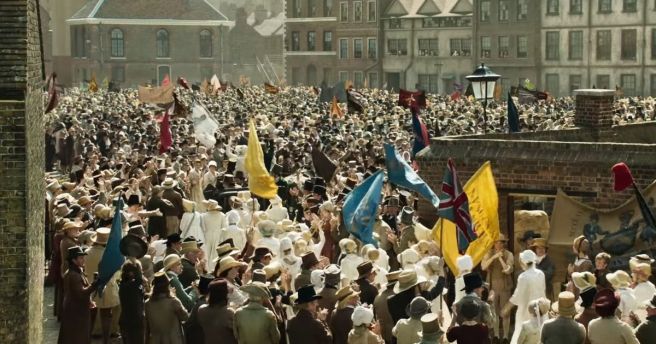 We saw recently the Mike Leigh film ‘Peterloo’. Maxine Peak, one of my favourite actresses, is one of the main characters. A review I had read in The Times had slated it, mainly it seems on the grounds that there was too much dialogue in meetings etc and not enough action. How feeble critics are. What a world we live in where there has to be movement and action all the time! It was quite long at two and a half hours but I didn’t notice this ……unlike The Times critic I was absorbed. What it is about is the background to, and the events of, the Peterloo ‘massacre’ in 1819. The Guardian precises it nicely…’ On 16 August 1819, at what we would now call a pro-democracy demonstration in St Peter’s Field, Manchester, an excitable band of cavalry and yeomanry – whose commander had airily absented himself for a day at the races – charged with sabres drawn into a crowd of 60,000 unarmed people, many of whom were unable to escape the enclosed space. The troops killed 18 and injured hundreds more……It was Britain’s 19th-century mix of Sharpeville and Hillsborough. The government was entirely delighted with the result, and not displeased with the nickname “Peterloo”, as it felt like a rerun of its victory over Napoleon, the creature of something it continued to fear intensely: the French Revolution.’ But the thing is, it was in many ways a victory for democracy – for never again would any Government allow such dramatic military actions to be taken against people expressing their free will in a public meeting. And eventually the Great Reform Act and Anti-Corn Laws legislation would be passed. It also led The Times to take up, to some degree, the whole issue of Reform, and almost directly led to the founding of The Manchester Guardian ( a great newspaper, sadly since its move to London a shadow of its former self). So a film on very important issues with some relevance to today and a topic ‘Peterloo’ which is hardly on the syllabus in schools. Mike Leigh himself has said children should be taught about Peterloo. “They will know about 1066 and Magna Carta and Henry VIII and his six wives and they may be told about the French revolution and the battle of Waterloo … [The massacre] was a major, major event which resonated down the 19th century into the 20th century in the context of democracy and suffrage.” Manchester Histories, a charity, is leading the campaign for Peterloo to be taught in all schools. What I didn’t like about the film (this and many others!) was how unrealistic the settings and stages were. It’s all very well finding a great location but covering the streets with sand of all things in order to hide yellow parking lines just doesn’t cut the mustard. The same with the characters. The poor of Manchester were atrociously dirty and smelly. It’s no use just dressing them up in costumes Hollywood-style. And everywhere was so clean. In reality you couldn’t see a hand in front of you because of the smoke and the smog. All wrong, wrong wrong……..
 Another slow-burn Brunetti novel whose main elements are the setting – Venice, and Brunetti himself and his relationships with colleagues and family. The plot or plots take second place. A corrupt pharmacist, an entangled female doctor, and possible murder – all a bit humdrum. But how I like following Brunetti around Venice and seeing how his personal ups and downs work out. Quite a lot of philosophy in this one too, and moral dilemmas to make us think. And at the end of it all not a happy ending. I just love it…..Donna Leon is an excellent writer and certainly gets right beneath the skin of Italy and Italians, allowing us to understand things like the North-South divide, the irritation at tourists, and much else.
 Now, we are off to Manchester for 5 days (it’s where I come from), to see whether this might be a place for our next house. Cornwall v Manchester – sounds like there is only one winner, but I’m not so sure. What Manchester has got (apart from some rain…..actually less rain than Plymouth over the year), is culture….restaurants, bars, cinemas, theatre, music, museums, football (ManCity my team is the best in the world right now according to some authorities, and probably the best that there has been in the Premier League era), and loads of visible and easily accessible History. We were last up there for the Commonwealth Games and it had much improved from my youth. My thinking is that it will have improved another several notches, from what I read. Anyhow, as always, before going anywhere I have done lots of research and dug out three or four books in particular. Charles Nevin’s ‘Lancashire’ is the pick of the bunch, a book that I simply couldn’t put down despite having read it at least twice before. It is so so funny, so enlightening, so full of mischief, and gets right to the heart of what it means to be a Lancastrian. And, for me, it is so nostalgic. Nevin talks of places I know, football line-ups which take me back 50 years, and big names of Rugby League I had forgotten all about but which I can picture in full 3D colour or should that be Black and White. But don’t let that put you off. Nevin is everywhere – from listening in to old ladies on the bus, to discussing Shakespeare’s Lancashire period with eminent historians, to some of the higher reaches of philosophy, taking us on a journey at break-neck speed through everything Lancashire. Have you heard of Donizetti’s opera ‘Emilia Di Liverpool’? No neither had I! Think Southport has a touch of Paris about it – particularly in the tree-lined Lord Street? Think again. Haussmann modelled his new Paris on Southport (probably). Why, Balzac of all people has a character in his ‘Le Lys Dans La Valle’ tell her seducer that Lancashire is ‘the county where women die of love’!! Thus the subtitle of this splendid book. I could go on, almost indefinitely, about why Lancashire is the best place to live, and Nevin certainly does go on, but let me leave you with this quote from Abraham Lincoln – talking of the Lancashire cotton workers’ solidarity with his North in the Civil War, and support for the abolition of slavery, whilst most of them were absolutely destitute – because of this support (cotton could no longer be got from the South to keep the mills running)….Lincoln called this ‘an instance of sublime Christian heroism which has not been surpassed in any age or in any country’. Well!! I am proud.
 On now to my factual books each telling me about Manchester in very different ways. The modern Pevsner’s architectural guides are usually rather good, and in fact in my opinion a lot better than the originals which, although a massive and unparalleled achievement, are dry as dust. ‘Manchester’ by Clare Hartwell is much more contemporary. It discusses all the major buildings in Manchester at the date of publication. As this was 2002 it shows the real drawback of this type of book…..so much has happened since which isn’t covered. Still, an excellent introduction.
 the city. So we are taken on walks through the centre and its most important suburbs. And interesting walks they are too. Glinert is a great guide. All human life is here, as the old News of the World used to say. Everything from the history of the buildings themselves, the people, their culture, it is a real mish-mash of often quirky stuff which is very engaging indeed. I learned a lot about my city that I didn’t know.
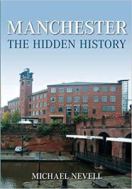 ‘Manchester The Hidden History’ is a more conventional history but based mainly on the more recent archaeological surveys. and with all the new building that has been going on in the last 30 or so years there have been more than a few of those. More for the serious historian (as I sometimes imagine myself!). Can’t wait to get there.
 F. and I do have bus passes which enable us to travel free on all local buses – well except in Wales and Scotland, which is a pity. Still, what a privilege and how we make use of them. There are arguments currently going the rounds that the elderly are well-off and that the young should be given free bus passes in their place. However, how else would half the country spend their time, and what mischief would they get up to? Perhaps more to the point, if a pensioner takes a bus journey to somewhere he or she wouldn’t otherwise be going and spends money in that place, even if only a cup of tea and a biscuit then economic benefit has been gained. And before any political party is brave enough to abolish bus passes for the elders (and betters), they should first do the economic sums. All this a result of me picking up my copy of ‘Bus-pass Britain Rides Again’. A terrific book with individual contributors talking in some
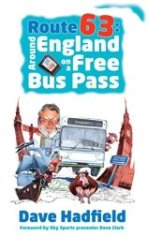 detail about their favourite (free) journeys. So many places to see, so little time! Having thoroughly enjoyed my re-read I sent away for ‘Route 63’ where Dave Hadfield travels the length and breadth of England on his bus-pass. A book of mild enjoyment. It is more stream of consciousness pub humour than anything else. You have to admire Dave. His free bus pass is because he has Parkinson’s. He is obviously someone you would really like to have a few pints with, but I could have done with just a bit less humour and witty asides and very subjective assessment and more nitty gritty.
 really felt he had got to grips with what it was like to live in Ancient Rome. In ‘Munich’ he turns his attention to what went on in the two Governments – Germany and Britain – as events took their turn for the worse. He builds up a very believable main character in Hugh Legat a member of the Diplomatic Service who becomes intimately involved in key events as he does more and more work for Chamberlain. But I was particularly impressed with how we get a very rounded impression indeed of what Chamberlain was like and what he stood for. Much maligned by many historians this novel gives an alternative view and is all the better for that. And who is to say it is not correct? The Victorian historian Maitland cautioned ‘We should always be aware that what now lies in the past once lay in the future’ (something many historians do not understand), and it is from this exact premise that Robert Harris constructs his novel. Very enjoyable indeed. there was program on TV recently about the Booker Prize where one commentator bemoaned the fact that someone such as Robert Harris would never win the Booker. How right he was. Better Robert Harris than a lot of the pretentious crap (excuse me) that does actually win.
 Enjoying Cornwall...