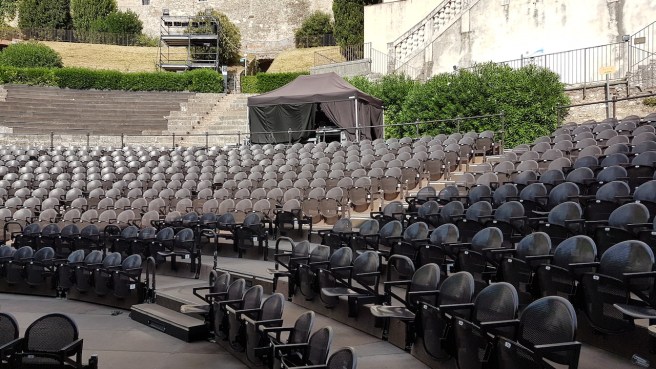
 Next stop was the Roman amphitheatre, not to be confused with the Arena where we would be seeing the opera..built around the end of the first century B.C. its visible remains today include the stage, the orchestra, the auditorium and some galleries on two subsequent levels together with a top corridor.It was being set up for a pop concert on our visit….
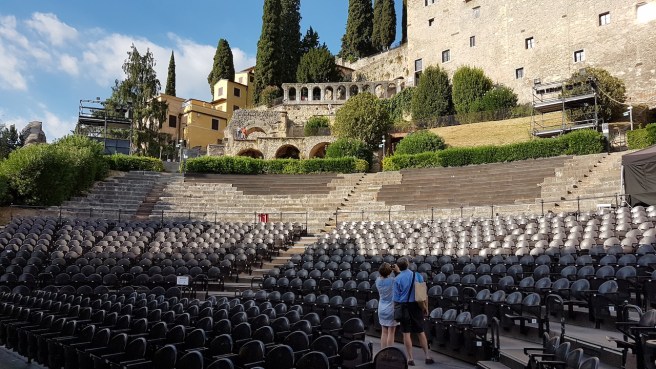 but the Roman seating was still clearly visible,
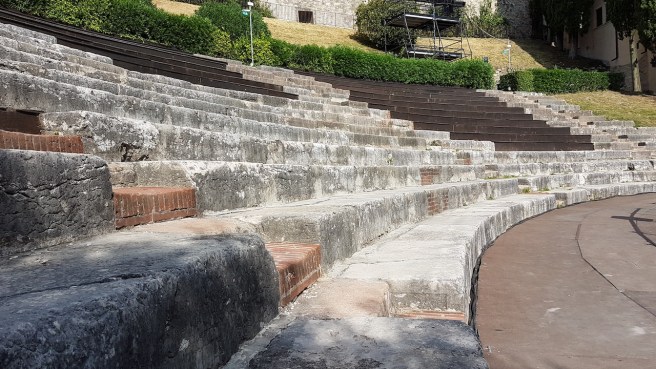 and the setting marvellous….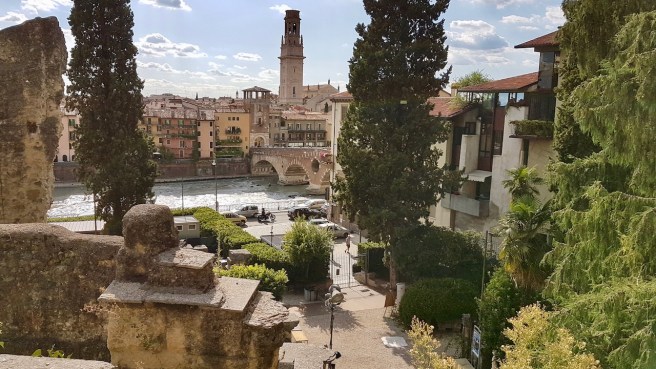
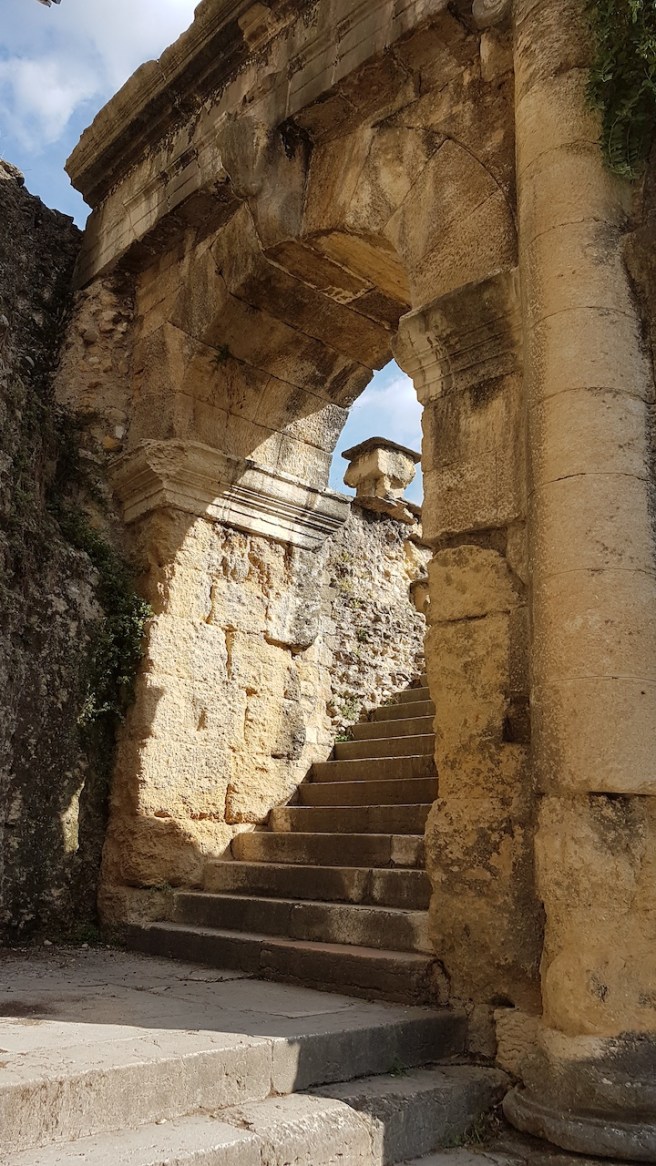

 Also on site there is a fascinating museum with Roman finds from Verona in an old fourteenth century monastery behind the theatre………….here a floor…
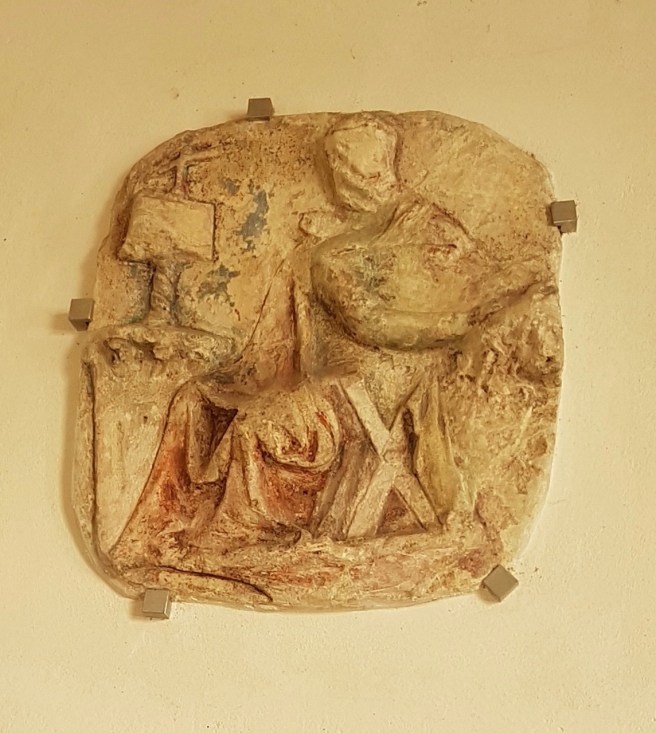
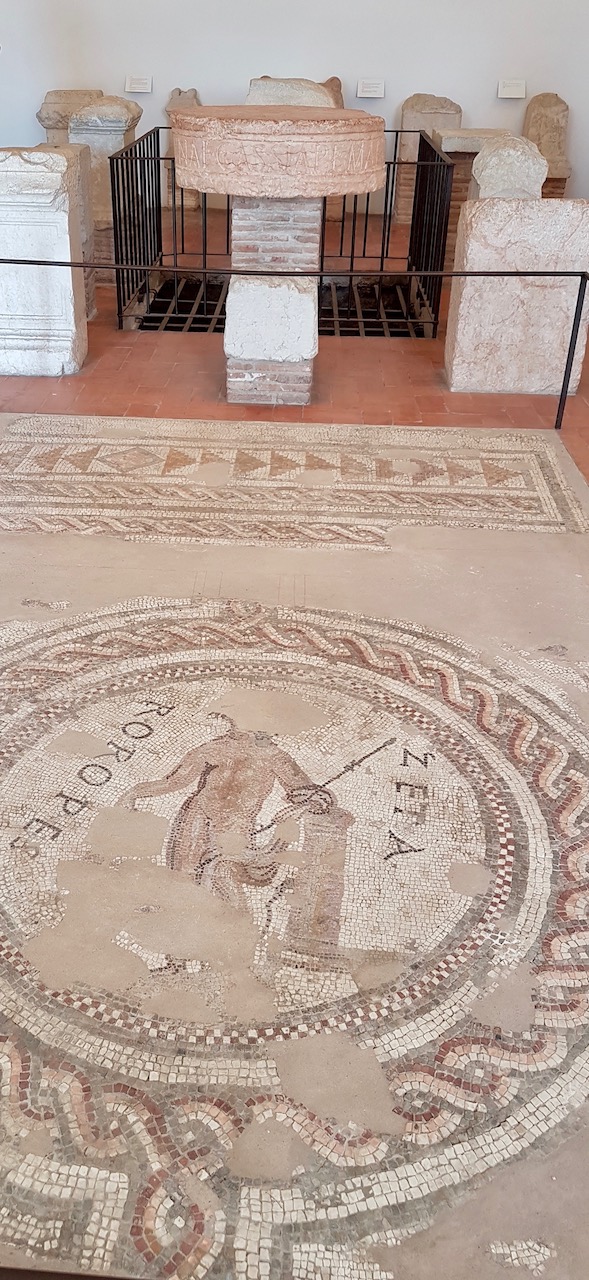 a wall decoration….
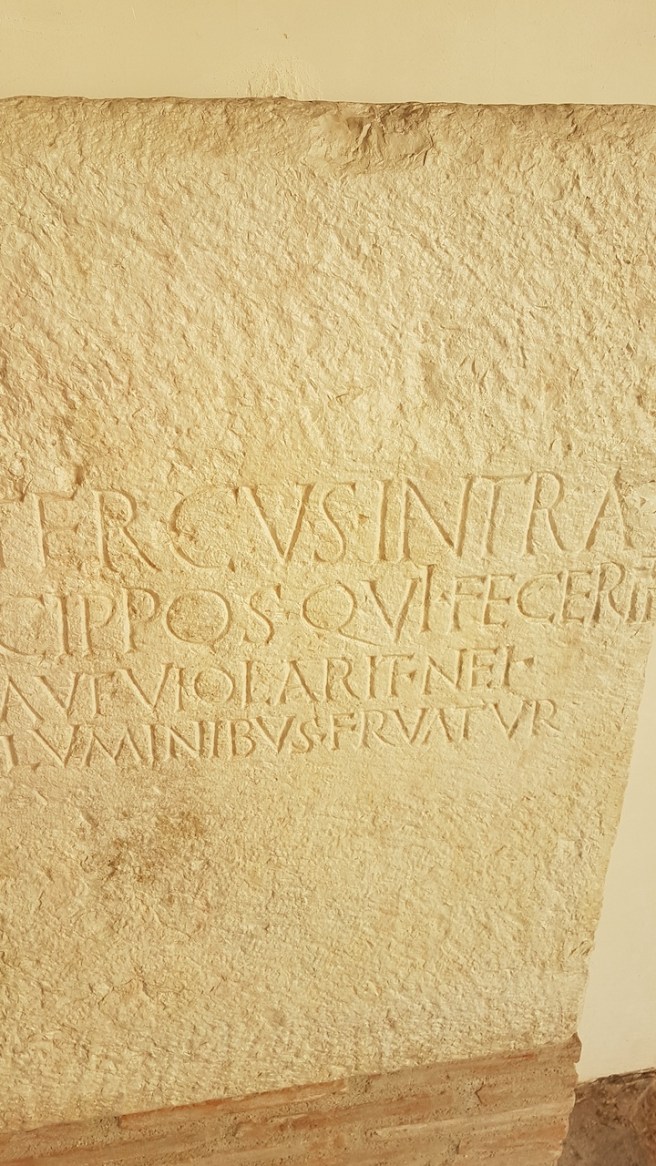
 ……a funerary Stella which translates “Cippus lays a curse on anyone who dares to dirty or violate the sepulchre”. Obviously this must have been an issue in Verona!
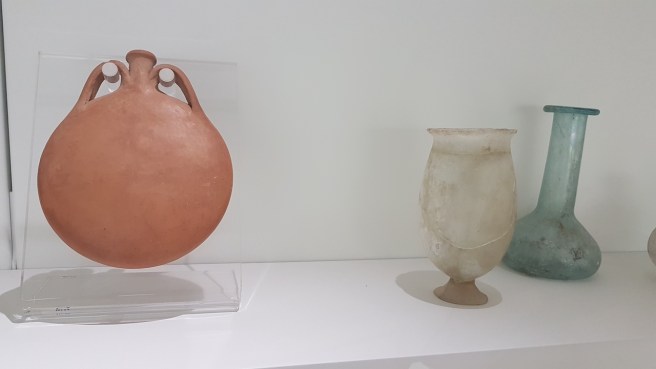
 …..lots of pottery and glassware….absolutely incredible it survives….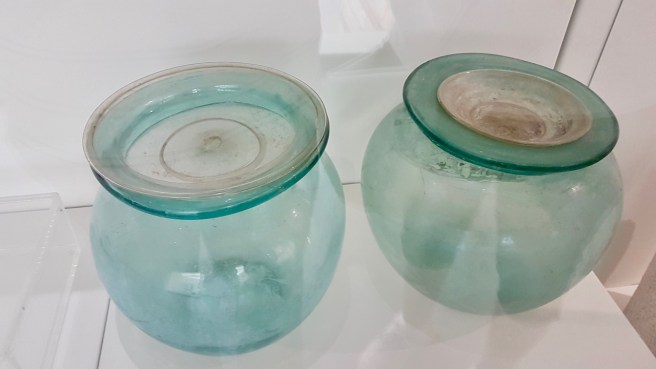
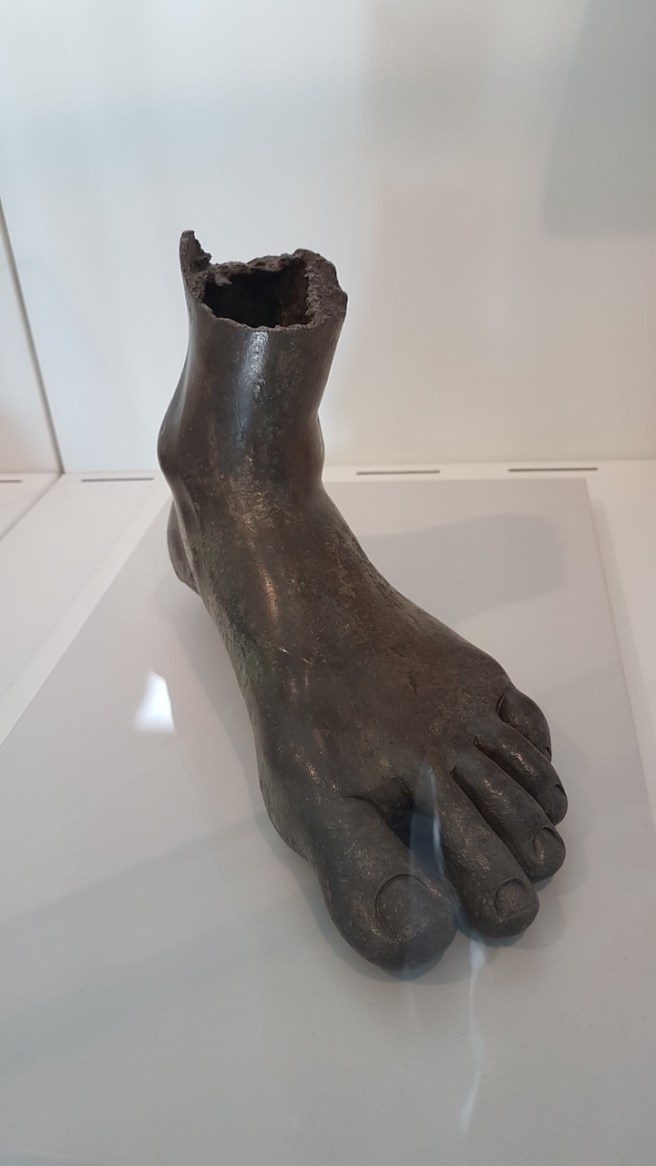
 …..a larger than life-size bronze foot from a statue….
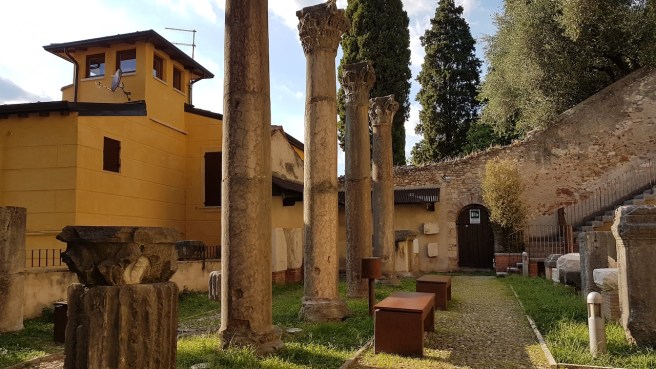
 and an upper walk…….Verona full then of layers of History which is all wonderful to see……..
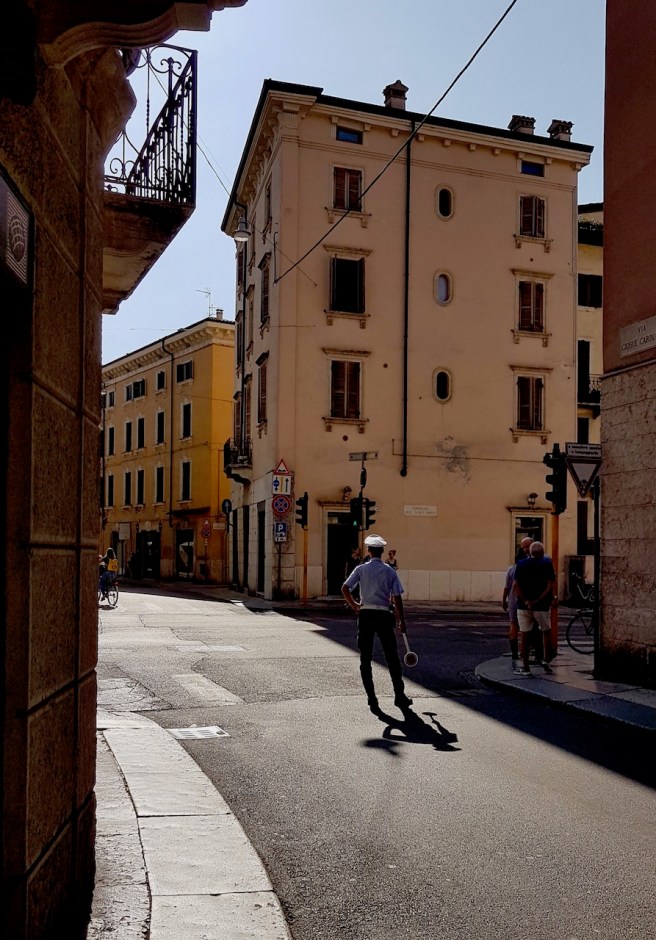
 Next day we again walked into town passing one of the ubiquitous policemen. wherever we went there were police of varying sorts some with sub machine-guns , all with holstered pistols……..all very different from England.
 Our first destination was the Arena itself…of the outside only the Ala, a short section of the outer ring that was the façade of the Arena, has been preserved, shown here in my photo. Under the reign of Theodoric (493-526 AD), the outer ring was partially demolished for the construction of a second set of defensive walls, and until the Renaissance the Arena was used as a stone quarry. The façade features just one architectural style, the Tuscan order, with bossages and limestone blocks from Valpolicella.
 Once inside the scale of the building became clear…..this was after all the third largest arena in Italy…..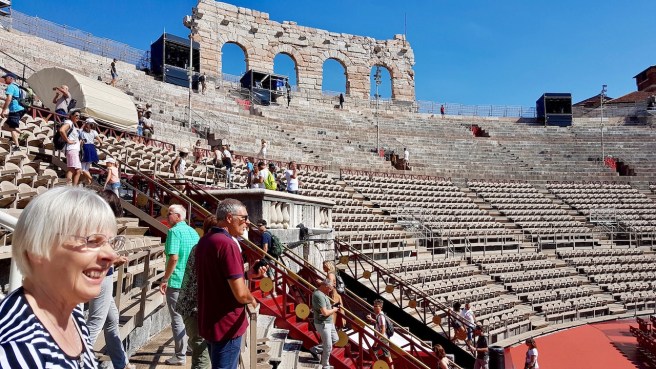
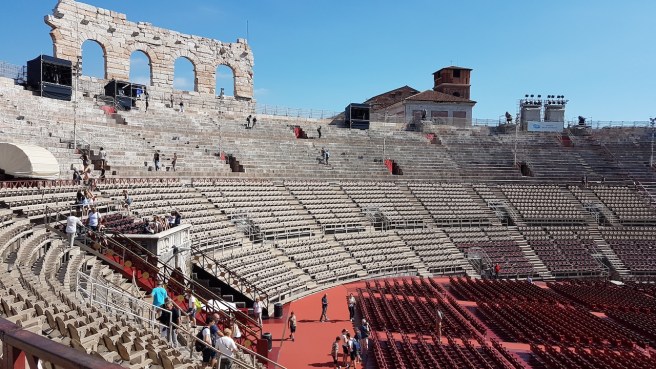
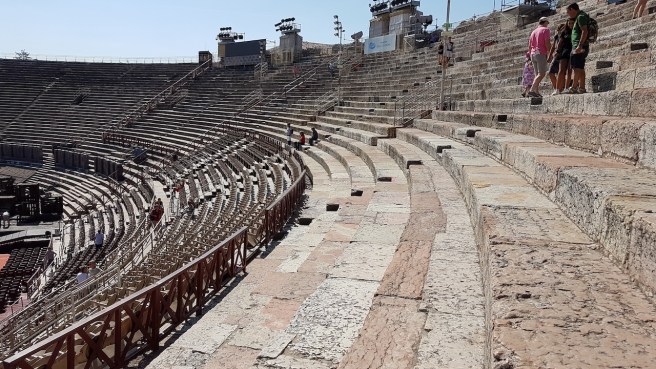 Excavations under the structure have brought to light a complex hydraulic system which enabled water to be brought inside the amphitheatre, both for spectacular water games and to clean up the arena after the bloody fights held there. All quite incredible to behold.
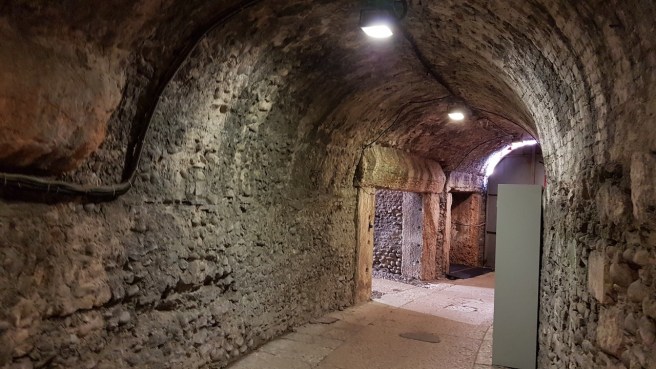 On our way to our next point of interest we popped into one of the many churches. This was St Niccolo, a fine example of Italian seventeenth century architecture…..
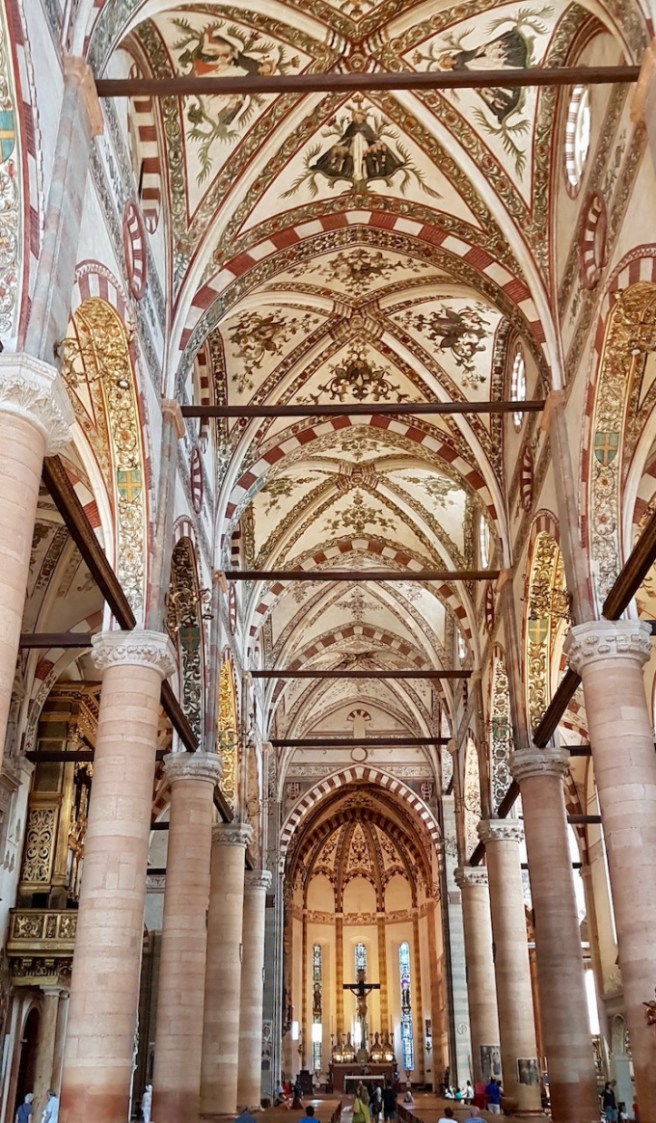
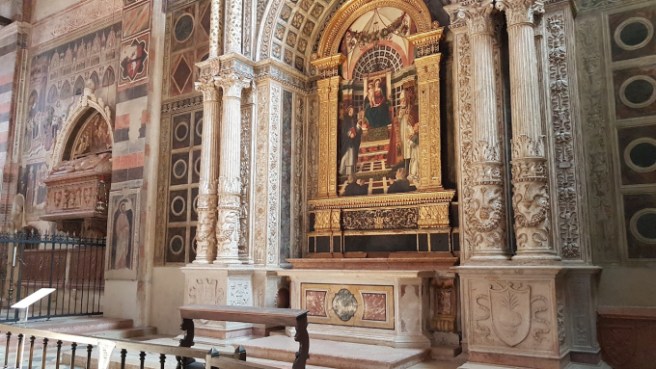
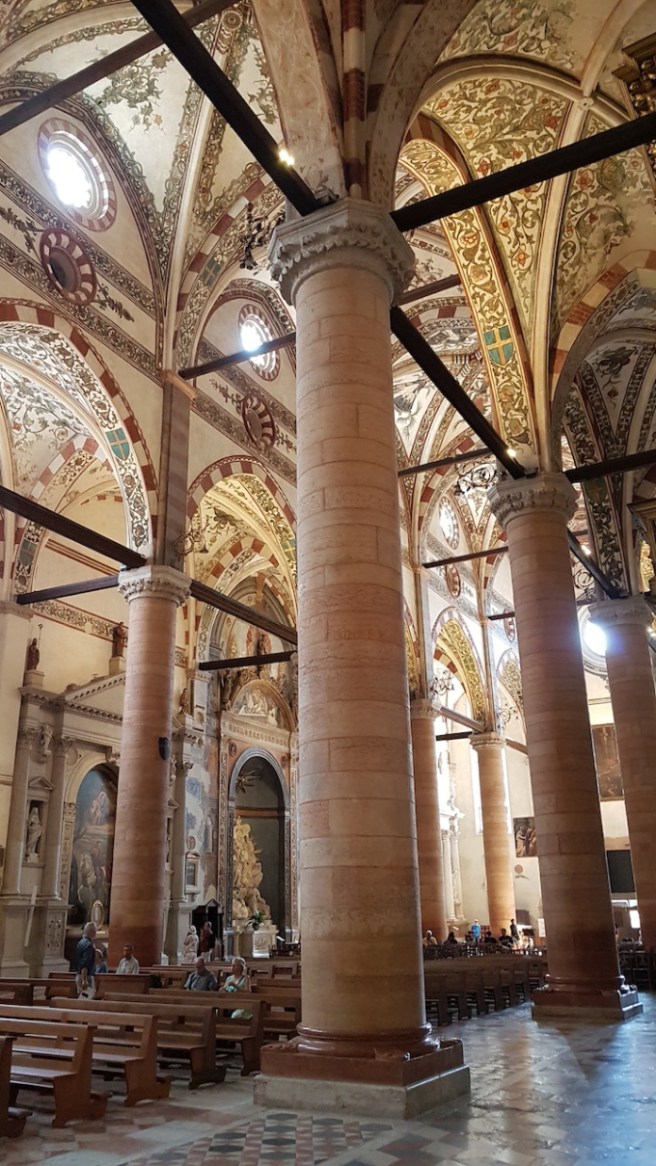
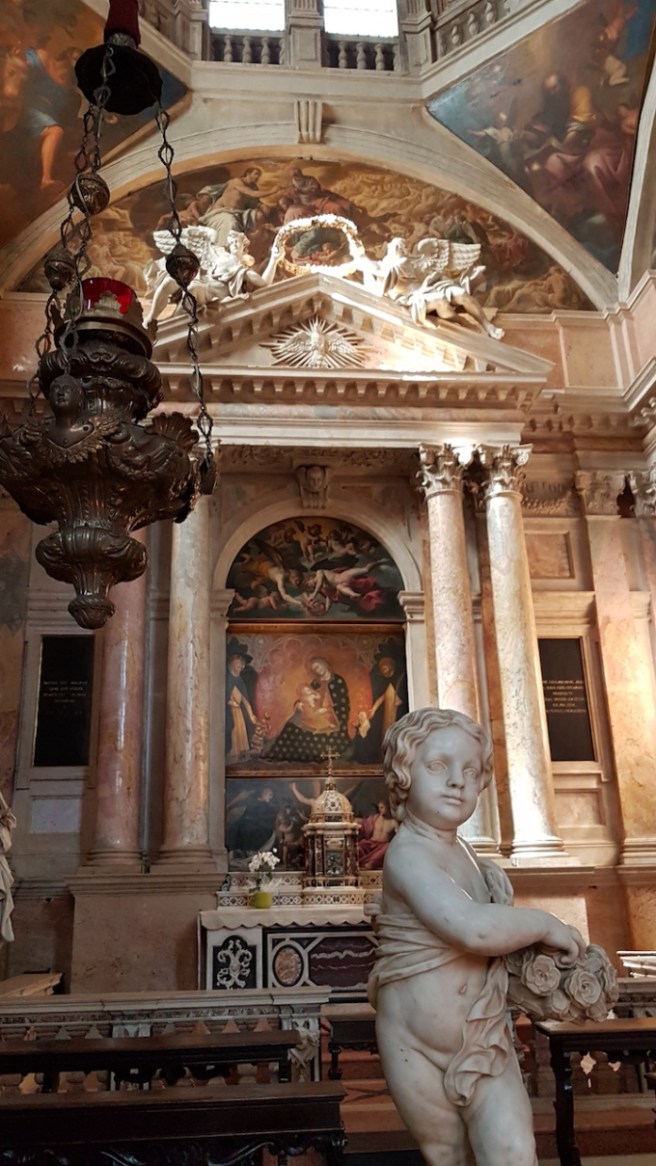
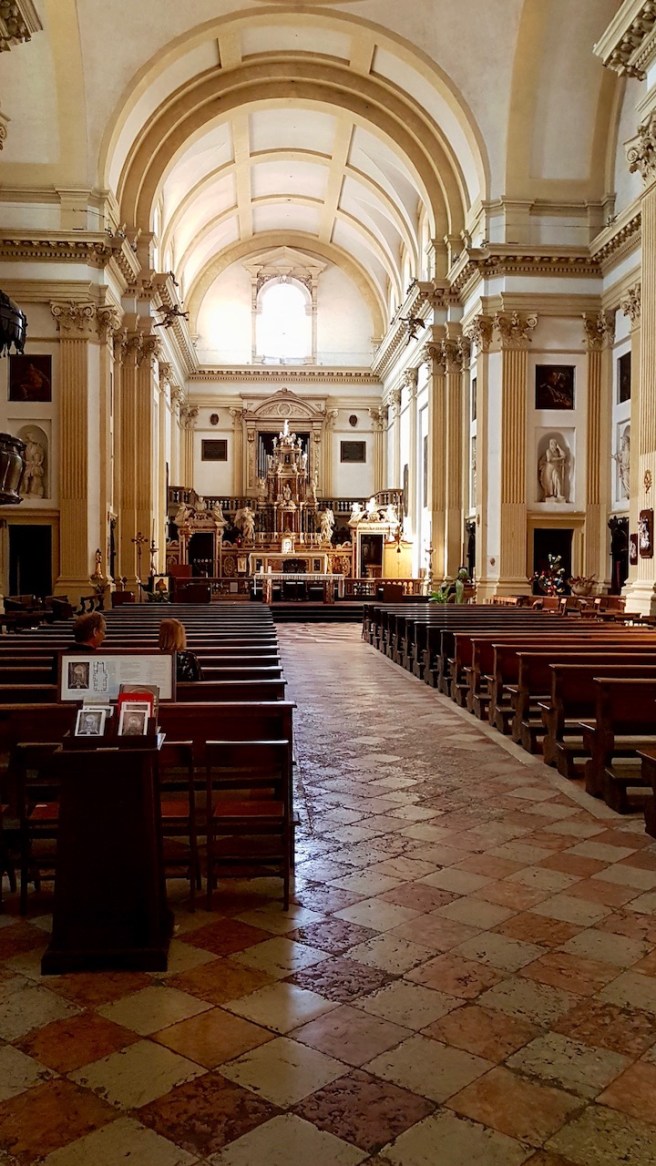 We also explored the church of Sant’Anastasia.
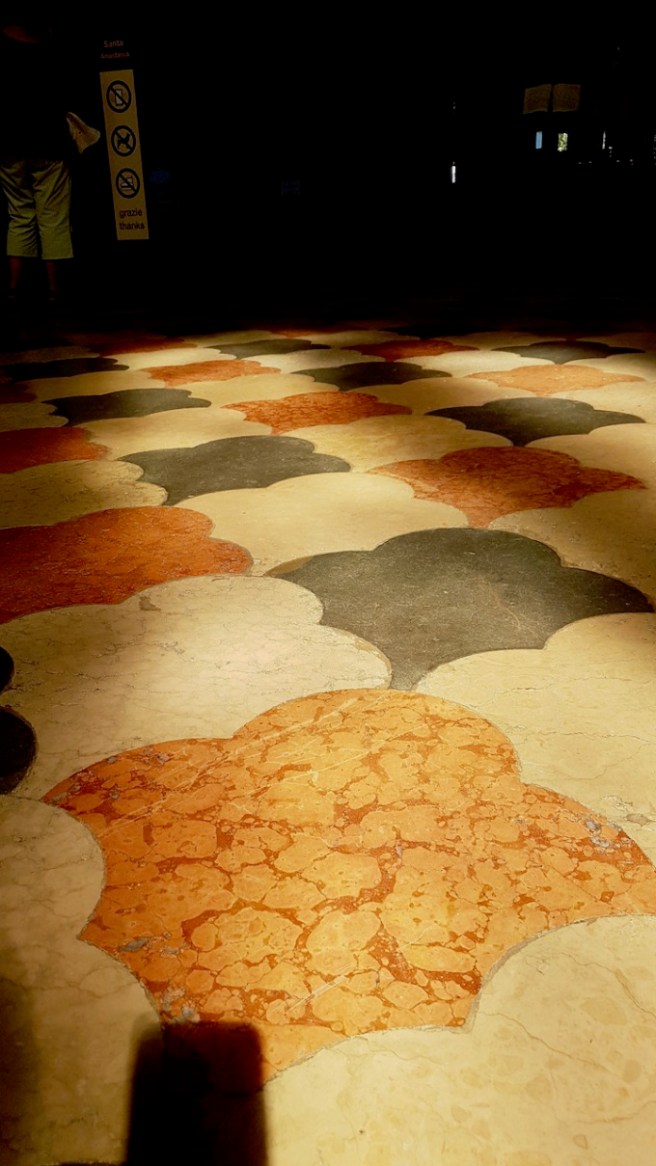
 I loved the flooring in particular, all local marble…..
 The hunchbacks of Verona are two figures in the church, which are supporting the two stoups at the base of the first columns of the church’s central nave.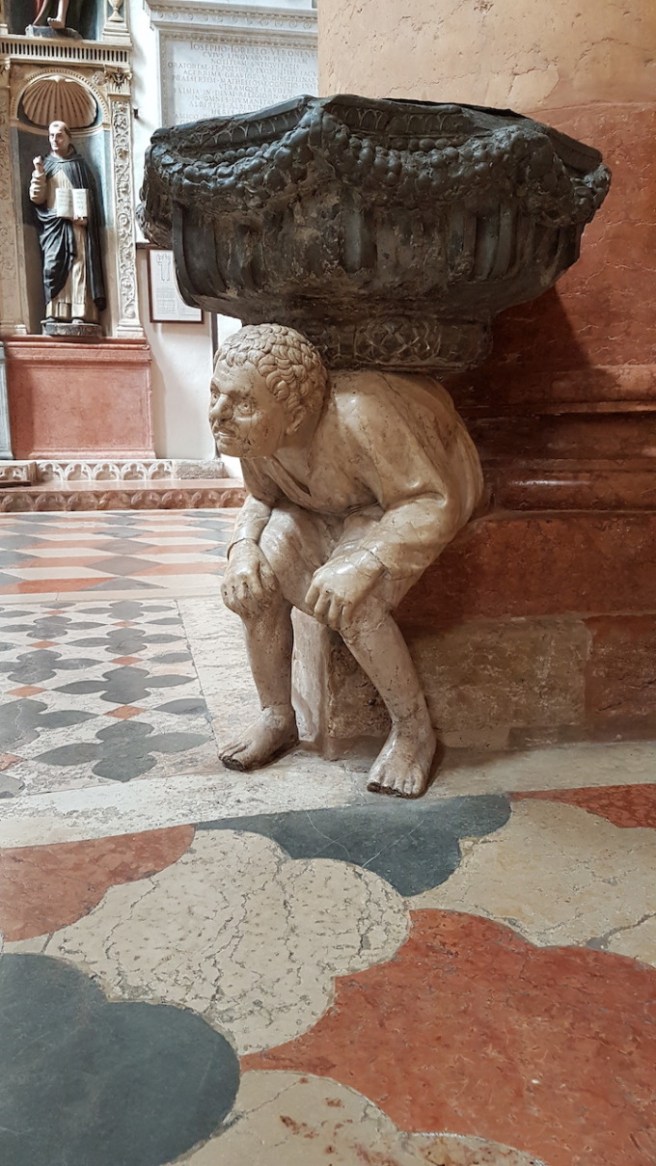
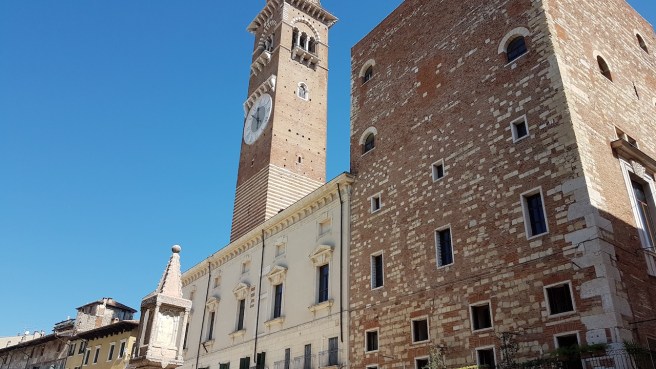
 Next on our itinerary however was the Torre Dei Lamberti Tower – located in the Piazza della Erbe, the Torre Dei Lamberti is the tallest of several towers in Verona. In 12th century Verona, as was the practice in many Italian cities at the time, noble families demonstrated their power and wealth through constructing tall and elaborate towers. The towers acted as luxurious homes as well as watch towers. Ideally, towers were built to be bigger than the nearest tower. Writing this has brought back memories of San Gimignano where there are many such towers giving it the name ‘The Town of Fine Towers’.
Anyhow as the name suggests, the Lamberti Tower was built by the wealthy Lamberti family. Work was begun on the tower in 1172 and was eventually completed in 1463. Over the years however, modifications have been made including the raising of the height by the Venetians in the 16th century. It is still possible to make out the different sections of the tower based on the building materials used.
 Before ascending the tower we visited what was called an exhibition of Veronese modern art. I must say it didn’t seem very modern to either of us, but that just shows everywhere is different.
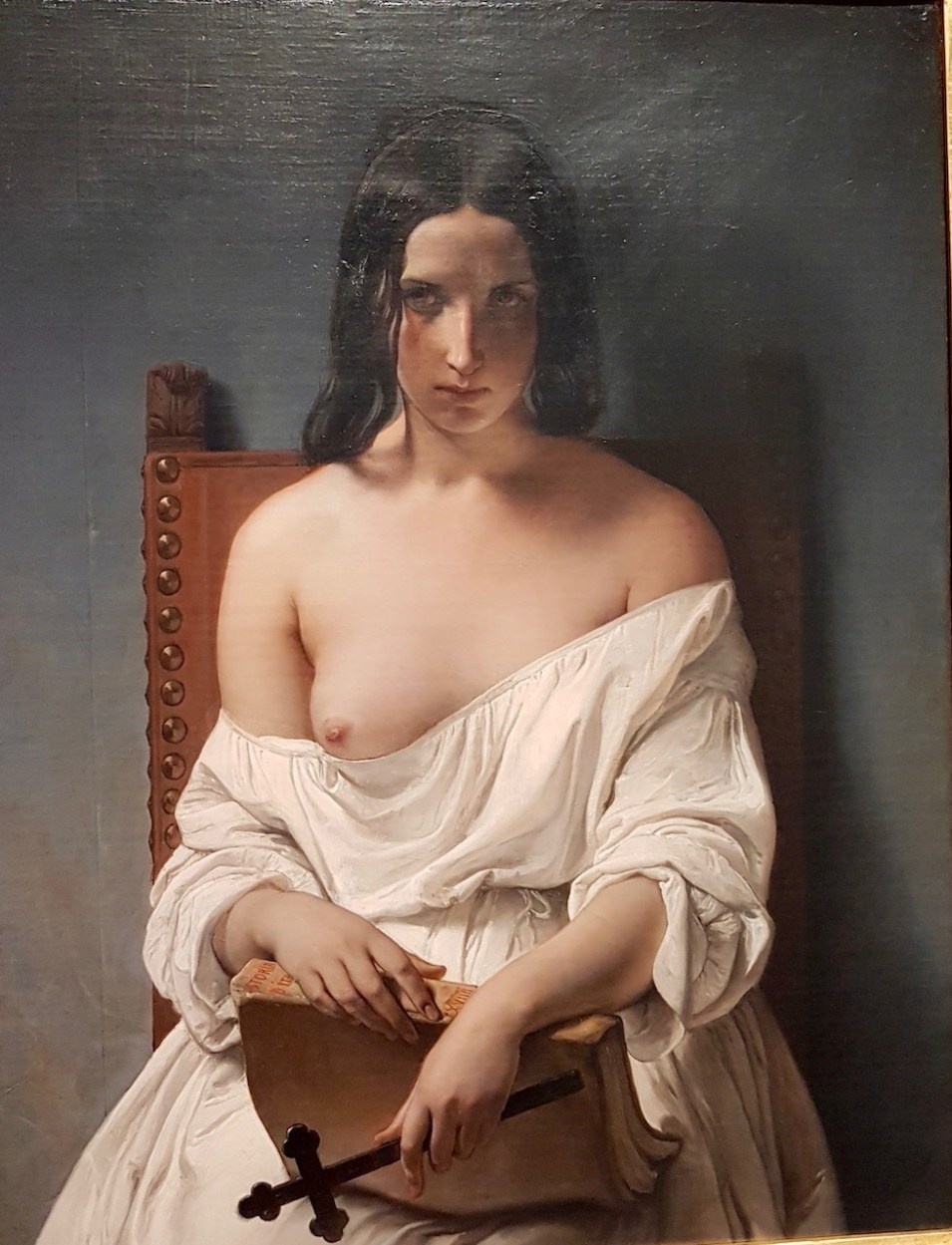
 What I did like very much was the sensuous painting by Hayez (the Italian equivalent to DeLaCroix) of the personification of “Italy”. She holds the cross in one hand and the volume entitled “History of Italy” in the other, in memory of the martyrdom that took place in the streets of Milan in the days of 1848, when attempts were made unsuccessfully to obtain independence from the Hapsburg Empire and work towards the unification of Italy…..she is therefore both strong yet vulnerable.
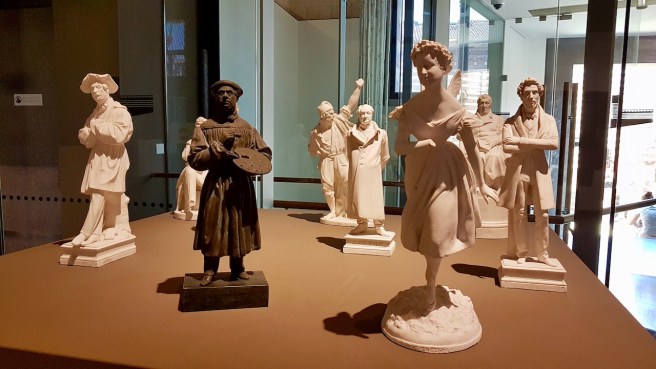
  and these sculptures I admired which were about six or nine inches tall…..
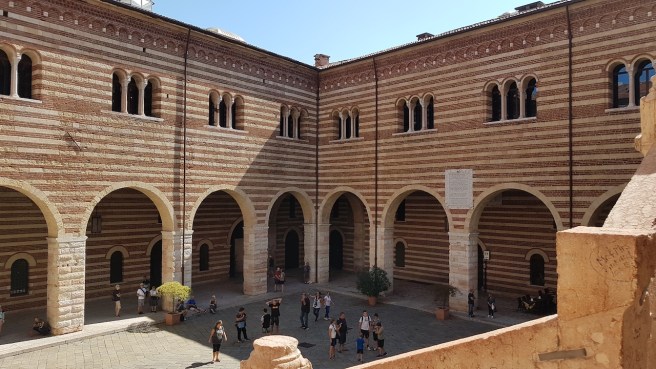
 We then exited into the courtyard where the striping effect of use of brick interlaid with marble was quite clear………..
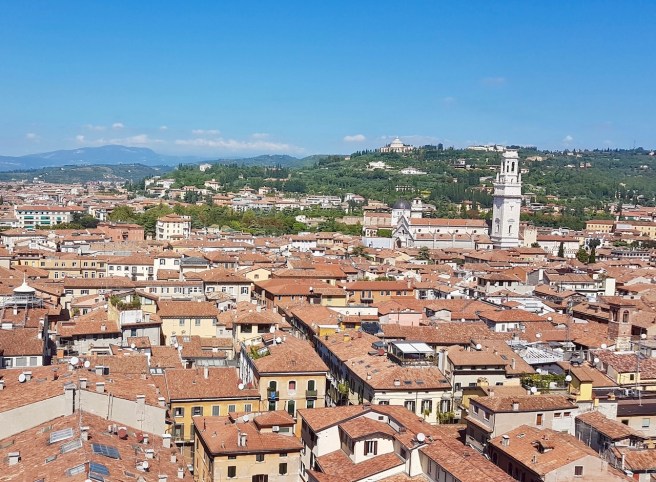
 and we ascended the tower not slowly by its 368 steps but quickly on the elevator! The views were worth our admittedly slender effort…..
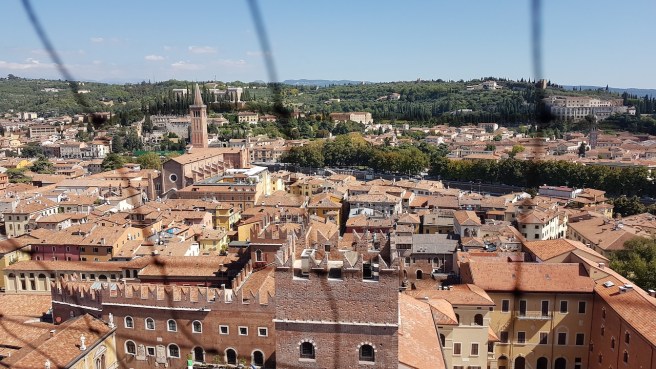 What is absolutely clear looking at these photos is the significance in historic towns of roofing all done in the same local materials….this gives such a sense of unity.
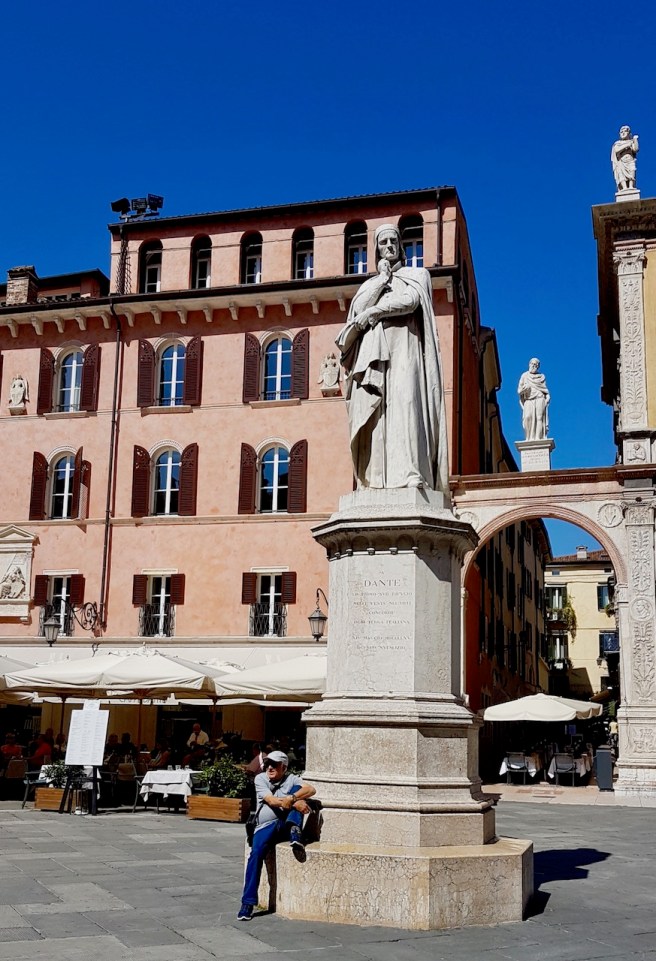
 We came out into the Piazza Della Erbe for a quick look at the pensive statue of Dante…..it represents another manifestation of the struggle for independence…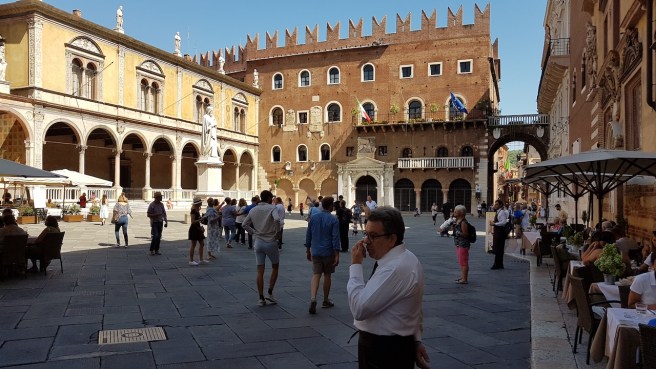
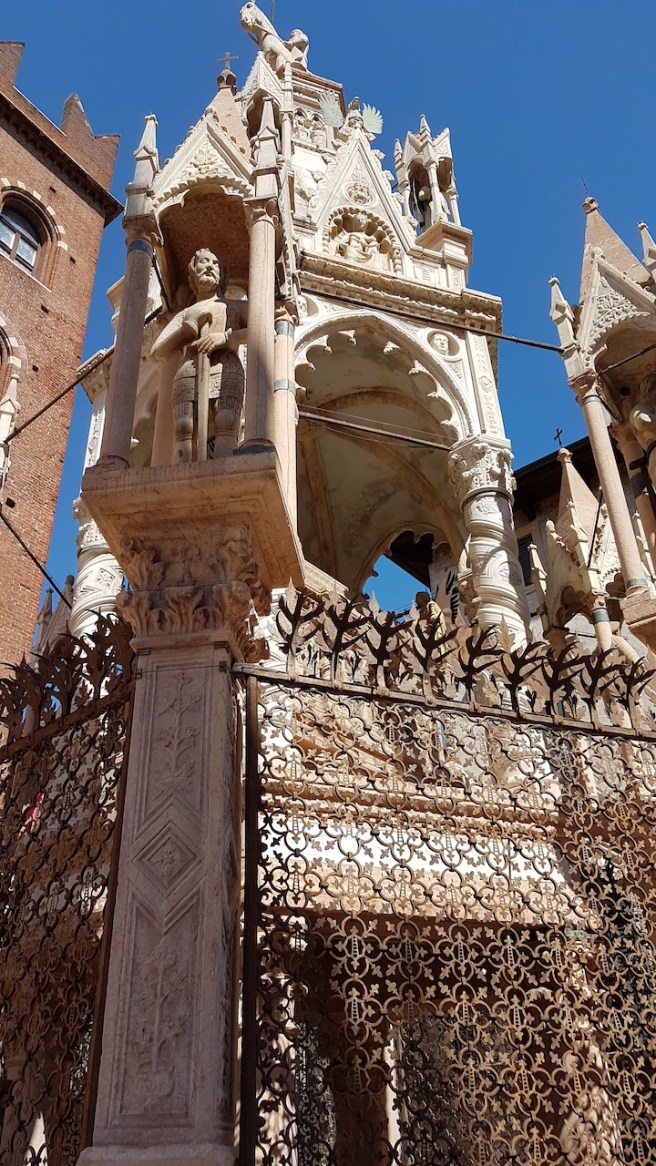
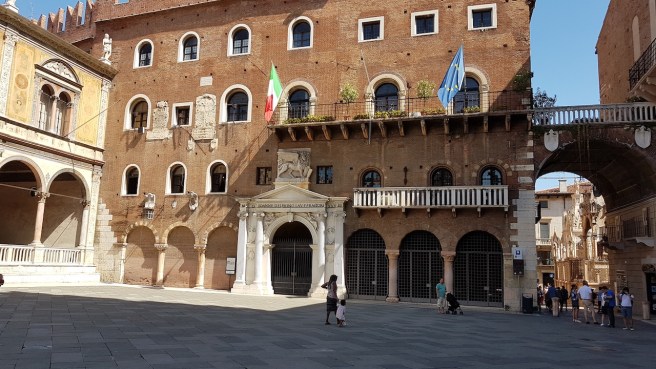 ………………we just had a fleeting visit then to the Scaliger Tombs – a group of five Gothic funerary monuments in Verona, celebrating the Scaliger family, who ruled in Verona from the 13th to the late 14th century.The tombs are located in a court of the church of Santa Maria Antica, separated from the street by a wall with medieval iron grilles. Built in Gothic style, they are a series of tombs, most of which are in the shape of a small temple and covered by a baldachin. According to the French historian Georges Duby, they are one of the most outstanding examples of Gothic art. The wrought iron enclosure is decorated with a stair motif, in reference to the Italian meaning of the name of the family, della Scala………..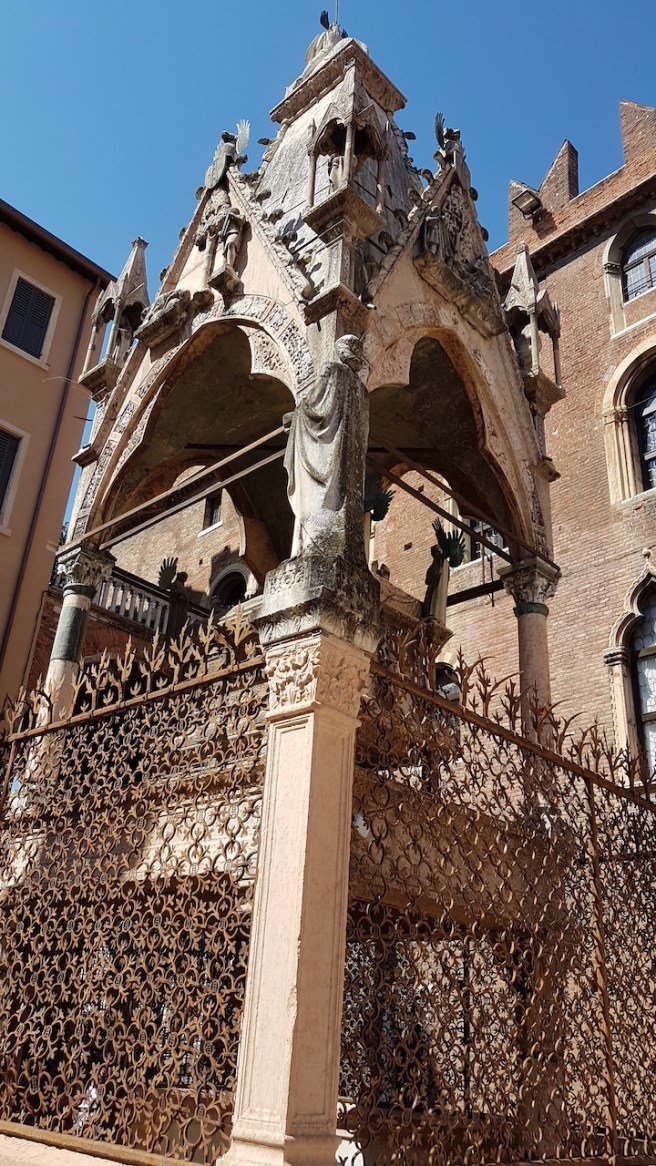
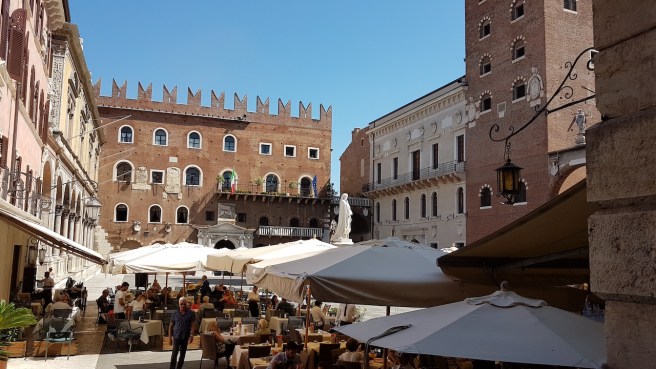
 Lunch beckoned and whilst the restaurants in the Piazza looked lovely………
  we found, down a side street, what turned out to be a fantastic local restaurant for my birthday lunch…..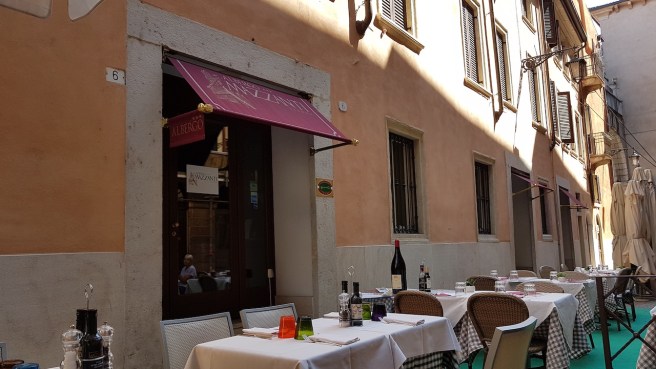
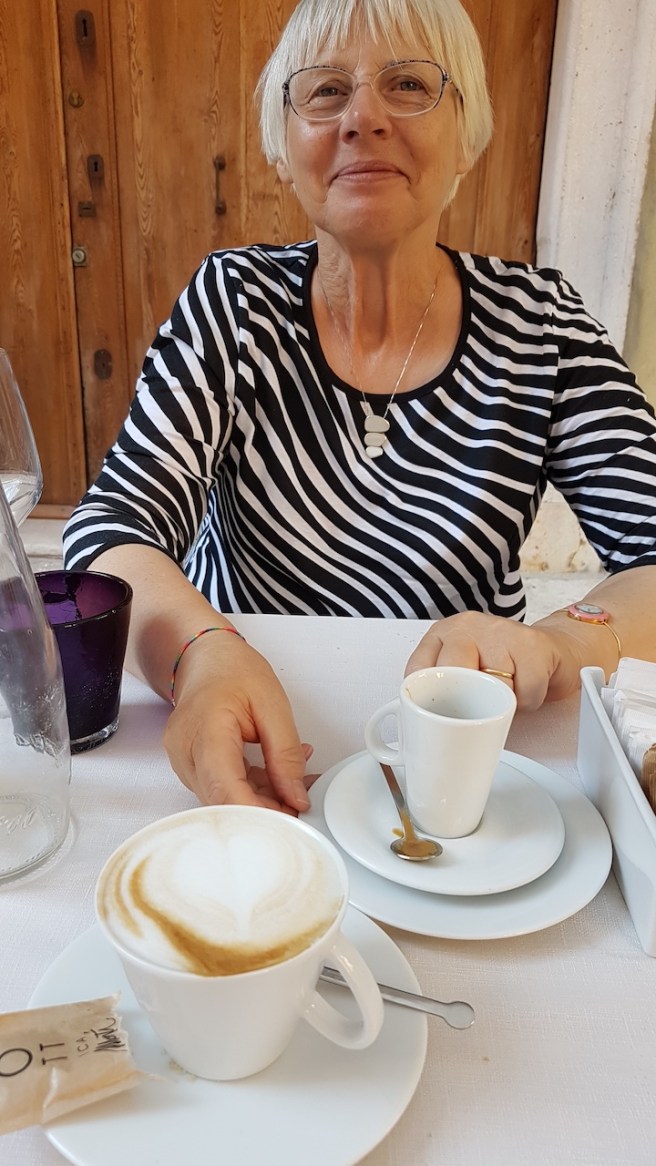
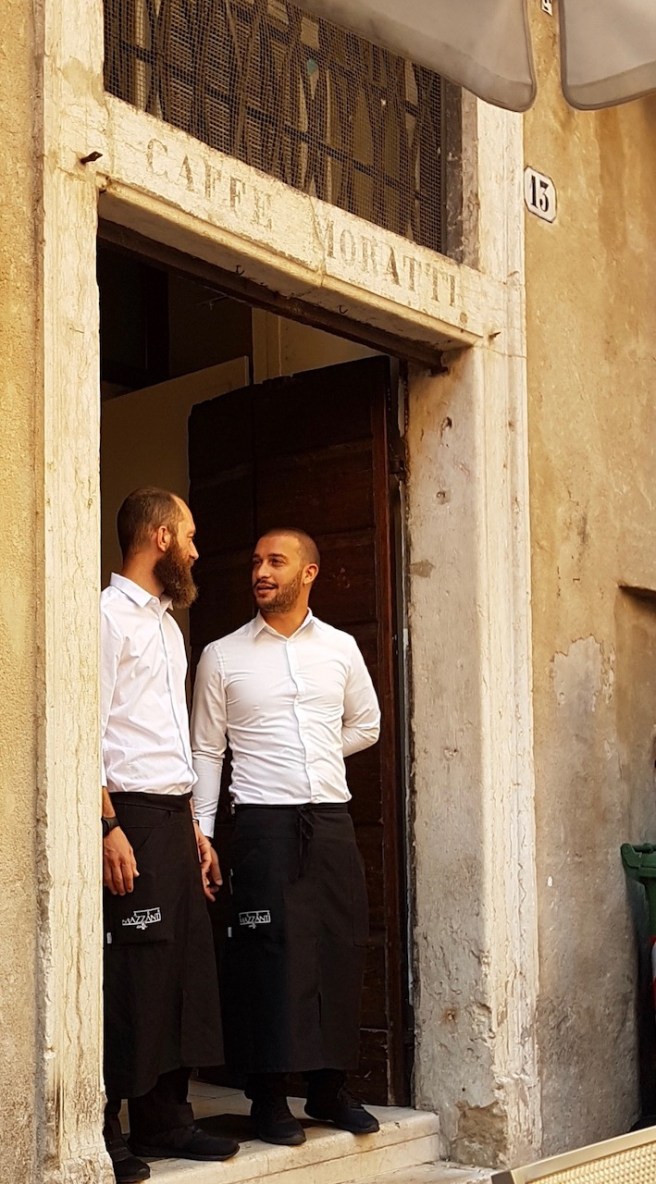 Prosecco, Soave, brilliant food and a relaxing coffee…what more could one ask?
 On our way to the Duomo…
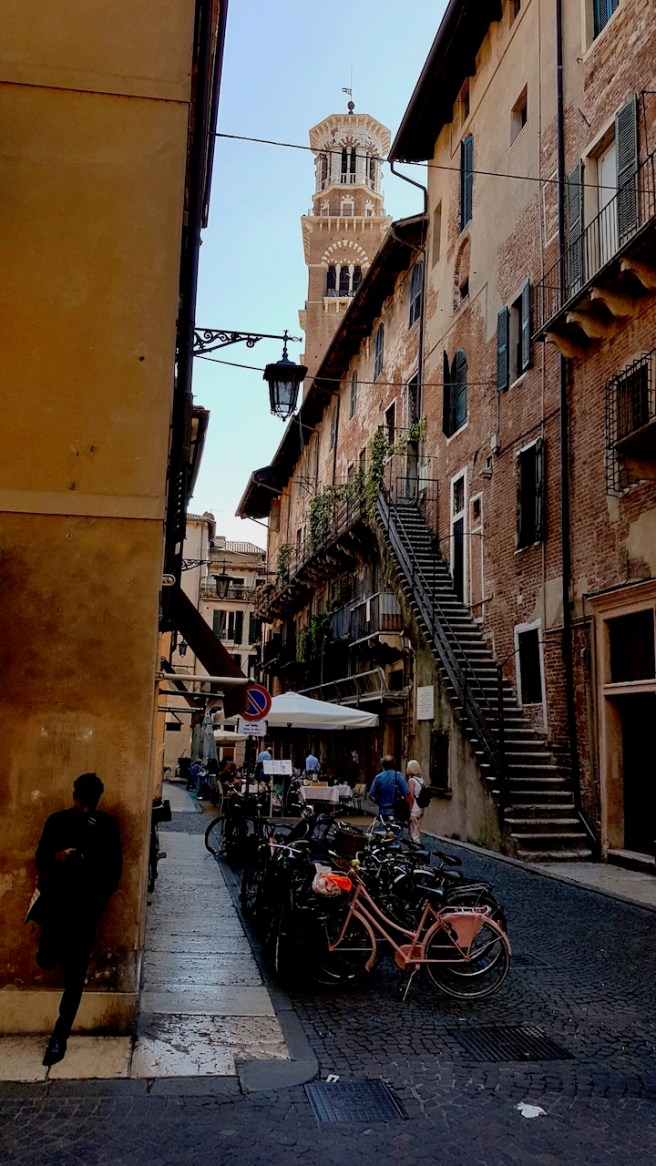 we saw yet another elevated tomb….it seems the Veronesi are trying to get as close to Heaven as they dare.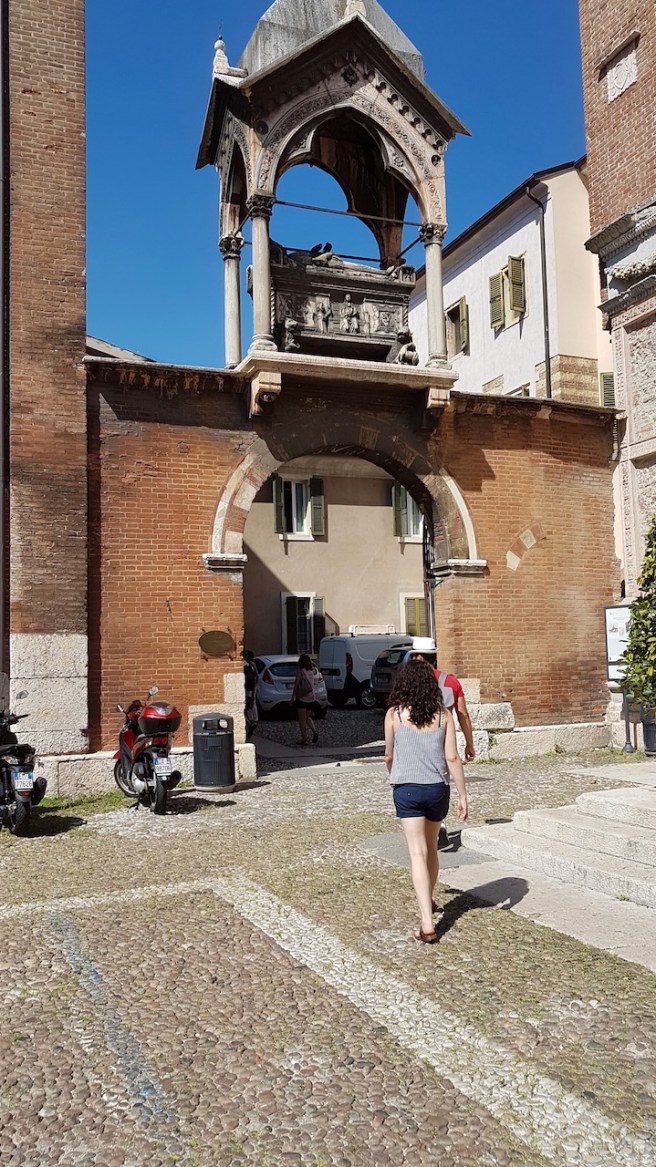
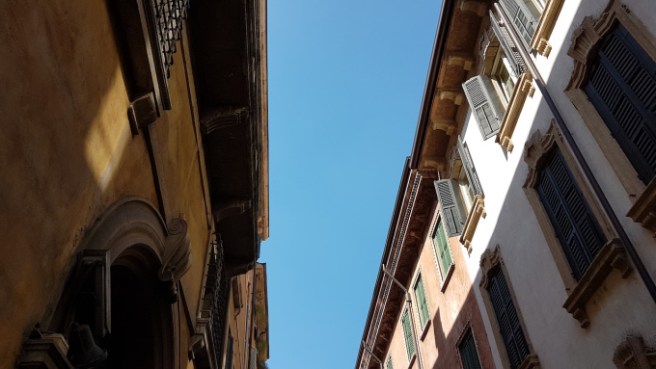
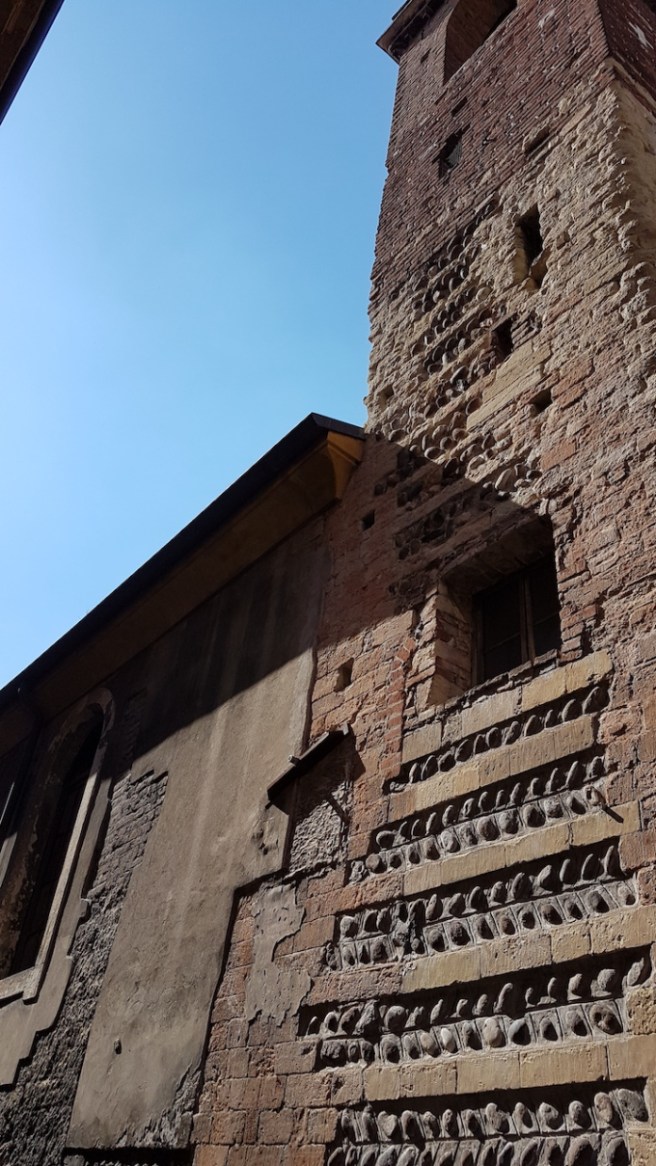
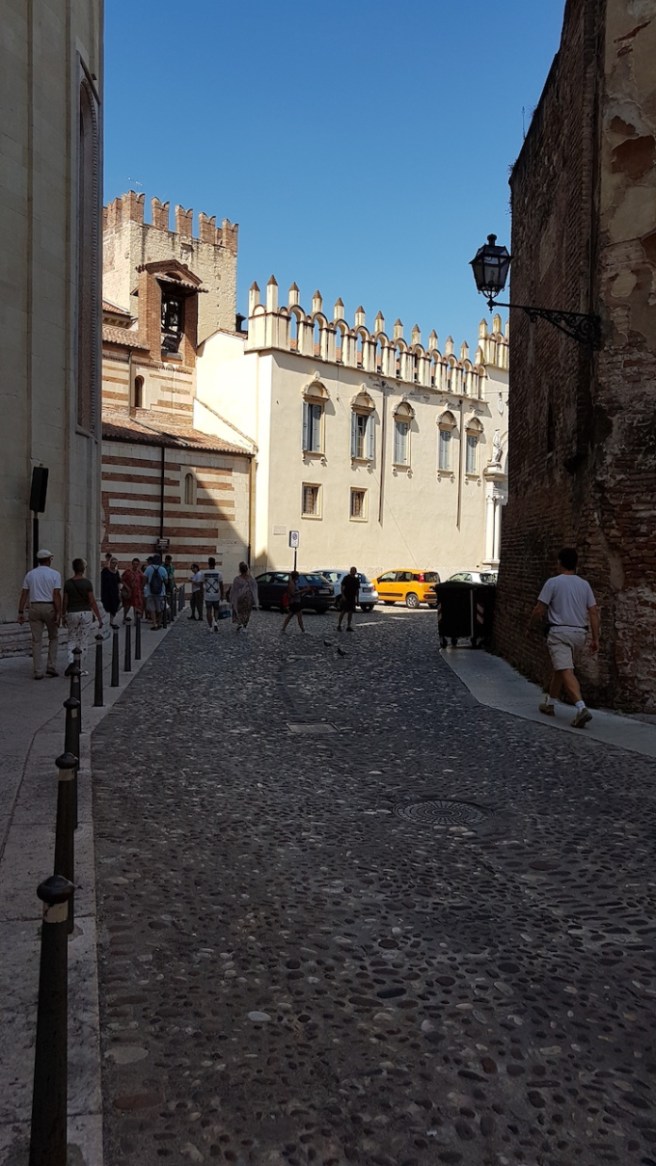 The Cathedral, which is dedicated to Santa Maria Assunta, is the central structure of a complex of architectural buildings which include San Giovanni in Fonte, Santa Elena, the Canons’ cloister, the Capitular library, the square in front of the church and the bishop’s residence. During the Roman Empire, in the area of the present day church, there were villas with private thermal baths (balnea) and probably also a few small temples.
 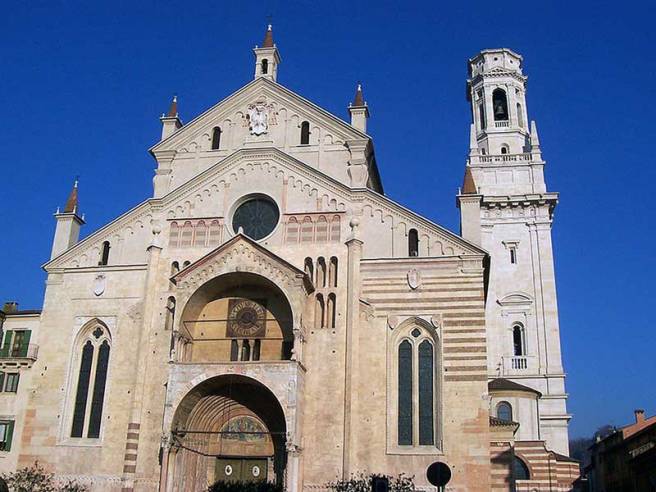 The first palaeo Christian basilica was built on the area occupied today by the church of Santa Elena. It was consecrated by S. Zeno, bishop of Verona, between 362 380 A.D. but it soon turned out to be too small and a few decades later it was replaced by a larger basilica. Quite a few remains of the mosaic floor of both palaeo Christian basilicas can be seen under the church of Santa Elena and the Canons’ cloister.
The second palaeo christian basilica collapsed, probably during the 7th century A.D., due to a strong fire or maybe an earthquake. Archdeacon Pacifico was in charge of the reconstruction of the church, between the 8th and the 9th century and the Cathedral, known by the name of Santa Maria Matricolare, was built further south, on the area on which it is situated today.
The church was greatly damaged by an earthquake in 1117 A.D. and reconstruction work lasted at least 20 years: the building acquired its current width and the two Romanesque porches.
The inside was completely renovated between the second half of the 15th and the second half of the 16th century with the addition of the side chapels and the semicircular choir screen.The floor is magnificent and composed of local marbles….
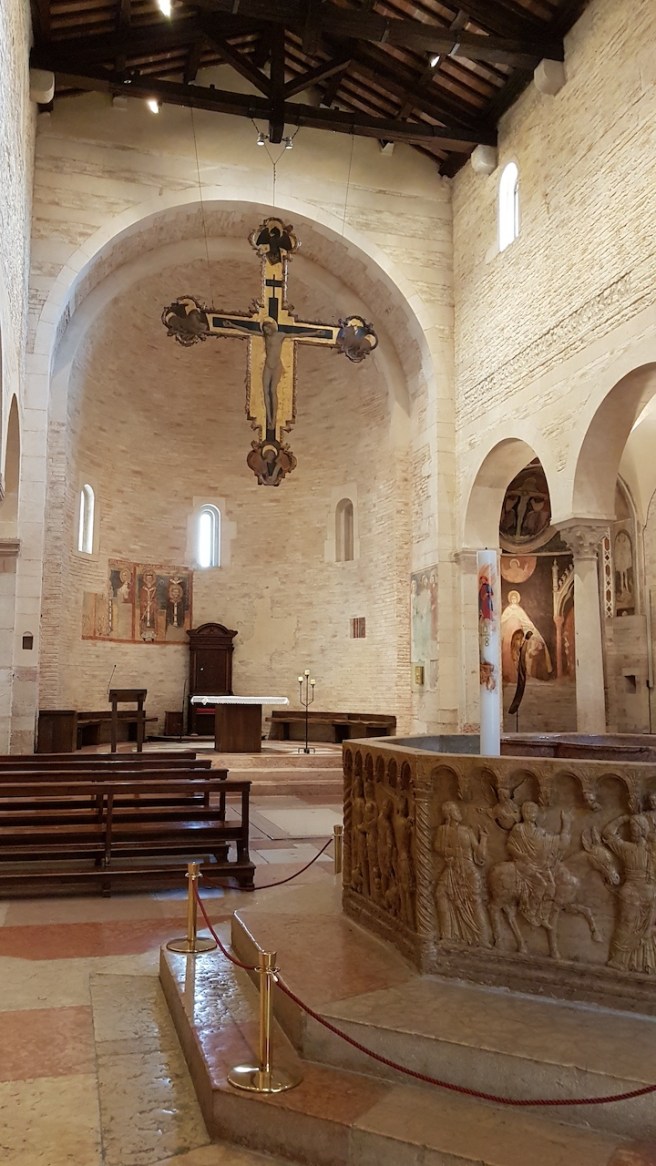
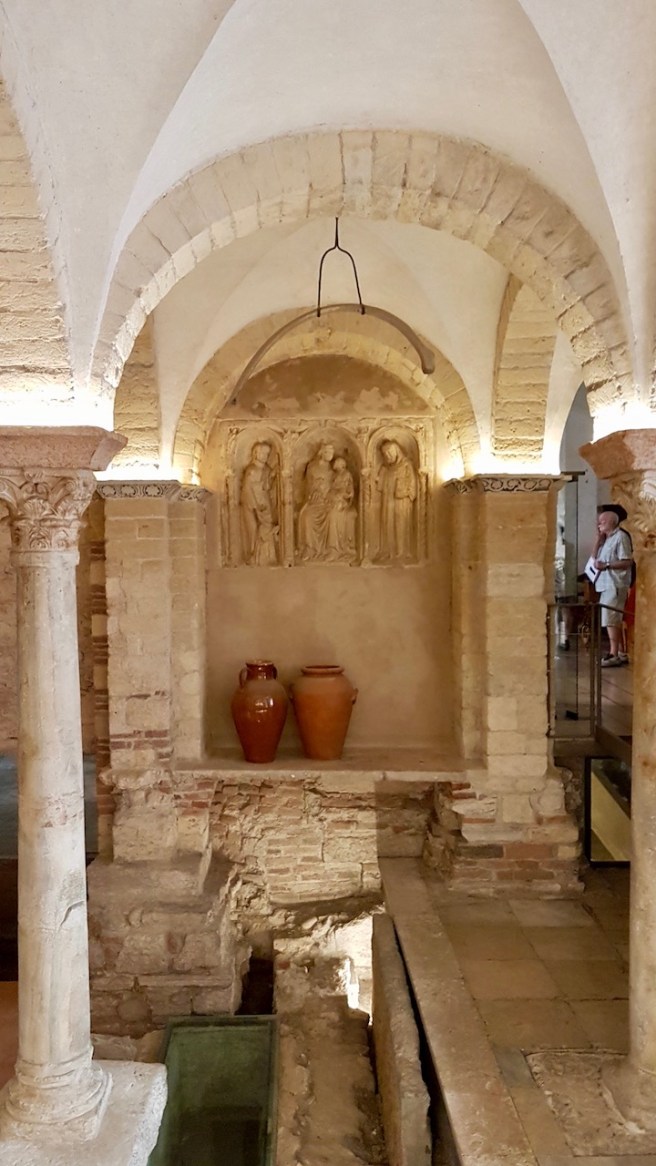
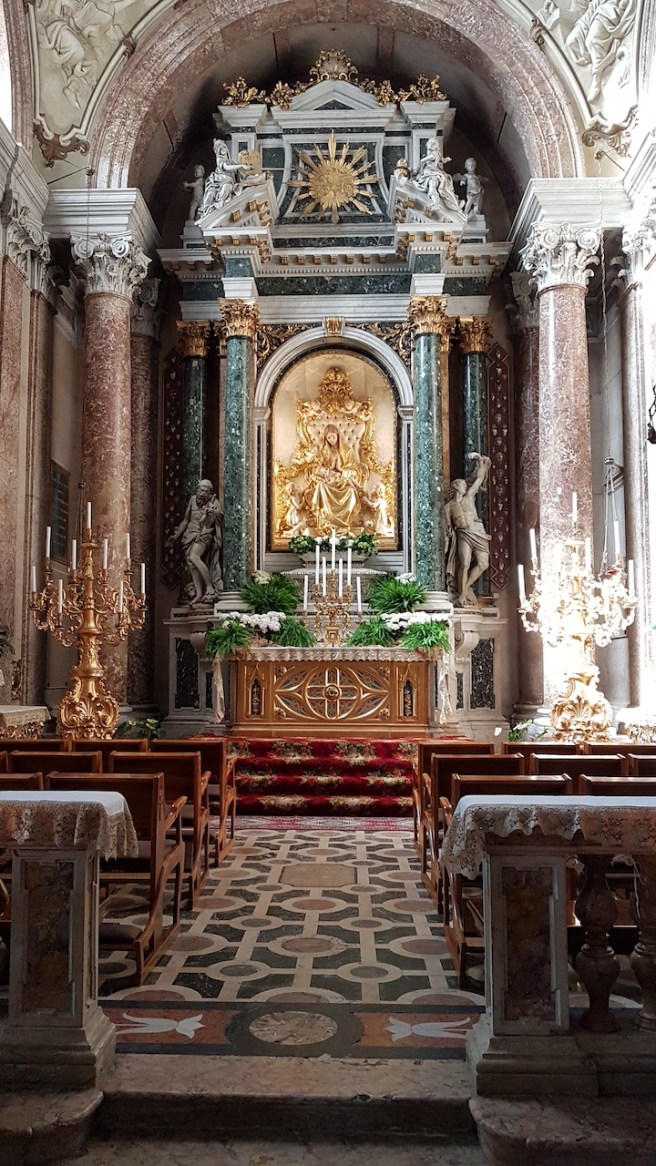
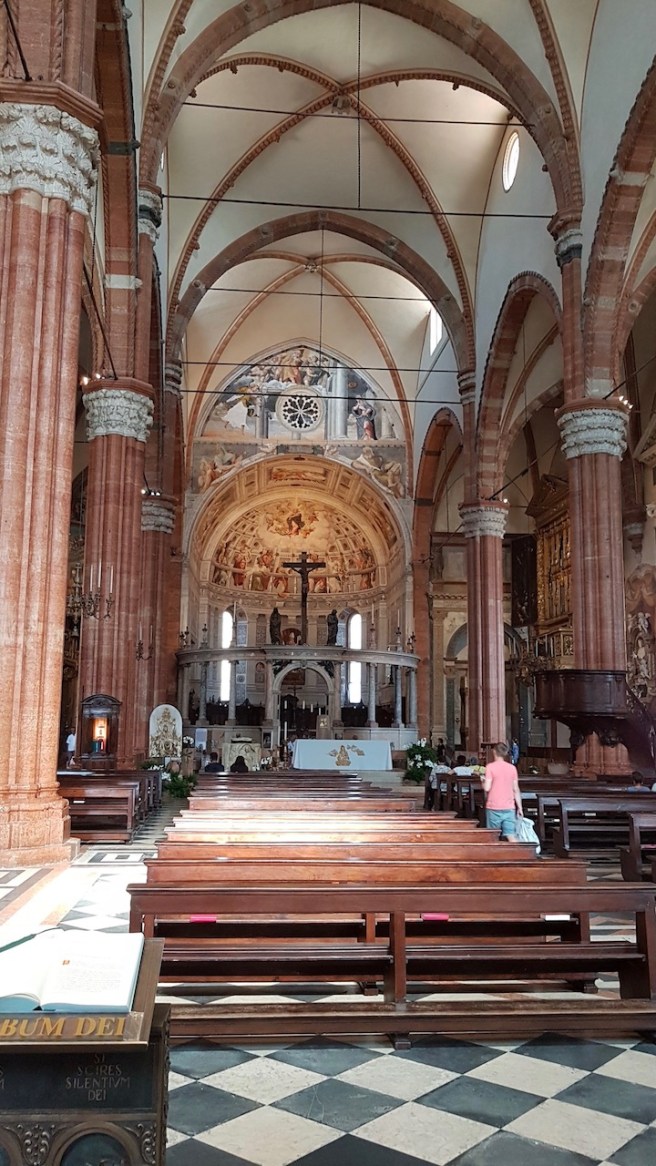 At one point I was amazed to find on a shelf some modern scriptural texts bound exquisitely which I examined……works of art in their own right…..
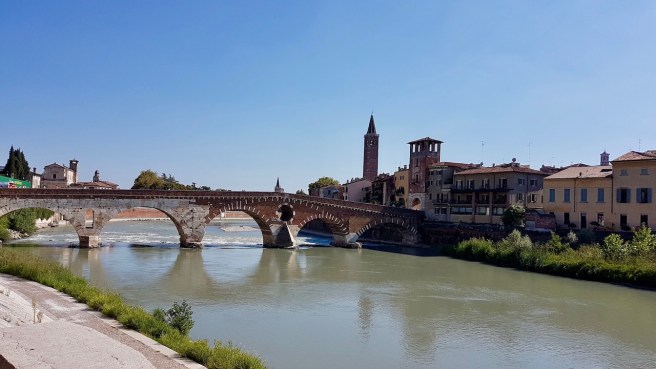
 Back home over the bridge of stone to get ready for the opera….
 Even arriving at the opera was special…..we were due to see Carmen.
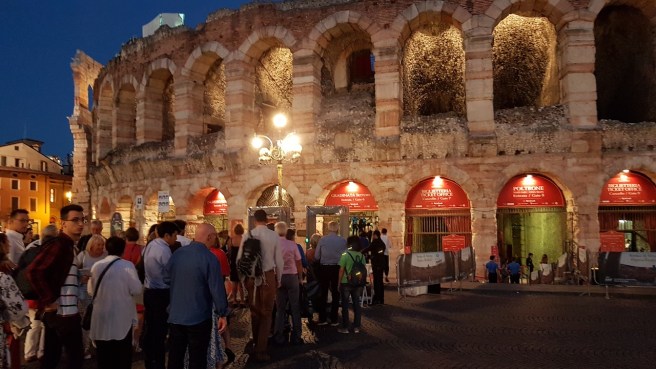 and once inside it was obvious how spectacular the occasion was going to be….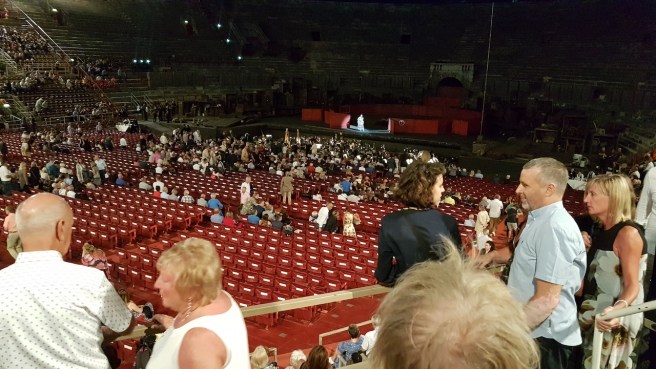
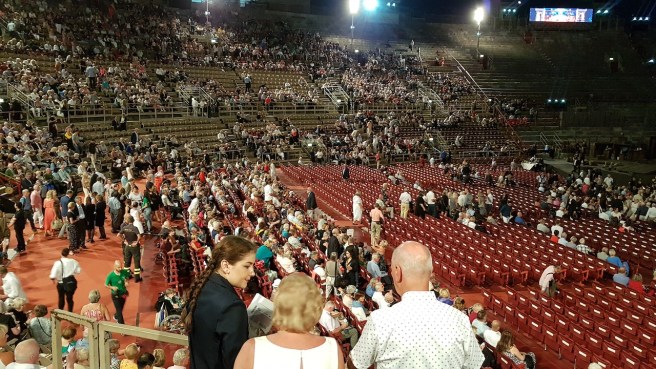
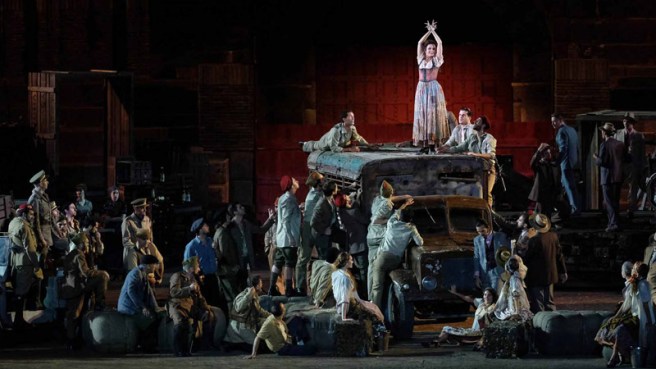
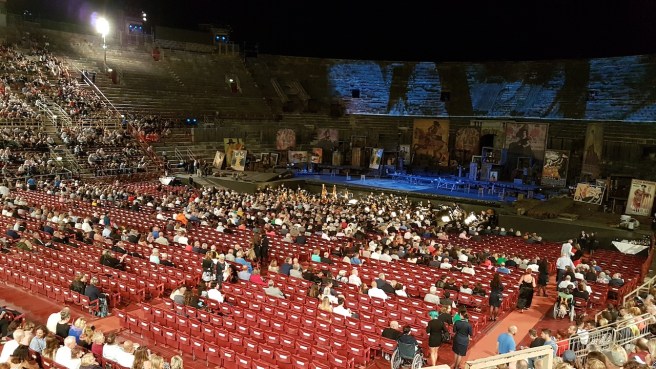 The performance was outstanding with two of the three main singers very strong. The orchestra was on top form and the production itself was all you would expect in so magnificent an arena. As a birthday present – sensational!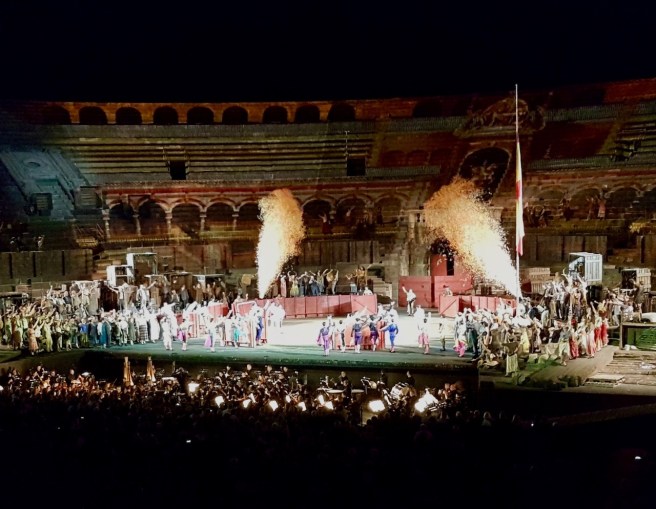
 The walk home through Verona at night was delightful…….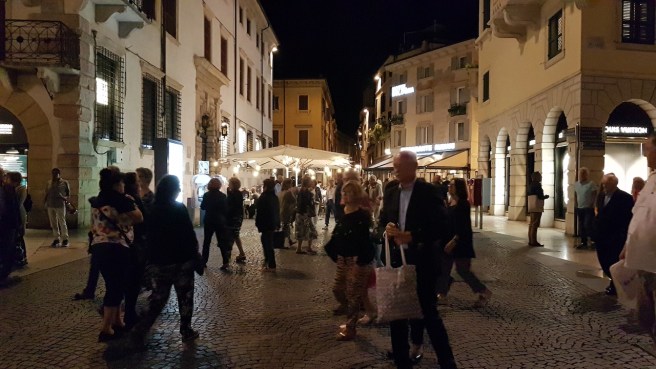
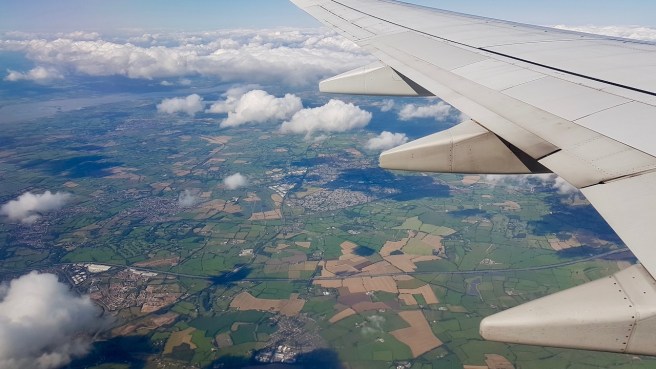 For my 70th Birthday I was treated to a trip to Verona to see the opera in the Roman arena ( a lifetime’s ambition). The flight from Bristol was great with unusually clear views over England and France and Italy. Landing at Milan Malpensa airport, we then caught the train to Milan. The station at Milan was incredibly large, imposing and typical of Fascist Brutalist architecture. I have since found out it is in fact the largest station in Europe.
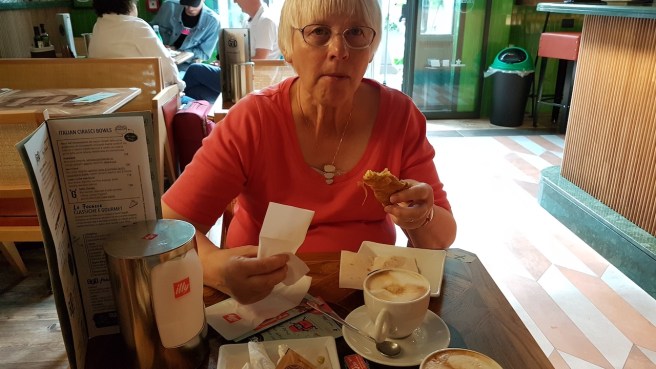
 It’s always nice to get your first cup of coffee and pastry when in Italy…here in one of the many station cafes…
 Getting to our hotel/apartment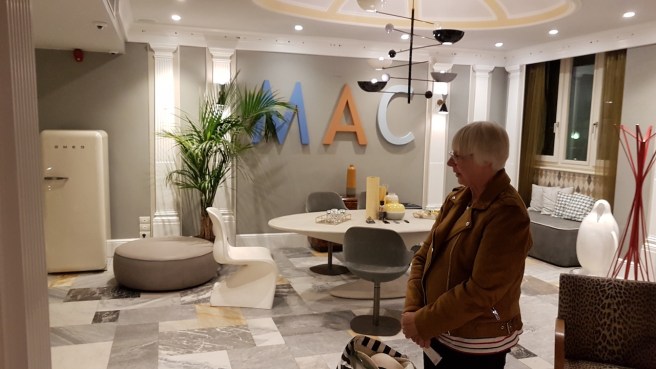
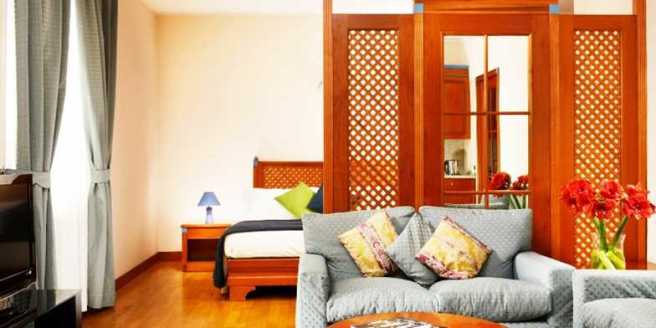
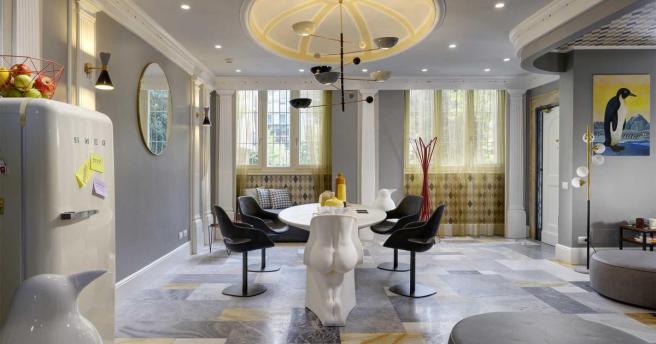 and the apartment itself was terrific.
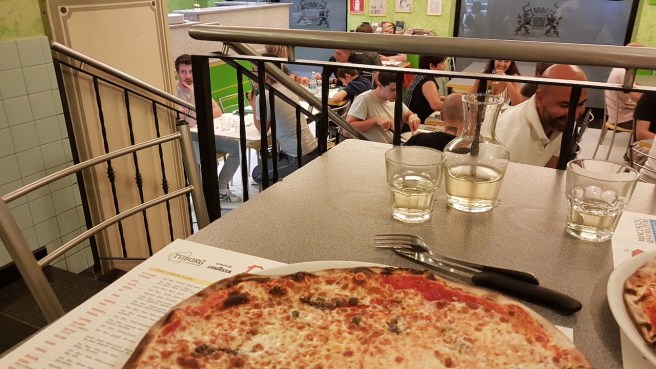
 I had done a lot of research on where to eat. However, around the corner we ignored all that research and found a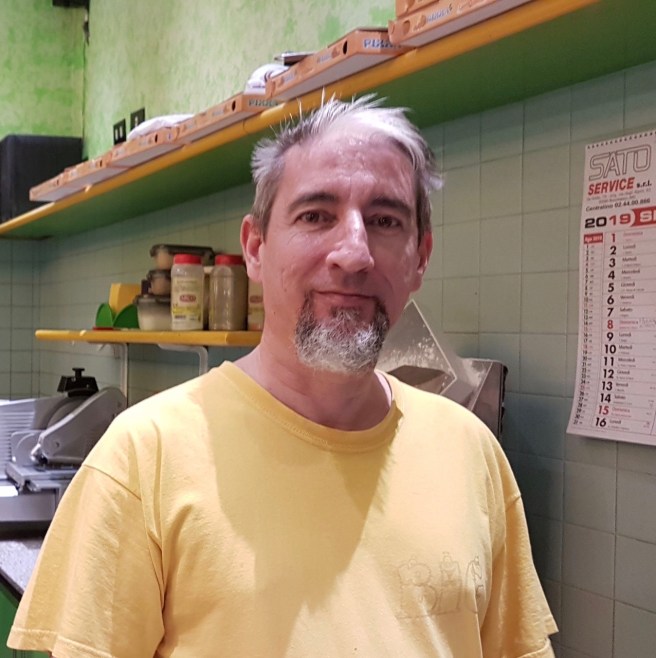
 Next day we went first of course to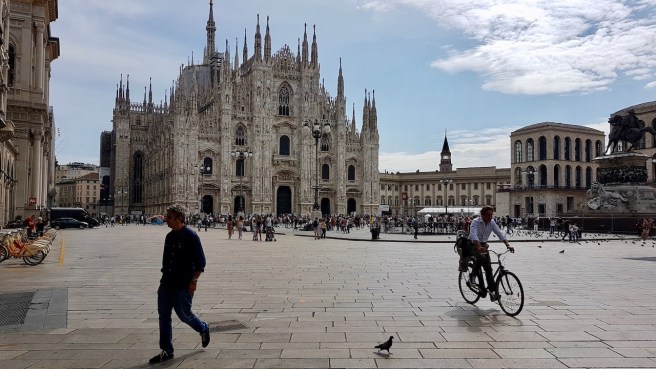
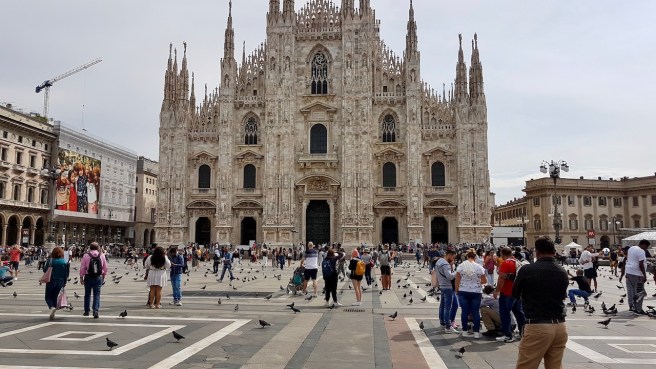 in stone……
 and bronze….interestingly the doors are nineteenth and twentieth century not the work of medieval craftsmen as I first thought.
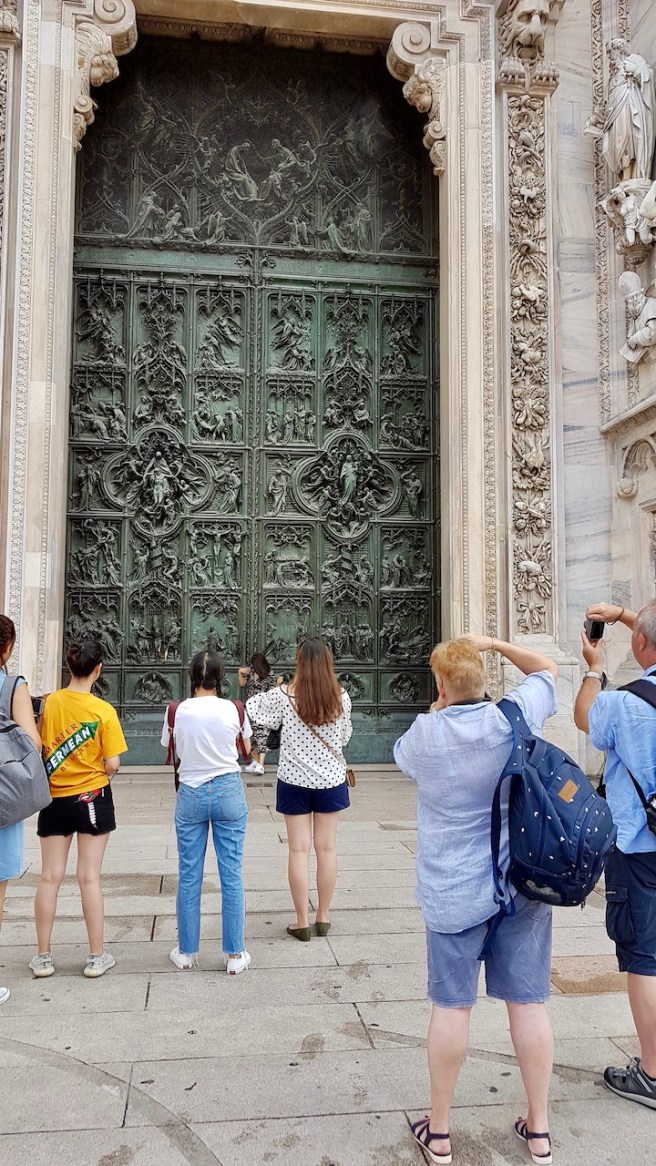 There was much to admire.
 After a quick walk around Piazza del Duomo…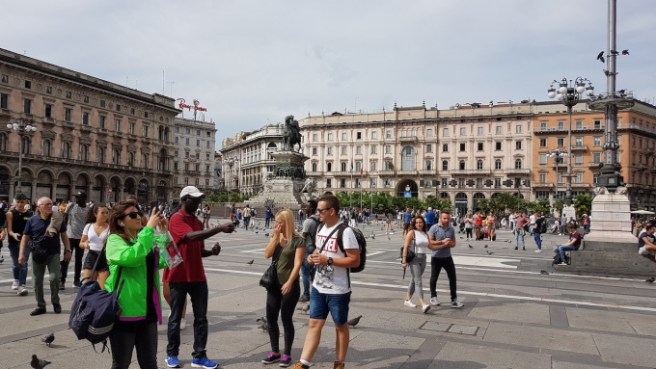
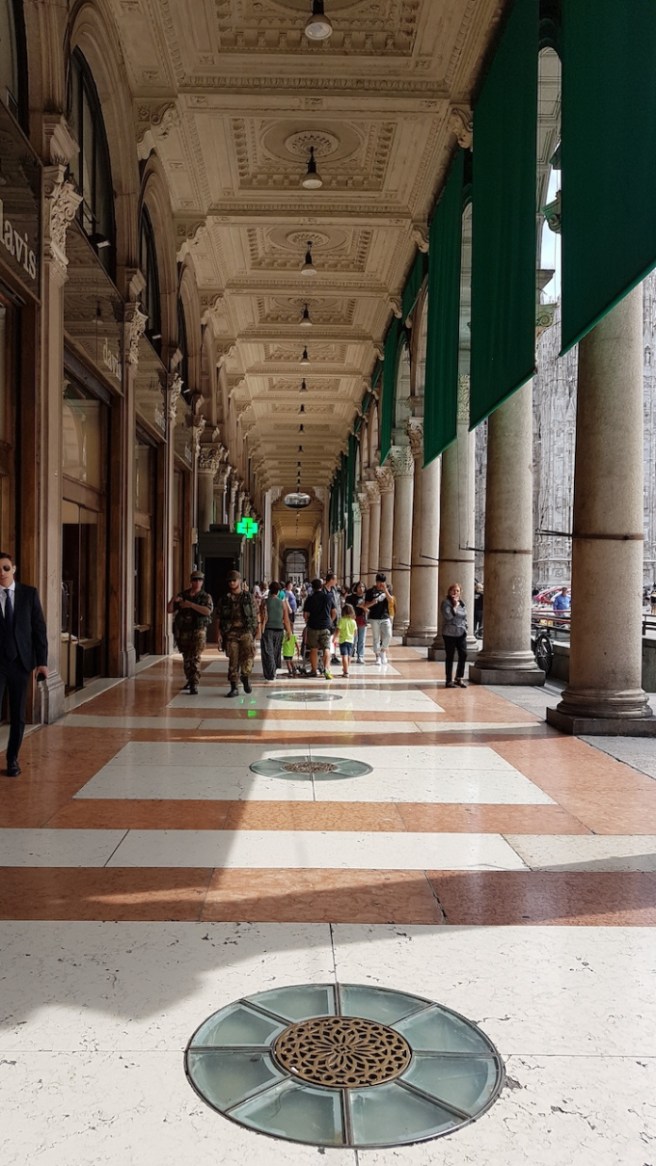
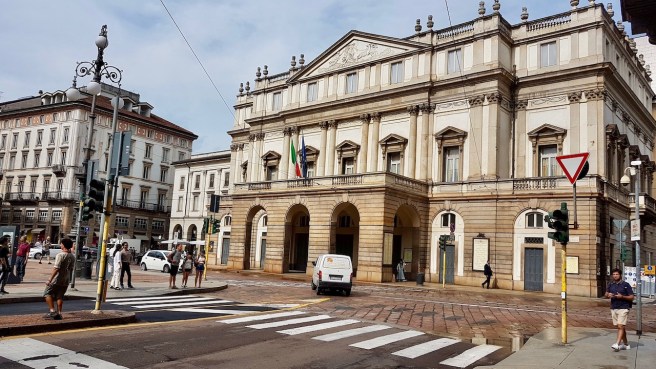 we passed up one of the streets full of stylish shops….
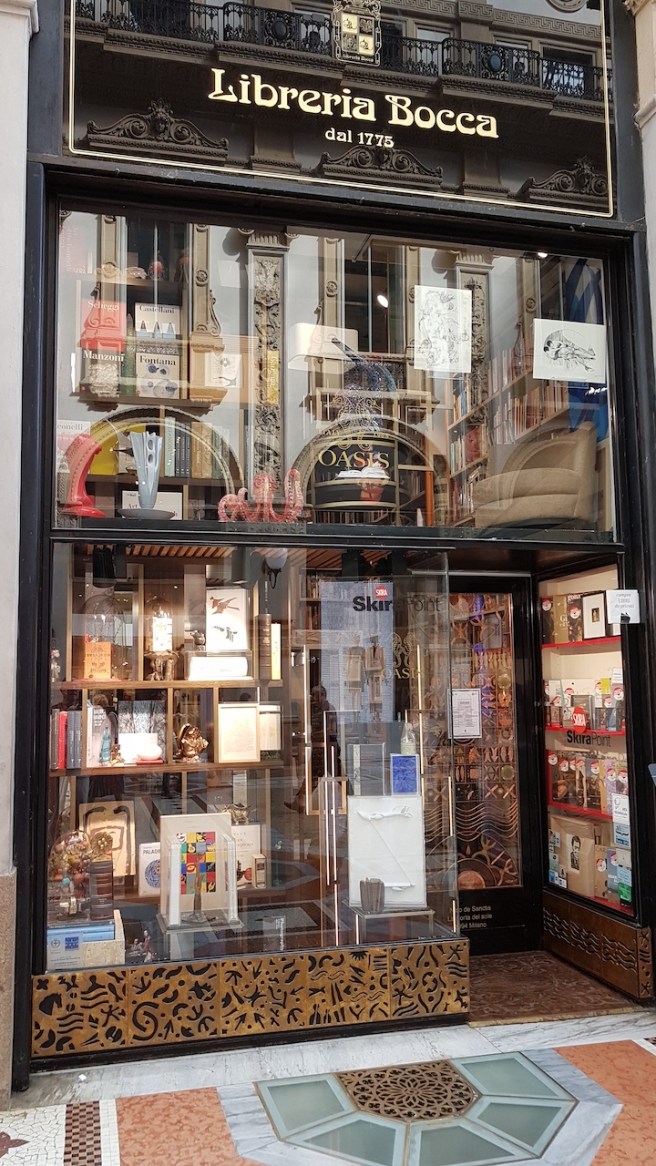
 ……..here a bookshop ( which we can never resist of course)….
 to come quickly to
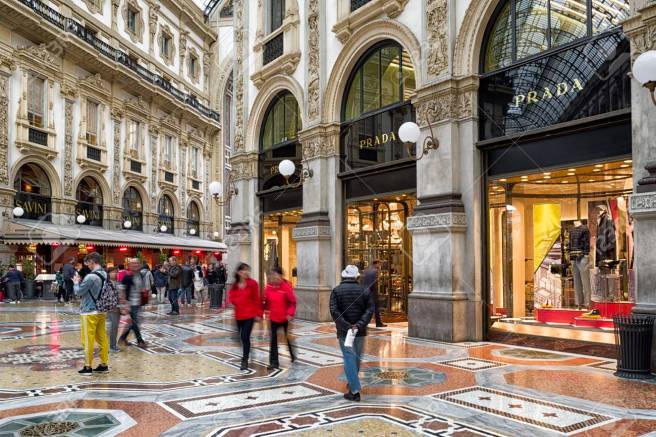
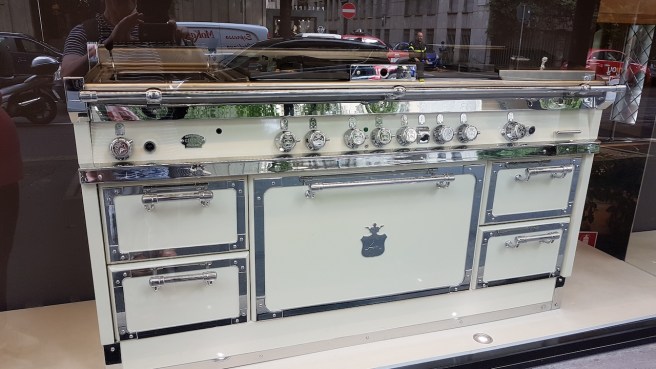
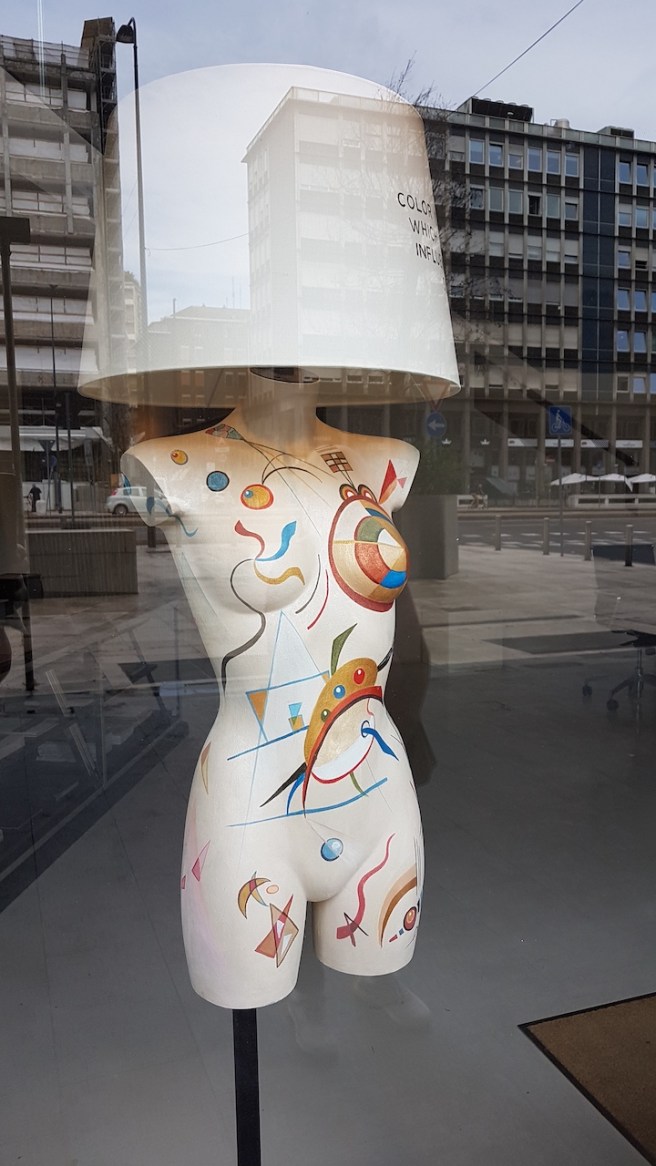 But all the shops in downtown Milan are sensational, not just in the arcade. How about this for an alternative to the Aga?
 Our stroll through the city revealed a superb range of classy buildings….
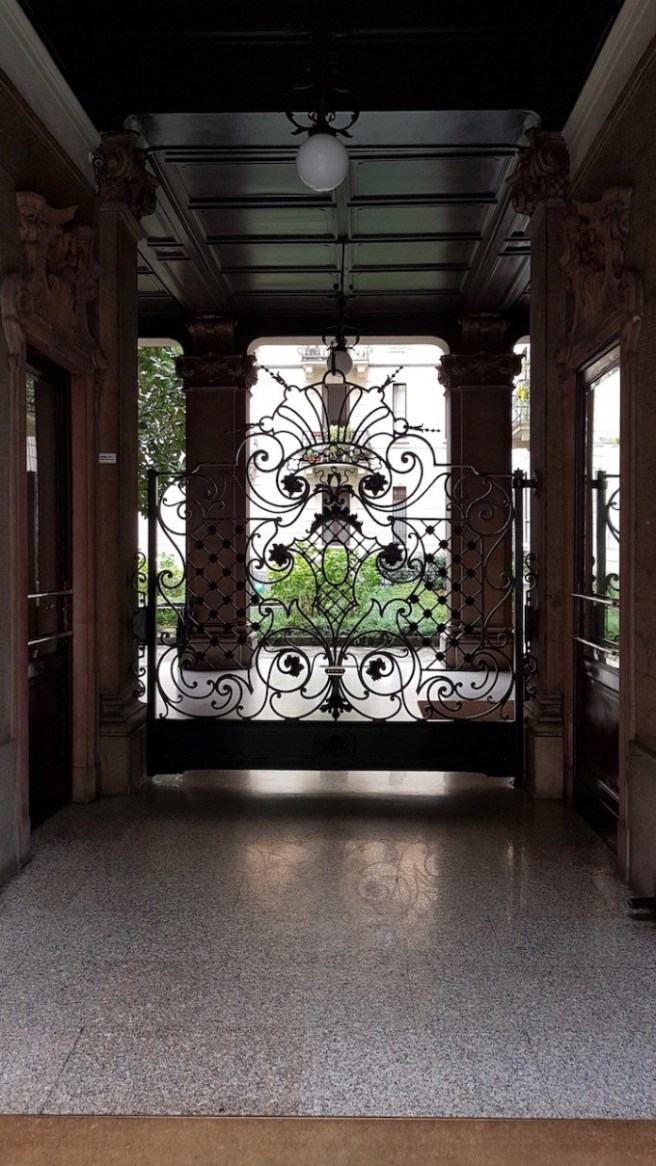
 and even gateways to splendid private houses…
 We lunched in the Piazza Del Duomo….
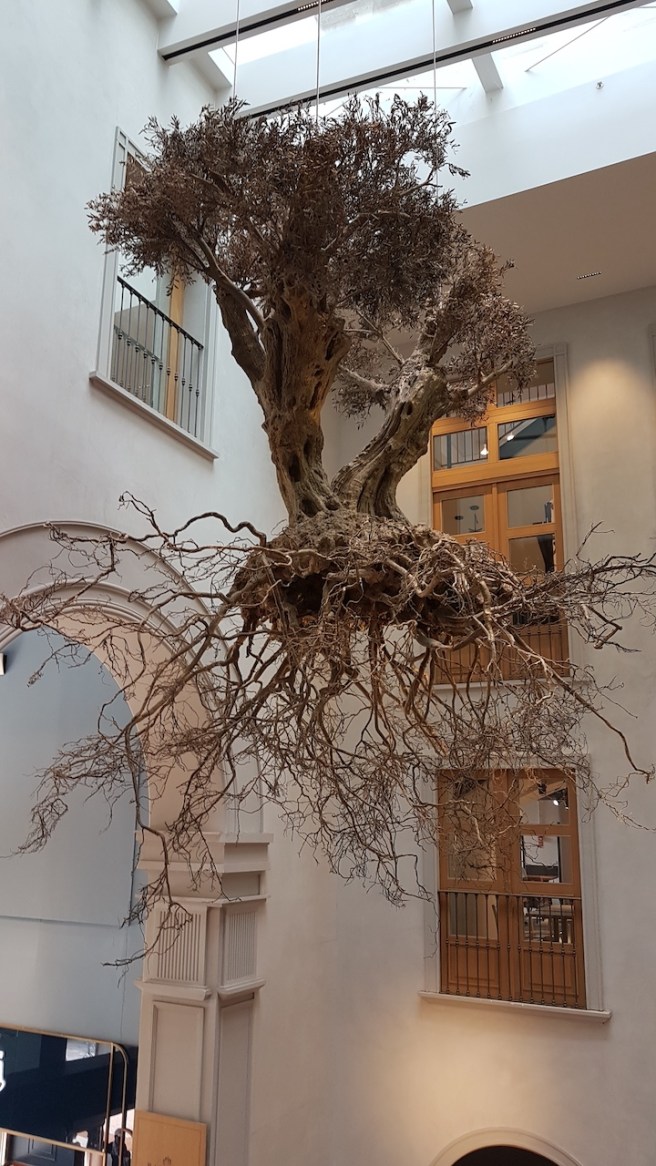
 having passed on the stairwell what looked like a very old olive tree but was in fact a bronze sculpture……..a- ma-zing….
 We then wound our way slowly down cobbled streets with a mix of old and new trams (very reminiscent of Lisbon)…..
 to a favourite Milanese public garden –
  we had a good look around the castle, the core of it dating back to 1358-1368 during the Visconti’s period who used the Castle as his residence while he stayed in Milan, but mostly used it as a military base. Later, it was mainly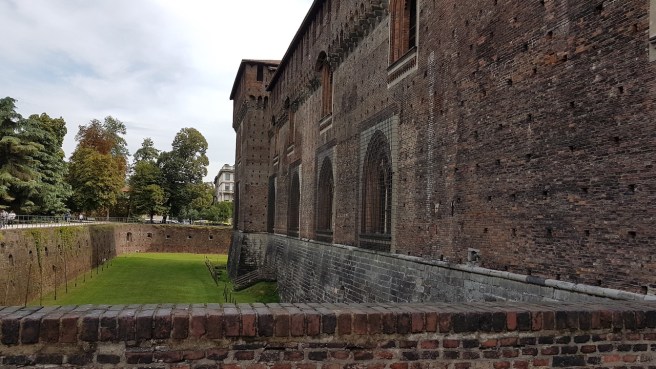
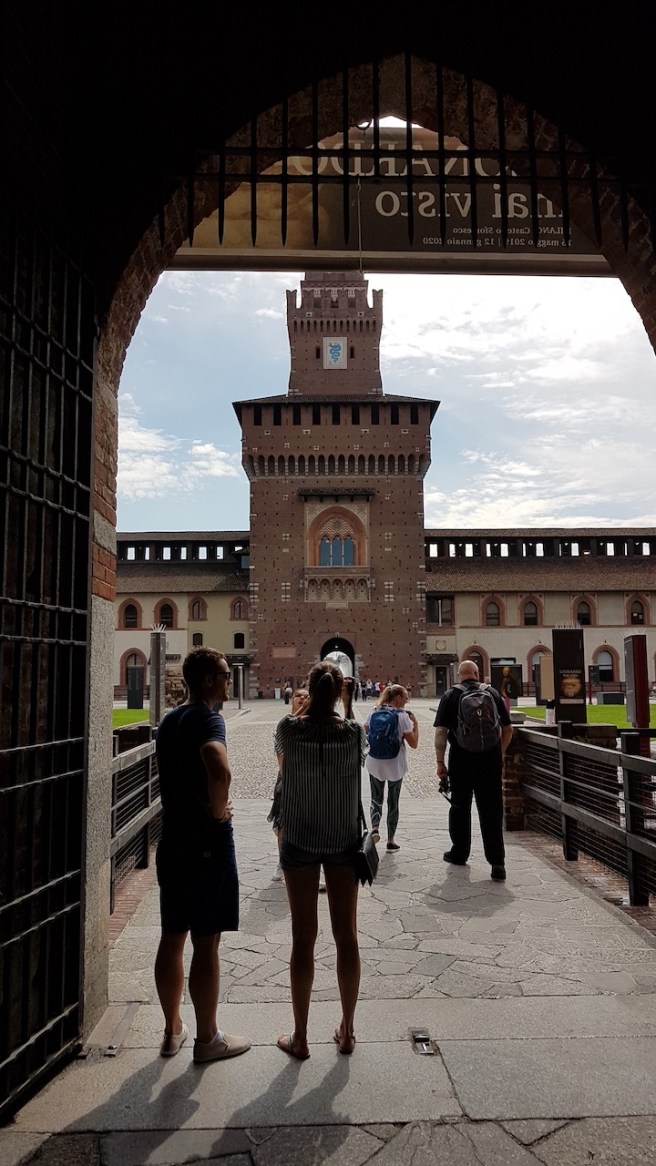
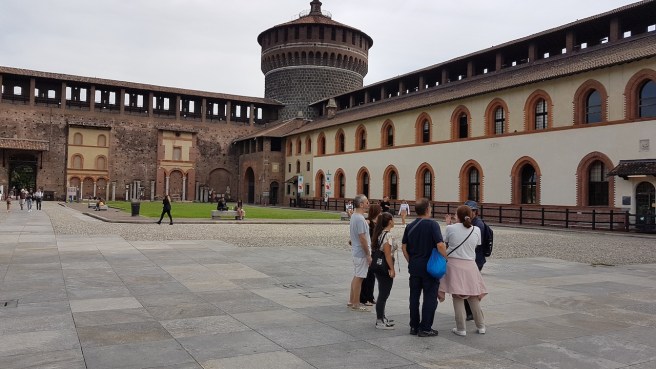
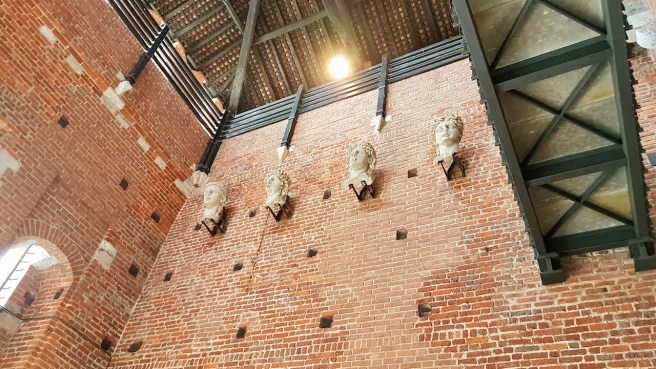
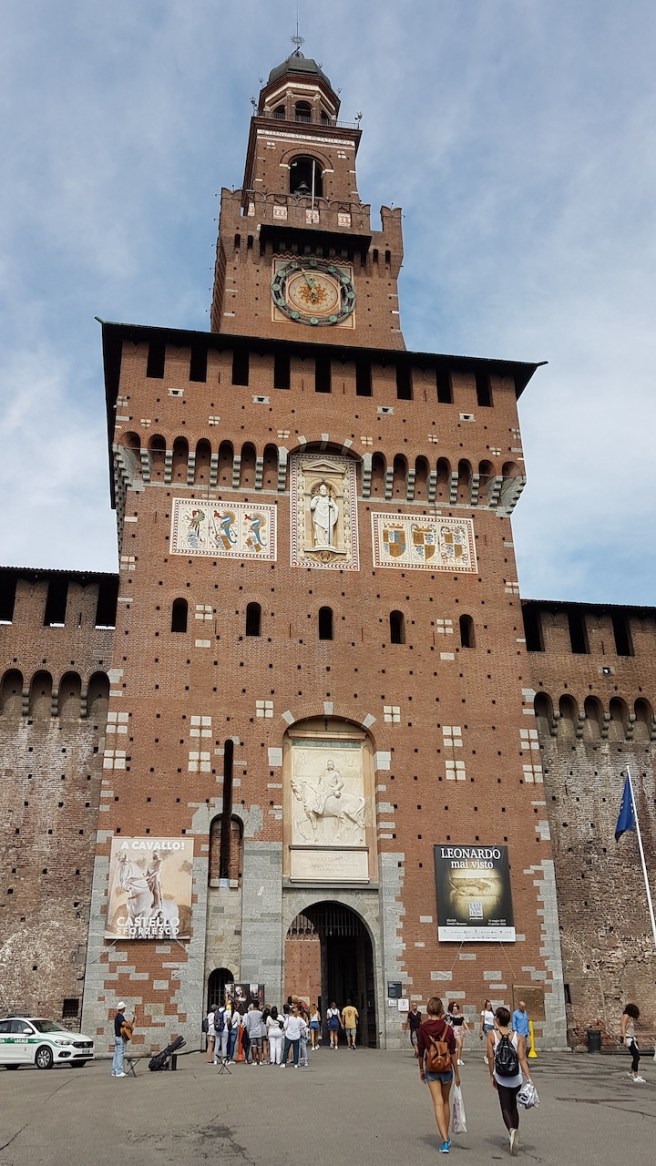 The inside of the castle is now home to several museums which we noted as worth our attention on a longer visit (let’s hope it’s soon!).
  We had covered a lot of ground and after another quick coffee made our way to our train, and here a word about the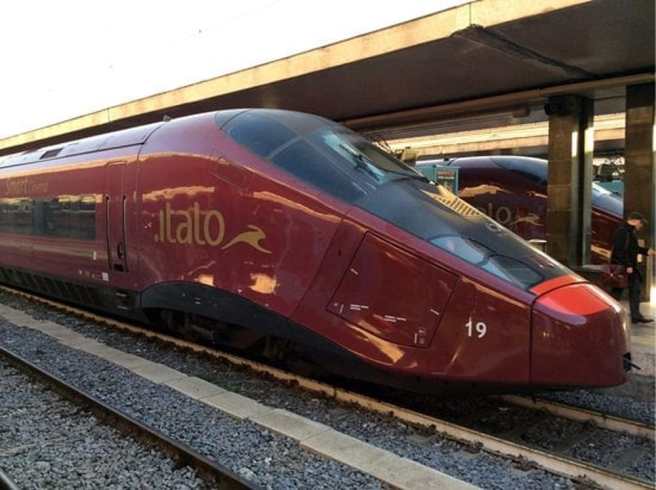
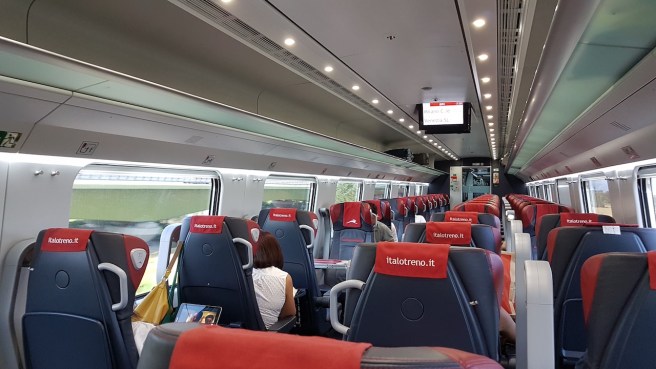 The area between Milan and Verona is famous for a number of
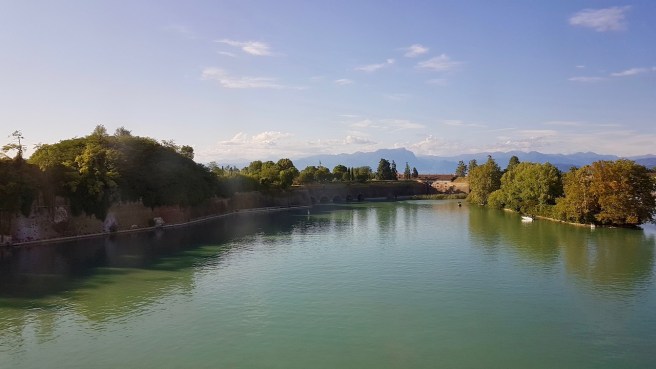
 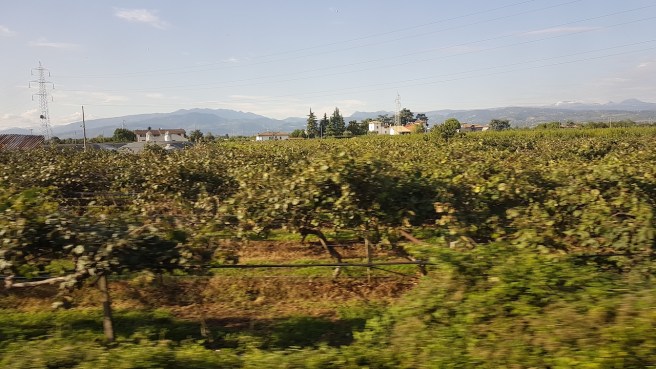 also the odd lake, and always the mountains in the background – the Apennines, the backbone of Italy, 870 miles long and surging up to 9000 feet at their highest…
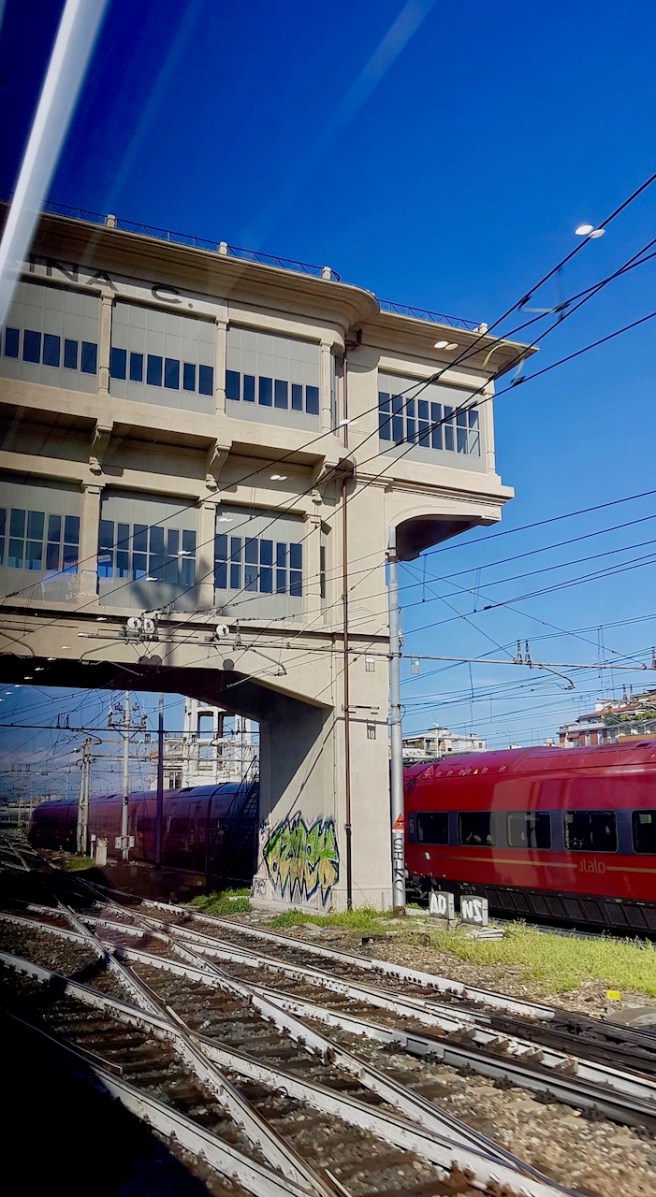
 The railway infrastructure was quite impressive too…here a signal box…what was most impressive however was the smoothness and speed of the journey – at one point we were doing 247k an hour (153mph). Fantastic.
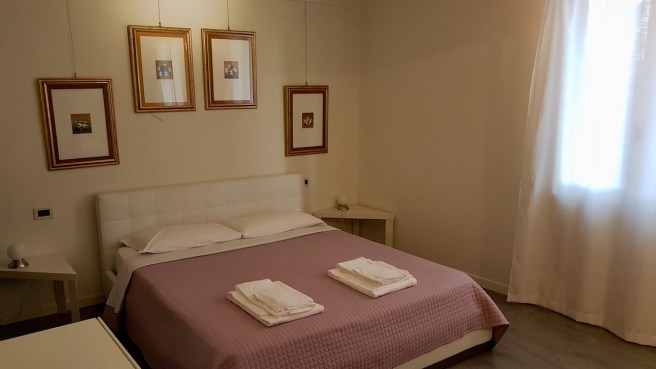
 Our flat in Verona was booked through Airbnb and was very pleasant. But its big plus was that it was outside the tourist centre and in a residential district. So the people we bumped into were Italian. Whilst this meant a reasonable walk to get into the centre, it was absolutely fine. We were in no hurry anyway.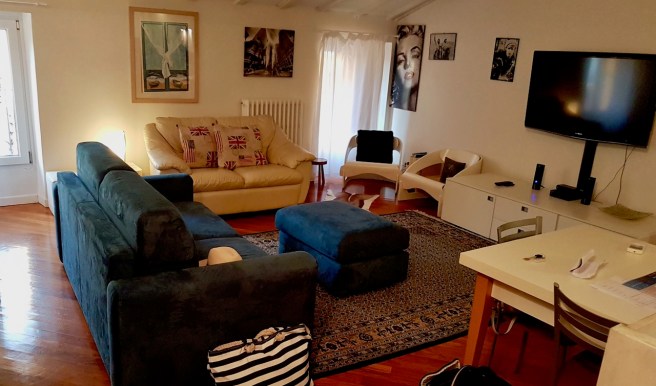
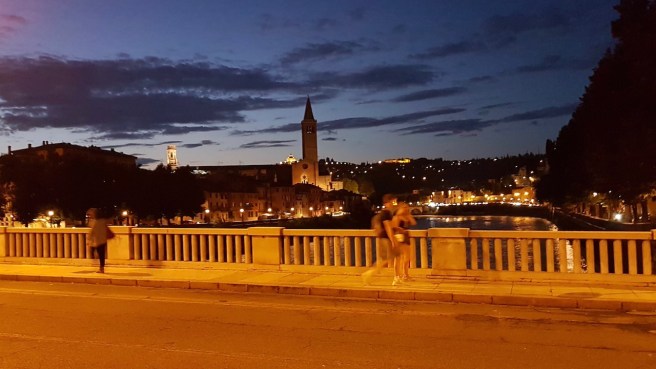
 On our first night we wandered over the Porta Nuovo into town, and relaxed with an outdoor meal at one of the hundreds of cafes and restaurants…
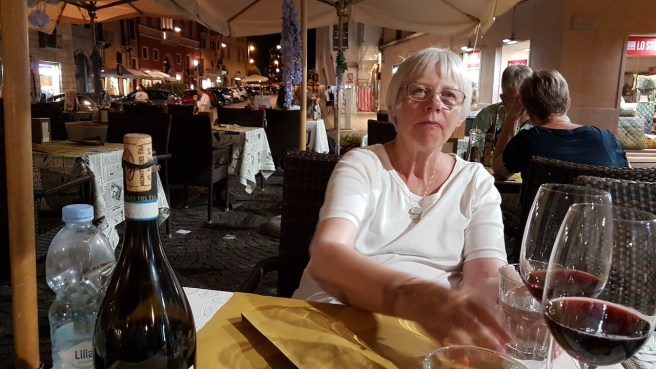
 F. had the most boring salad ever, my spicy aubergine bake was very tasty. The bottle of local wine went down a treat..
 Along the street of our restaurant were some excavations revealing what? I never did find out!
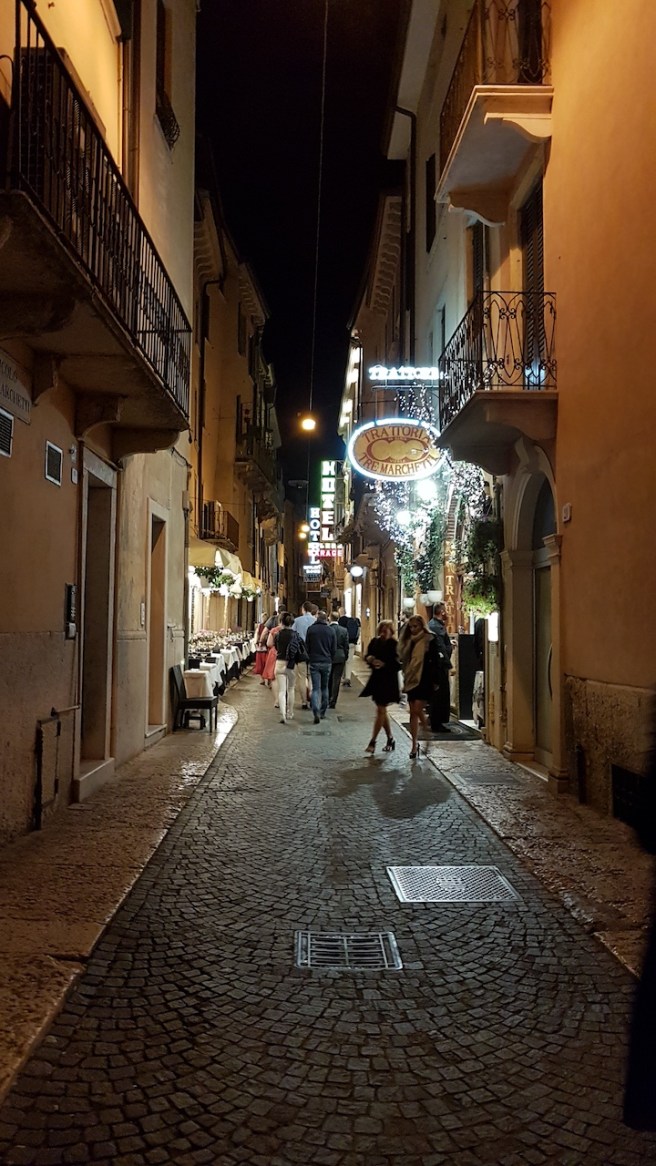
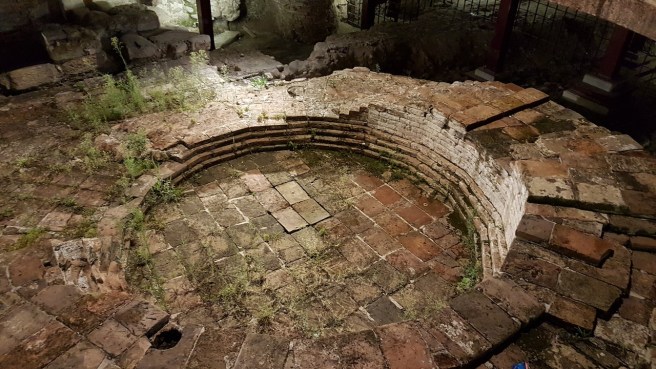 The atmosphere at night in Verona is great….it’s a pleasure to walk around.
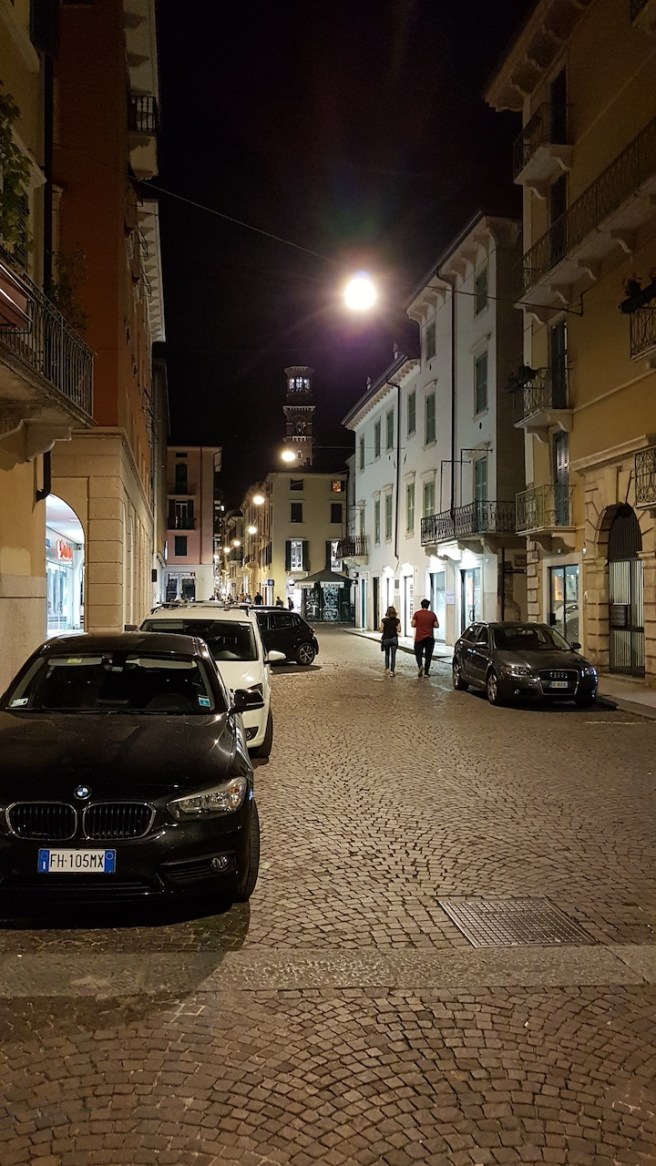 and lively……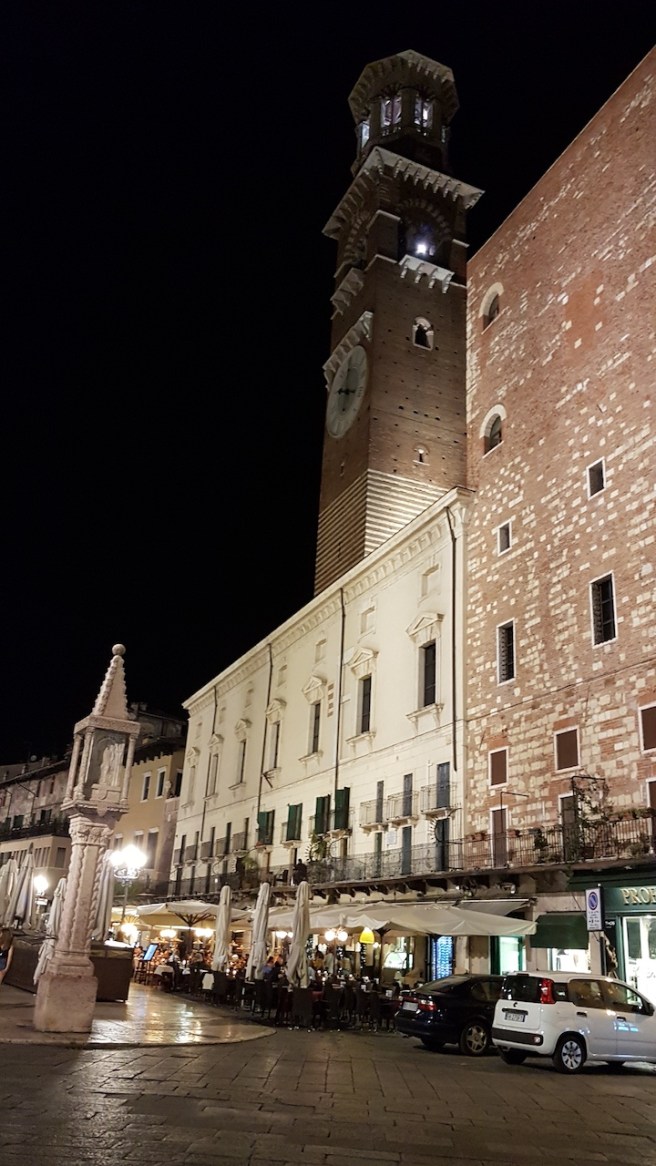
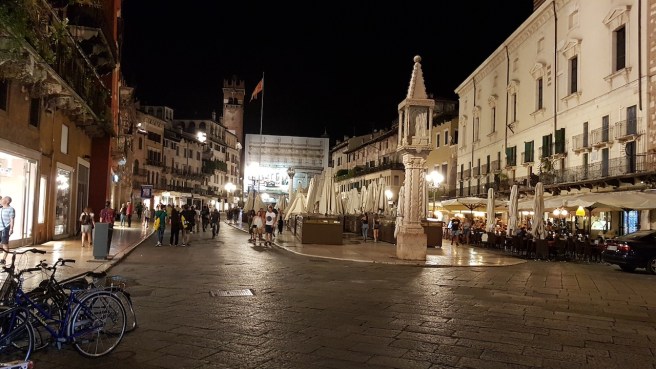
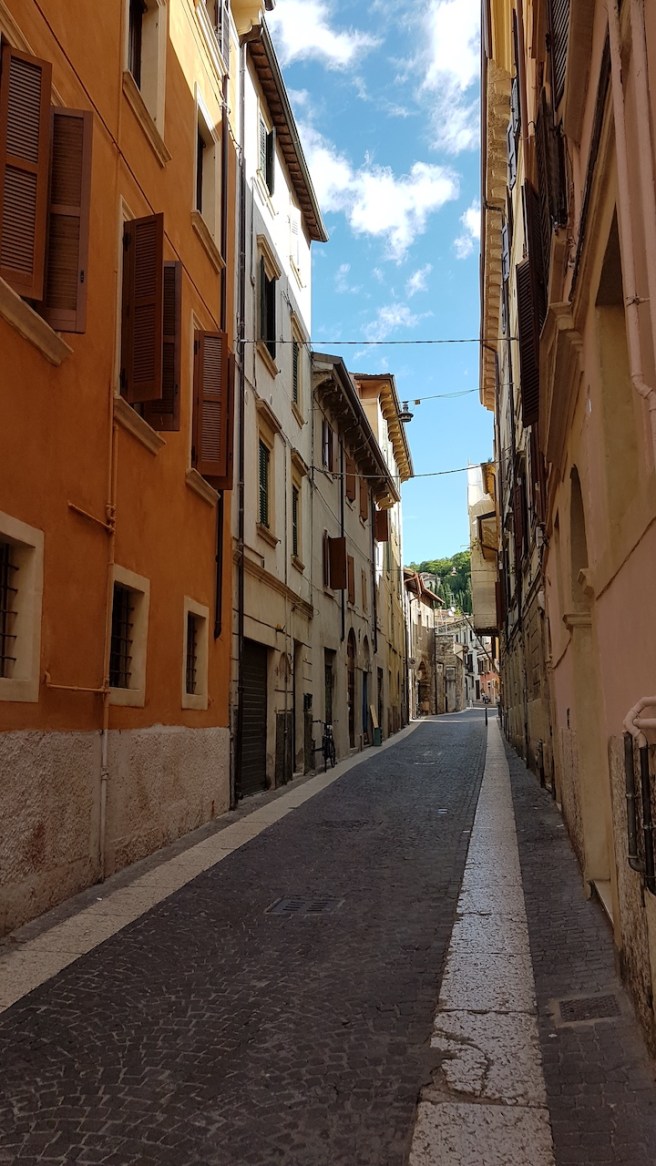
 The next morning – our first – we ambled along our narrow little street to the river…
 This is the river Adige, second longest in Italy, rising in Switzerland…..and there are beautiful walks and promenades along it….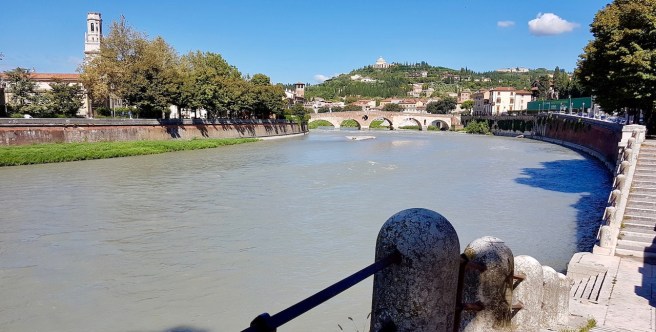
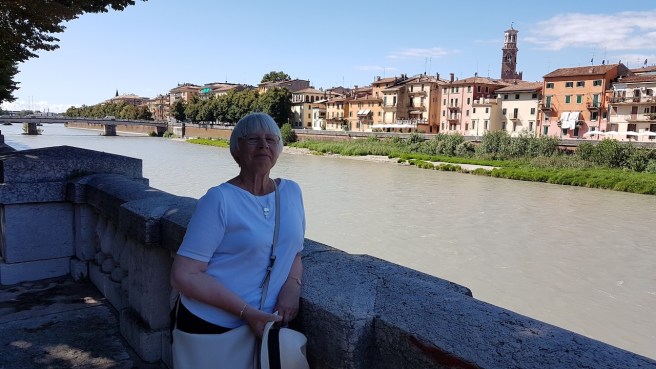 As this is Italy there are quite a lot of bikes…..
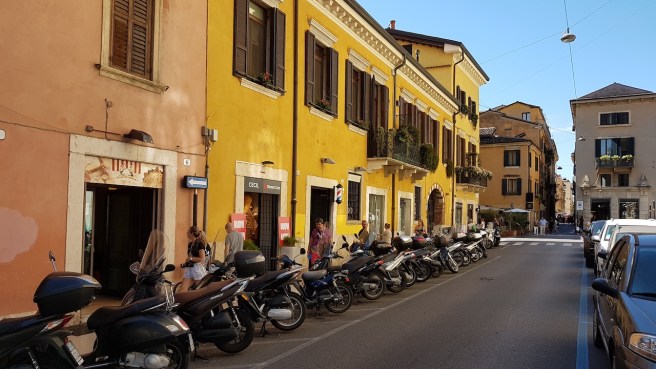 after walking into town we reached what is regarded as the centre of Verona –
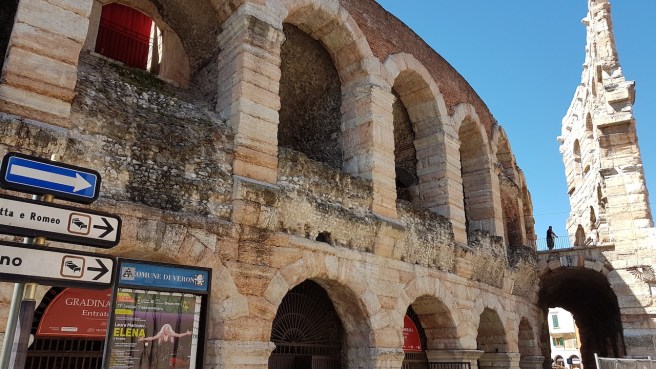
 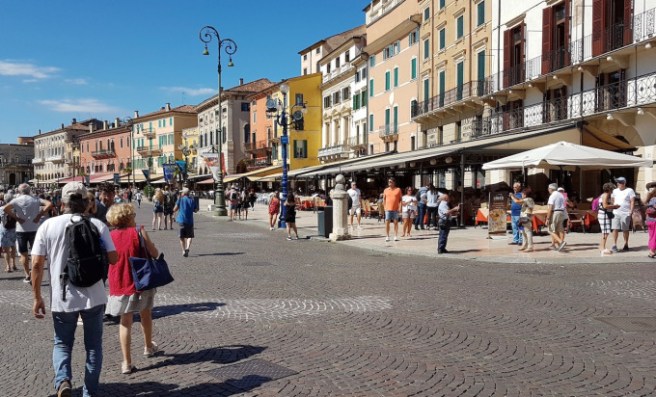 and of course the
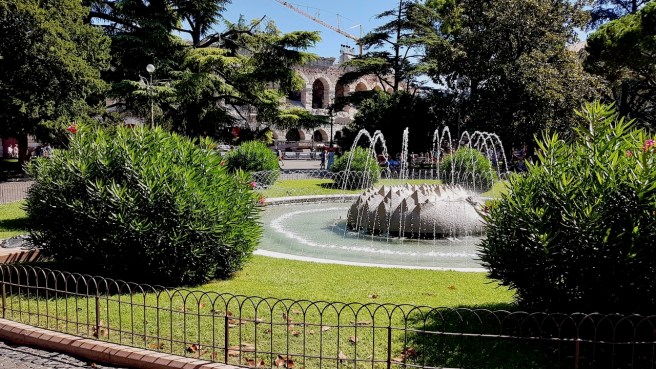
  Luckily, as the weather was hot, there is a beautiful little garden in the midst of Piazza Bra which we availed ourselves of to consult our map.
 Having bought a Verona card which was 25 Euros each for two days ( a bargain as it turned out ), and which allows entry to all sorts of places as well as bus travel etc, we then made our way through one of the ancient arches, this one fifteenth century……
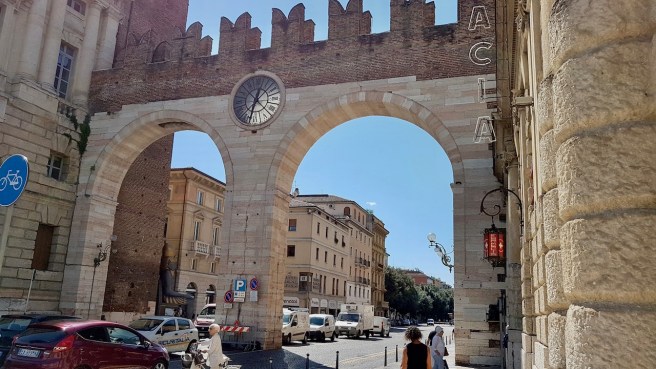 and along some nice arcades……
 to the Castelvecchio fortress which took the name “Castelvecchio” (meaning “old castle” of course in Italian) just after the construction of the Castel San Pietro in 1393, which is located nearby.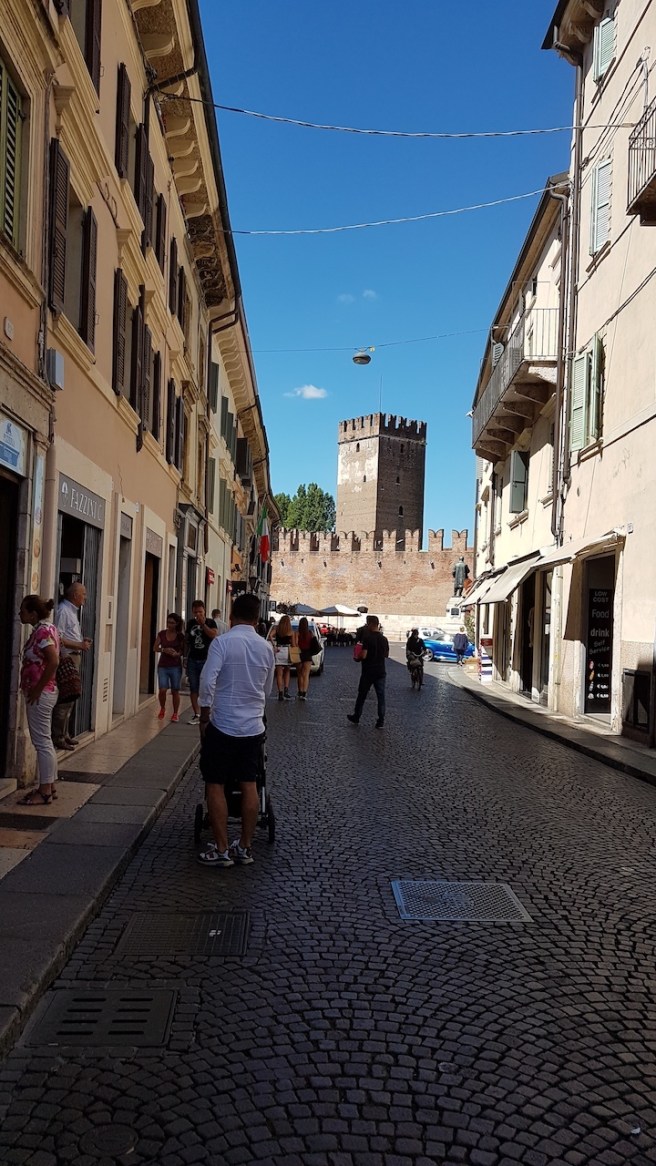
 The building is a large square compound made mainly out of red bricks and is an impressive example of Gothic architecture. One of the most noteworthy features of the castle is its imposing M-shaped merlons which run along the walls of the bridge and the castle itself. There are seven towers in the castle along with a maschio or a super elevated keep. Inside are four main buildings. Castelvecchio is surrounded by a ditch that is now dry. When the castle was first built, the moat was filled with water from the nearby Adige.
 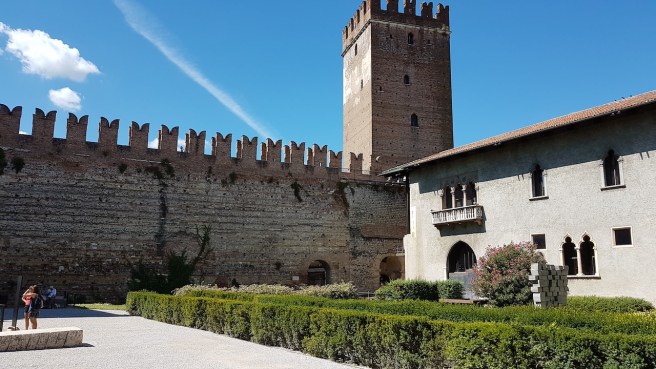 “It is believed that the castle was built on the location of an earlier Roman fortress. The castle and nearby bridge were built by Lord Cangrande II della Scala, who in 1350 married Elizabeth, the daughter of Louis IV of Bavaria and the Countess of Hainualt, Margaret II. The castle was constructed as a deterrent to attack by powerful neighbors like the Sforzas and Gonzagas and the city state of Venice. The construction of the castle started in 1354 and Cangrande died in 1359, before it was completed. The fortified bridge over the Adige was designed to let the castle’s inhabitants escape north to Tyrol in case of a rebellion or a coup d’etat. During the time of Venetian rule in the area slits were added to the structure to allow defence by cannons. The fortress was badly damaged during the Napoleonic Wars and Napoleon himself stayed in the castle many times when he visited Verona. Under the later rule of the Austrians the castle was used as barracks and was later restored in 1923.”
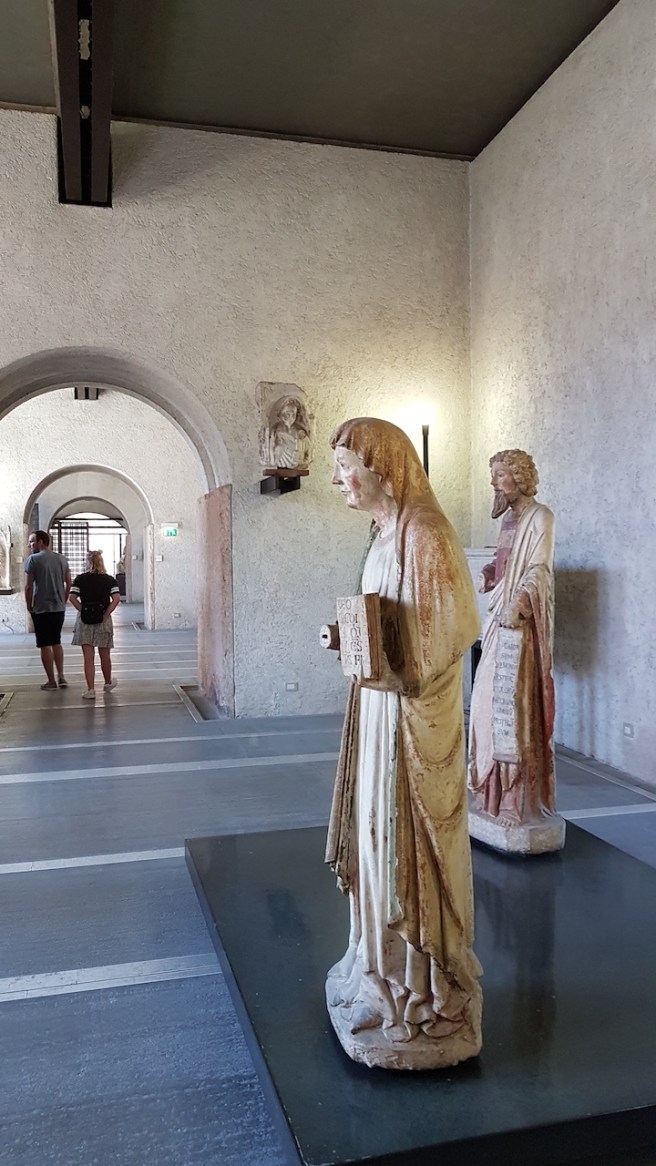
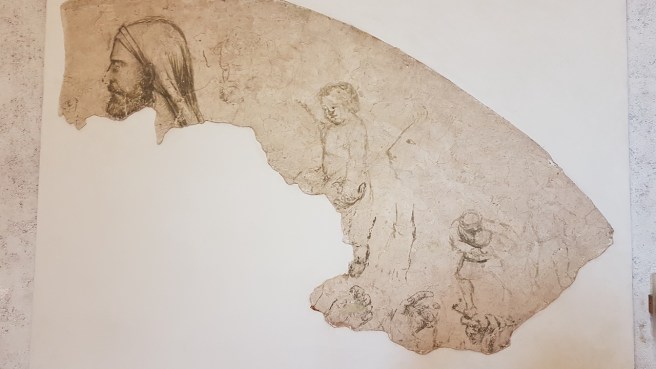
 The art galleries and museums were full of surprises and well worth an extended visit…
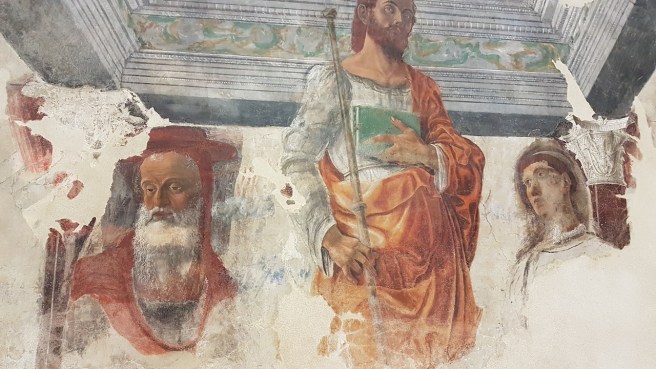
 One thing that particularly caught our eye on the walls were these artists’ preparatory drawings and underpainting – absolutely fascinating – and fourteenth century.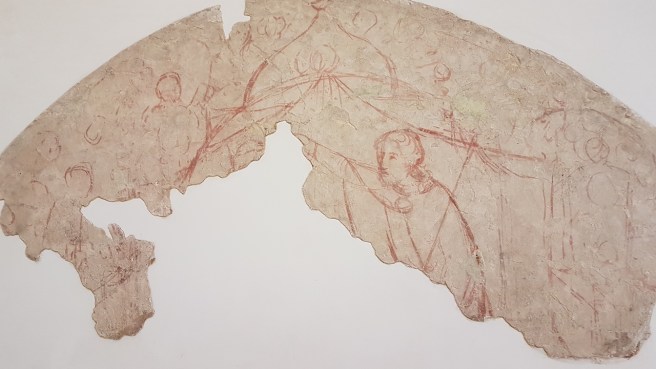
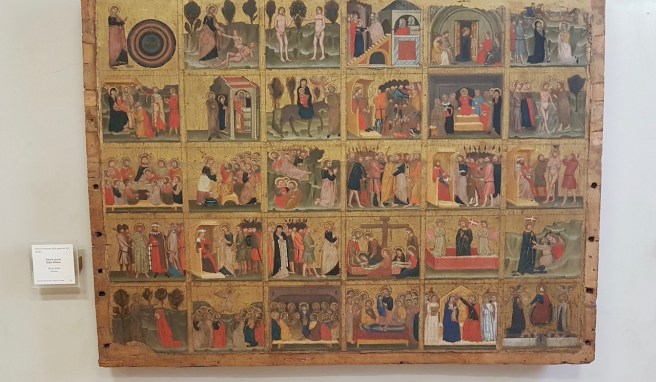
 and this – almost like a cartoon book – thirty Bible stories painted on wood, again fourteenth century.
 These pics give some idea of the sumptuousness of medieval wall decoration….pretty spectacular you have to agree.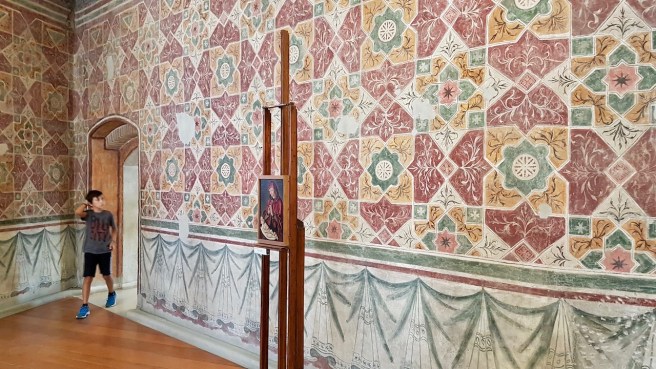
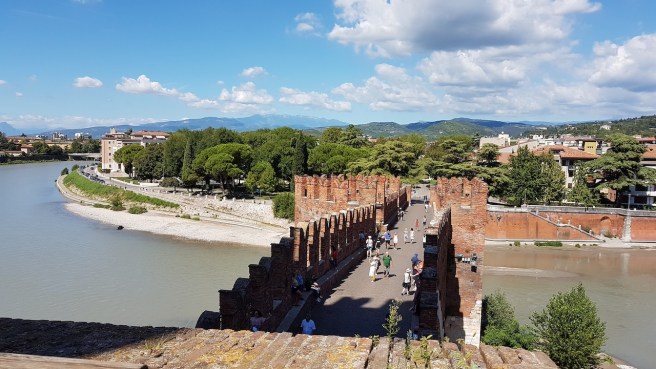
 And here a view of the Skaliger or Castelvecchio Bridge – a fortified bridge that was built over the River Adige. The bridge featured segmental arches and when it was originally constructed it had the world’s largest span at 48.7 meters.The bridge was built as we noted around 1354 by Lord Cangrande II in order to facilitate escape from his fortress. A reflection of the times! The construction was solid and the bridge remained intact until the end of the 18th century when French troops destroyed the left bank tower. In 1945, during World War II, the bridge along with Ponte Pietra was totally destroyed by the Germans. Reconstruction began in 1949 and was completed two years later on all but the left tower. The bridge was built using red bricks for the upper part, quite common with the landmarks in the city during the Scaliger era. The lower portion of the bridge was fashioned out of white marble. Legend has it that the designer of the bridge, Guglielmo Bevilacqua arrived at the inauguration ceremony riding a horse, ready to flee in case it came crumbling down. When the bridge was seen to be a success Bevilacqua was reportedly presented with a sword belonging to Saint Martin by Cangrande.
 One of the highlights of our visit was the walk around the walls and battlements…..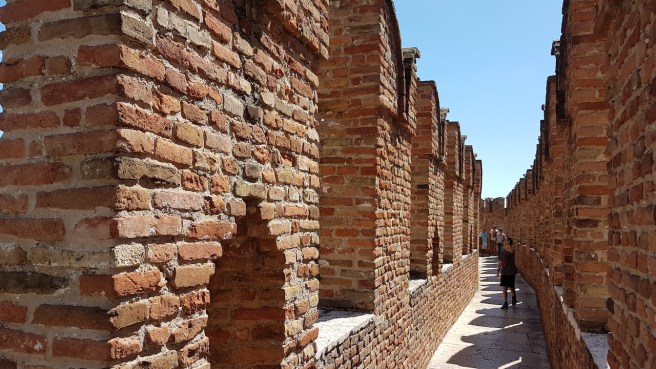
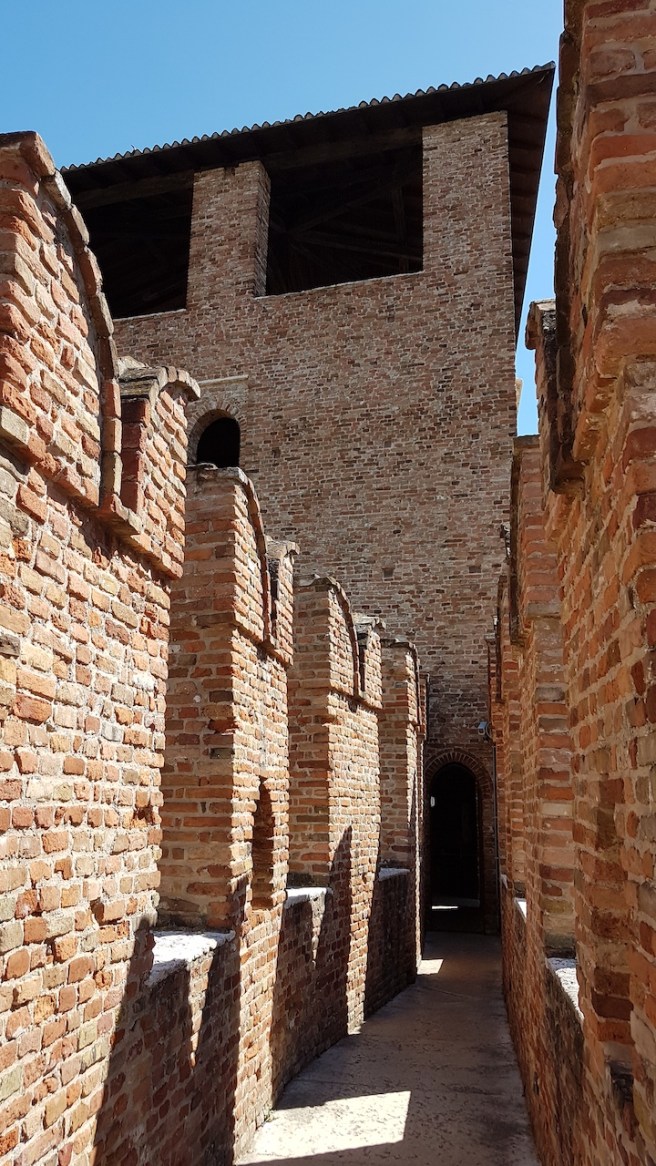 and I thought a very unusual and perhaps typically Italian stylish touch was to find a little garden perched on the battlements themselves. Terrific.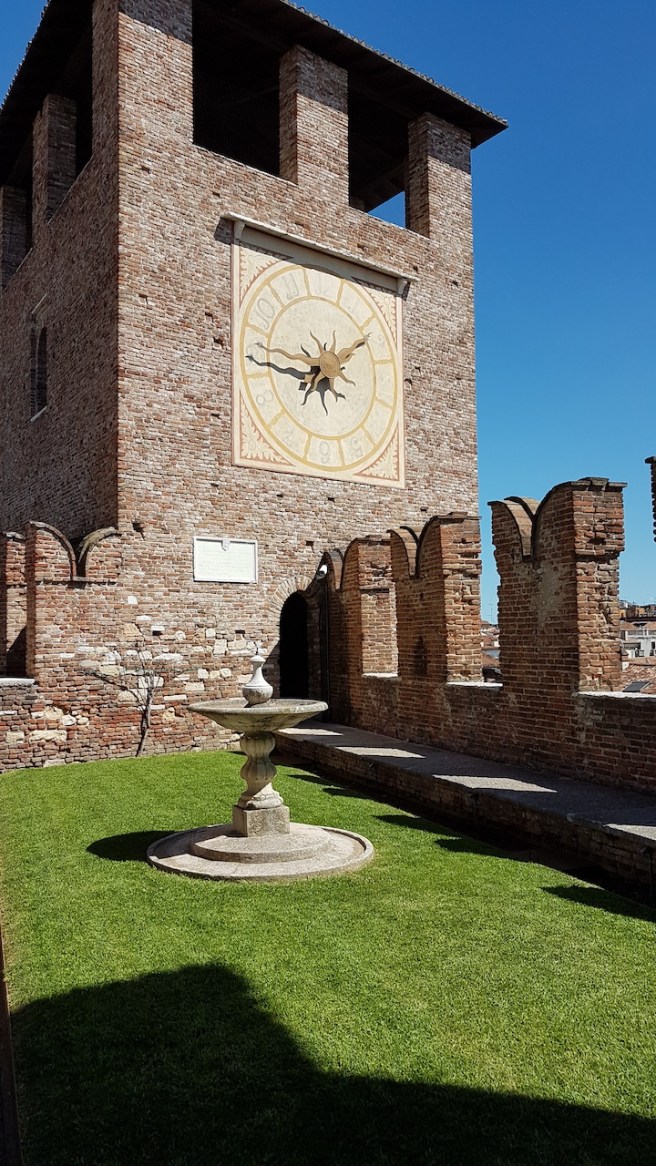
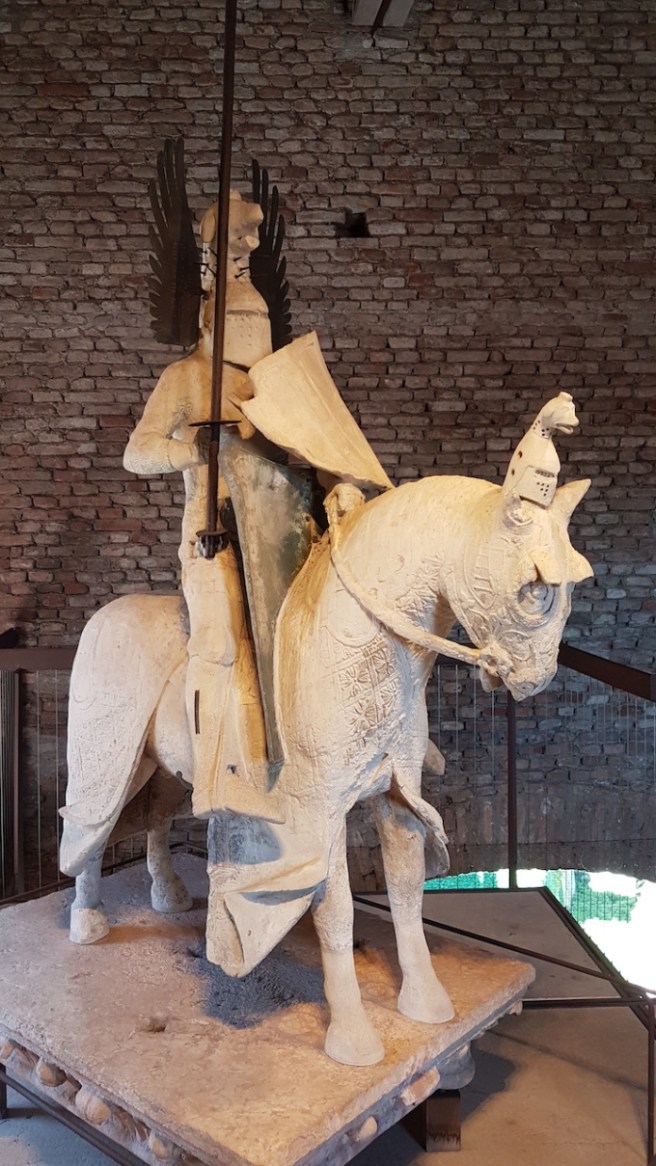
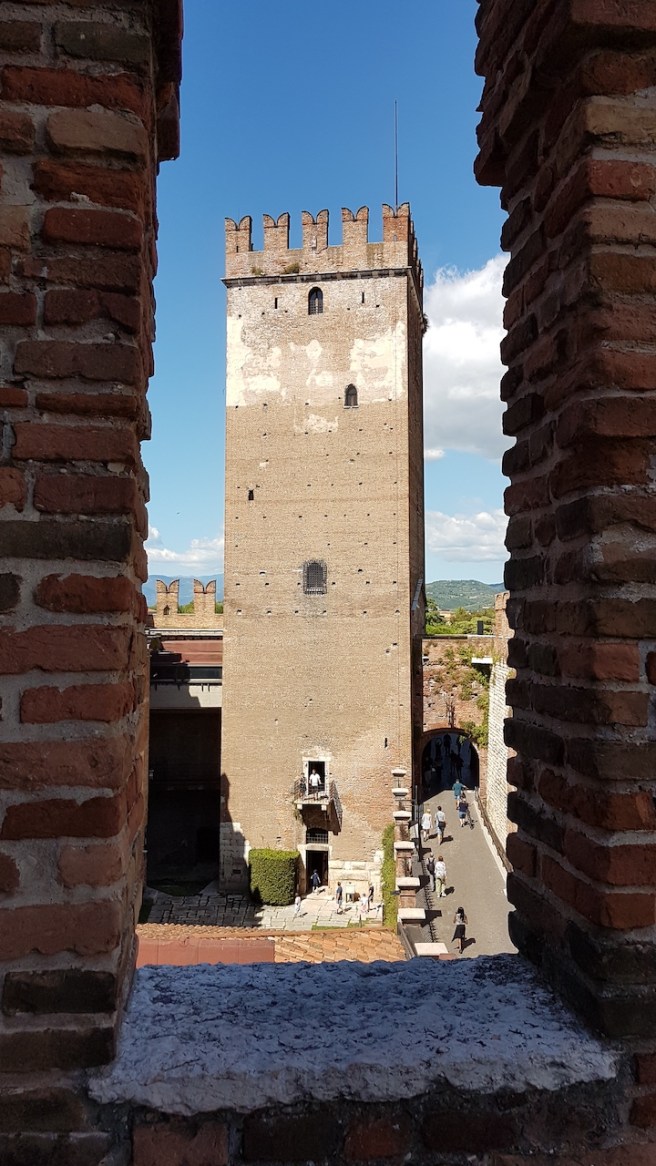 At the end of the high-level walk we came across a statue of Cangrande II Della Scala himself, immortalised in stone like the archetypal cavalier. Scarpa the architect decided to place this particular sculpture on a concrete plinth seven metres high, creating an niche that allowed the work to be seen from multiple angles…….
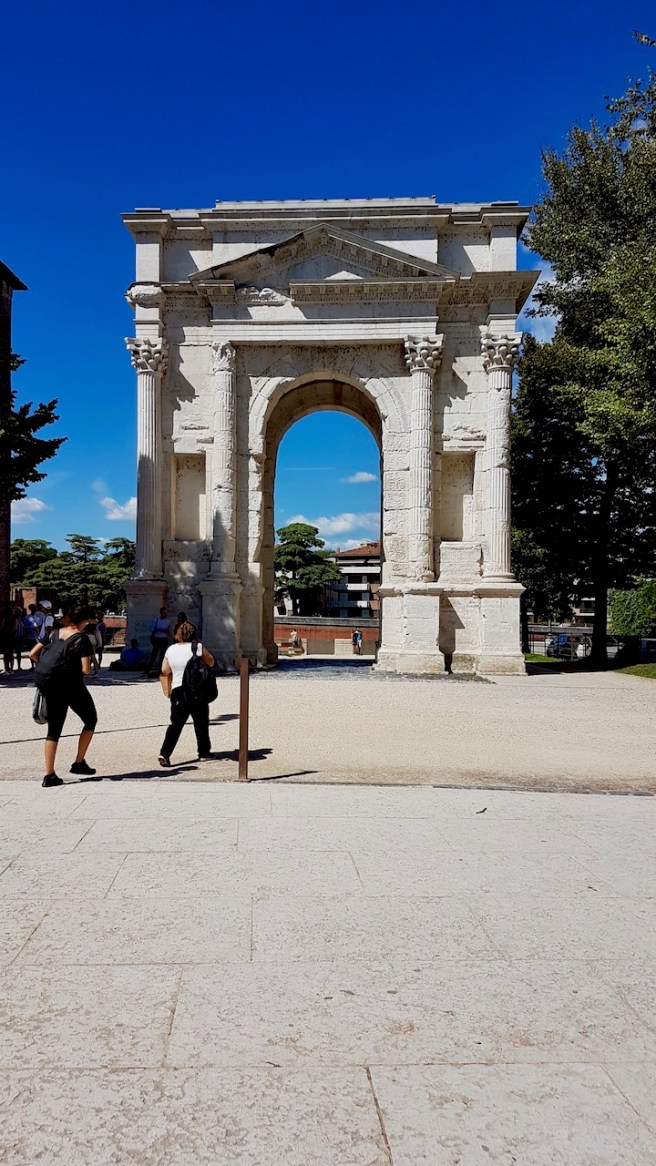
 Our little tour finished, just beside our bus stop was The Arco dei Gavi an ancient structure built by the gens Gavia, a noble Roman family who had their hometown in Verona, at the beginning of the Via Postumia, the Roman road leading into the city. During the Middle Ages it was used as a gate in the walls.
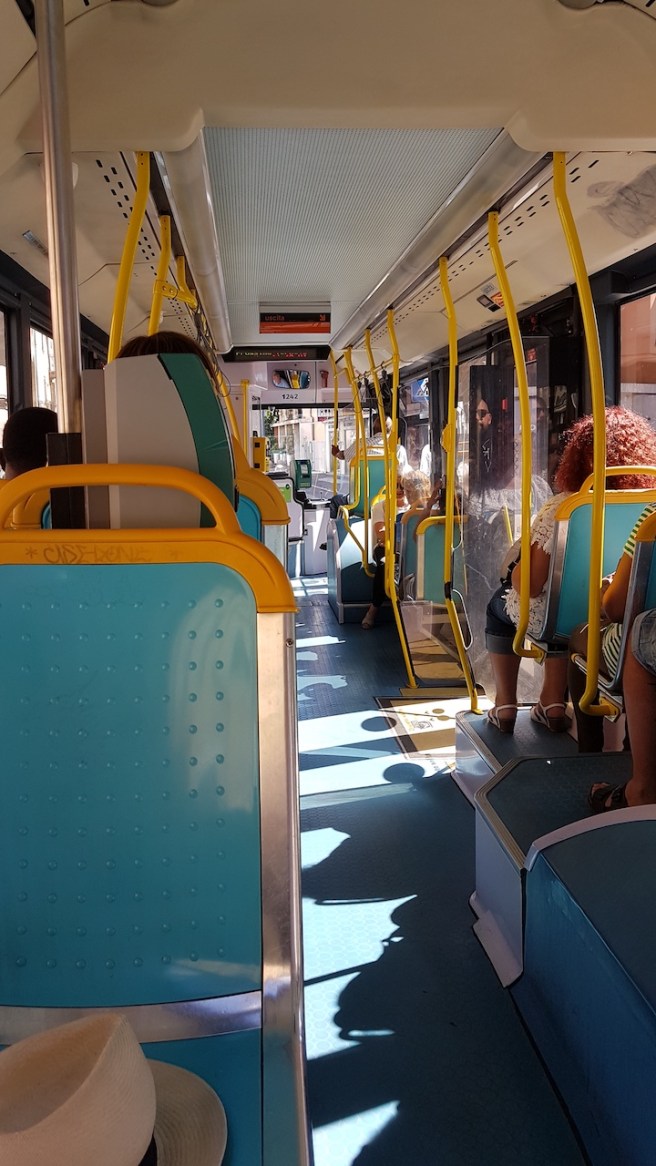
 Our free bus was very pleasant and free of tourists….
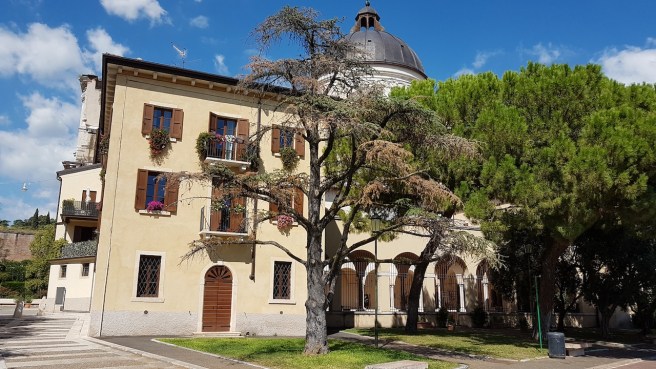
 We got off in an area where we quickly disposed of a double ice cream each and headed past a group of rather nice buildings….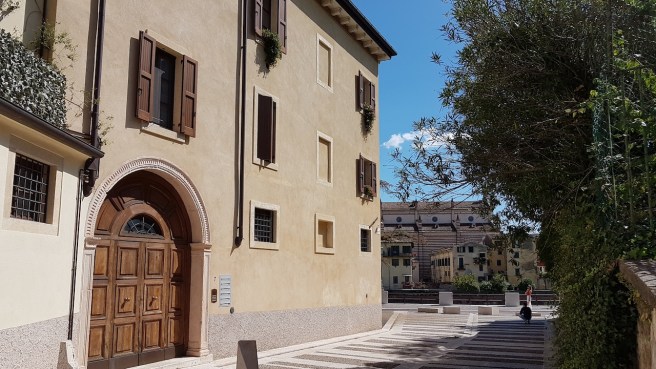
 and along a promenade…..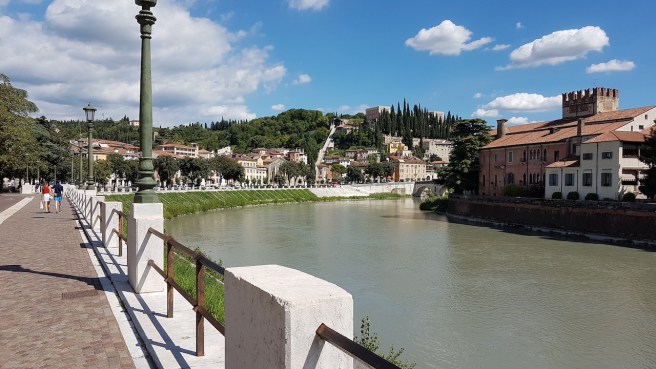
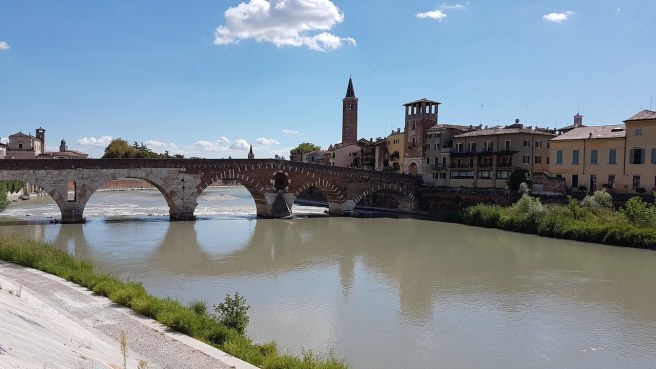 to the funicular which we took up to the viewpoint…
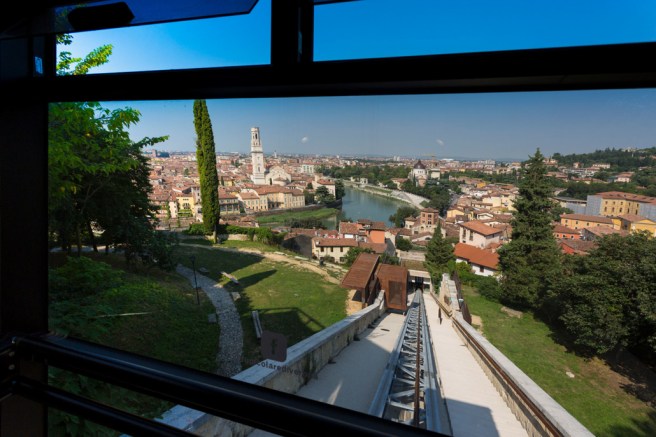 where we stayed a while enjoying the amazing vistas……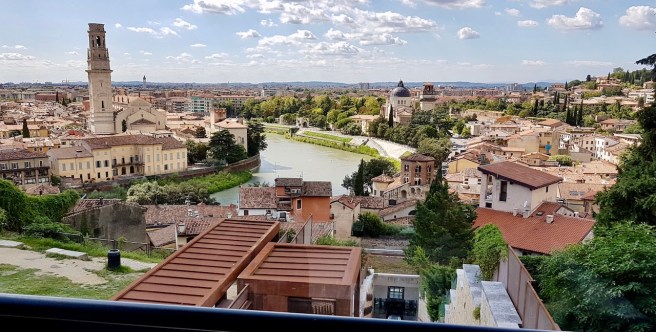

 It had all been thirsty work, so we stopped off at a hilltop cafe again with the incredible views and sank a large beer and orange juice…..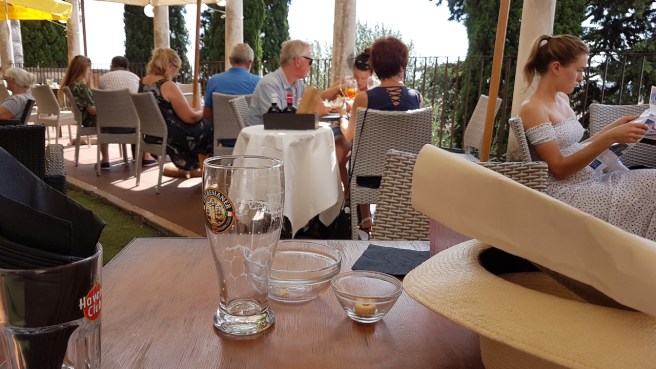
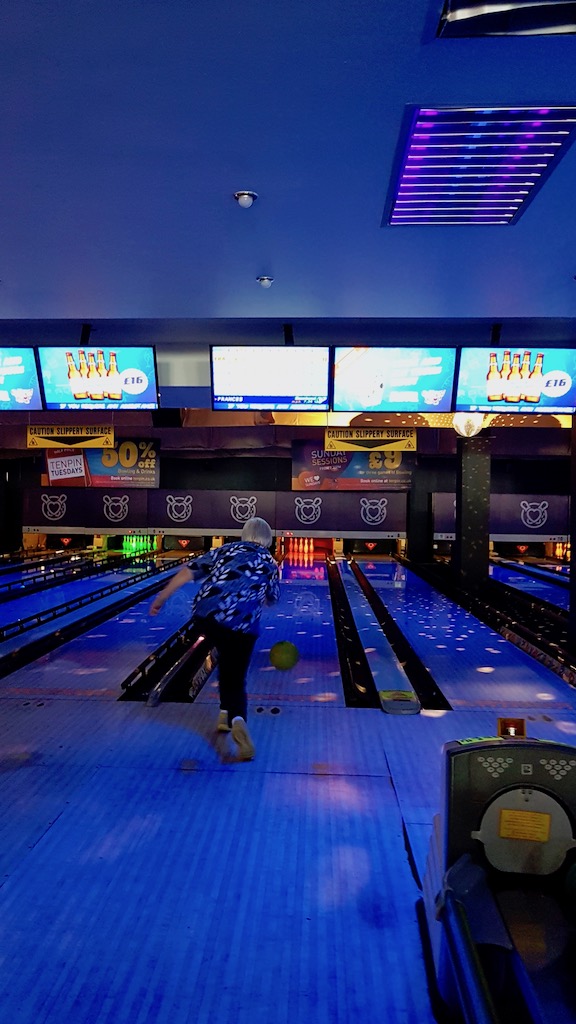 Visitors gives us the chance to do something different. When you have been in a place three years, you tend to the obvious. The always welcome appearance of David and Jennifer took us first ten-pin bowling. None of us the best but enjoyed by all.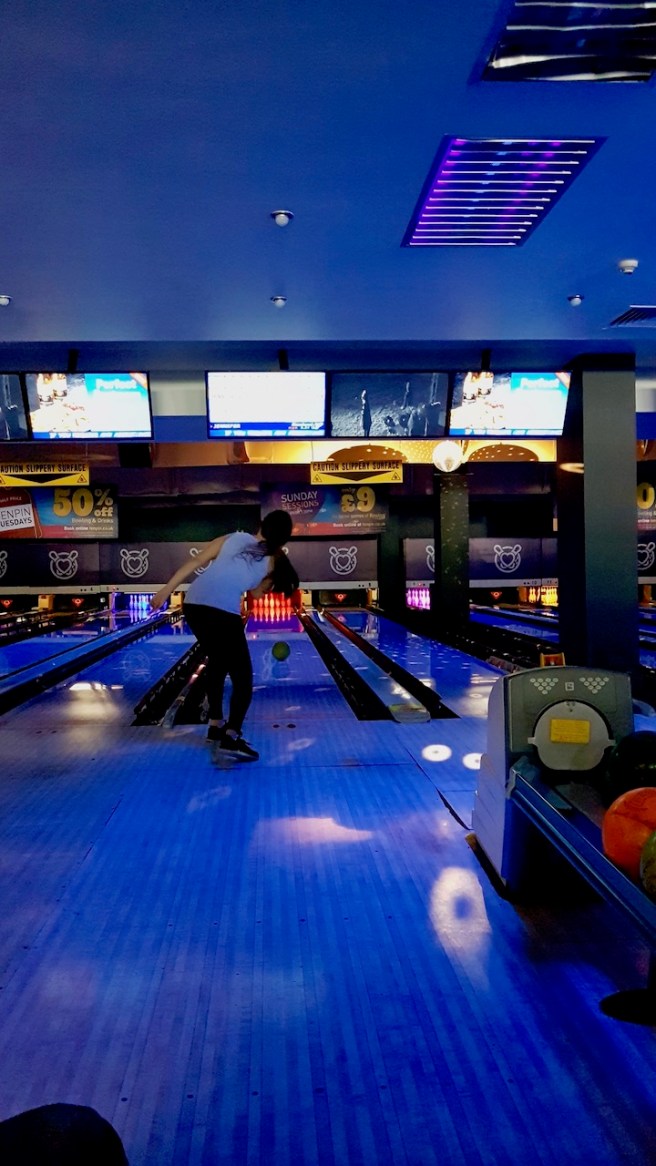
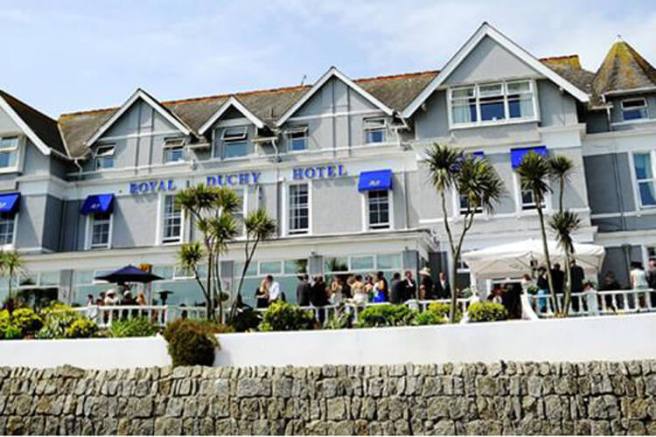
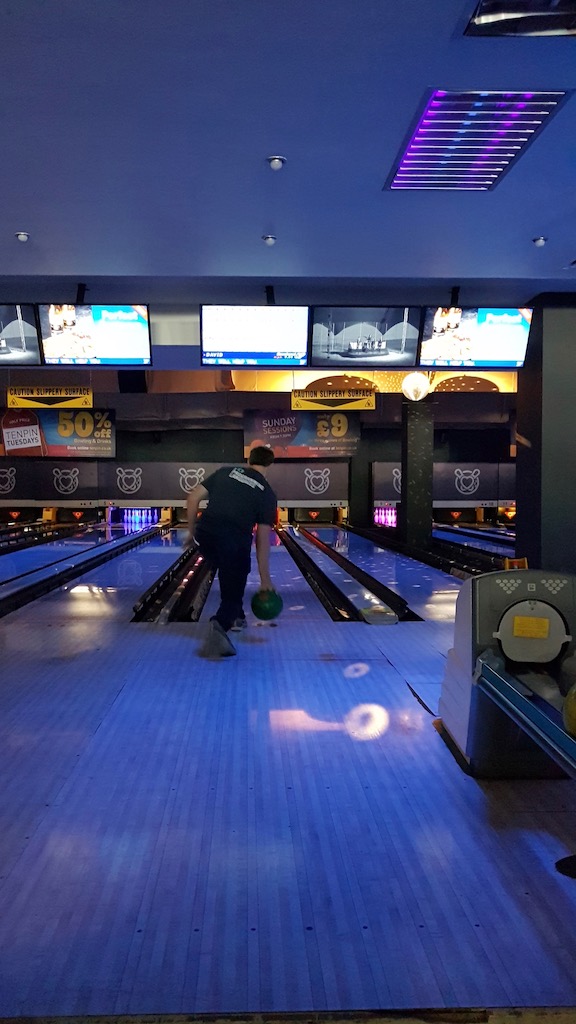 On another day we went to Falmouth. First a splendid birthday lunch at The Royal Duchy Hotel where we were then able to leave our car for the afternoon’s trip. Then into town.
 Always a great place to visit, apart from its seaside connotations Falmouth has some nice streets…
 and some brilliant houses and buildings – often the historic homes of sea captains.
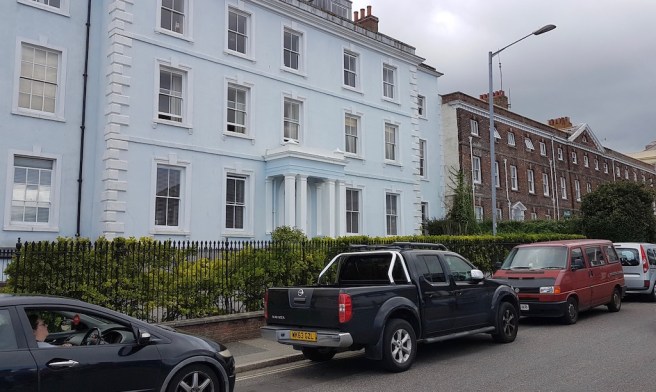
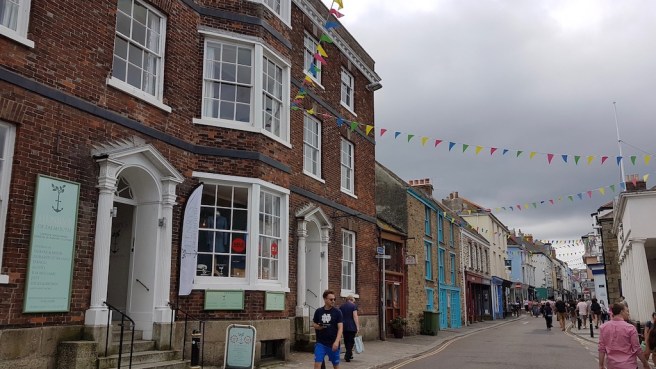
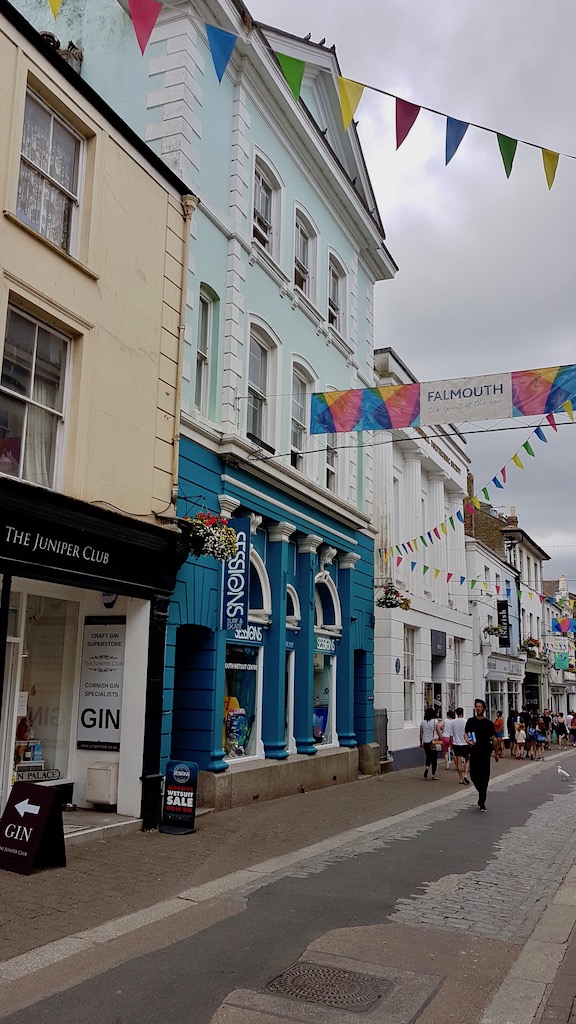
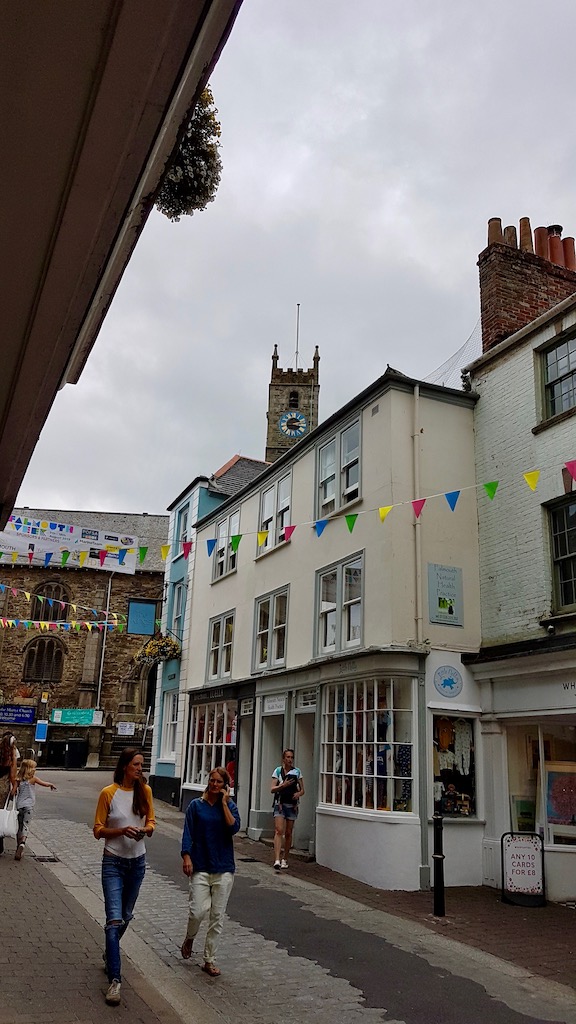
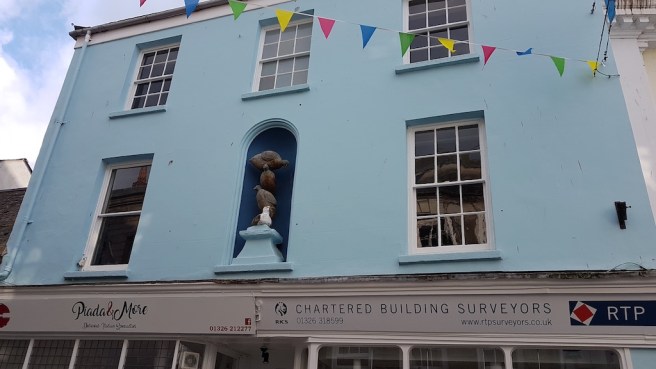 Being a Bank Holiday, the shopping streets and harbour were full of people and atmosphere.
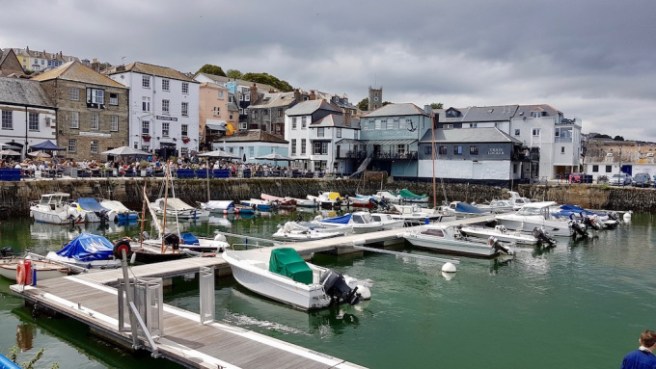 We however had decided to take the ferry across to St Mawes which is always a really enjoyable trip with plenty to see…..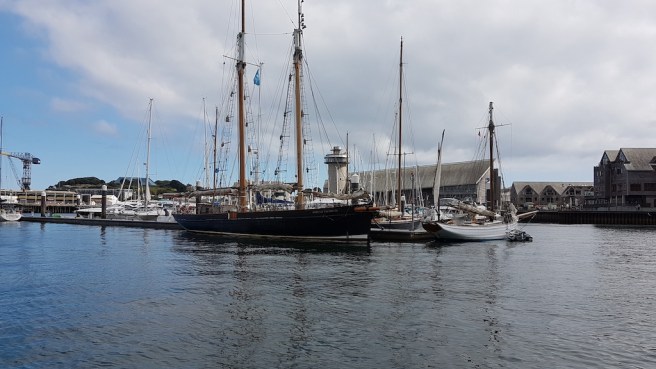
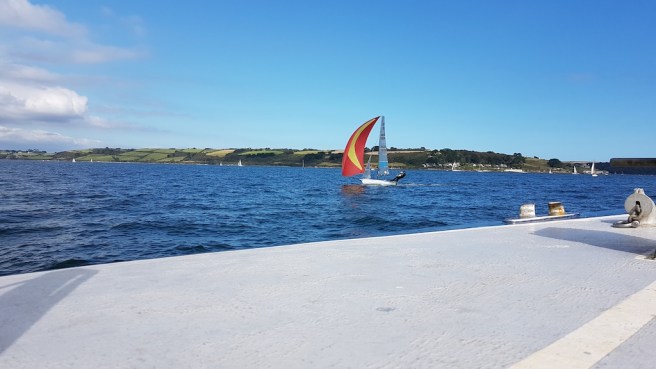
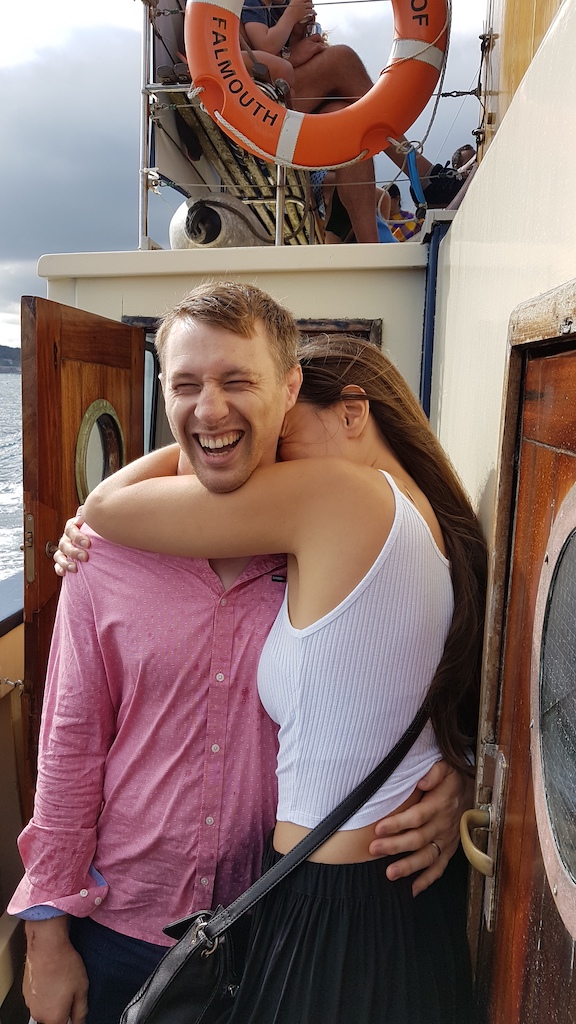 at both ends…..
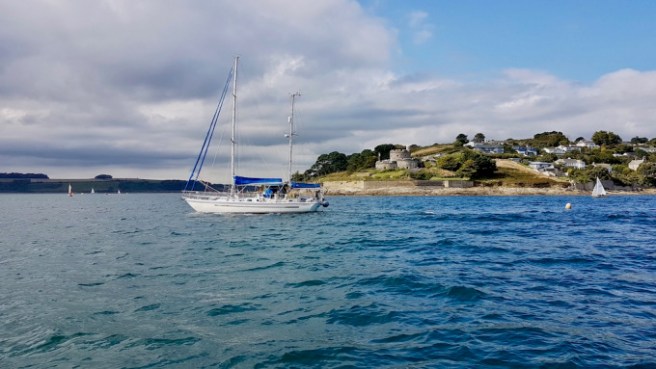 After a little paddle…….
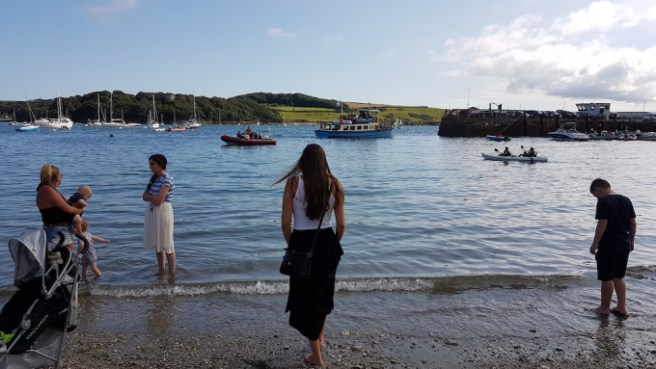 ……….it was good to see David and Jennifer were still enjoying themselves. We then walked along the ‘promenade’ through town to the castle.
 On the way this time I noticed a very quirky little gunnel or alleyway (don’t know what they call them in these parts……where we used to live in York it was ‘snickleways’}. Anyhow very picturesque.
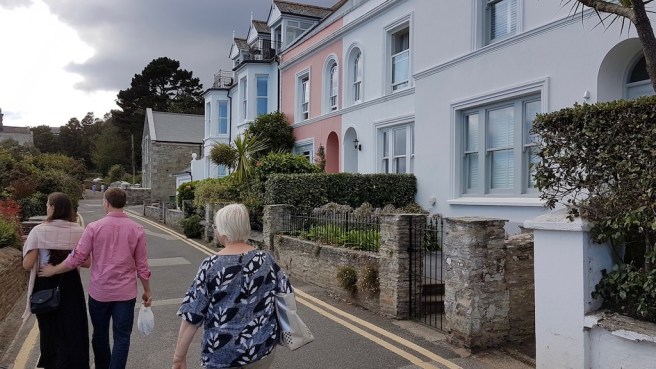
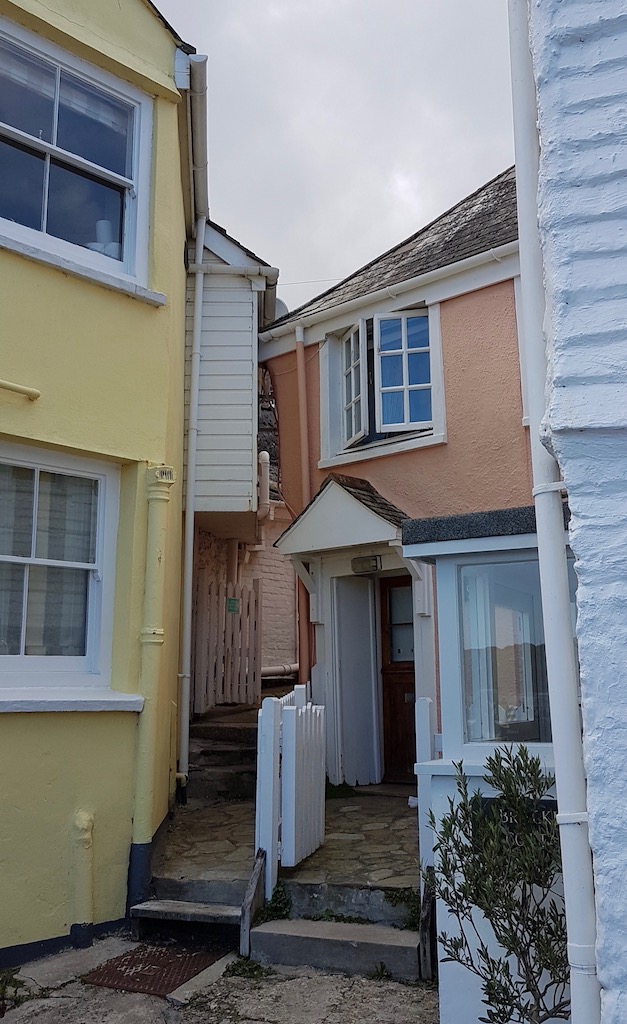 Not a single house in St Mawes I wouldn’t give my right arm for……
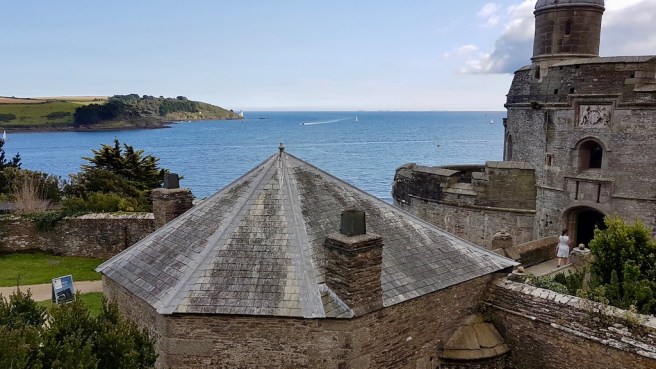
 The castle, looking across to its sister in Falmouth, was impressive as always….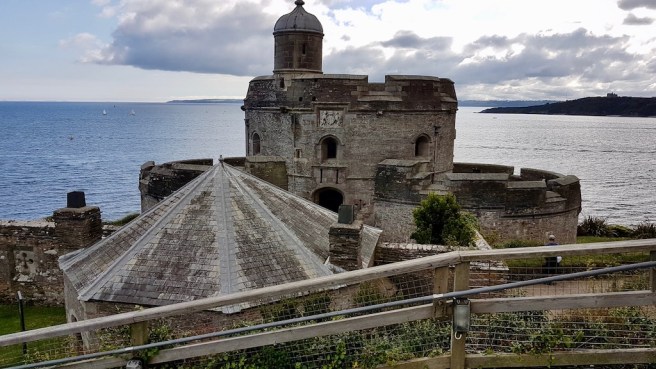
 But we decided it was all thirsty work and called to Olga Polizzi’s Hotel Tresanton for an ice cream and cup of Earl Grey….very nice.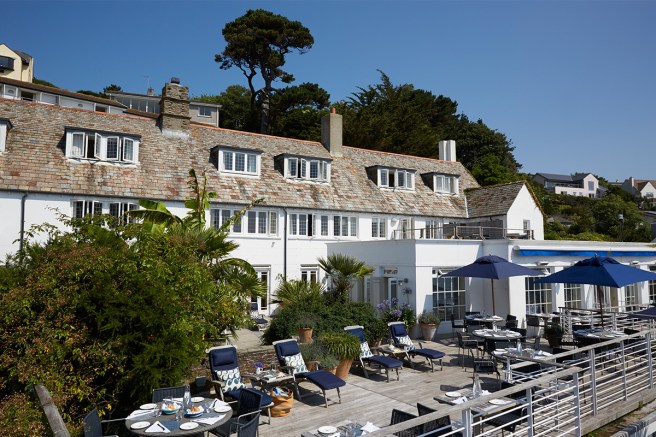

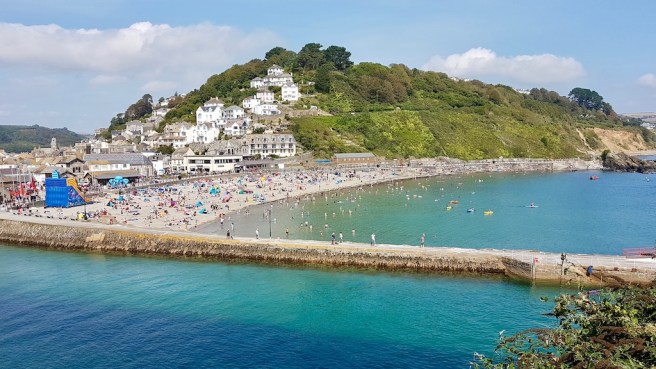
 All in all a lovely two or three days. And when they had disappeared back to London it was still Bank Holiday and one of those days when, in going to Looe to collect our daily paper, we found the sea busy as well as the beach…there are’nt many days like that!
 We also enjoyed the Lambretta parade through town…….maybe 50 or 60 of them.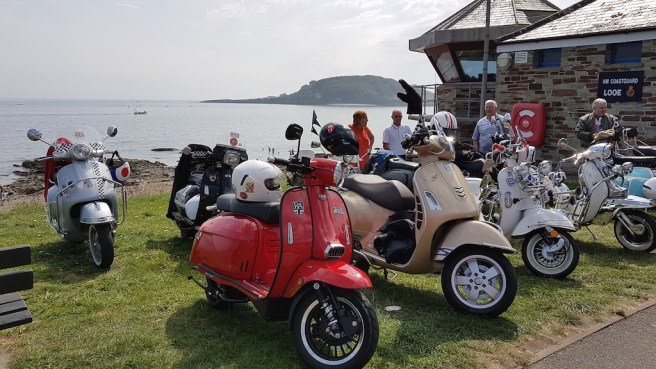
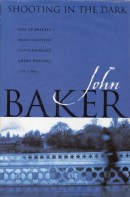 Rescued this ‘Shooting In The Dark’ from ‘unread books’ section, and found it was set in York which is where we used to live once upon a time. It’s Crime Noir North of England, and good for that. Location is so important to me even in crime novels, and John Baker ensures you know you’re in York. It got good reviews in The Sunday Telegraph, The Independent and from Val McDermid, so I had high hopes and I was not disappointed. I must explore what else John Baker has written. The first third in particular read like a hard-core New York novel with humour, and then it settled into its plot the main protagonists being Sam Turner, an world-weary private tec and two vulnerable sisters one of whom was blind. This gave an entirely different slant to things. Basically they were being stalked by someone who wanted revenge for a childhood disaster. I really liked the fact that the characters were sympathetic and nearly all of the time I appreciated the minor characters being highly intelligent (much philosophising, particularly on existentialism). Recommend? Definitely……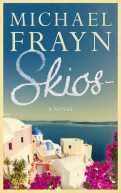
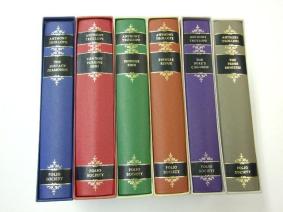 Trollope himself considered ‘Can You Forgive Her?’, ‘Phineas Finn’, ‘Phineas Redux’ and ‘The Prime Minister’ to be the four novels that constitute the Palliser series. In his autobiography he wrote…….”To carry out my scheme I have had to spread my picture over so wide a canvas that I cannot expect that any lover of such art should trouble himself to look at it as a whole. Who will read Can You Forgive Her?, Phineas Finn, Phineas Redux, and The Prime Minister consecutively, in order that they may understand the characters of the Duke of Omnium, of Plantagenet Palliser, and of Lady Glencora? Who will ever know that they should be so read?”. Self-deprecating as usual, he thought that his reputation would soon wither, and that in no time at all he would be forgotten.
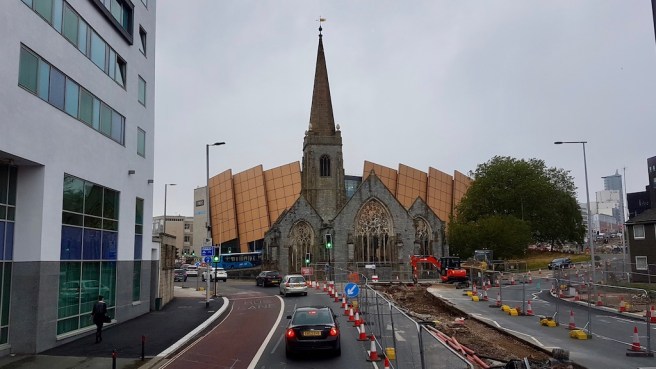 Katherine and Aiisha came hot-foot from Spain to share a birthday weekend. My 70th. On our way to our first ‘adventure’ – ice skating at the Pavilions in Plymouth, we passed Charles Church, bombed out during the war but given almost a sculptural quality with the background of the Drake Shopping Centre. It almost seems planned to set the old church off….perhaps it was. Skating was good. The next day we chose to have lunch at the Duchy Garden Centre so that Katherine could look at some plants for her new garden in Edinburgh. Aiisha and I decamped for a short while to the new children area which was very nice indeed…….
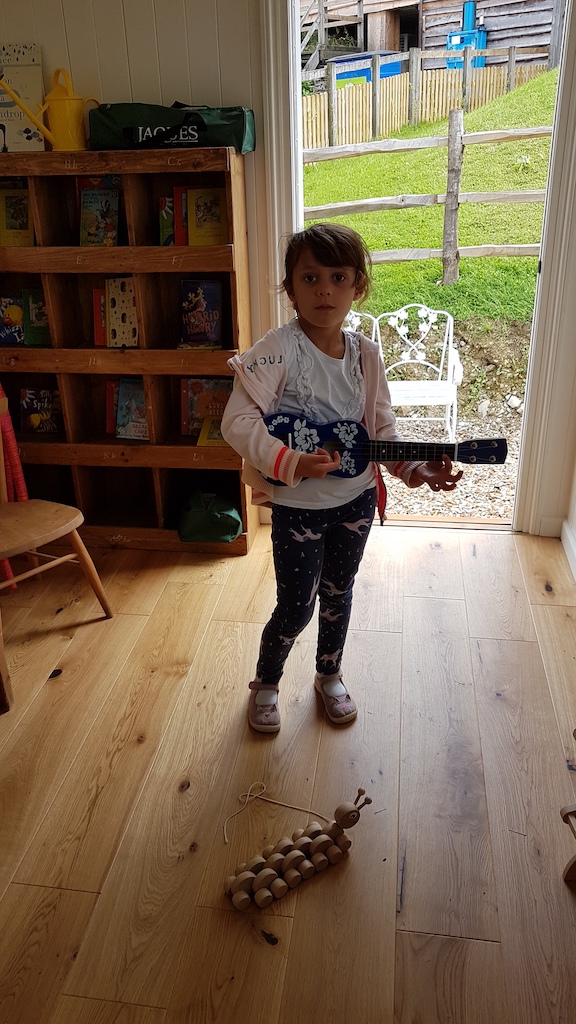
 and we loved the wheeled gypsy hut, where Aiisha showed off her versatility with her Dad’s instrument of choice…
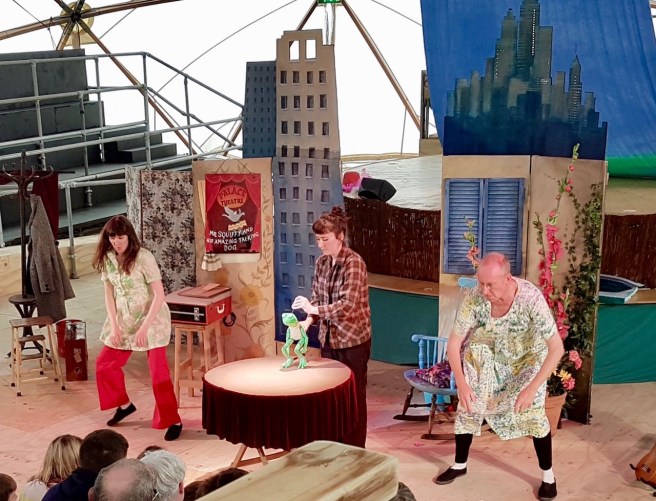
 Lunch over we set off for Carlyon Bay where Katherine had bought tickets for a show by the Knee-High Theatre Company called The Dancing Frog. After a lacklustre start it developed into a really really fun show. I haven’t enjoyed myself as much for a long time, and I really must write them a review. Pleasure and laughs were had by all and I did think the puppetry was amazing. Ten out of ten. The audience of all ages were captivated.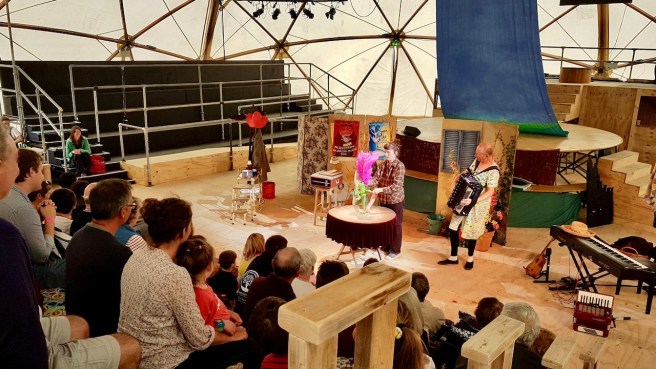

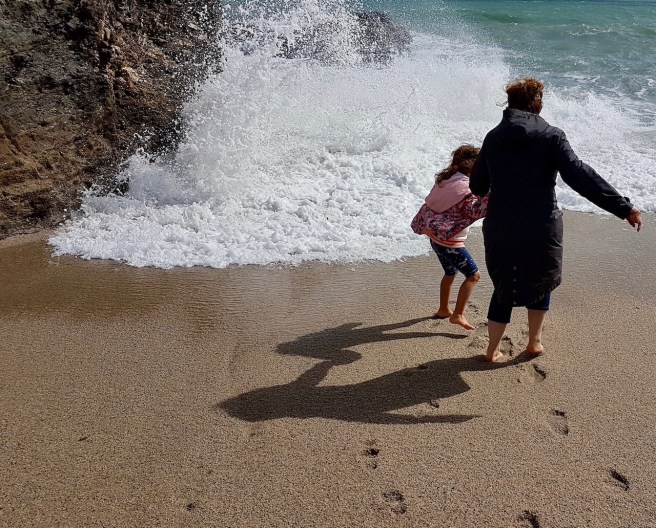
 We then couldn’t’t resist the beach where the tail end of a storm was apparent. Luckily the weather held off for us.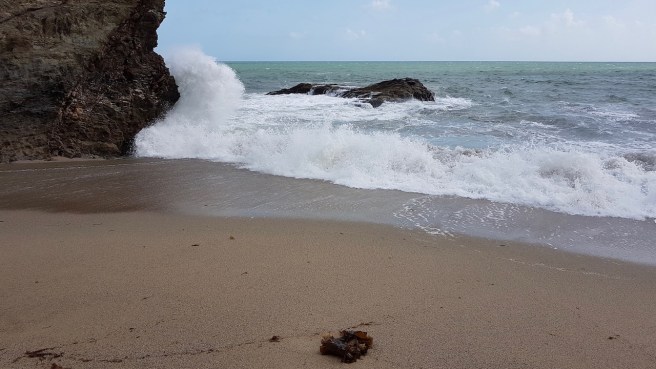
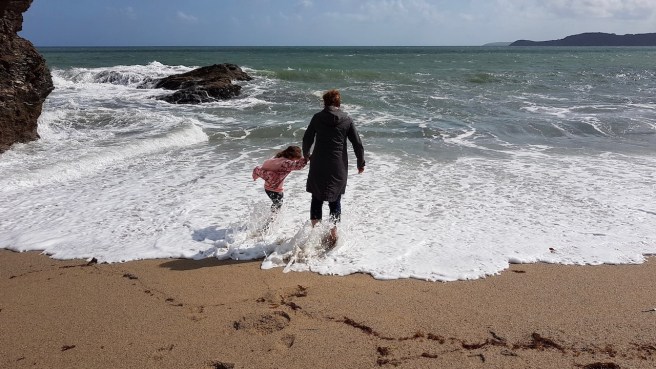 The biggest ‘adventure’ perhaps came the next day when we visited the nearby and well-named Adrenalin Quarry. Neither F. nor I were participants, but we certainly enjoyed watching. Katherine and Aiisha proved fearless in attempting first The Giant Swing……

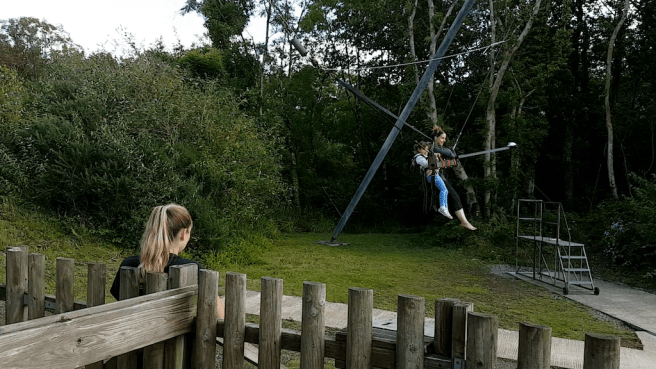 Apparently the first drop from what seemed an enormous height was ‘scary’ but thereafter things got a little better. Aiisha was heard to say in the gentler parts ‘I want to do it again’ at which those watching burst into laughter…they were absolutely stupefied that one so young had attempted this in the first place!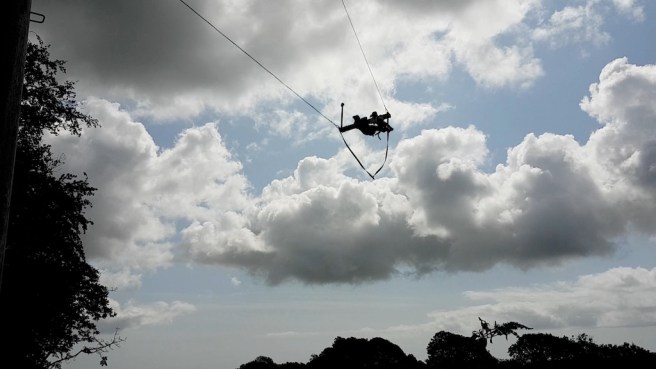
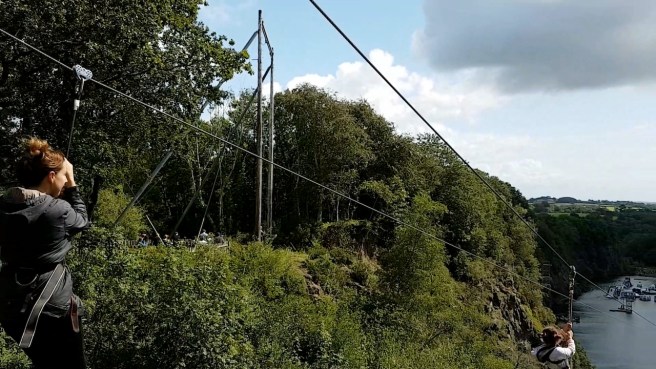
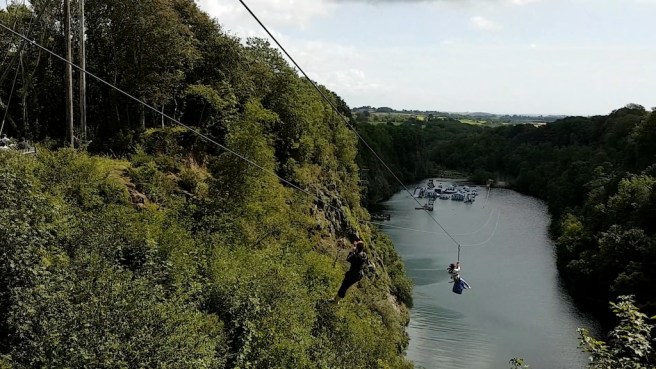
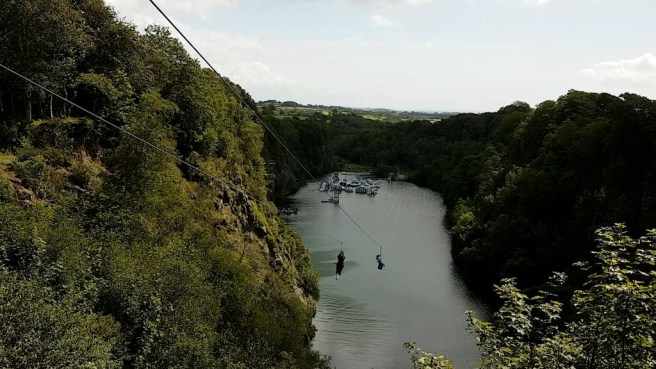
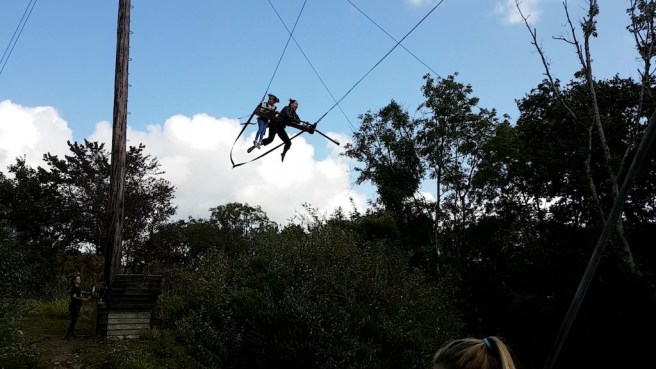 Next was the zip wire which went from the heights at one end of the quarry to the other. Not quite the longest or most terrifying in the world, but certainly up there. Rather them than me. Who knew such things were within 15 minutes drive of us?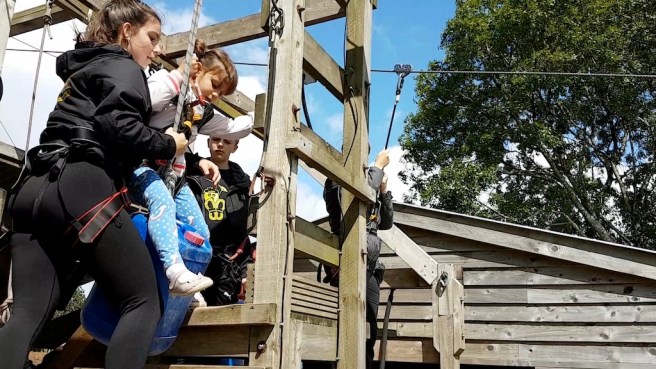
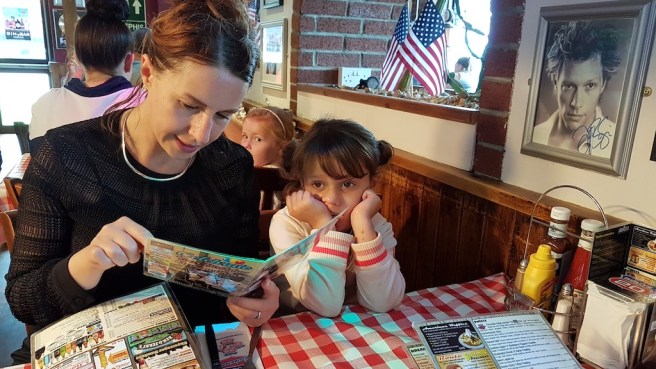
 We then celebrated all that bravery with snacks in the nearby American Diner which was actually enjoyed by all of us.
 Whilst Katherine did some work the next day, Frances, Aiisha and I drove to Looe to play the arcades as it was a bit inclement. We all had a great time playing the twopenny dip where you roll coins to displace other coins (and prizes).
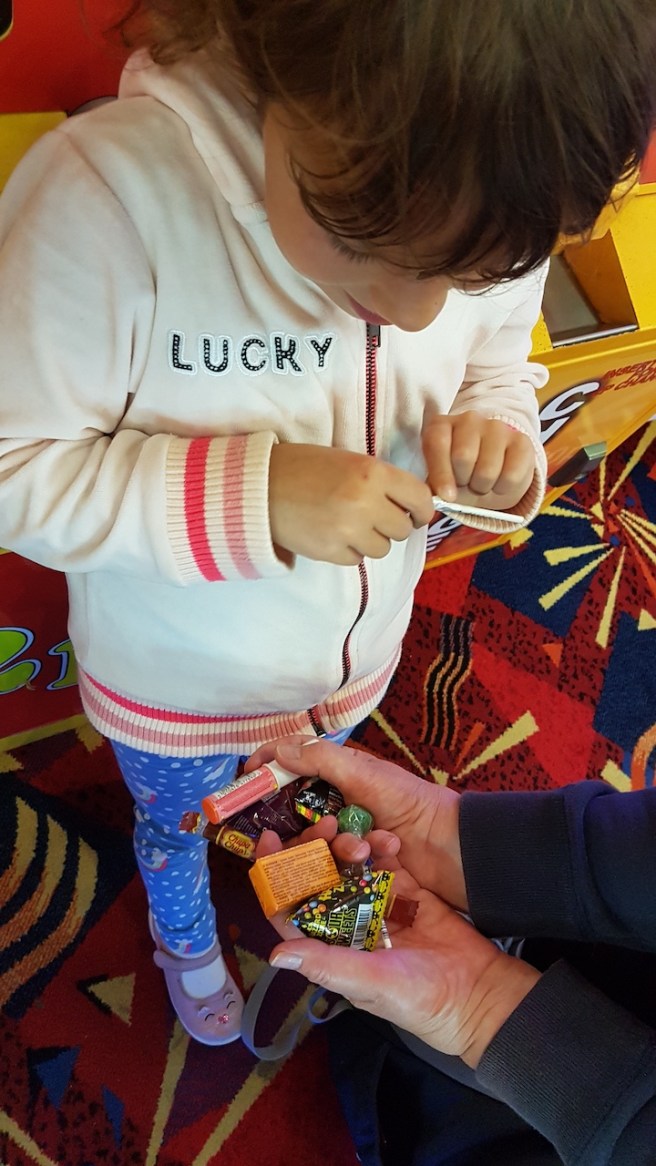
 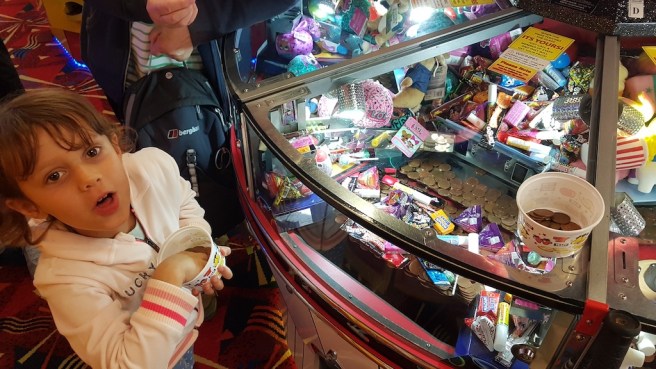 Aiisha’s top said it all. Lucky. We won an enormous haul of sweets, of which you can see a part……
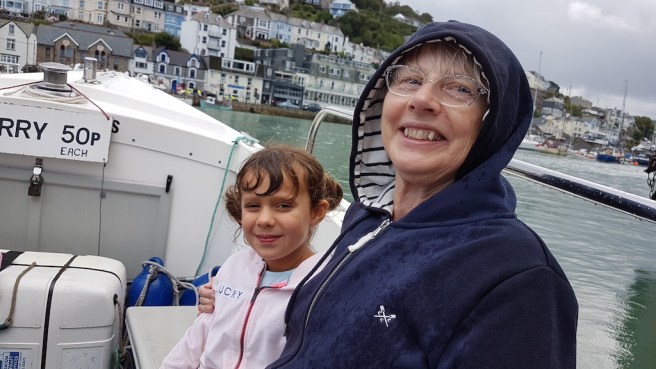
 We crossed the river on the little ferry for a change, and thoroughly enjoyed our trip to the seaside.
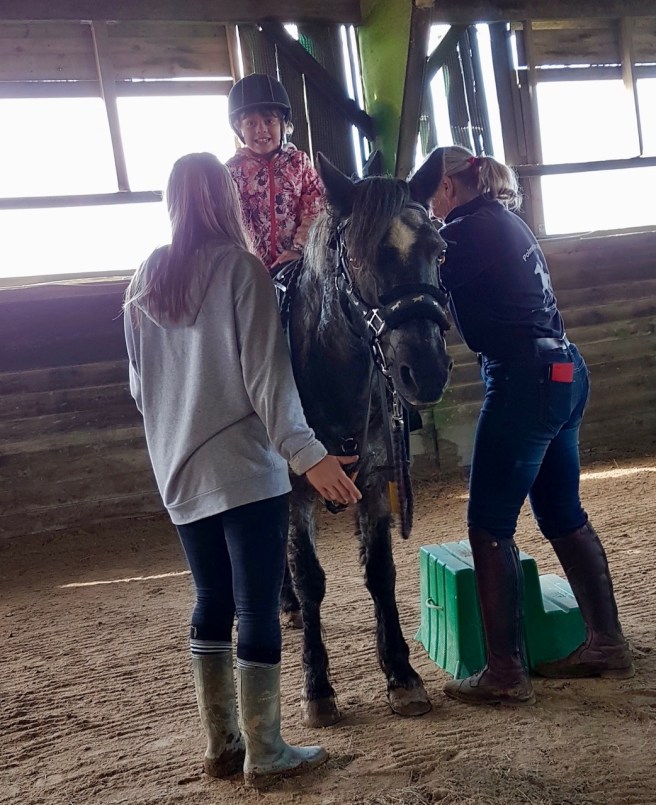
 Adventures were now coming thick and fast. A riding lesson got us up early the next day. After kitting out…….
 ……..Aiisha showed much aplomb in dealing with her horse – and with the lady instructor who was to say the least formidable. All the adults looking on were quaking in their shoes. However the lesson was indoor and out, and went down very well with our intrepid rider.
 A fine day was then promised so we went on one of our favourite walks the circular route from Lerryn (our favourite Cornish village) to St Winnow. After stocking up at the terrific local stores we set off along the for now dryish river…
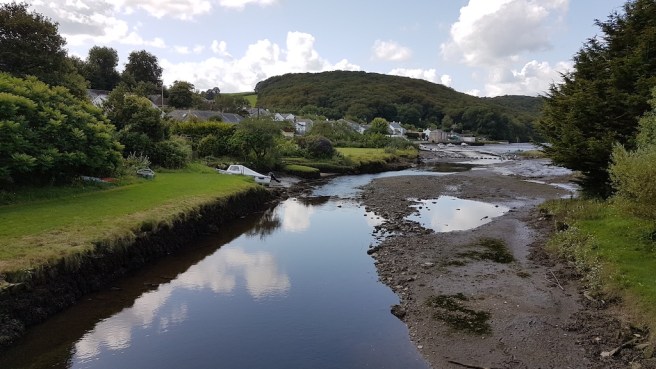 crossing the medieval bridge…..
 and crossing and re-crossing the stepping stones.
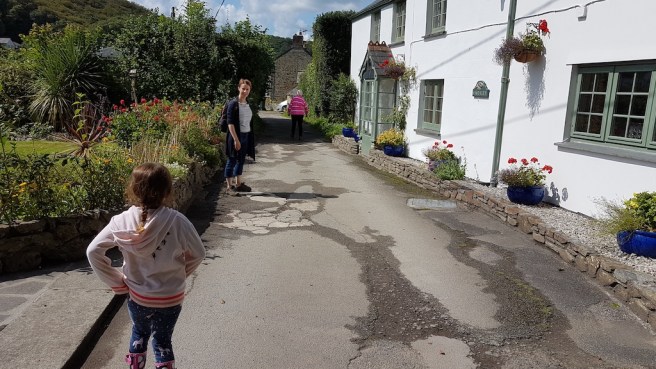
 All the cottages are without exception lovely and, unusually it seems to us, nearly all lived in as opposed to used or owned by holidaymakers. That accounts for the hugely lively village life.
 Our first objective was a particular bench with a view, and this is where we had our pasties and cakes from the shop. One of the best lunches ever!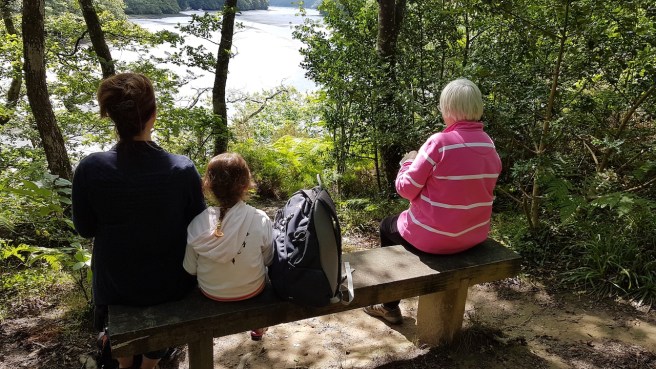
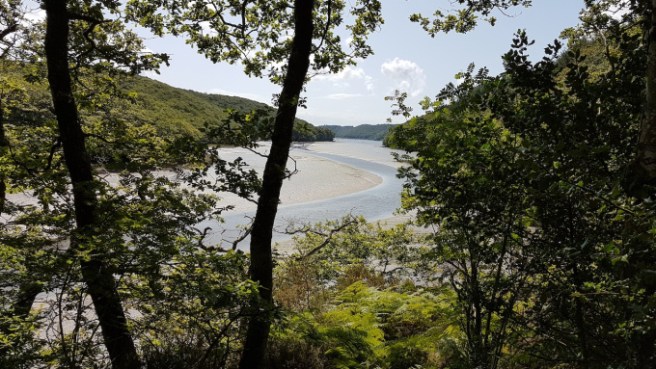
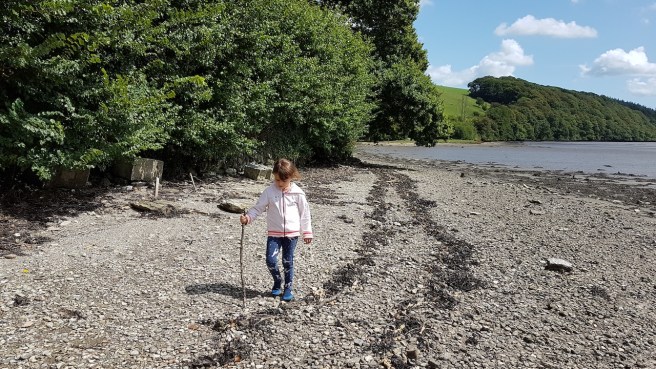
 We then aimed for St Winnow’s and along the way Aiisha picked up and fashioned her own walking stick which not only proved useful but also was a great prop for her impressions of “an old lady walking”. Very good.
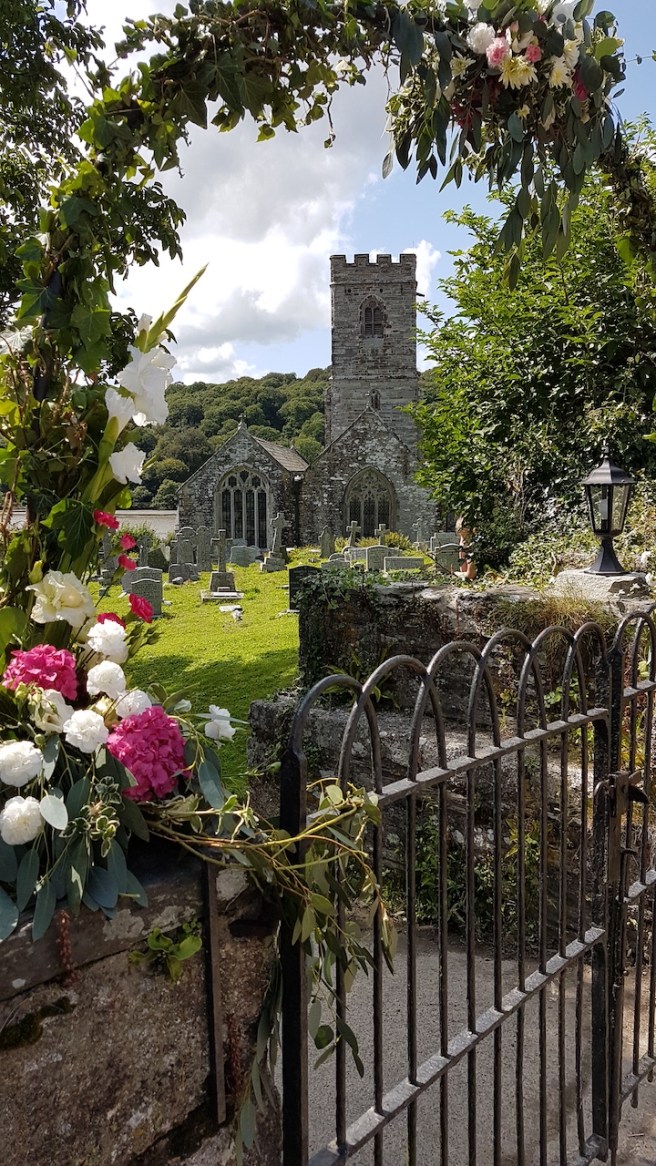
 The church was bedecked for a wedding and whilst this was all very pretty, it had meant the closure of the ice cream stall. Not as disappointing as it might have been as we were all ftb.
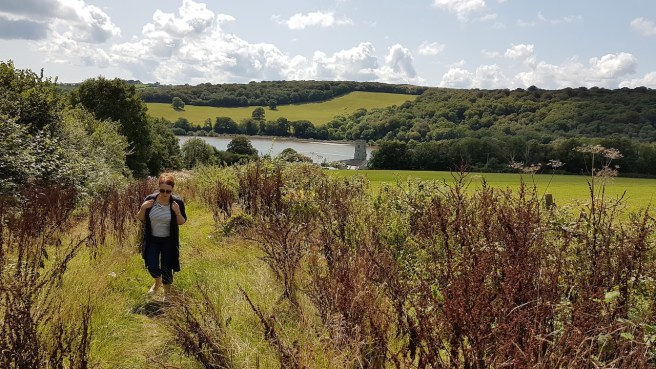
  Pulling up from the hamlet (just a farm and a cottage and a church (plus usually an ice cream stall!), we soon had good views.
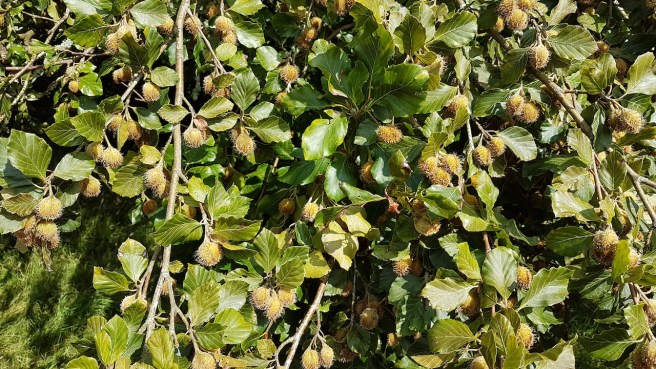
 There were several kinds of trees with plenteous nuts (perhaps betokening a hard winter?).
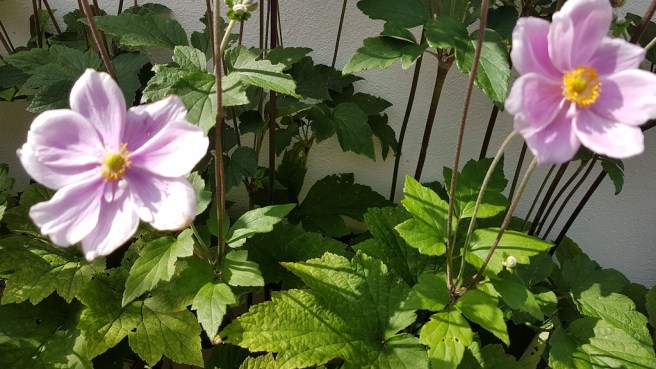
 And pretty garden fronts as we descended once more to Lerryn.
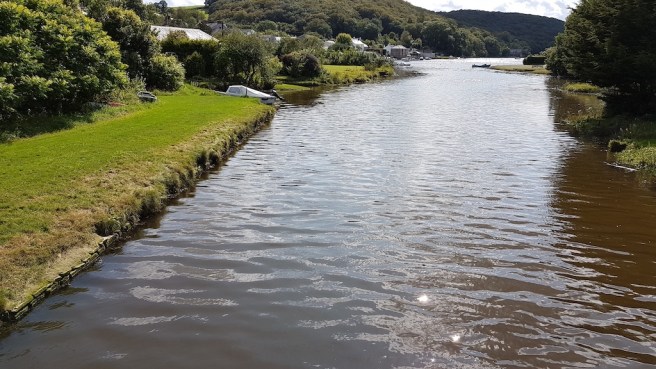
 The tide was now in. All in all a special day and a very long seven and a half miles for young feet…all done without a grumble!
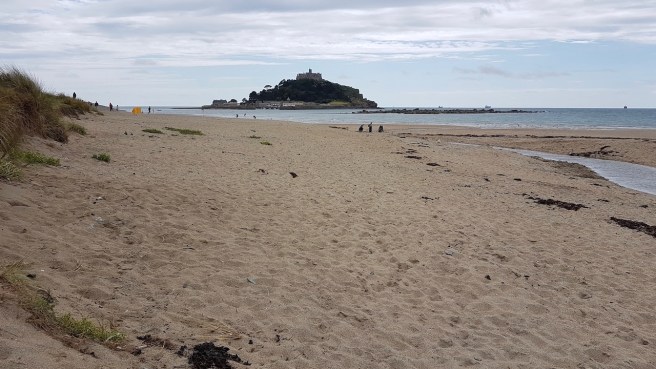
 Our last full day together was my birthday and we had lunch at the Godolphin Arms now turned into a somewhat boutique hotel. Sensational views from the car park…
 and the restaurant where we eat well.
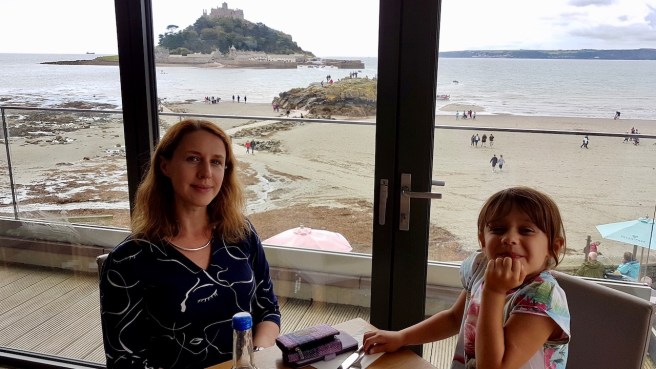 We planned to look at the beautiful gardens on St Michael’s Mount but on the way to the ferry (the tide was in) we were waylaid.
 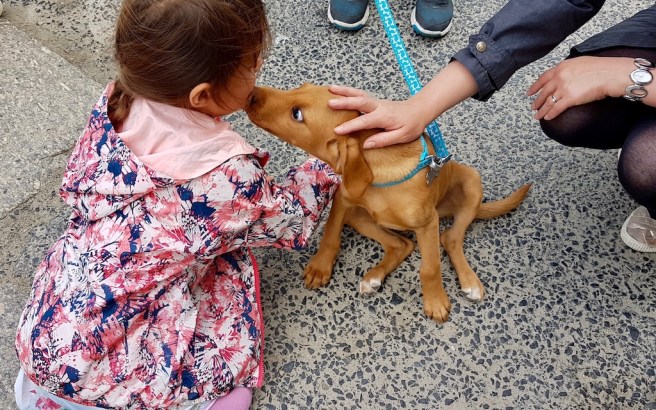 Marazion itself is quite captivating…….
 Six ferries were in continuous use (it was Bank Holiday after all), so we didn’t wait too long.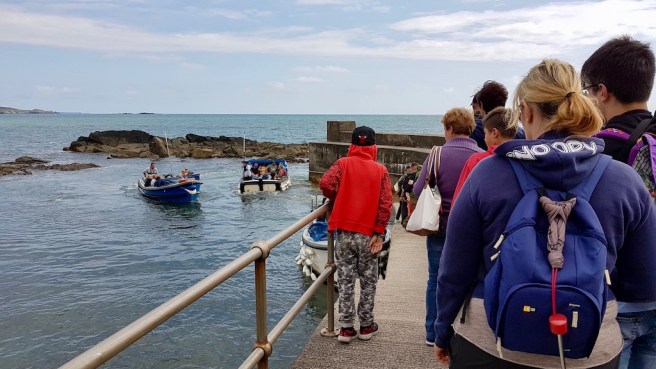
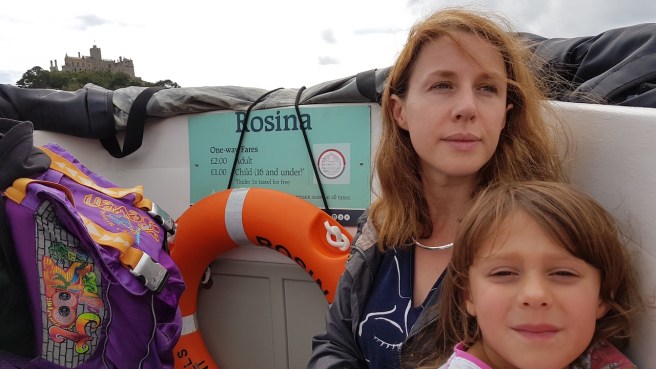
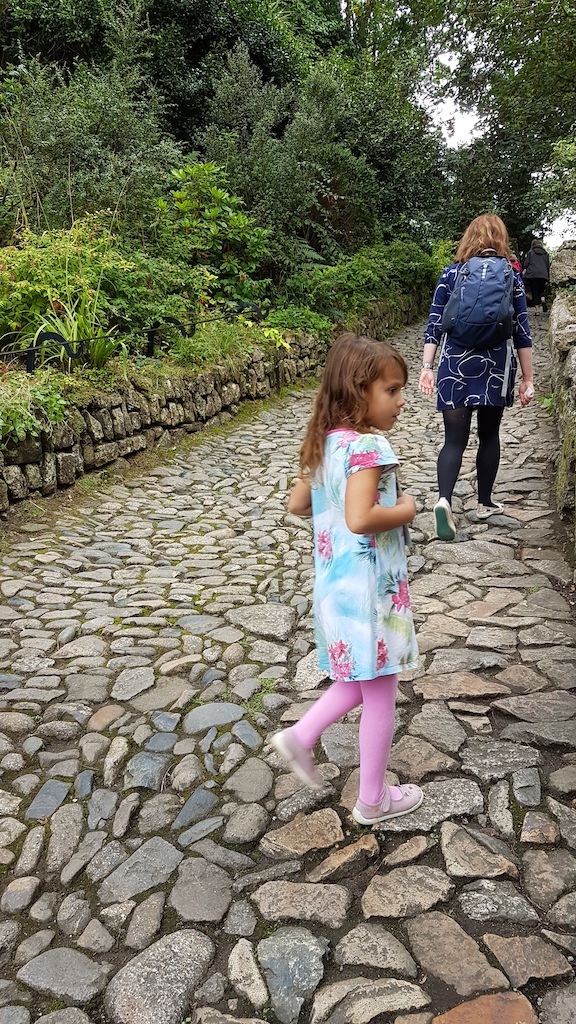
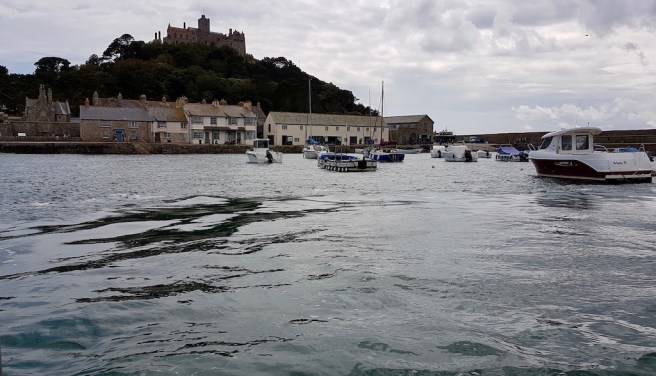 On reaching the island we found the gardens were closed, but this enabled us to climb up to the castle itself, looking for the Giant’s Heart on the way up……
 and making use of the odd canon for a resting point…..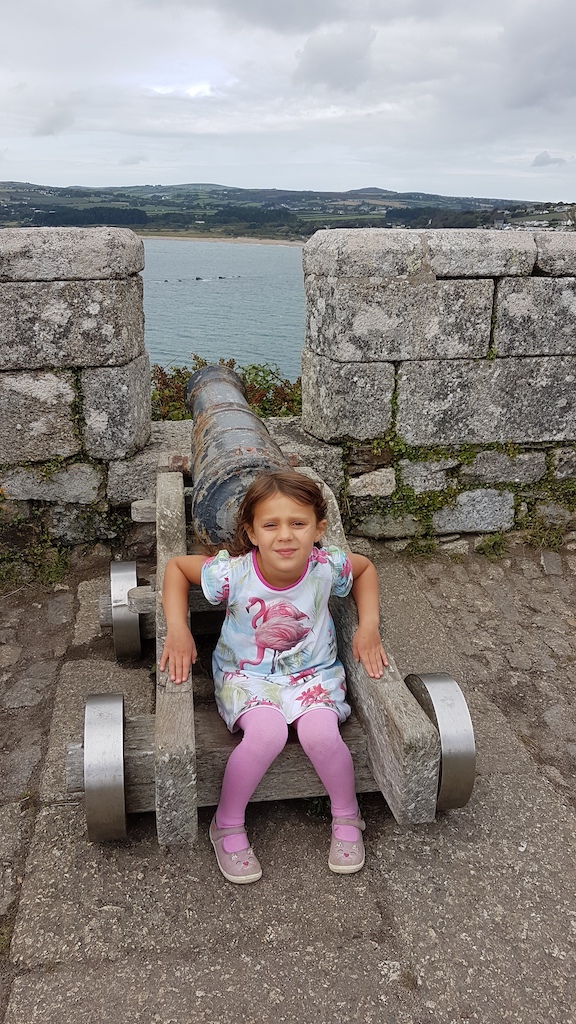
 Inside we did a rapid tour and completed a successful quiz, and enjoyed the special atmosphere of this amazing place. We also were able to see some of the gardens!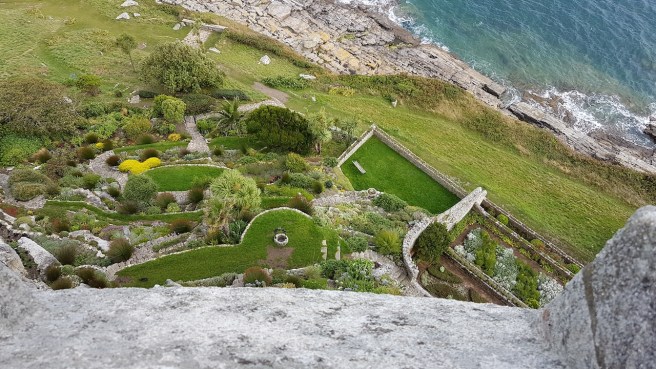
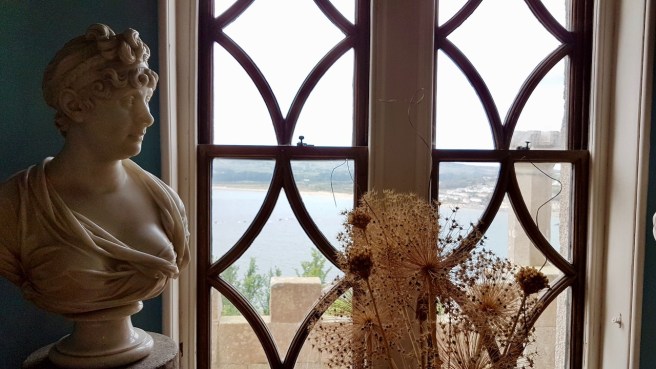
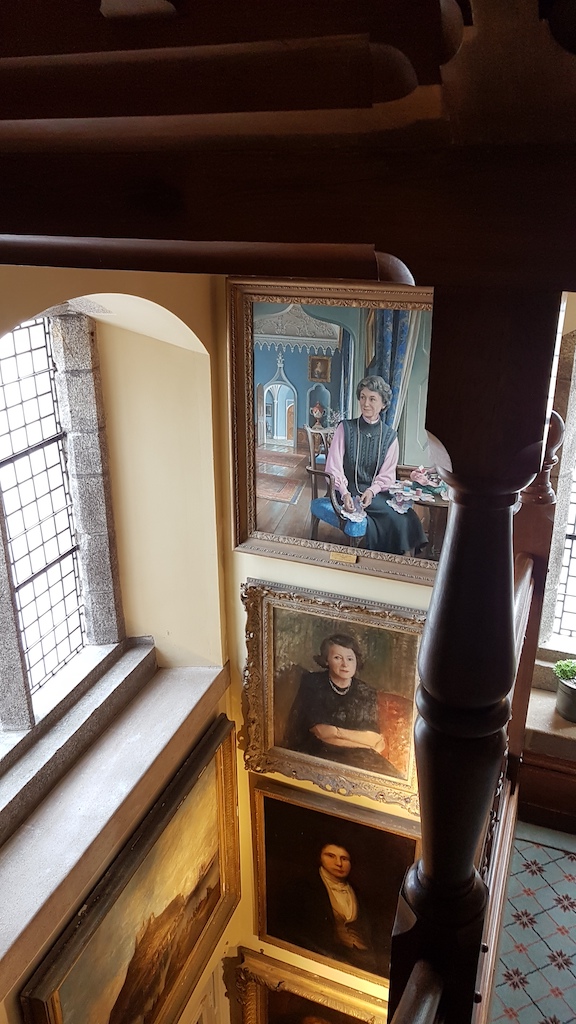 The queues for the ferries to get back to the mainland were long to say the least, but we made our own amusements.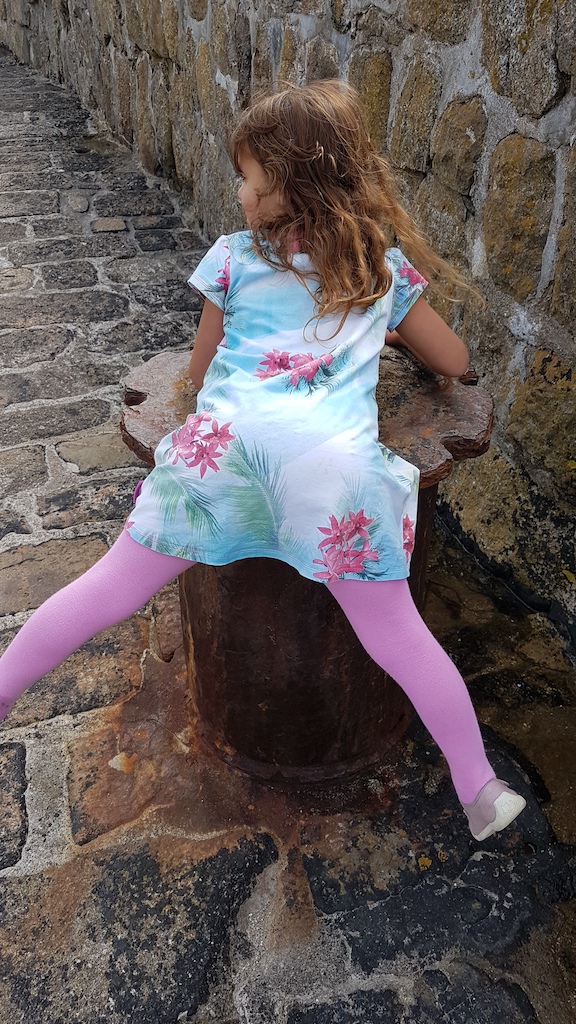
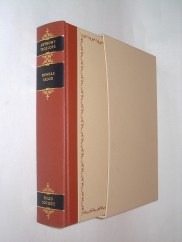 Always a pleasure to read a Folio Society edition, and Phineas Redux the fourth in the series of six Palliser or ‘Parliamentary’ novels is by common acclaim one of the best of Trollope’s extensive writings. He certainly appears at the top of his powers, whether in his descriptions of riding to hounds (one of his own favourite things) or his semi-satirical take-offs of some of the great issues of the day particularly the Disestablishment of the Church in Ireland and the Reform of the political system. He also appears a prophet before his time in his sub-plots involving the possible introduction of decimalisation and the positioning and powers of the monarch in a constitutional crisis. Having said all of this, Trollope as usual develops all these themes around the life and loves of his main character, and Romance plays an equal part to Politics. His characters are very strongly drawn and in a novel of some 700 pages we get to know them well! A large part of the second half of the book concerns the court case where Phineas is accused of attempted murder, and Trollope revels in his taking to pieces of the legal system as it existed. So, not only is Phineas Redux a page-turner, it is a detailed and extensive commentary on the constitutional, political and social life of Victoria England and in that equal to the efforts of Dickens. Only two more novels to go. Far more demanding of time and concentration than War and Peace!
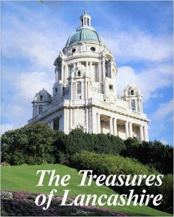 Because we are in the middle of selling our home and hope to move to the North West, I have bought second-hand copies of two excellent books ‘The Treasures of Lancashire’ and ‘The Treasures of Cheshire’. These are very detailed portrayals of
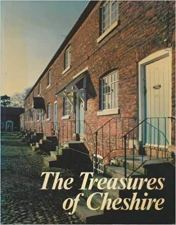 the two counties in terms of the countryside and towns, which are described succinctly and well, and the treasures therein, with emphasis on the churches, public buildings and houses to be found. I must say that I took great pleasure in reading these minutely and I discovered so much new about areas I know well enough. Not only have the two books strengthened how much I am looking forward to moving, they have directed my attention to considering alternative locations for our new home. These books weren’t available new any more and I only paid between £3 and £4 each. A real bargain.
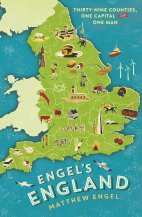 For some light relief, as both the Trollope and the guides were demanding of concentration, I have been re-reading ‘Engel’s England’. His book is not a gazetteer, he explains, “nor a guidebook, nor a compendium of England’s best anything”. It is, rather, he claims, a celebration of “the most beautiful and fascinating country on Earth”, though even the determinedly upbeat Engel cannot avoid an Anglo tone of loss and melancholy. “By way of subtext,” he notes in passing, “I visited all 41 (Anglican) cathedrals and lit a candle to my late son in each.” But that in no way gets in the way of his genuine desire to see what makes the different counties tick, and to find the quirky or humorous things that will both amuse us and inform at the same time. This he does in spades and very funny he is more often than not. He is warm, human, funny and cutting at times. The sort of man who would be interesting to talk to in the local pub, knows a lot, plenty to say, empathetic and probably very willing to stand you a pint or two. I thoroughly enjoyed my trip around England in his company (as I did the first time).
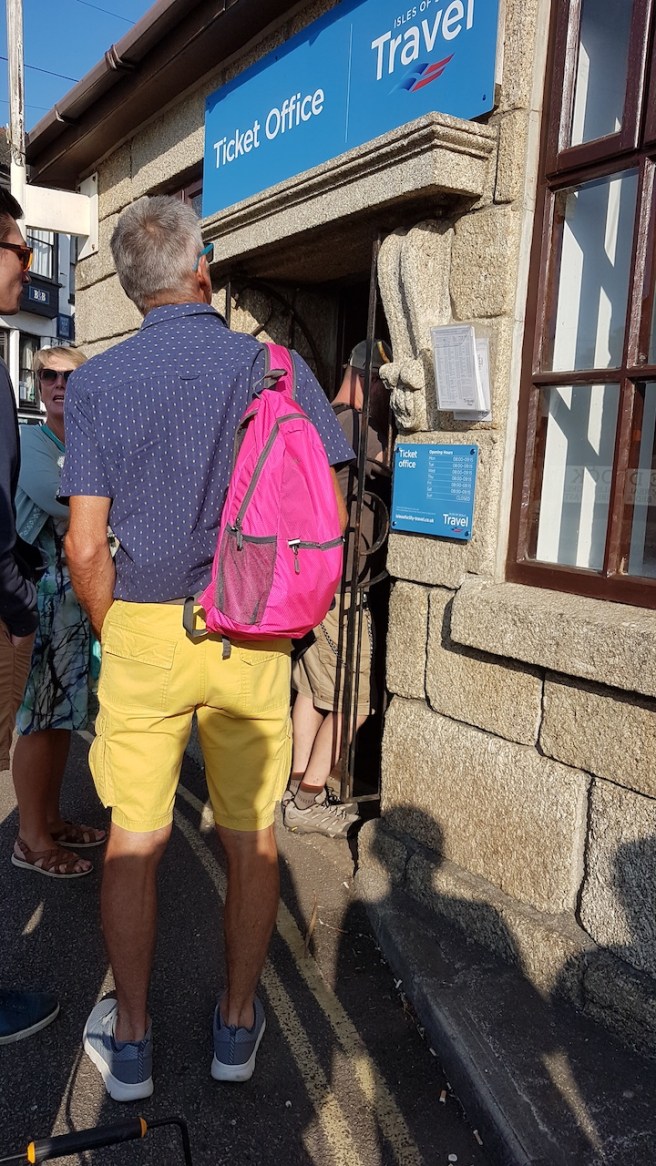
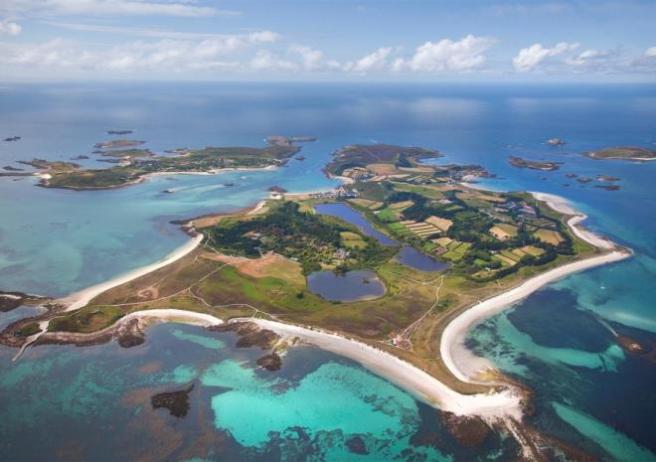 A last-minute decision to take advantage of the Locals offer (£25 each return) to visit the Scillies again on a day trip meant an early start. The alarm was set for 5.45am and that proved just right. In arriving at Penzance we joined the small queue to pick up our tickets – the staff were incredibly helpful and efficient………
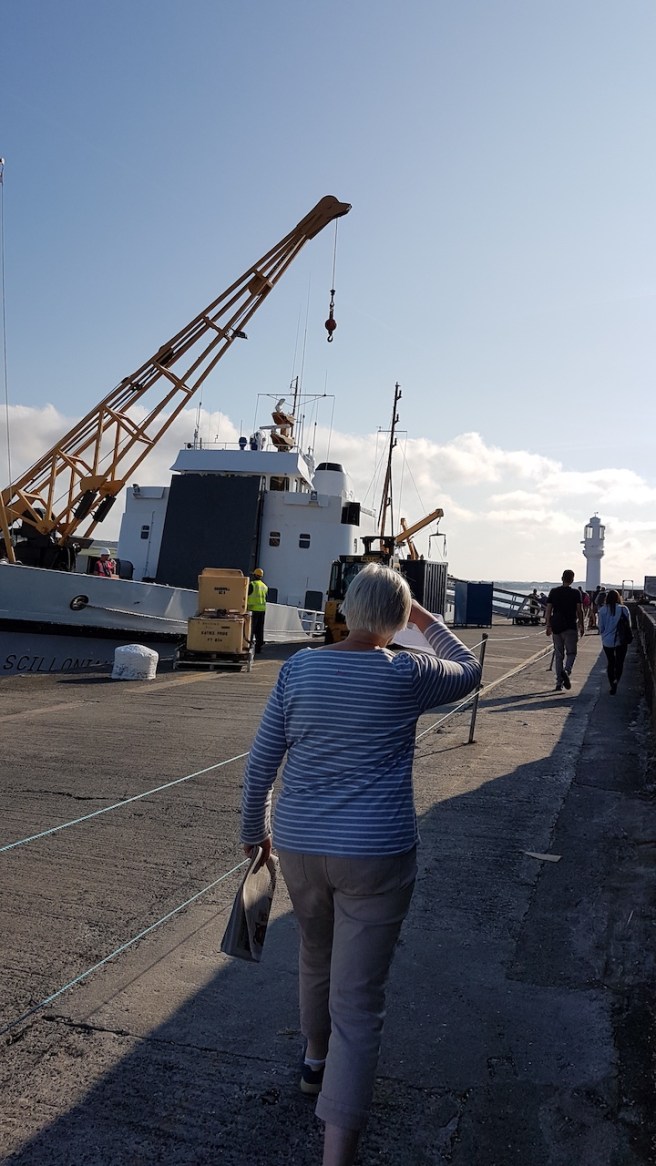
 and in no time at all we were wandering along the harbour to board the Scillonian.
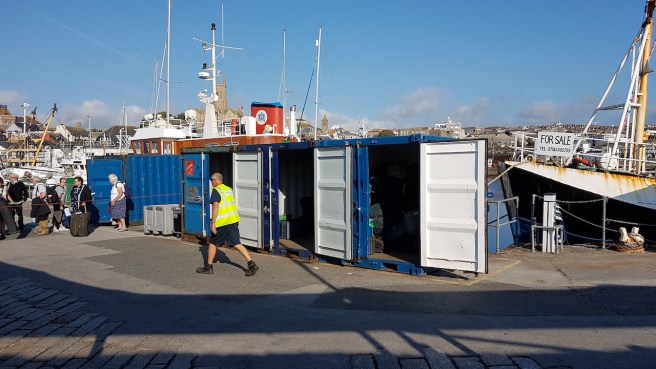
  These are the mini containers which hold passengers’ luggage, but also anything and everything that the Scillies need that they don’t have or grow themselves.
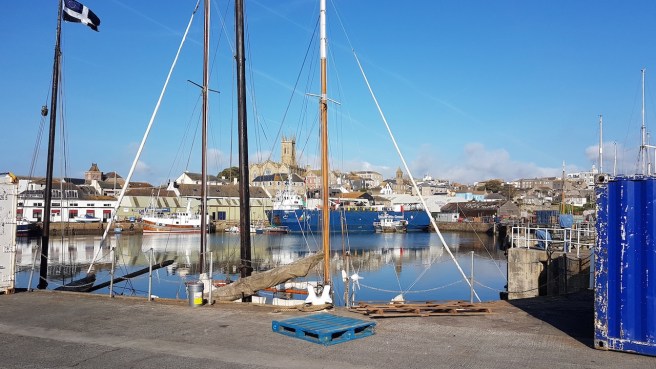
 Seeing Penzance like this early in the morning makes you wonder why you don’t get up early more often.
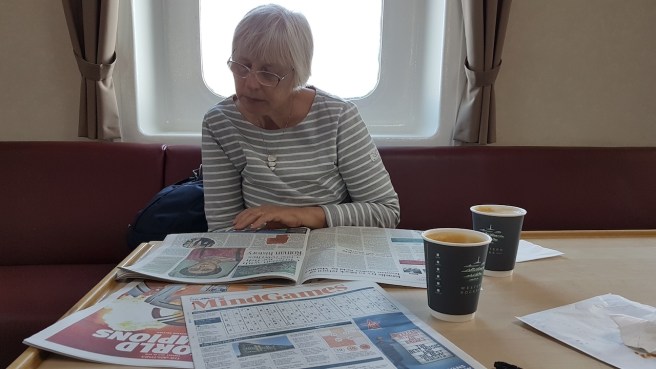
 Anyhow we were soon settled in for the 2 hours 45 minutes journey with a coffee and lovely fresh warm pastry each and the Times crossword, sudoku, word wheel etc which are our daily attempt to activate our brains for the strenuous days of retirement.
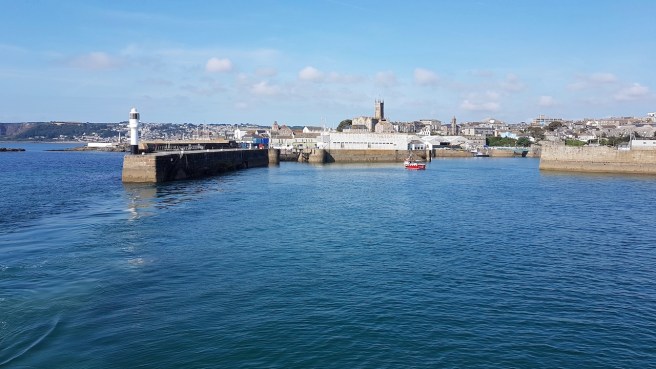
 The sea was placid, the day hot and sunny as we exited the harbour.
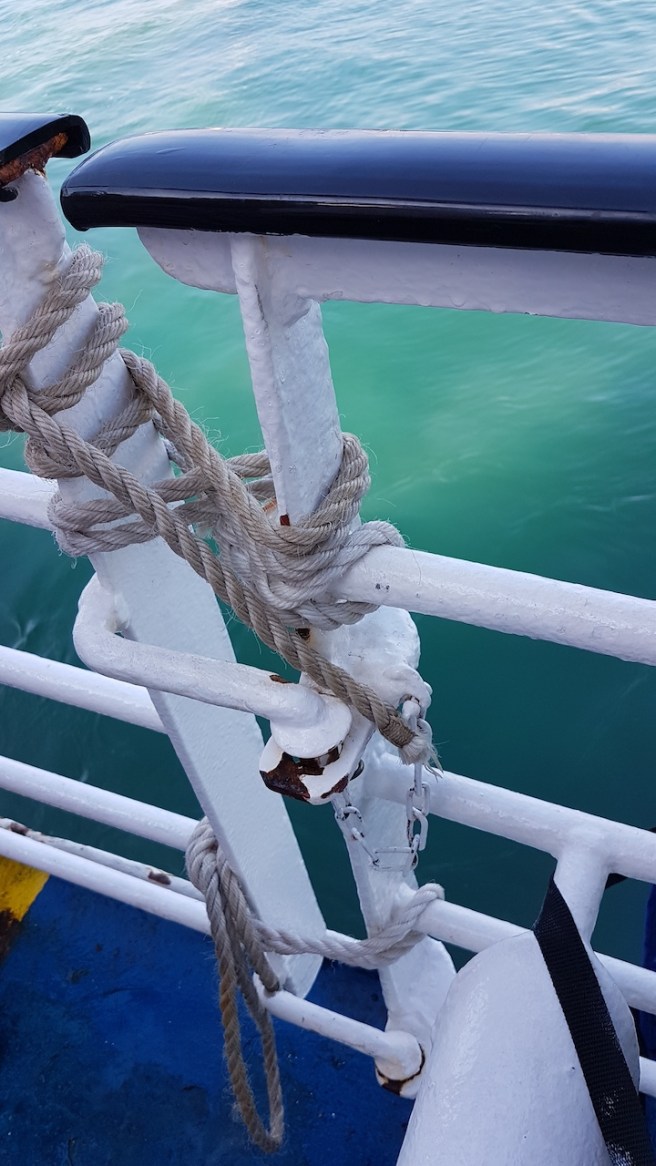
 Everything secured nice and firmly….
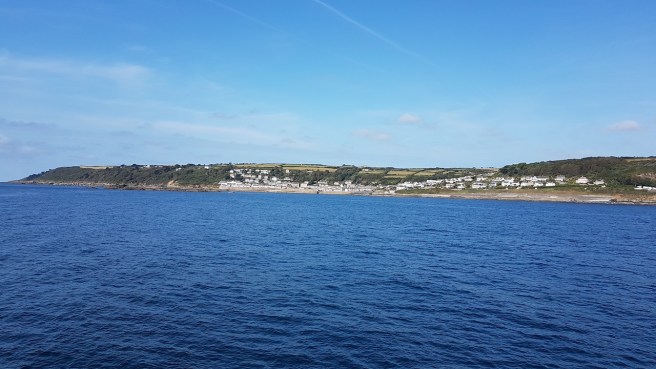
 It’s always interesting to see places from a different angle…here Mousehole.
 And it’s a joy to arrive in the scattered isles of the Scillies……
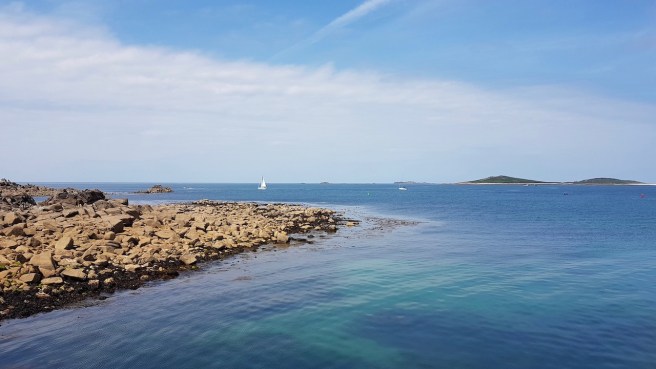 before berthing in St Mary’s……where we hopped off rather sharpish to ensure we made the inter-island ferry to Tresco our destination for the day.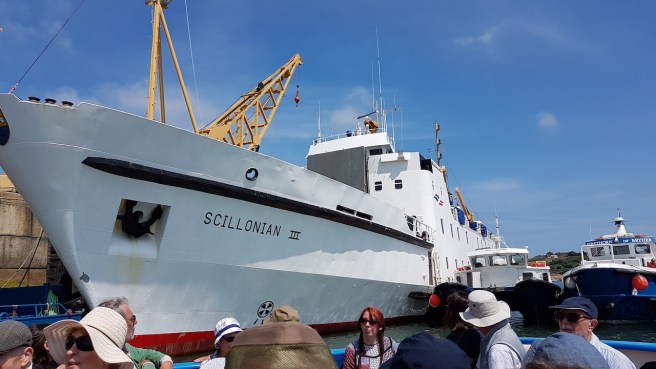
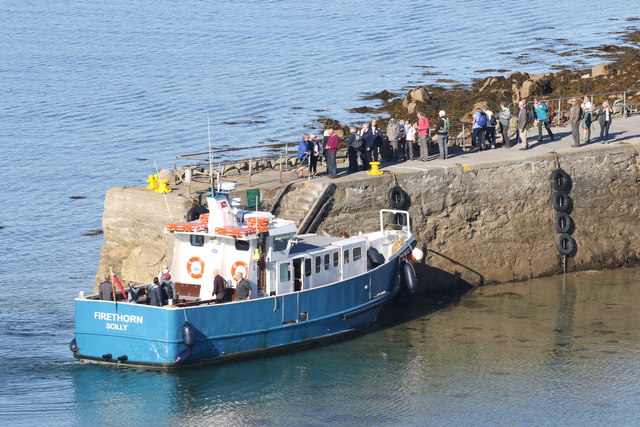 You see all kinds of craft, and nearing Tresco……
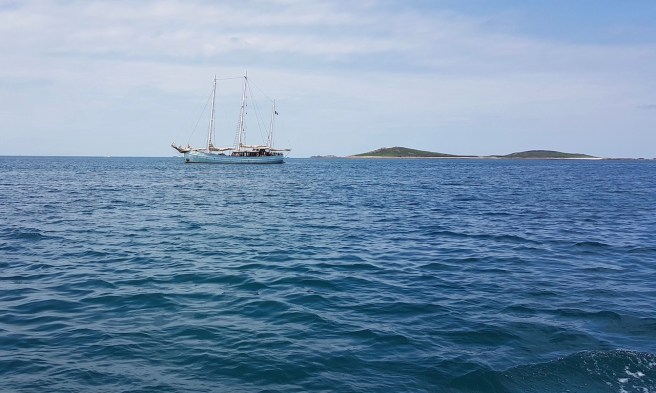 ……….the incredible white-sanded beaches gleamed in the sun, and all of them were, as they often are apparently, practically deserted. Paradise!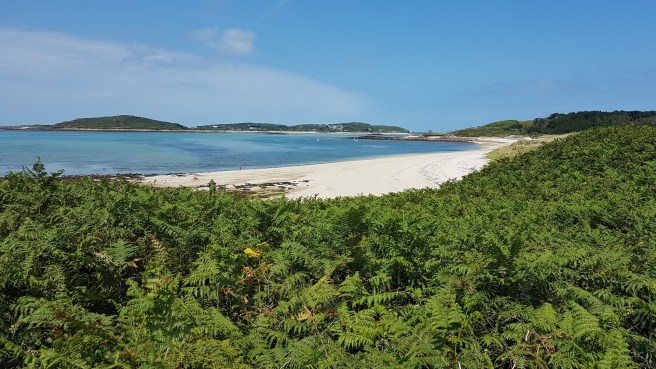
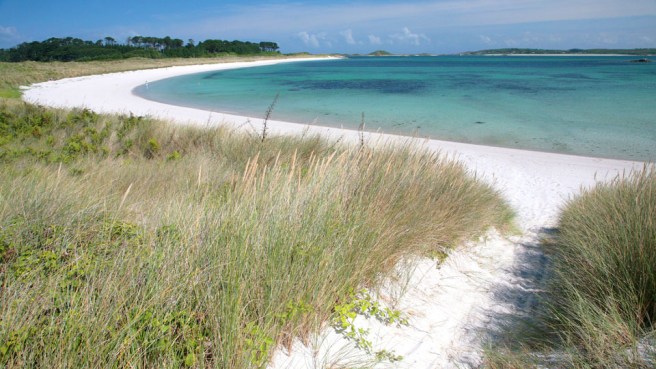 On our walk to
 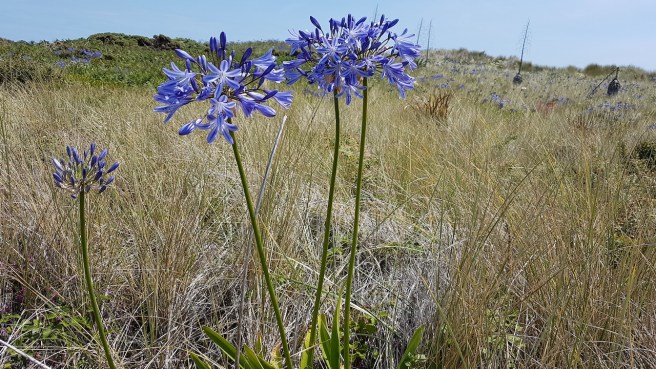 and everything was super-sized…
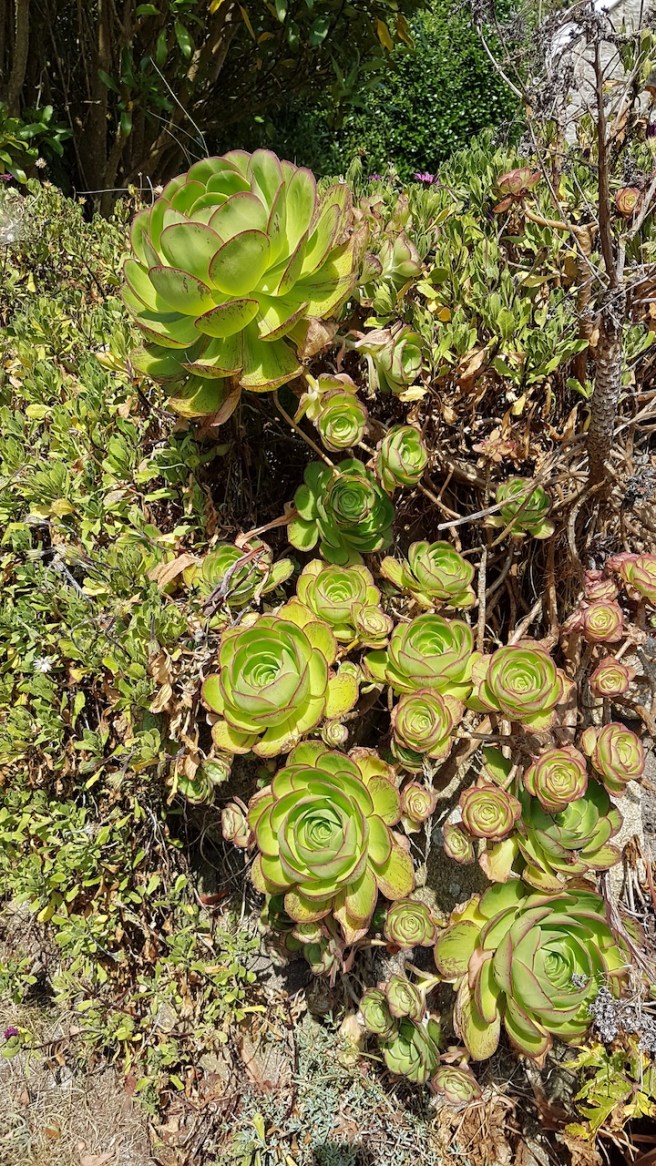 All this before we got to the Gardens….
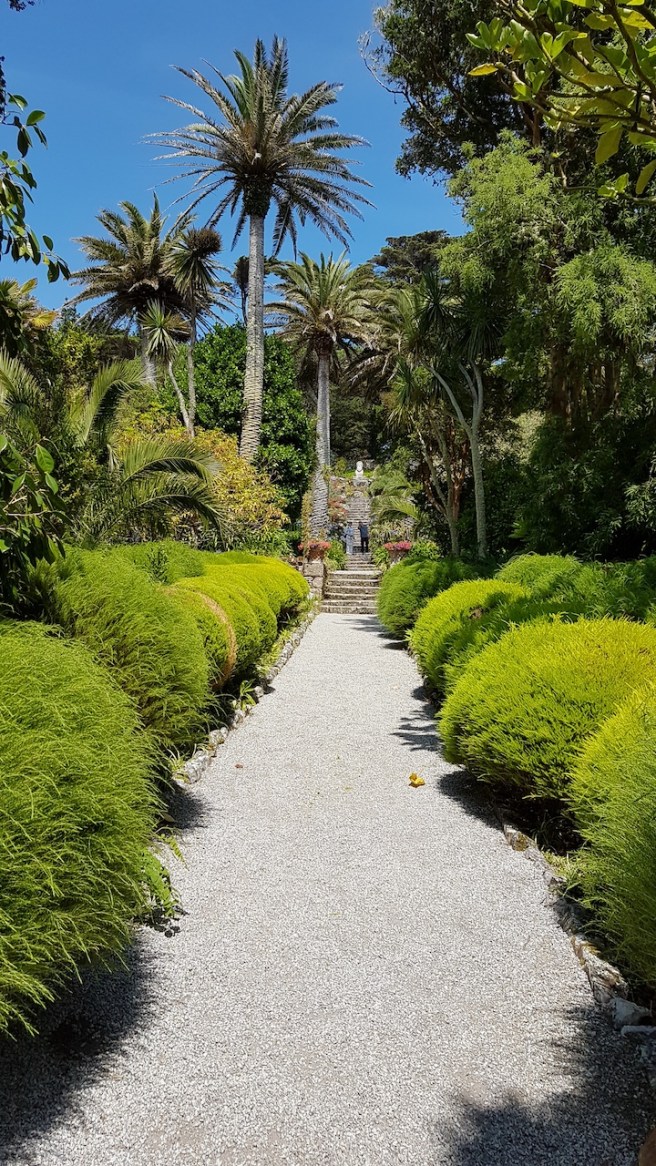
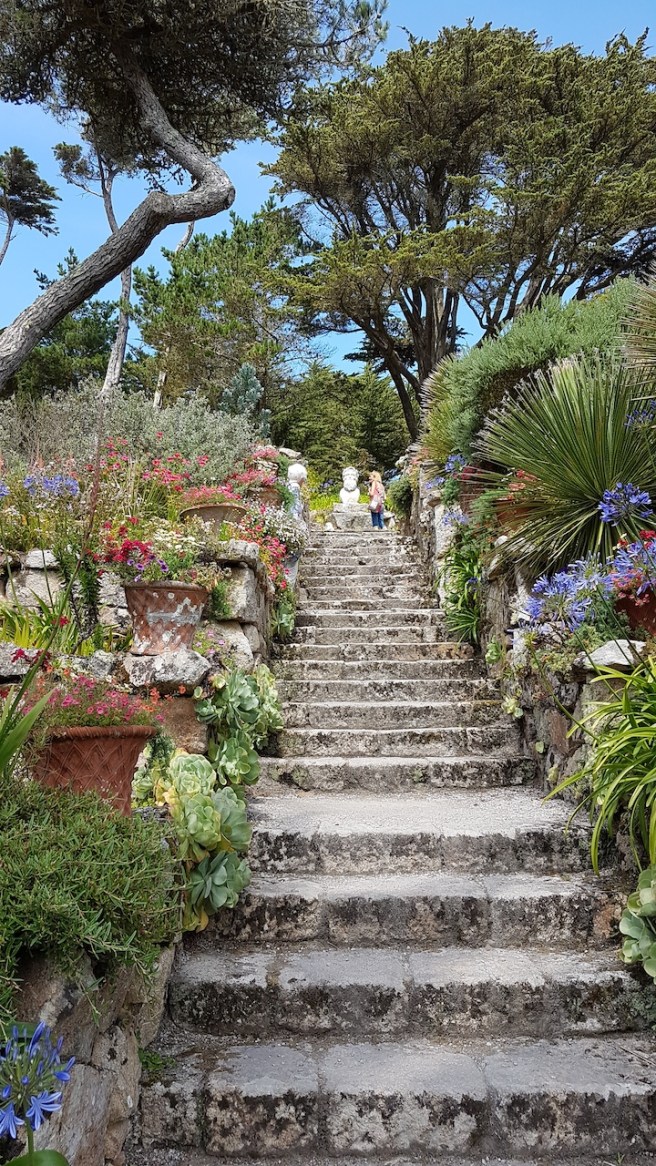
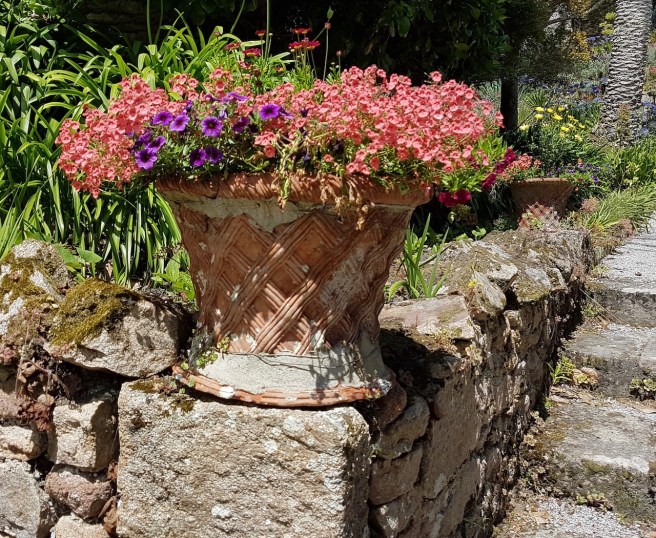
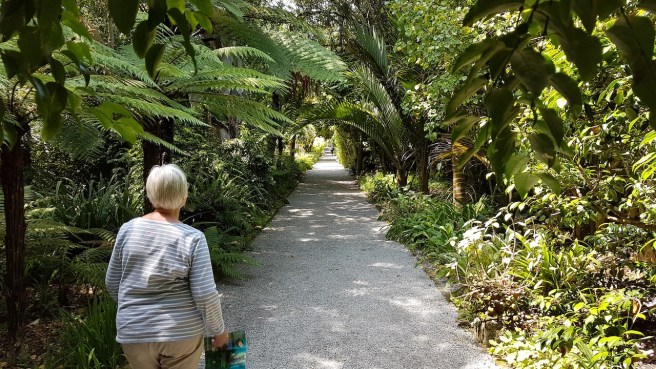
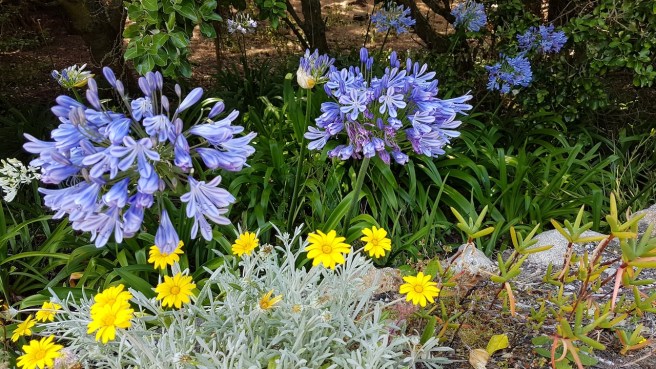 Before visiting the Gardens themselves we had a light lunch in their cafe sitting in the beflowered courtyard soaking up the sun. After that we were ready. Now if you don’t like pictures of flowers, plants, settings like the Garden of Eden look away now…….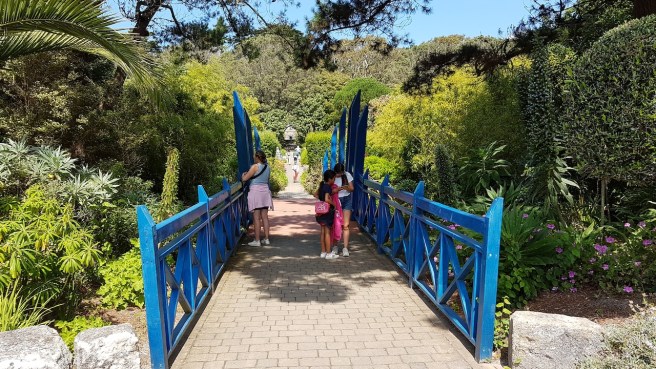
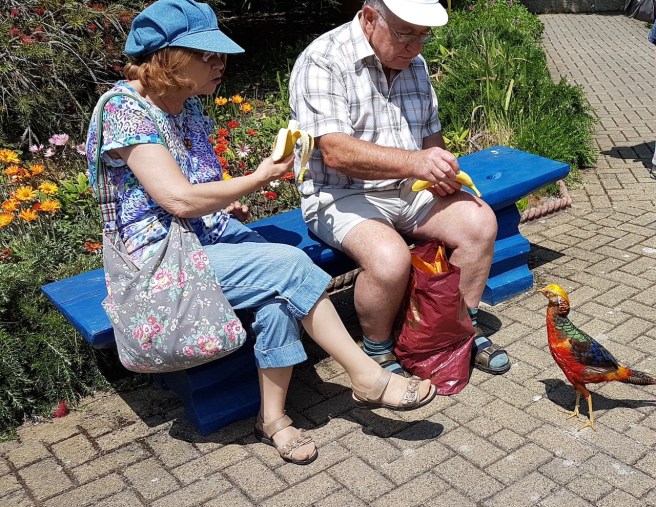
 and there was wildlife too…here a magnificent
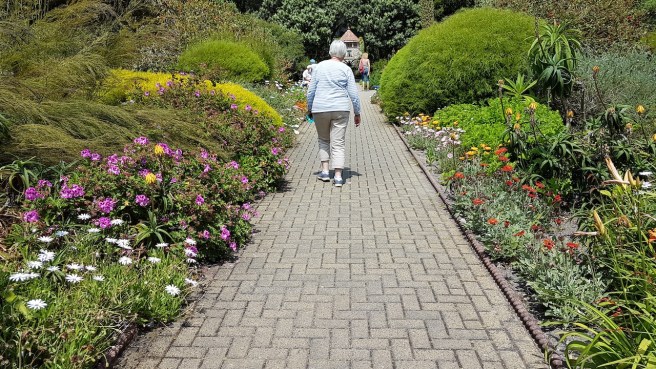
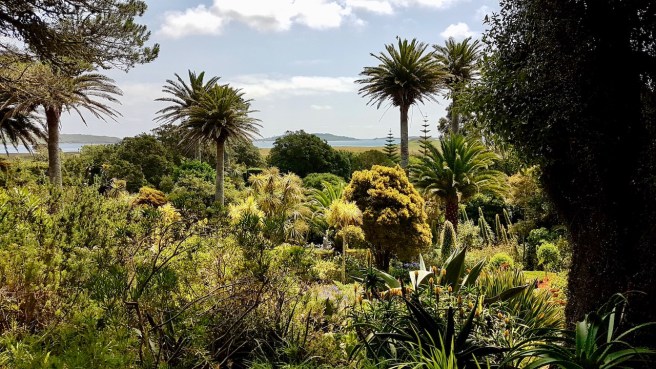
  The shapes against the blue sky were pretty special and the feeling you were in some tropical paradise, rather like the Eden project but all outside in real-life as it were, never left you.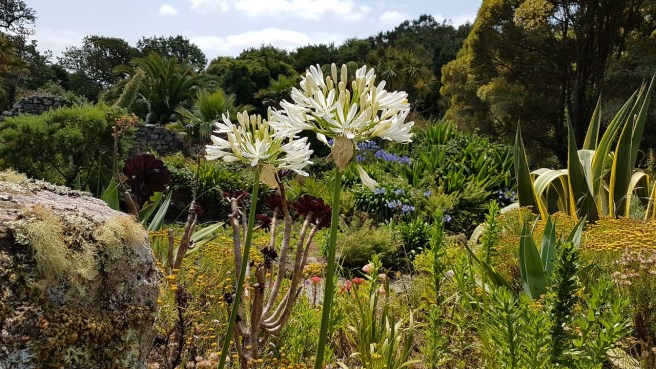
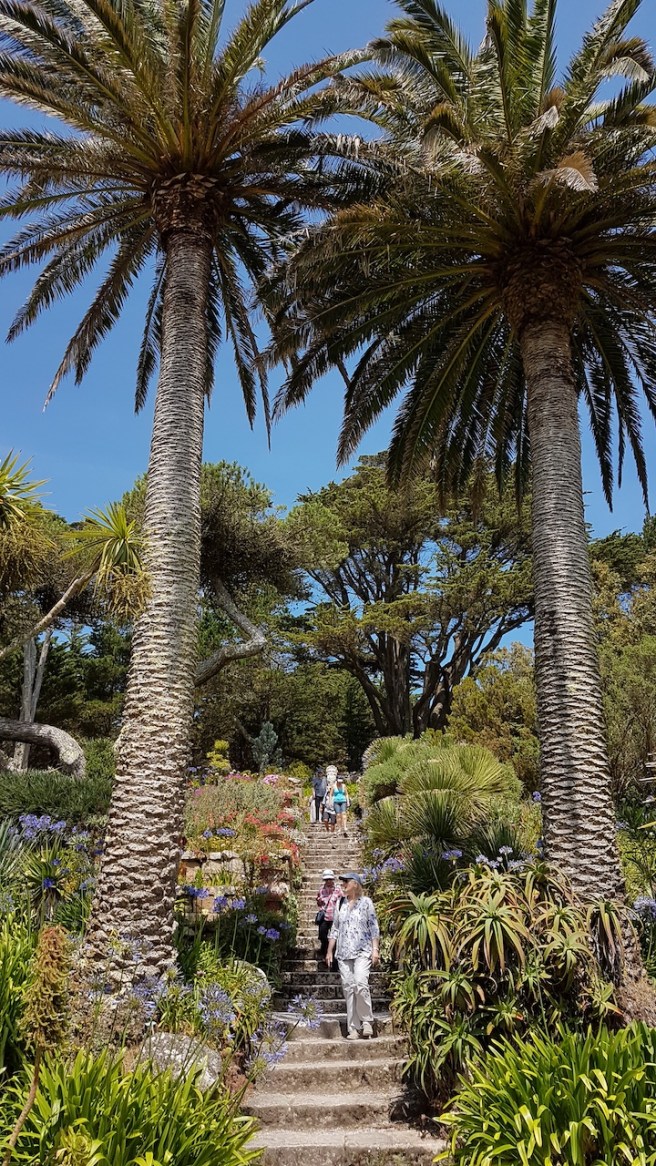
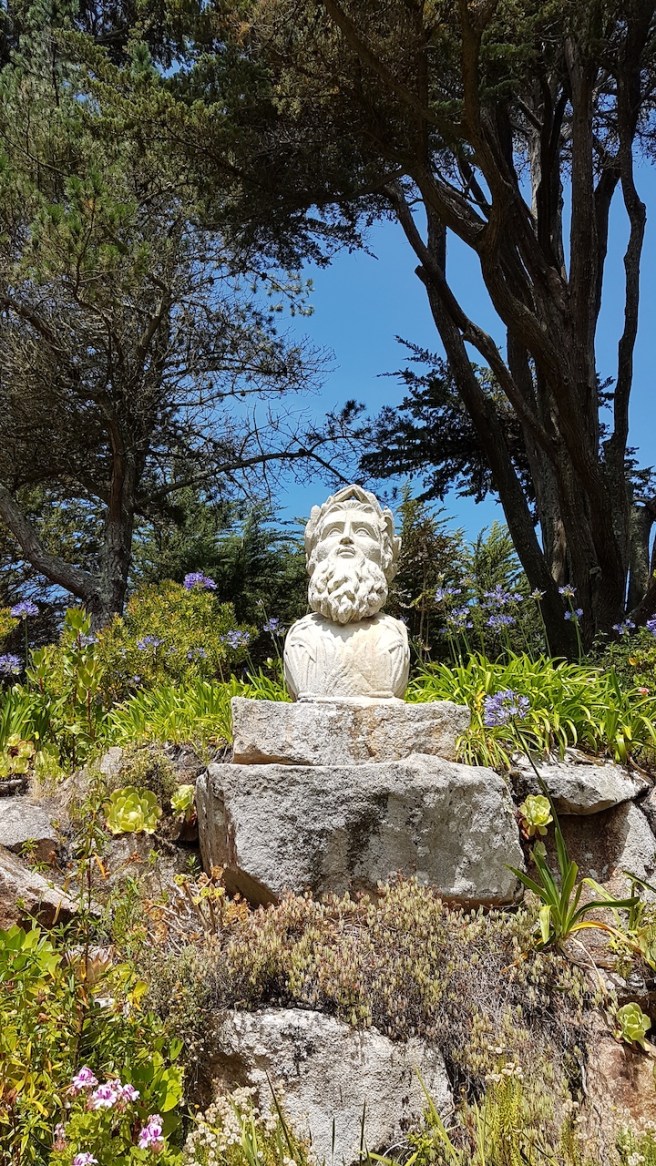
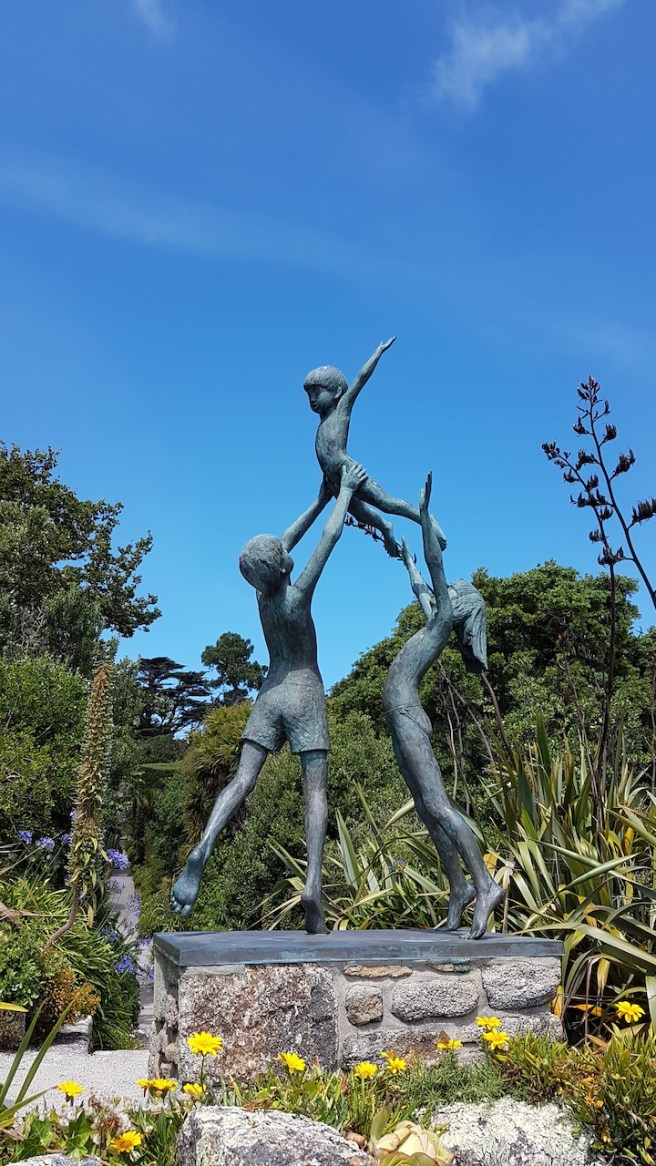
 And it wasn’t just plants and flowers that were special, there was a huge range of modern sculpture something I would normally take with a pinch of salt but here somehow all very appropriate…..
 This particular sculpture of a balancing box lies below the Abbey house itself where
 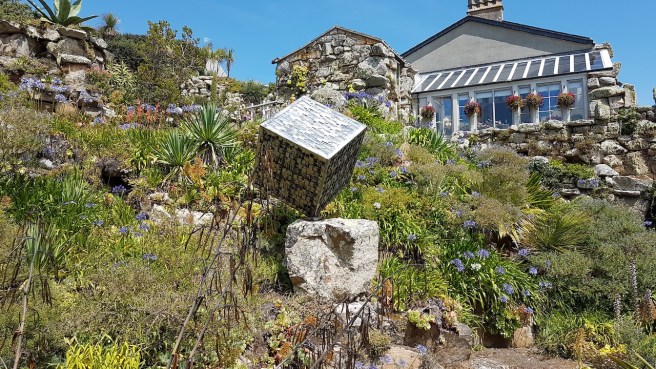 even the well was turned into a piece of sculpture…..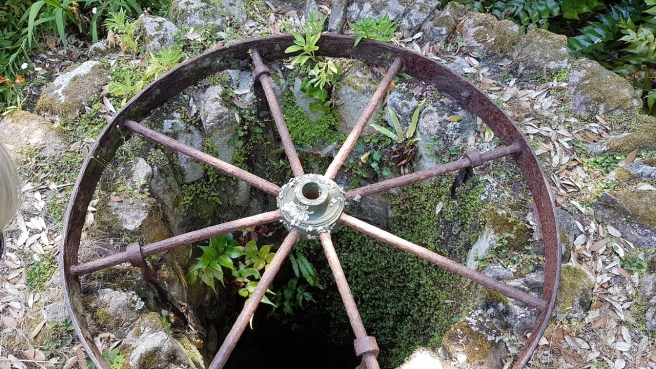
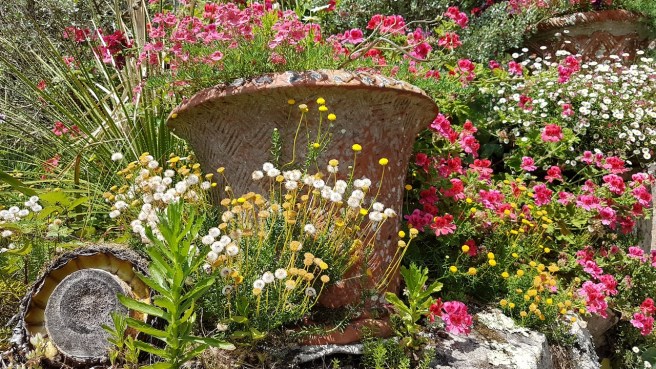
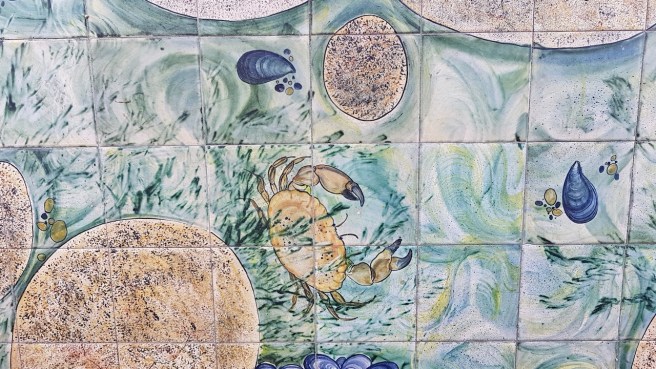
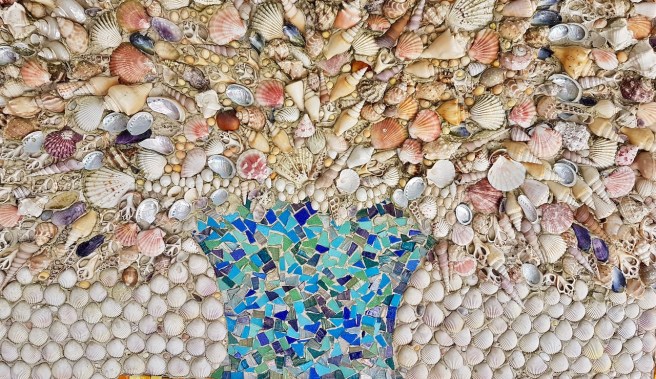
 The Shell House (1994), a pretty shell grotto designed and made by Lucy Dorrien-Smith, has a shell-themed tile floor, and individual initialled tiles commemorating members of the family can be seen amongst the shells on its internal walls. But the craftsmanship was incredible. The finest shell house I have seen, and I have seen a few.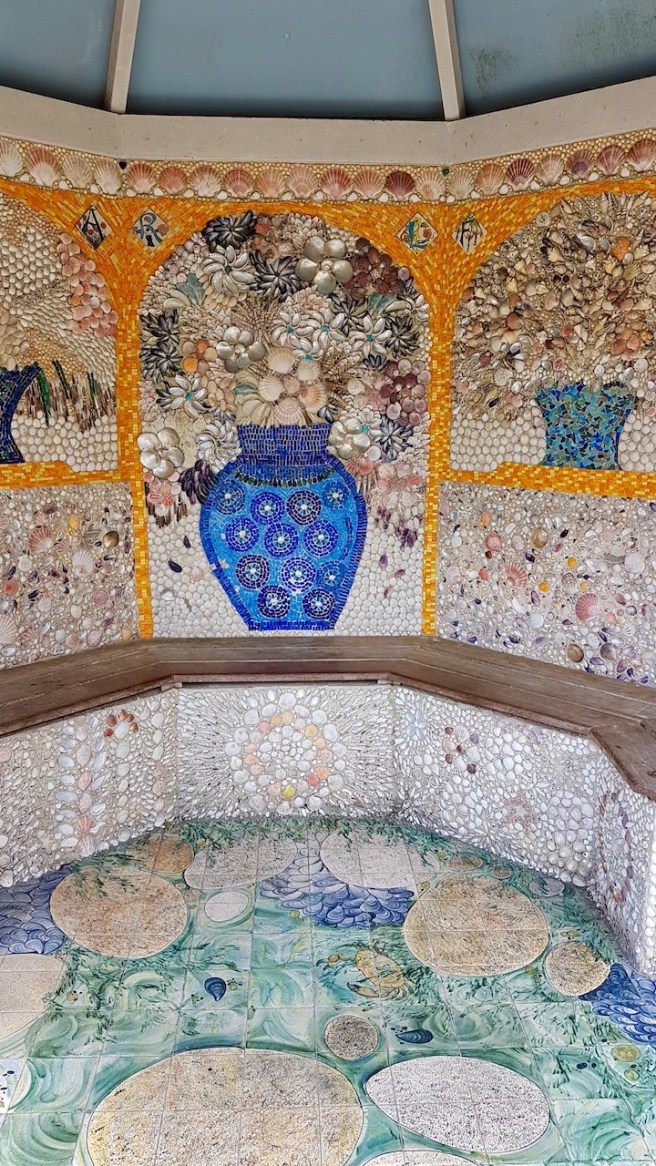
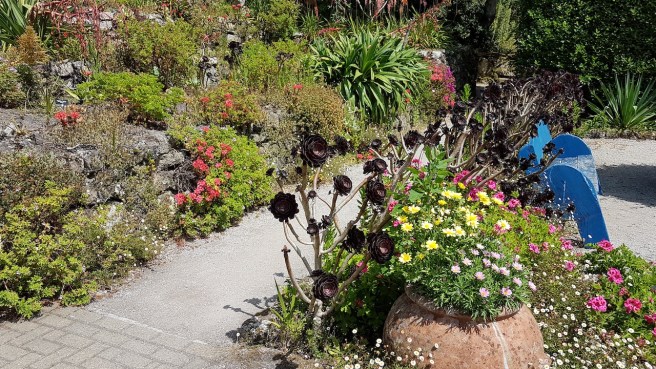

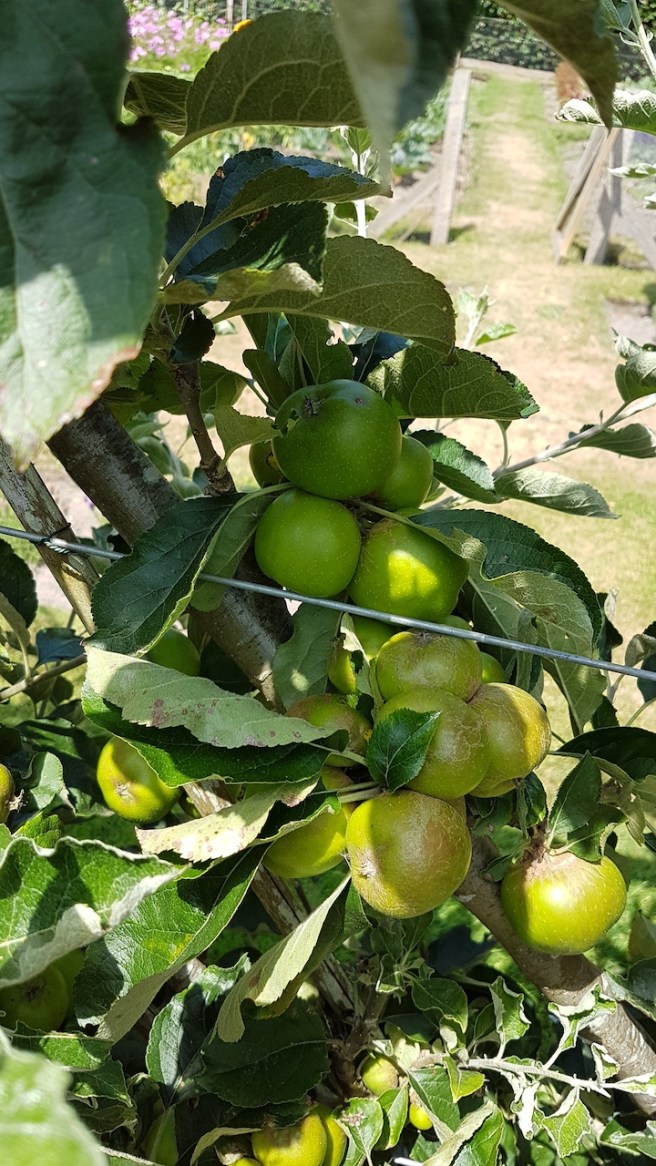
 Towards the end of our stroll around the gardens we happened upon a fruit and vegetable area which was patently not part of the main run of things. Our assumption was that this was maintained (in tip-top condition) for the Abbey owners themselves.
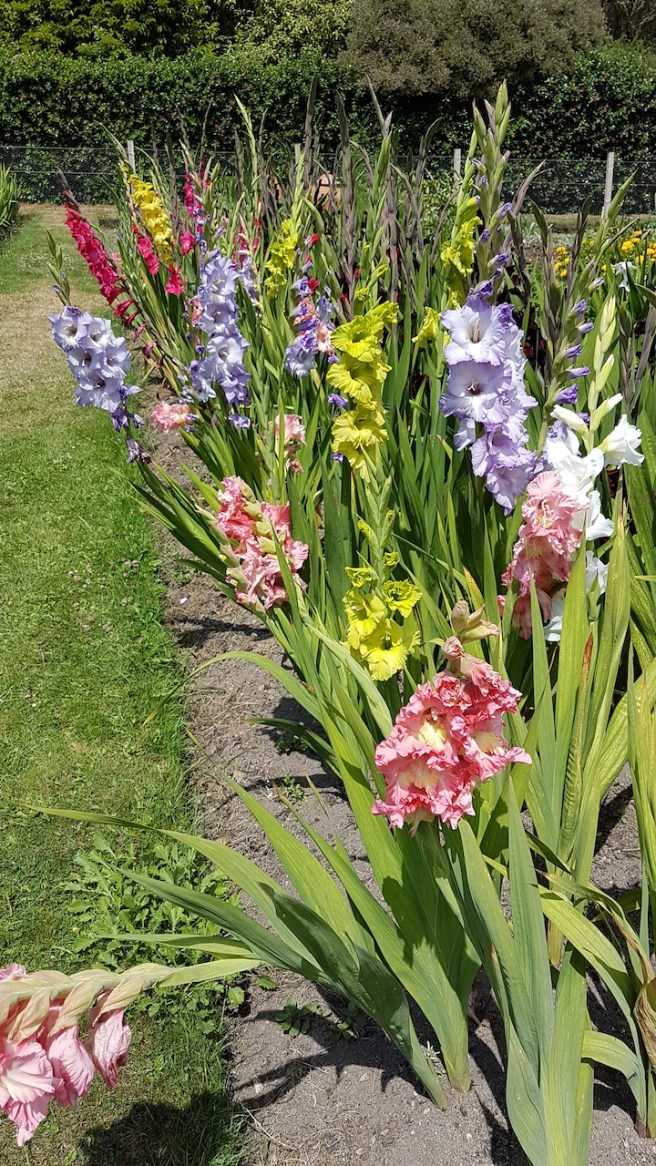
 It also contained cutting beds, again probably for the owners vases.
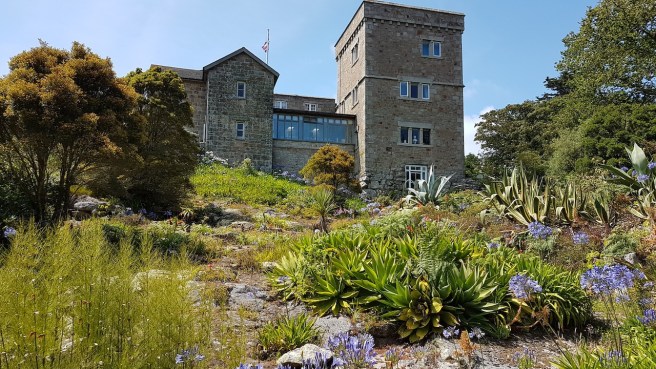
 We had the ferry to catch at 3.30pm to link up with the Scillonian, so we reluctantly left the gardens. On our way to
  the outside of the house itself….
 and finally had beautiful vistas opening up of the sea……
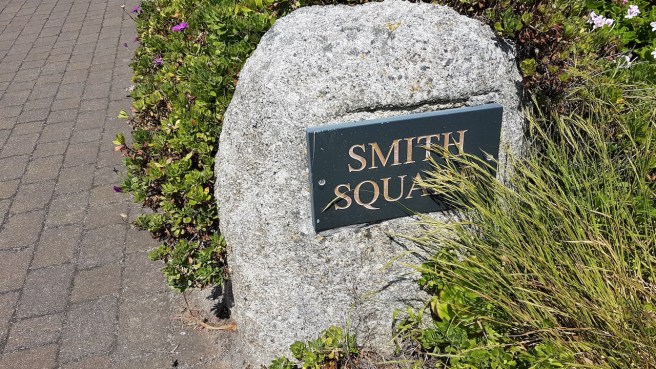
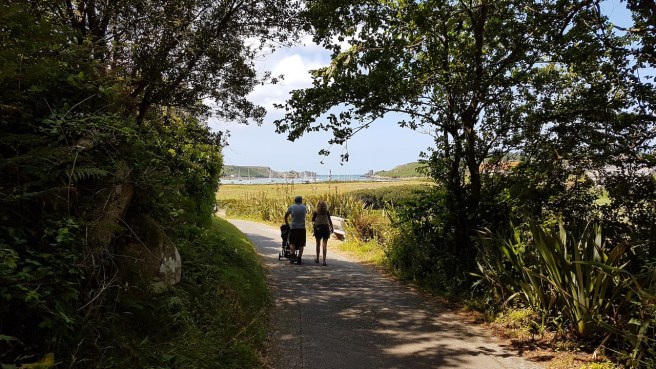 I noted in the outskirts of the hamlet that they had even named a square after me (very nice of them)
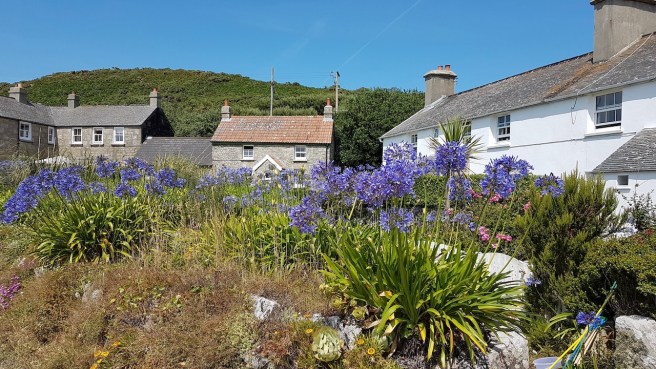
 and passing the beautiful cottages in their verdant setting we made our way….
 ……to the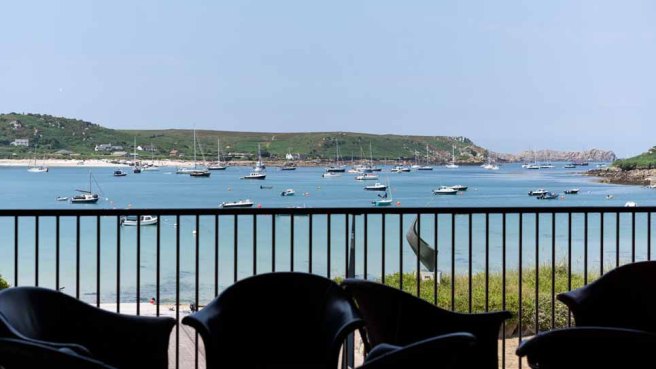
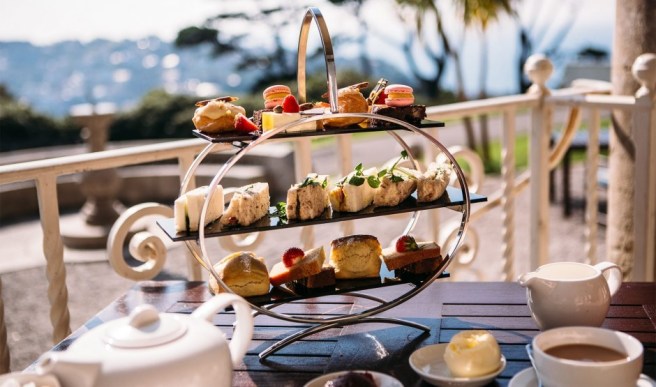 As part of our Christmas present from Katherine, we had a voucher for afternoon tea at the Fowey Hall Hotel. We had visited once before and came away extremely disgruntled with atrocious service. This time the service was impeccable.
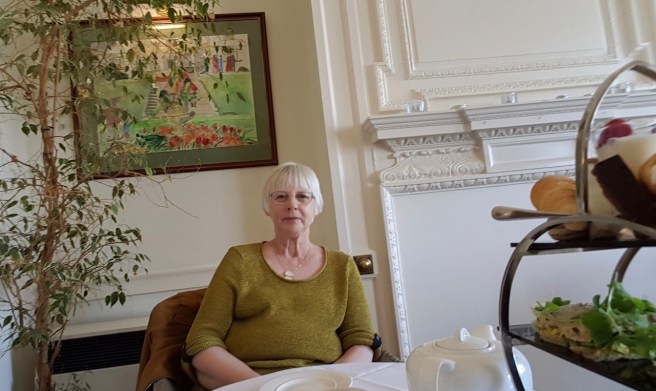 The tea was lovely, the weather great, and the setting and views tremendous.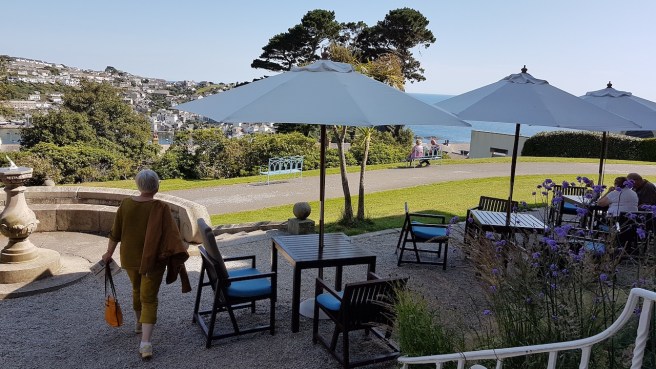
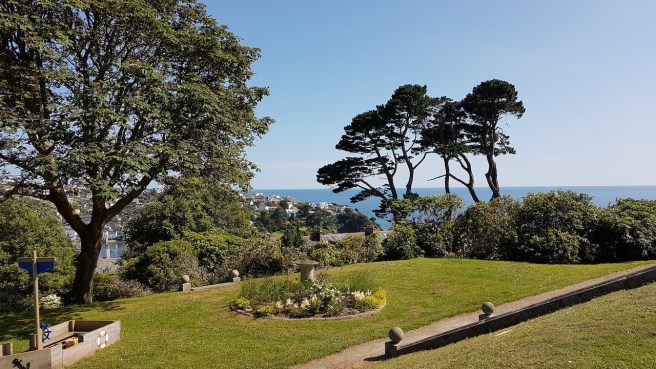
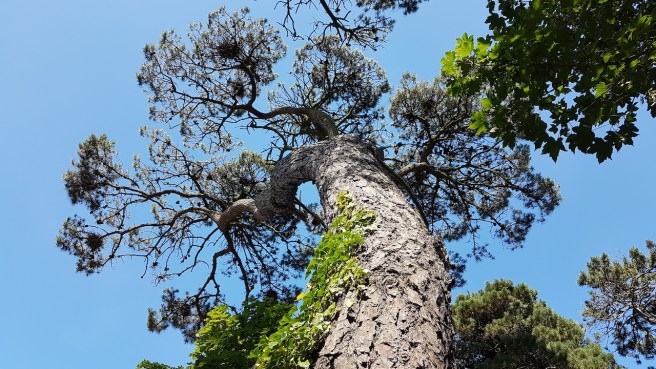 As you might expect we were sated and decided we had better work off some of the culinary inputs by steeply descending into Fowey.
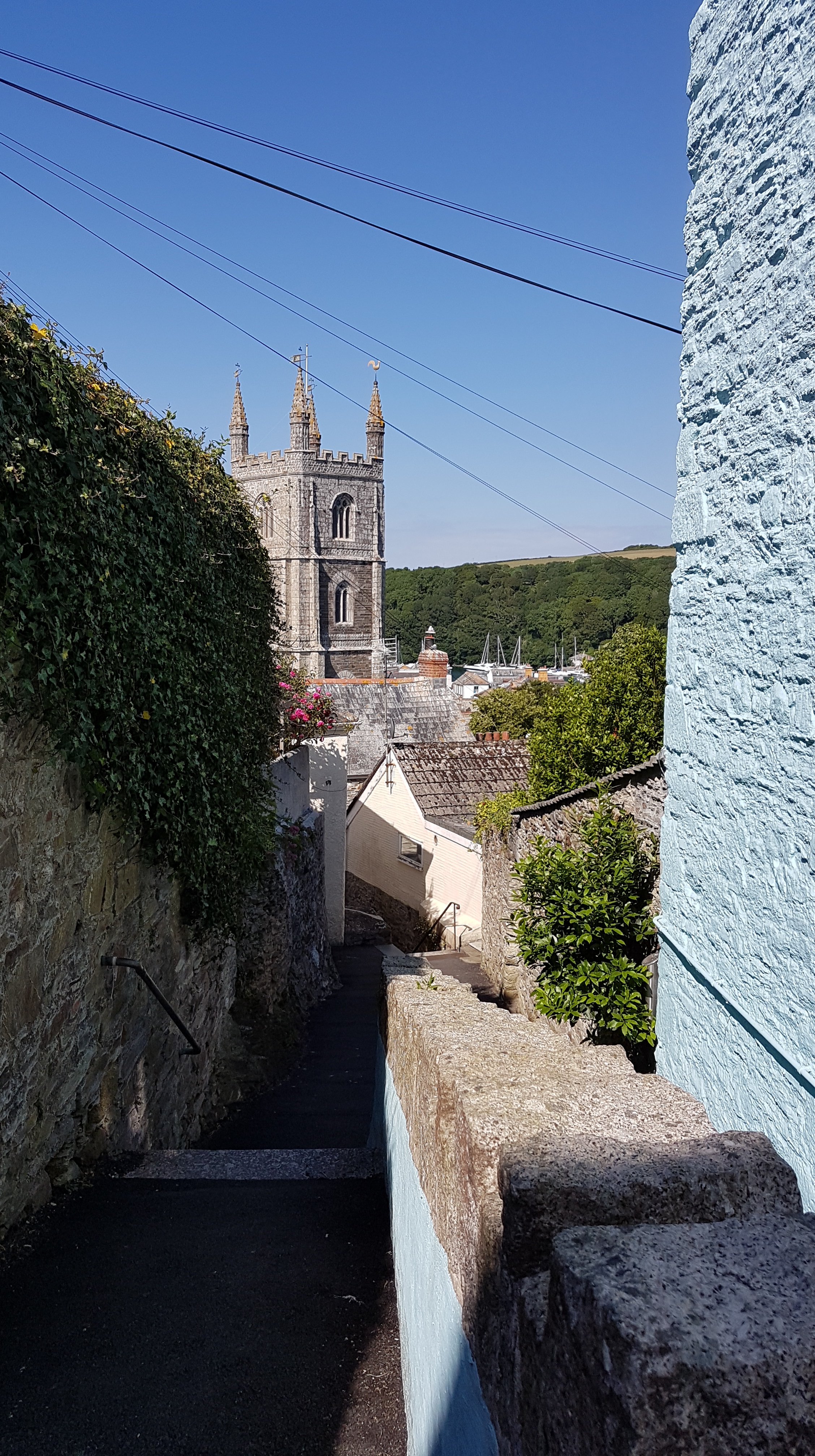
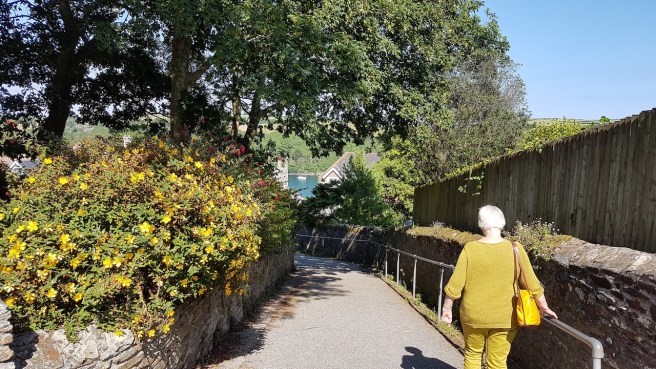 Some people might regard Fowey as twee. But it is one of my all-time favourites.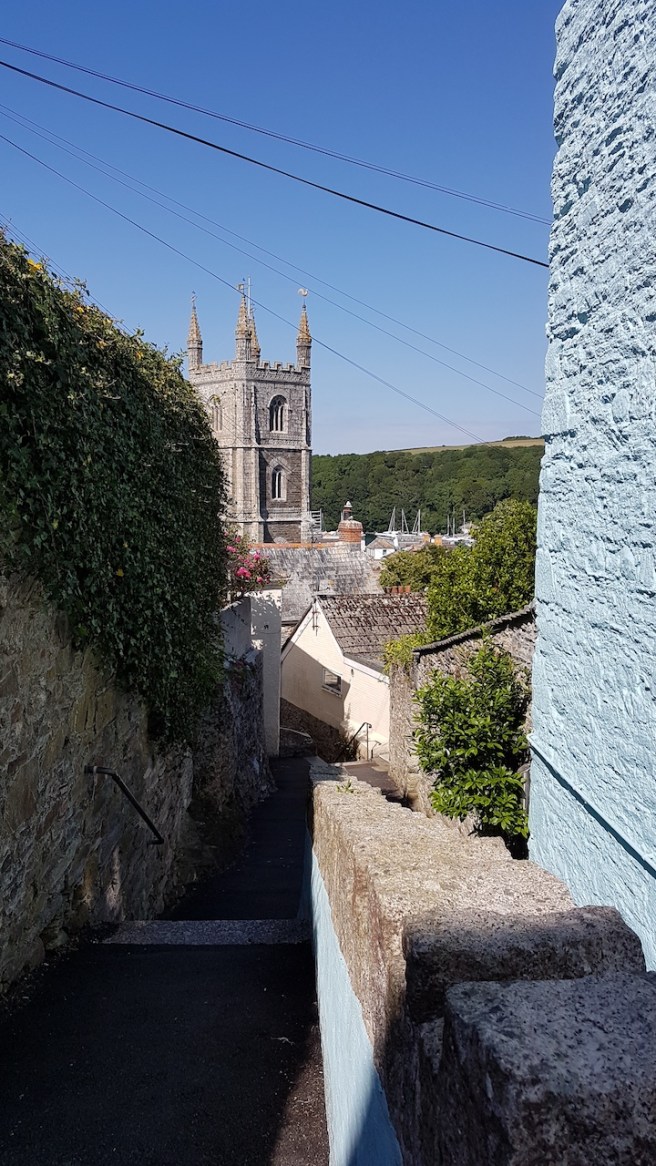
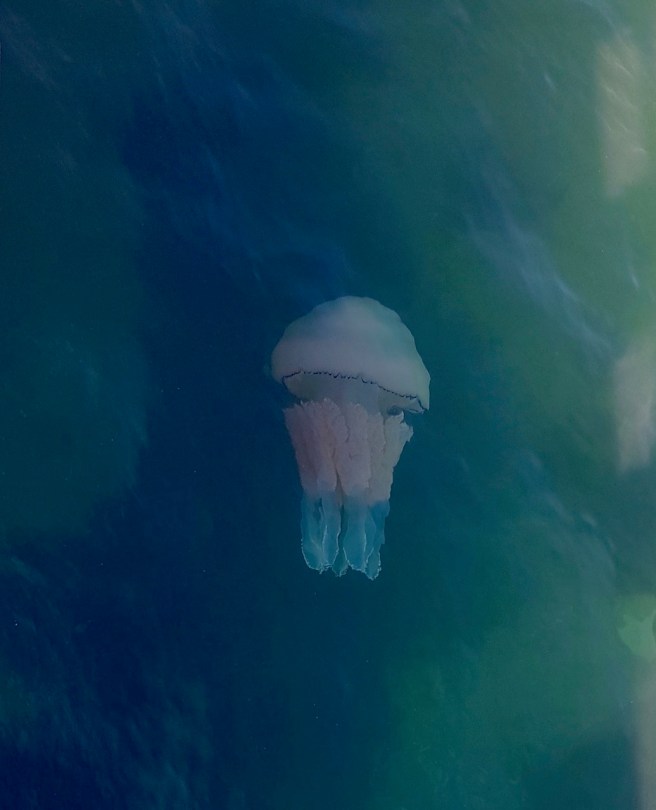
 The harbour and town were busy. Whilst enjoying the views, staring down into the waters we couldn’t believe our eyes when we saw a group of the most enormous jellyfish at least three or four feet long…..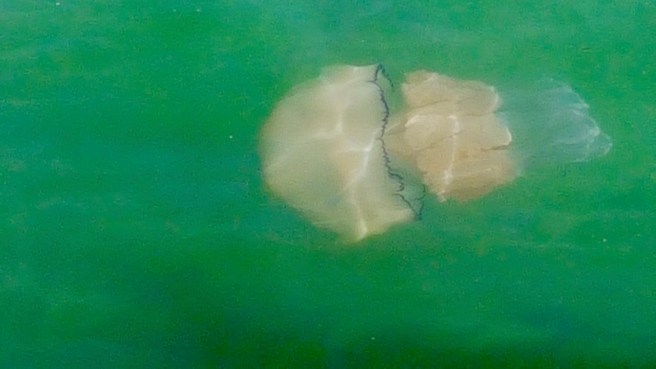
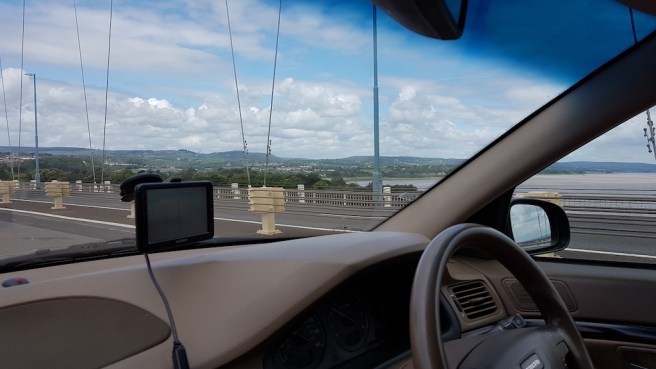
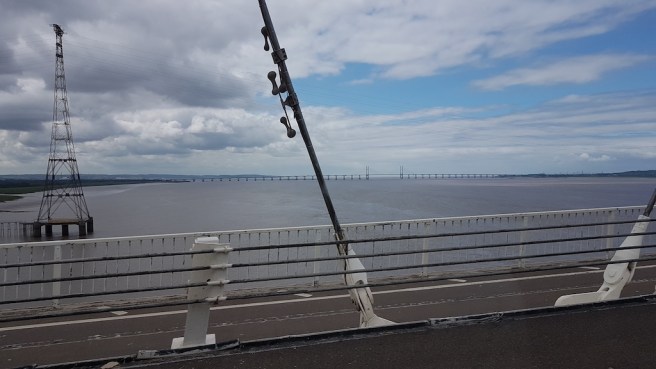 We were off for another week’s house-hunting in Cheshire, having narrowed our search down to Sandbach and district and, rather than belt up the Motorway, we decided to use the ‘old’ route up through the border country. What a terrific decision. So pleasant driving through the rural and idyllic counties of Monmouth, Hereford and Shropshire then into Cheshire. And always an impressive start to a journey to cross into Wales via either of the Severn bridges….
 We broke the journey for lunch at
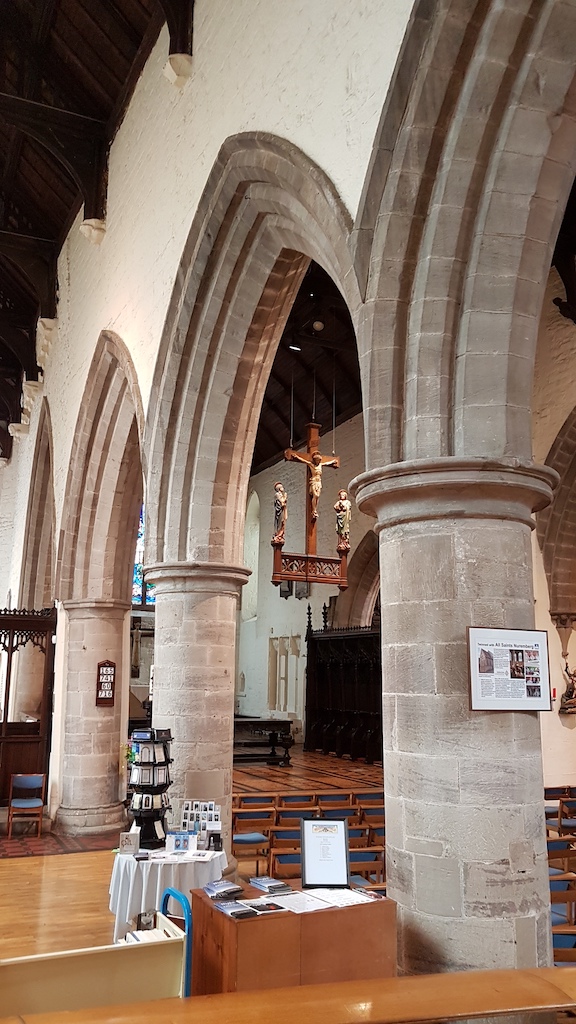
 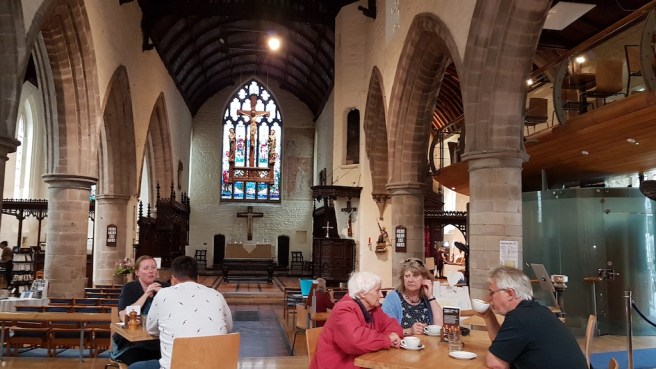 Suitably refreshed, we took the opportunity to look round the church itself (another bonus to the church of having the cafe) and it was fascinating. Basically it is Fourteenth Century.
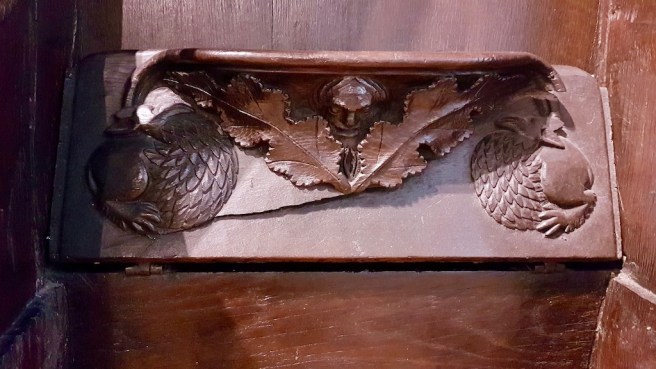
  There are some wonderful misericords….
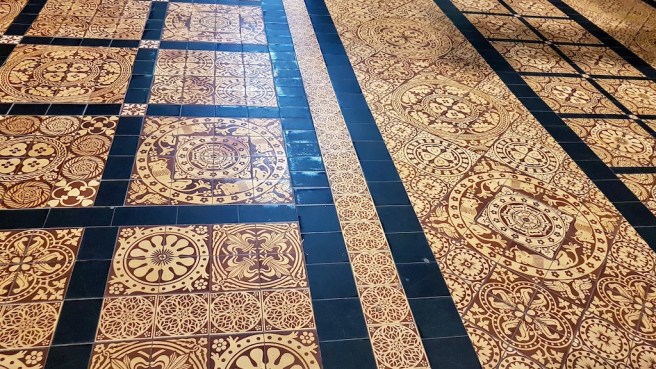
 breathtaking Minton tiles…
 and a famous, indeed infamous, rude carving in the roof…..
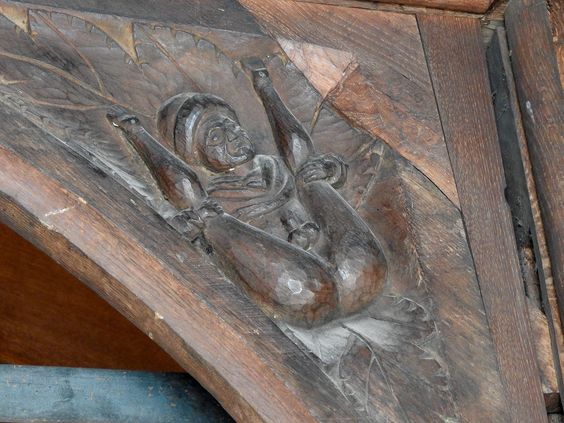 ….apparently the current vicar wanted to make some money out of this by publishing postcards etc but he was stopped by the PCC who ruled it out as too inappropriate!
  Our little tour of the church over, we wandered around the town itself to admire many wonderful buildings…..
 .
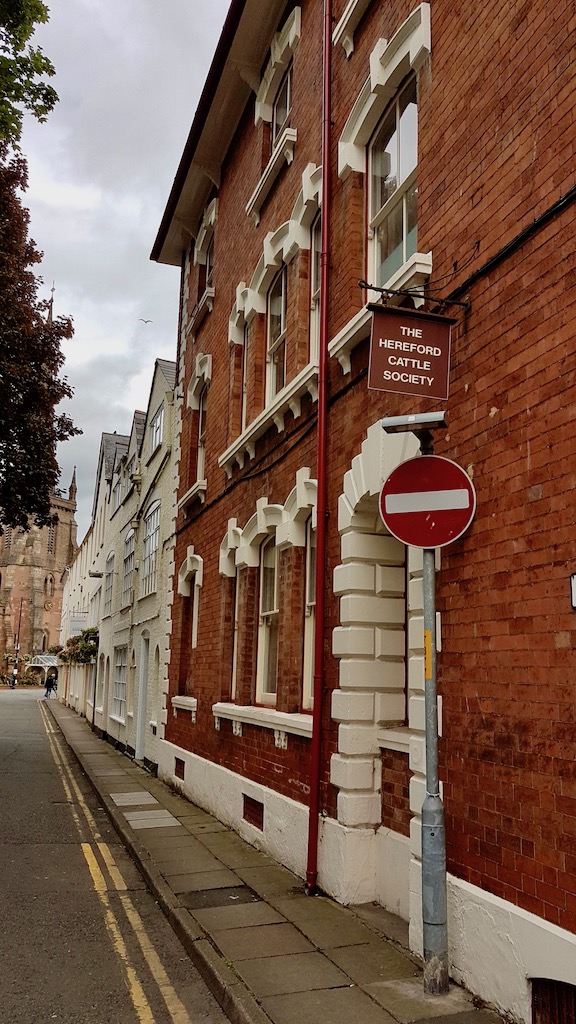
.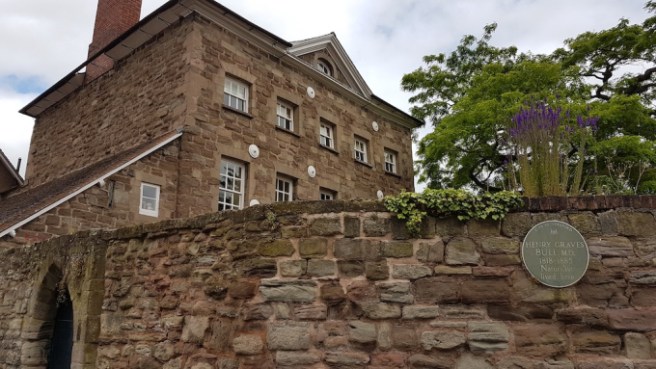 …we noted how bucolic the city really was….not many city centres after all have offices for a cattle society….
 we said hello to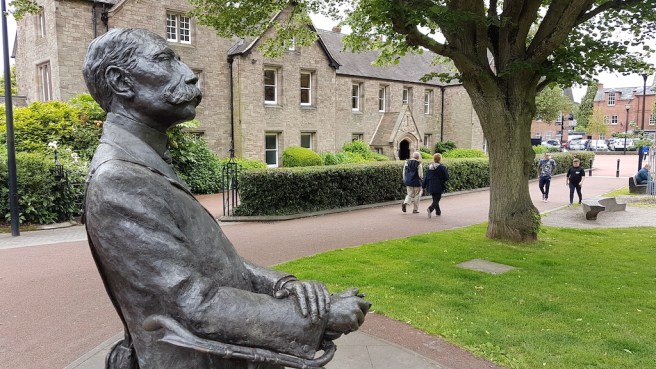
 and marvelled at the exterior of one of our great cathedrals…..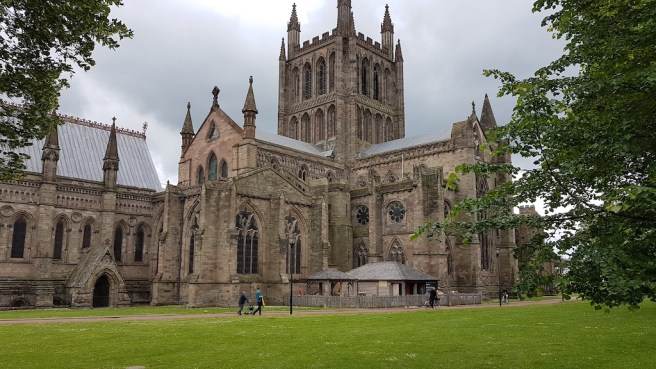
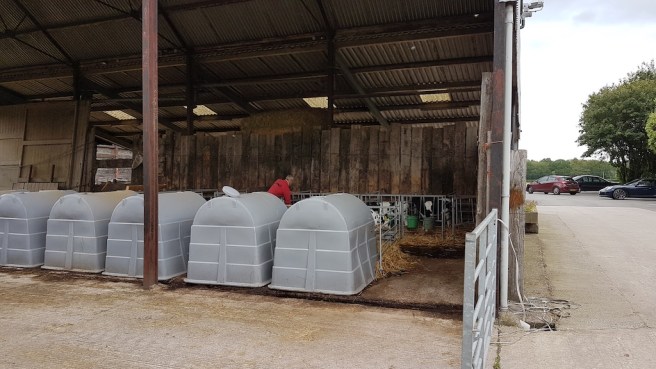
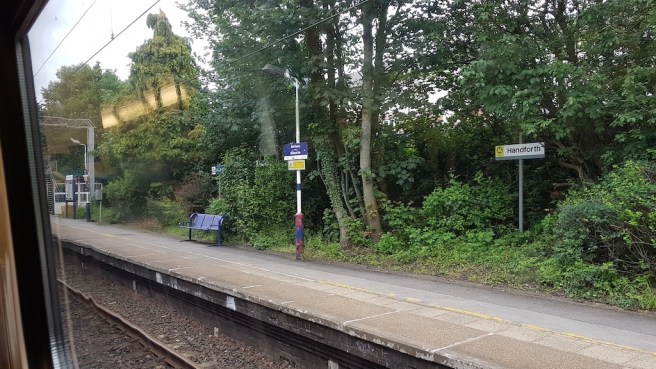
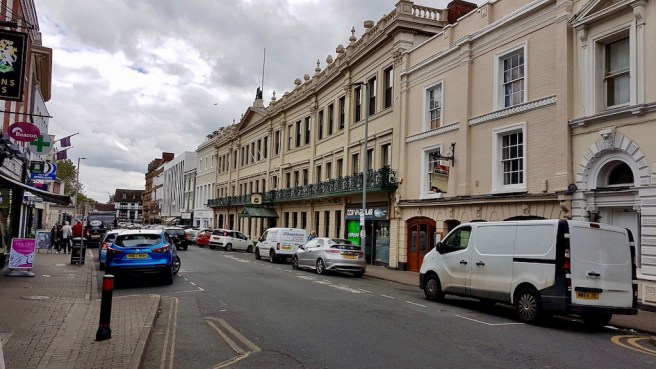 Resuming, we eventually reached our destination – Holly Cottage near Holmes Chapel, and settled in to farmyard life!
  The cottage was everything you would want and we had our own little garden..
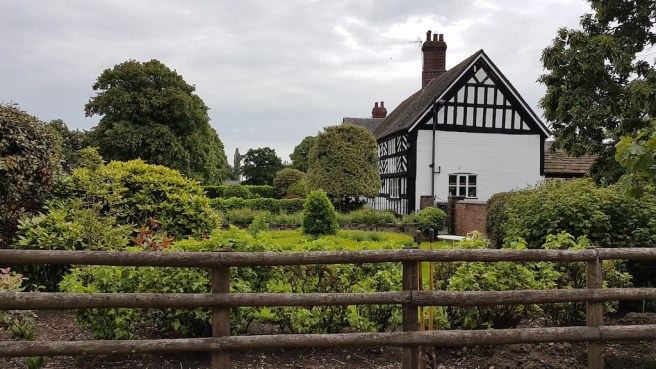
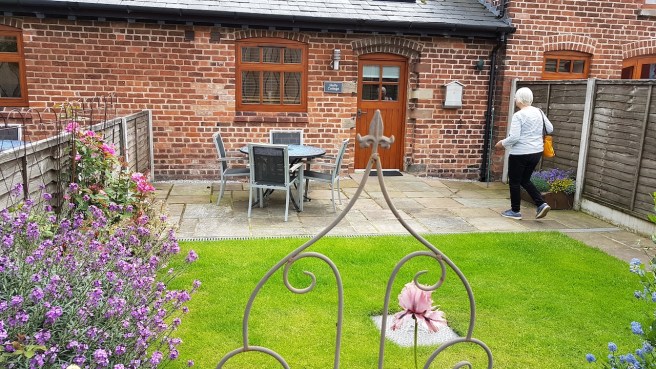 and the owner’s farmhouse was just typical of Black and White Cheshire…
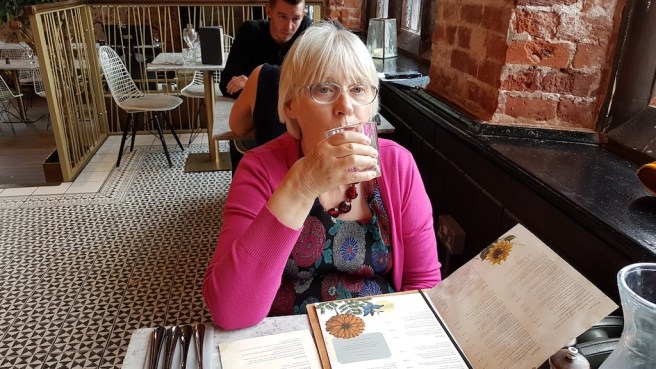
 After some serious hard work house-hunting the next two days, for F’s birthday on the 19th we went in the evening to
  The restaurant was full of character and we really enjoyed ourselves.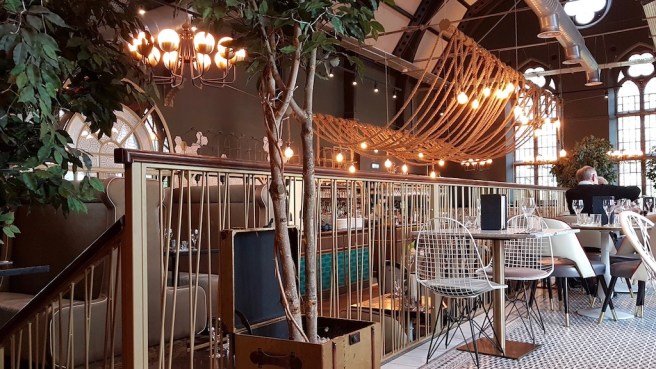
 On a ‘day off’ we again used the train to go to Liverpool – somewhere I haven’t been for a long time. As soon as you come out of Lime Street station you are confronted with the most marvellous array of public buildings among them St George’s Hall, the Walker Art Gallery, various museums and the Central Library, all worthy of a capital city. Indeed we both had the feeling that we were in somewhere much akin to Barcelona or Lisbon. Who knew that Liverpool was as impressive as this? We were taken aback.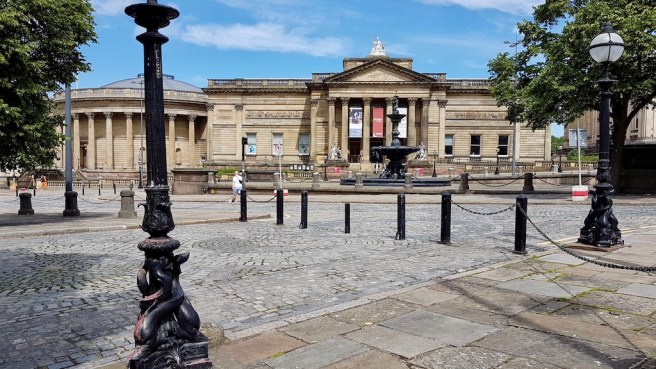
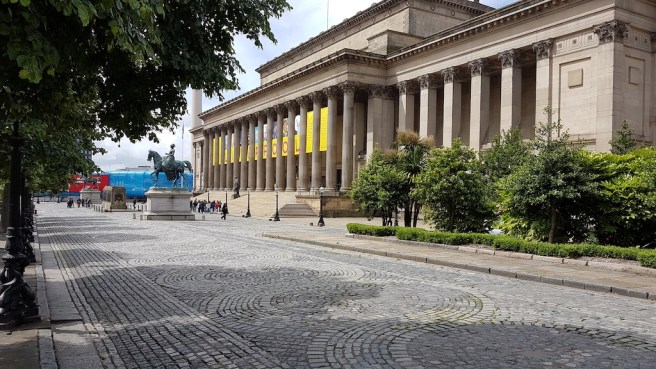 Opposite was the Empire Theatre where I once, with my first girlfriend, saw Ken Dodd perform. The show started at 7.30 pm, and by midnight Ken was informing us that the doors were locked and we wouldn’t get out until he had finished! The Empire has the largest two-tier auditorium in Britain and can seat 2,348 people.
 A lovely park set off all the buildings around here.
 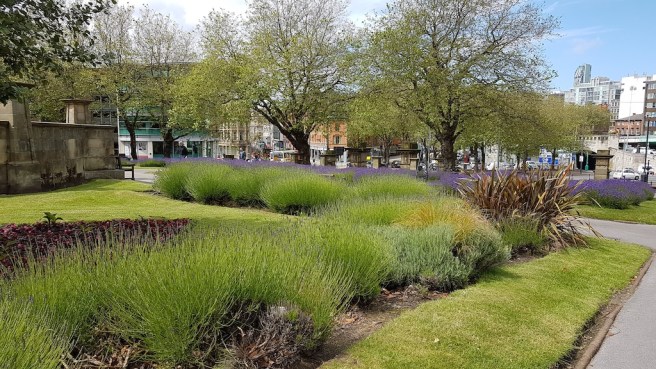 As we progressed through the city towards the sea the buildings remained impressive.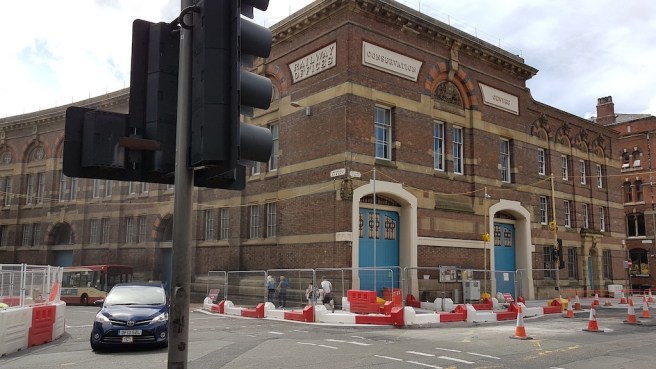
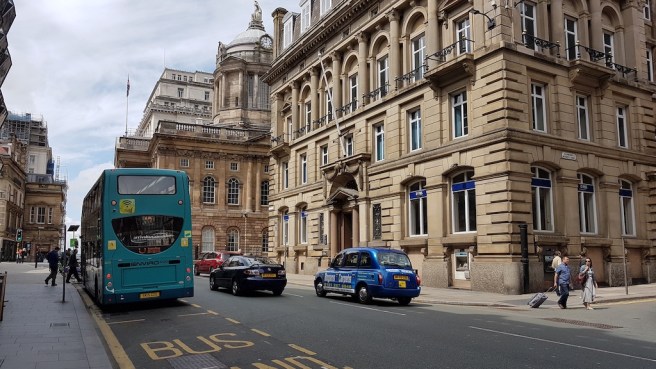

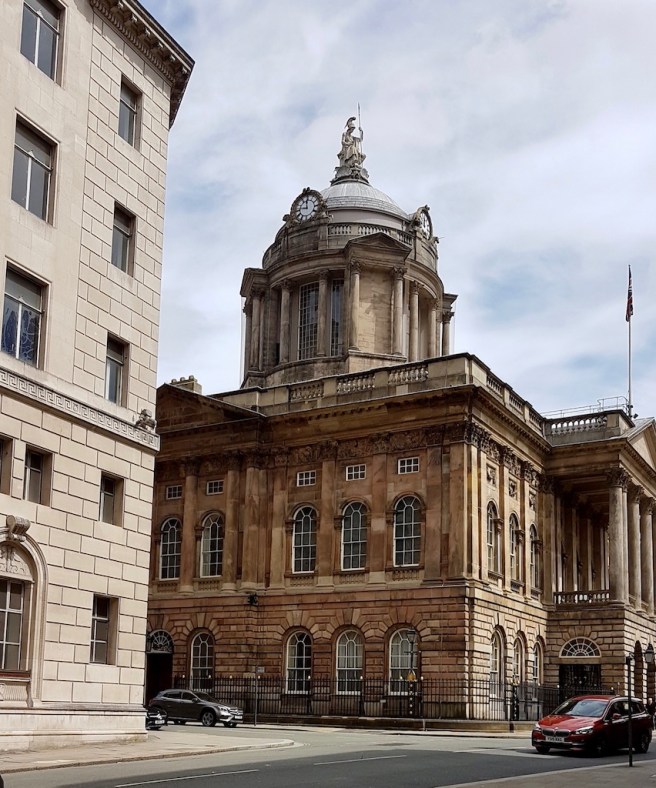
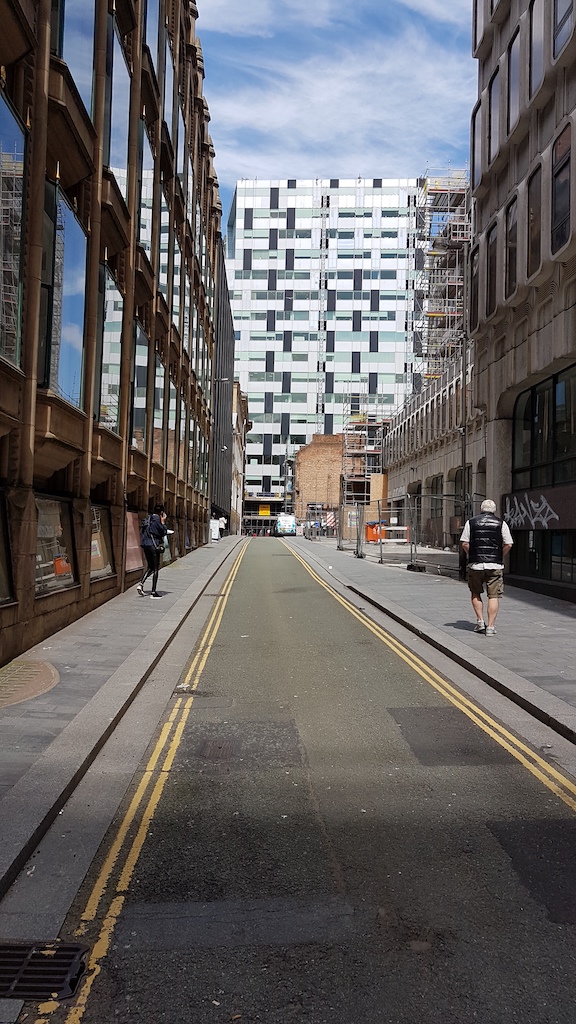 It’s always nice to see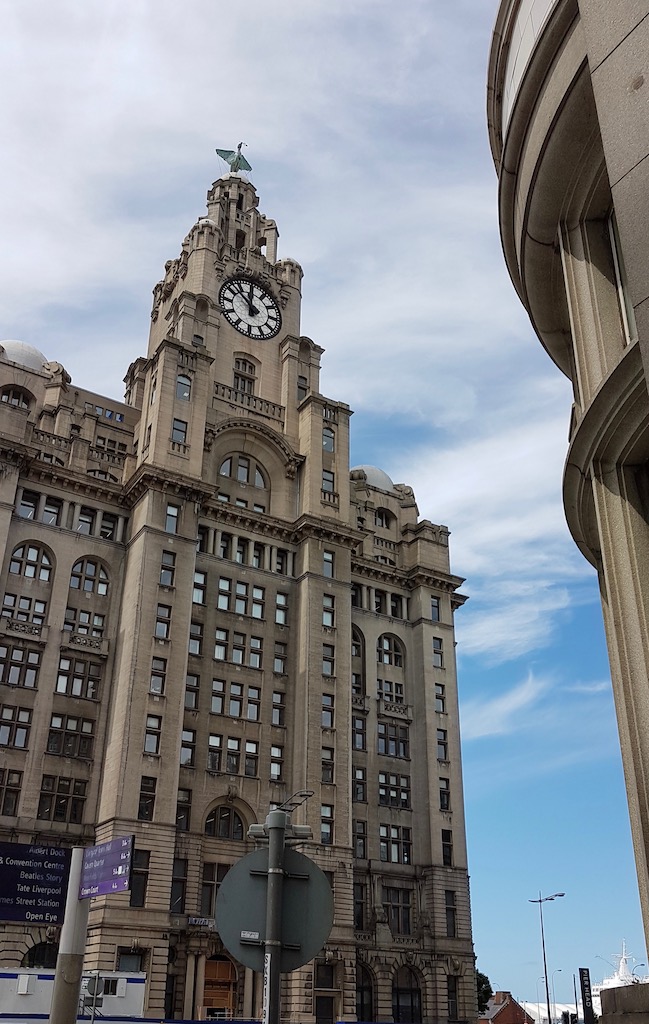
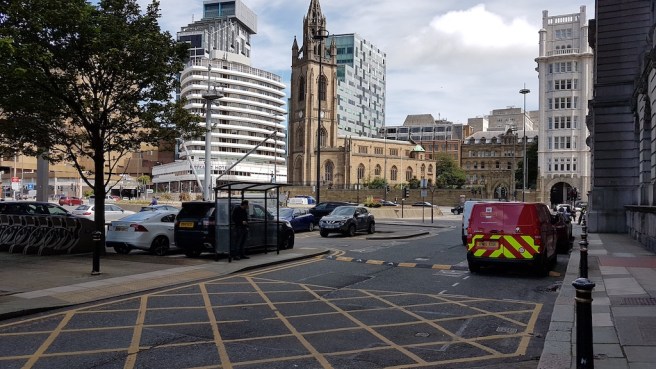
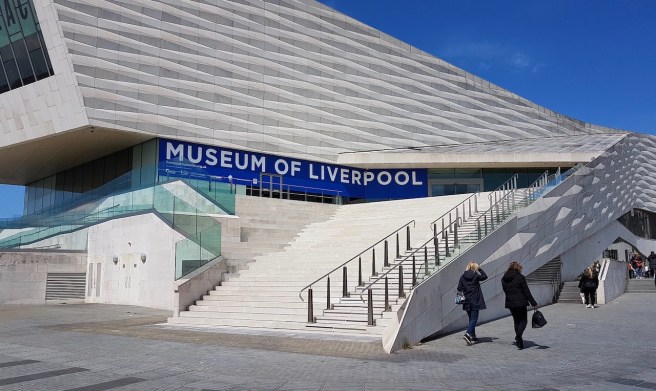
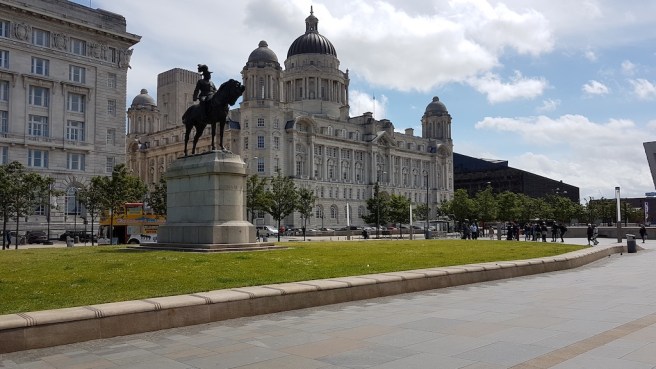 And the front of the city facing the sea was busy and stylish…..full of museums which unfortunately we had no time to see….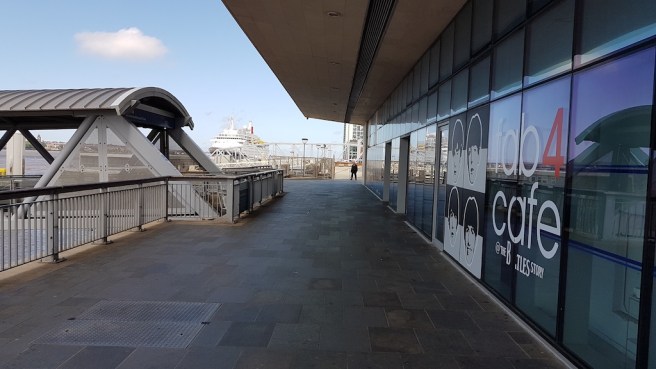
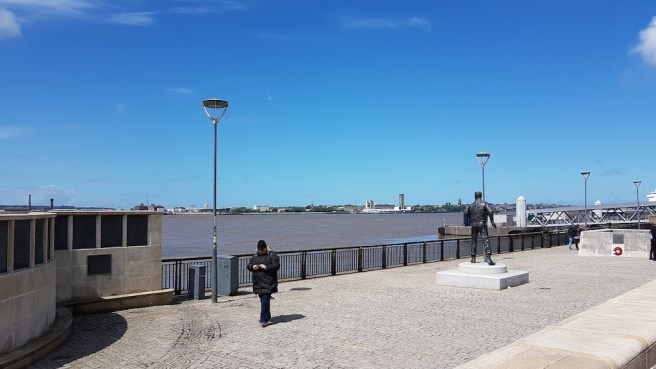

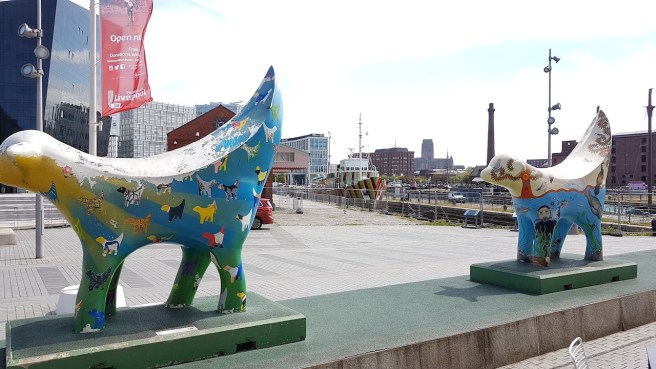 We walked from the pierhead towards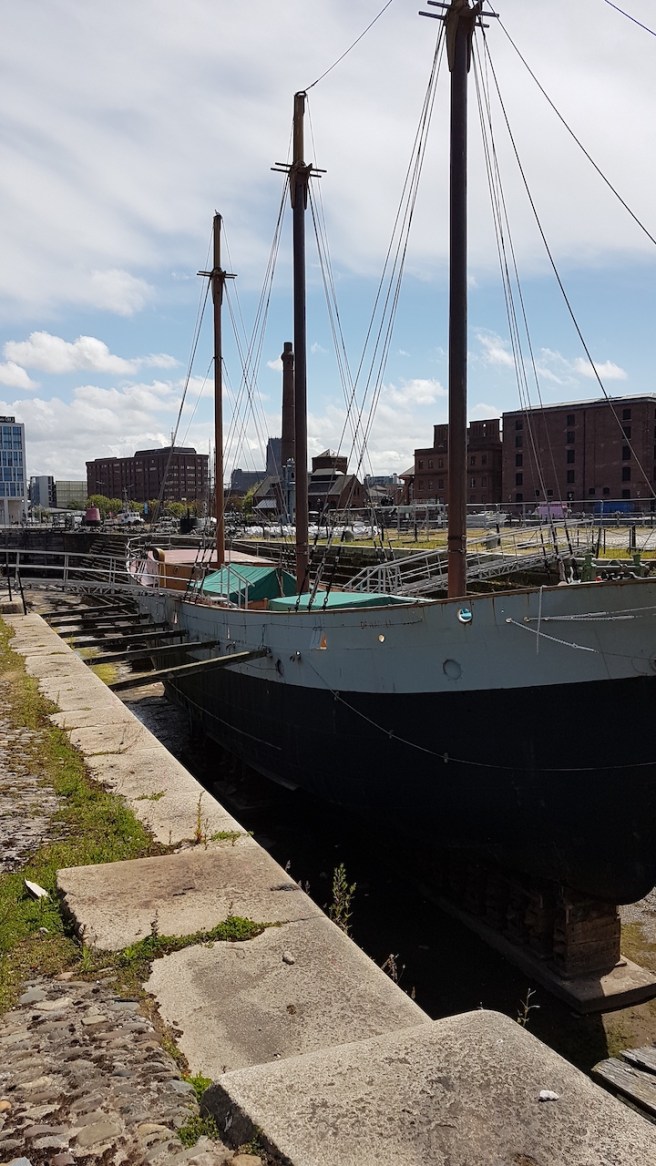
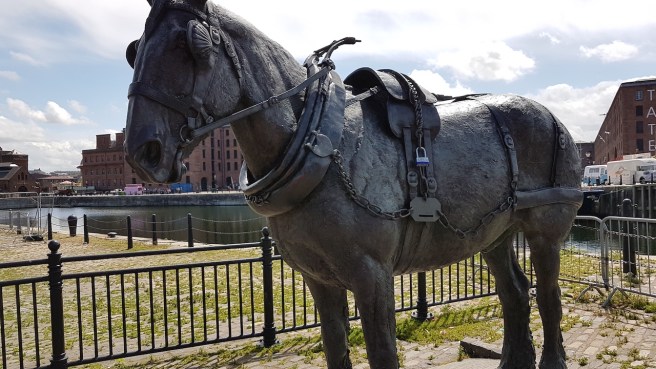
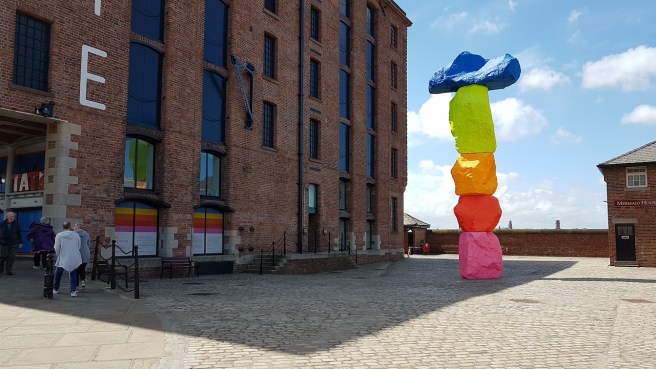 The Albert Dock itself was lovely, a great conversion, full of people. The flats looked stylish but the shops and restaurants were leaning a wee bit towards tat and greasy food unfortunately. But that didn’t take away from the splendour of the buildings and setting.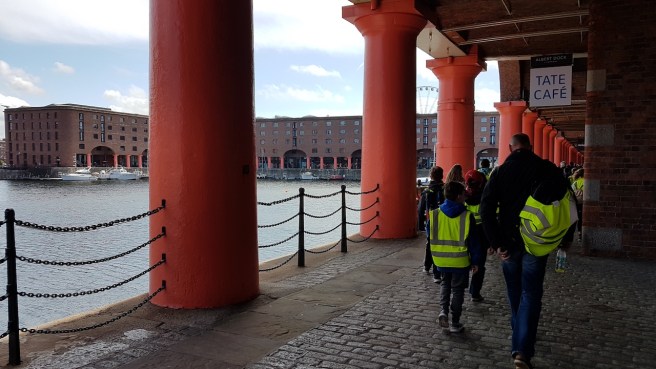
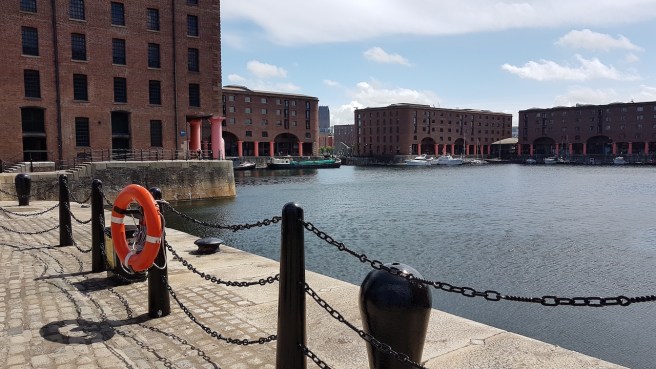
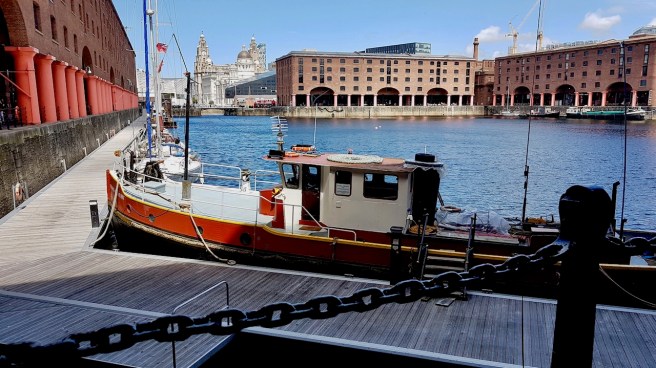
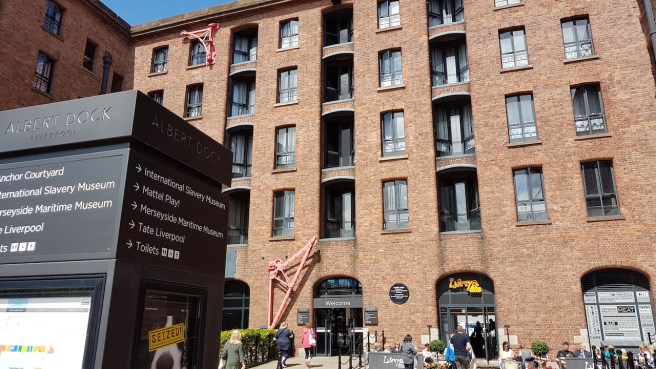 We moved into town to seek somewhere to eat…
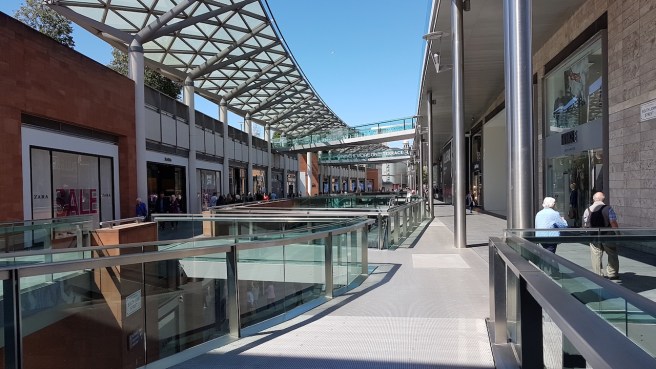
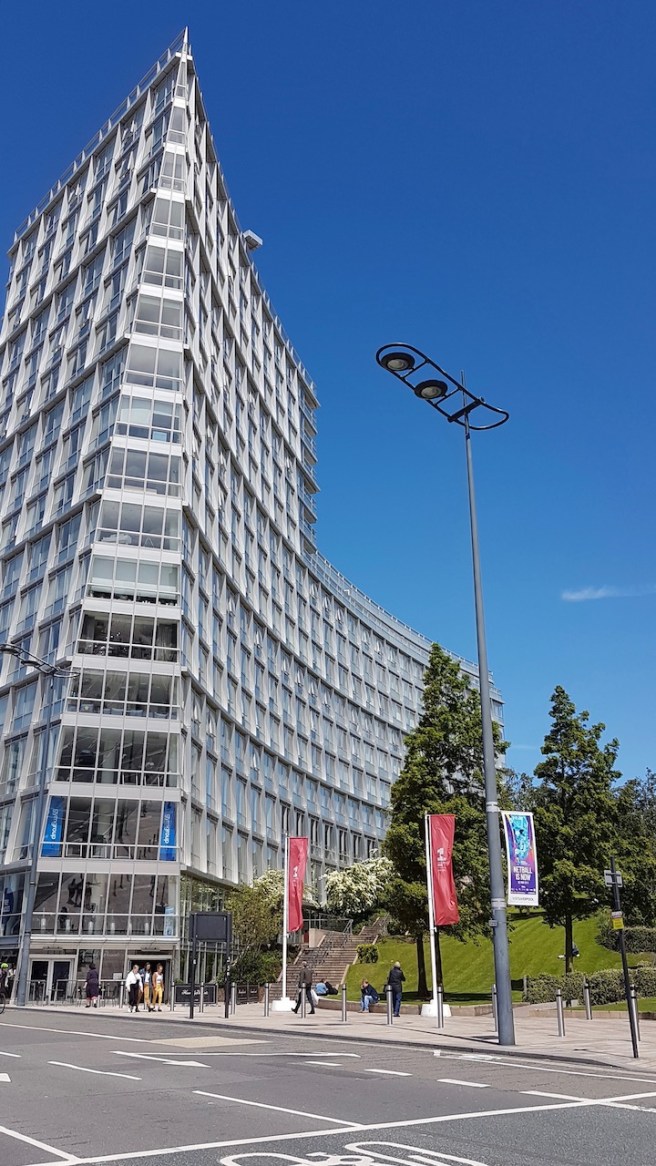 and because we couldn’t find my carefully researched rooftop cafe with a view, we ended up in the shopping centre and a rather conventional lunch at John Lewis’s….not to be sniffed at with a glass of wine. The shopping centre was great too…… very clean, modern and sleek and there was a nice ‘grassed’ area for lunch and watching buskers…all in all a memorable visit to a city that has recovered all its old vim and vigour and self-esteem. I almost like it better than the greatest city of them all (Manchester).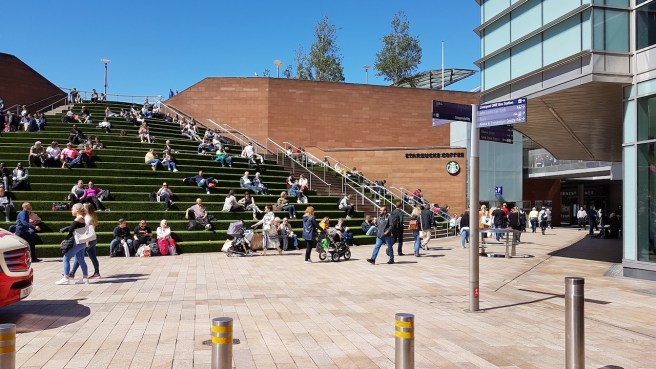
 Another of our trips out was to
  Just as when last time we had visited Lymm Hall it was really notable how friendly, helpful and knowledgeable all the guides were. It makes a visit so much more rewarding. But then, as we all know, everybody is friendly in the north west! the entrance hall is rather splendid…..
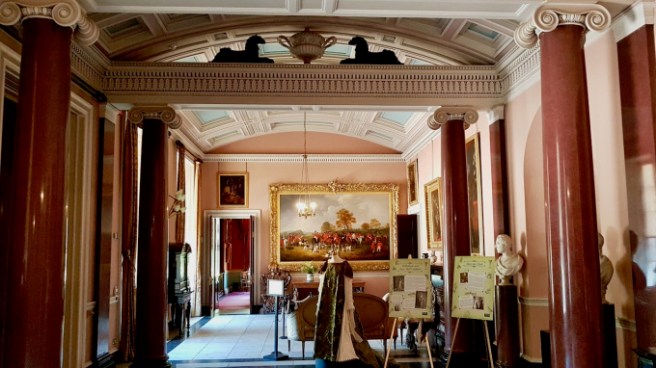 and the spectacular painting ‘The Cheshire Hunt 1839’ almost dominating the hall shows three generations of the Egertons who owned Tatton.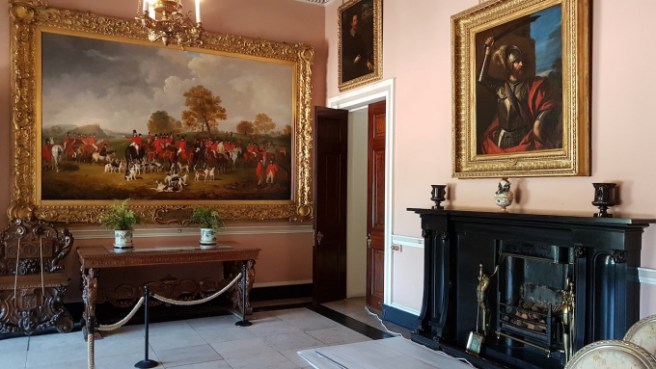
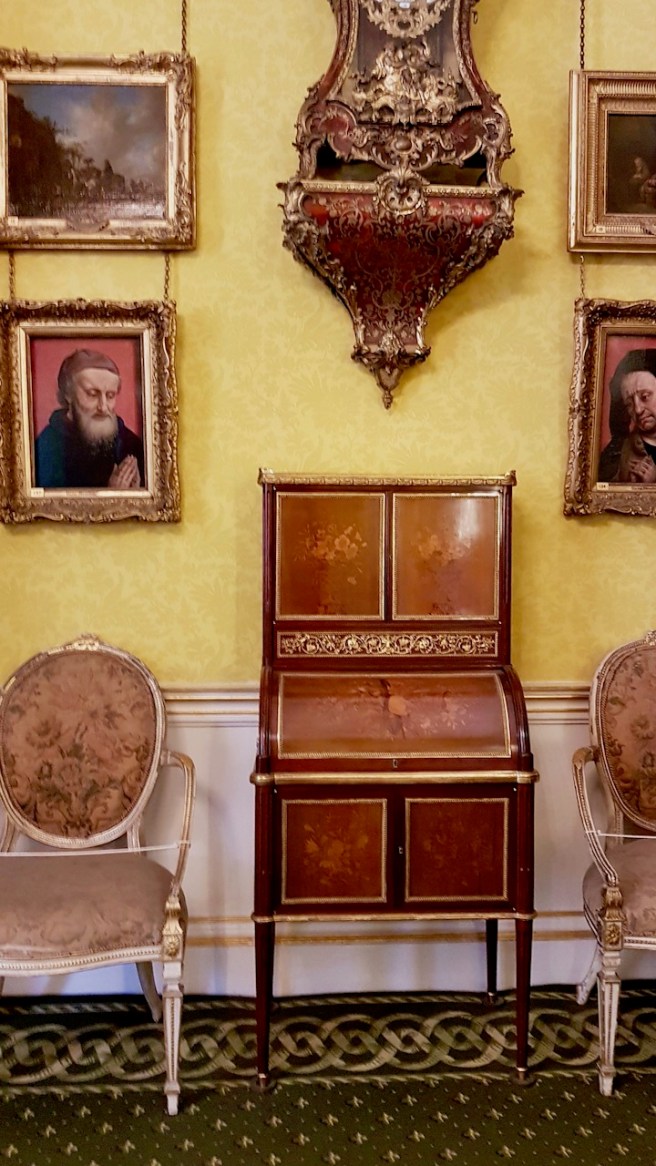 The music and drawing room is the most ostentatious room in the house; Tatton’s collection of Gillow furniture is unrivalled. Wilbraham Egerton’s ownership (1777–1853) saw the commission of many pieces especially for the house.
 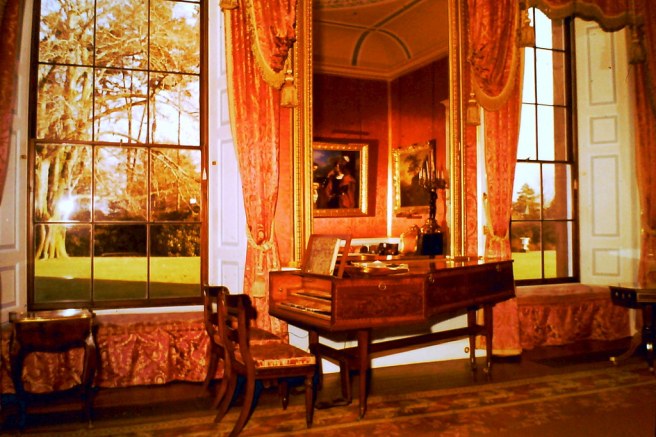 Views from many of the rooms were of the 50 acres of gardens and series of lakes for which Tatton is well-known. they descend all the way down to Knutsford town centre. Lewis William Wyatt and Joseph Paxton, architect of Crystal Palace, designed various elements.
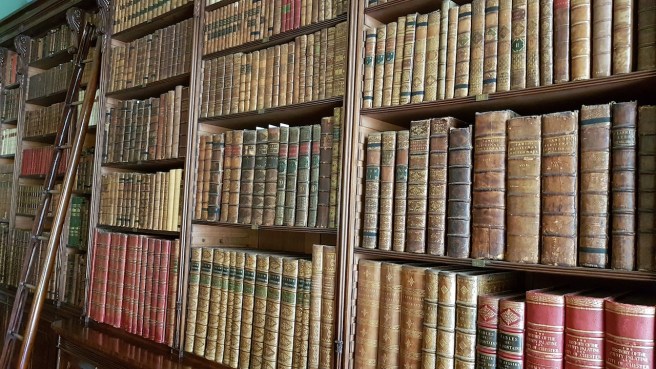
 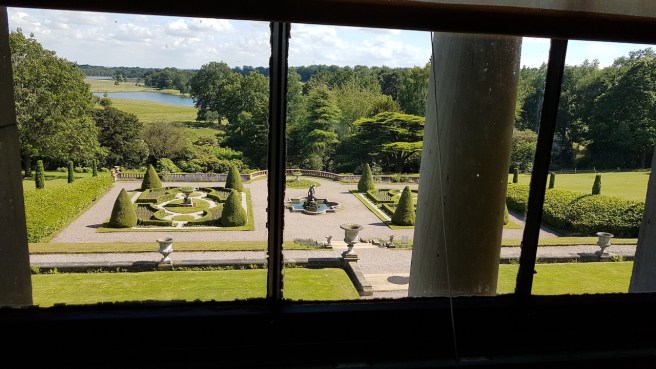 The Library is a perfectly symmetrical room, in keeping with the formality of the neo-classical style. It houses one of the largest and most important library collections owned by the National Trust with over 8,000 books in this room alone, many still in their original covers and in mint condition. We had a fascinating conversation with the guide in this room who is very knowledgeable about the books and gives one of their 10 minute talks on the library. We will be sure to go.
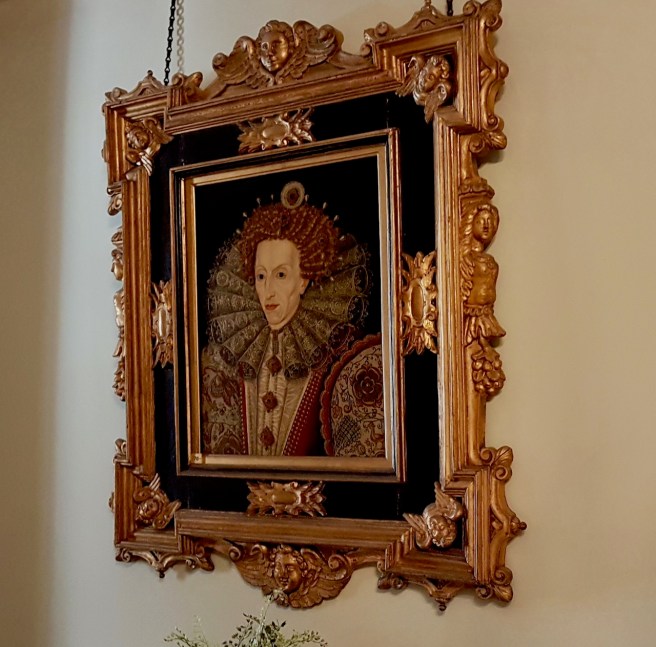
  No-one can resist a portrait of any of the Tudors…..
 All in all time very well spent. We then were able to drive through the grounds past the lakes into Knutsford where we had another wander around this delightful town.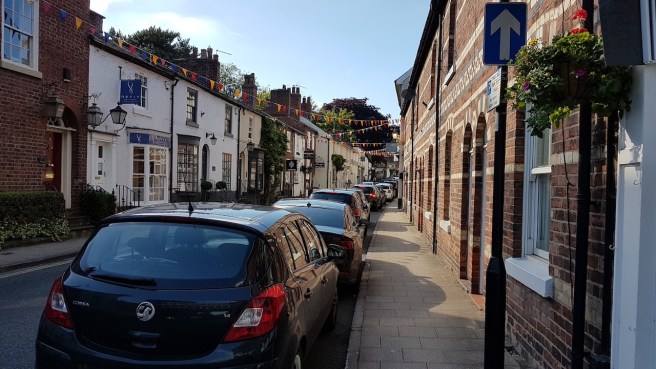
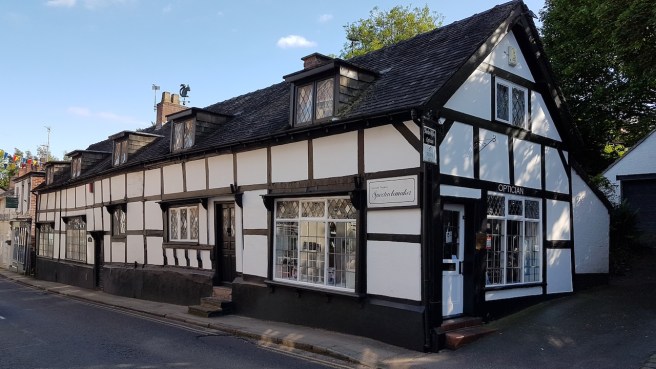
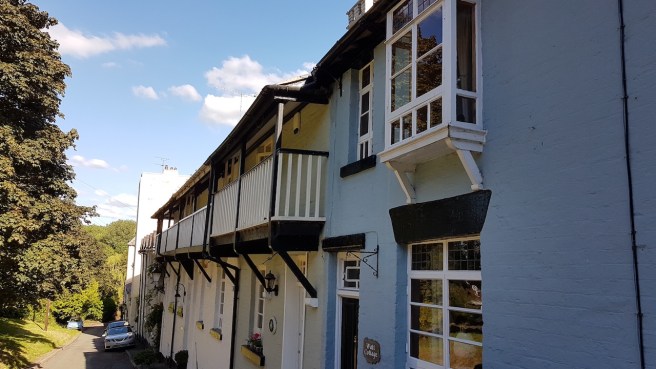
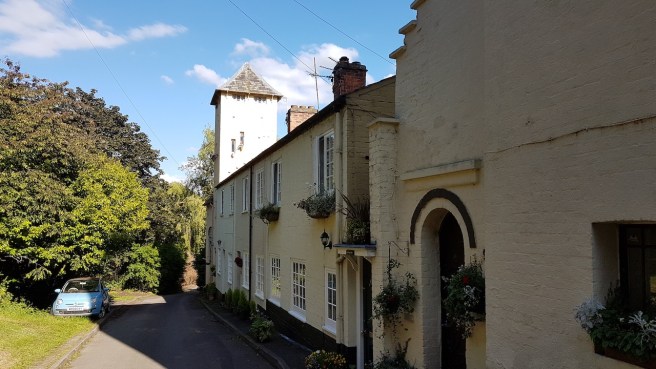
 Parts of Knutsford seem very Italianate….you could almost be on the side of Lake Garda. They are nearly all the work of Richard Harding Watt (1842-1913) who was a local philanthropist, traveller and idealist with a passion for building, who made his fortune from glove making in Manchester. He worked with four professional architects to transform the townscape of Knutsford with a series of eccentric buildings.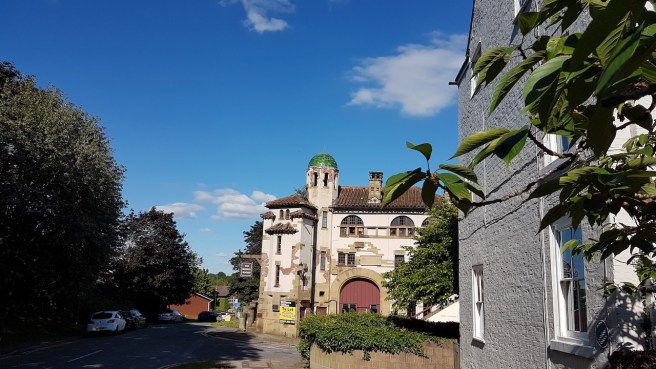
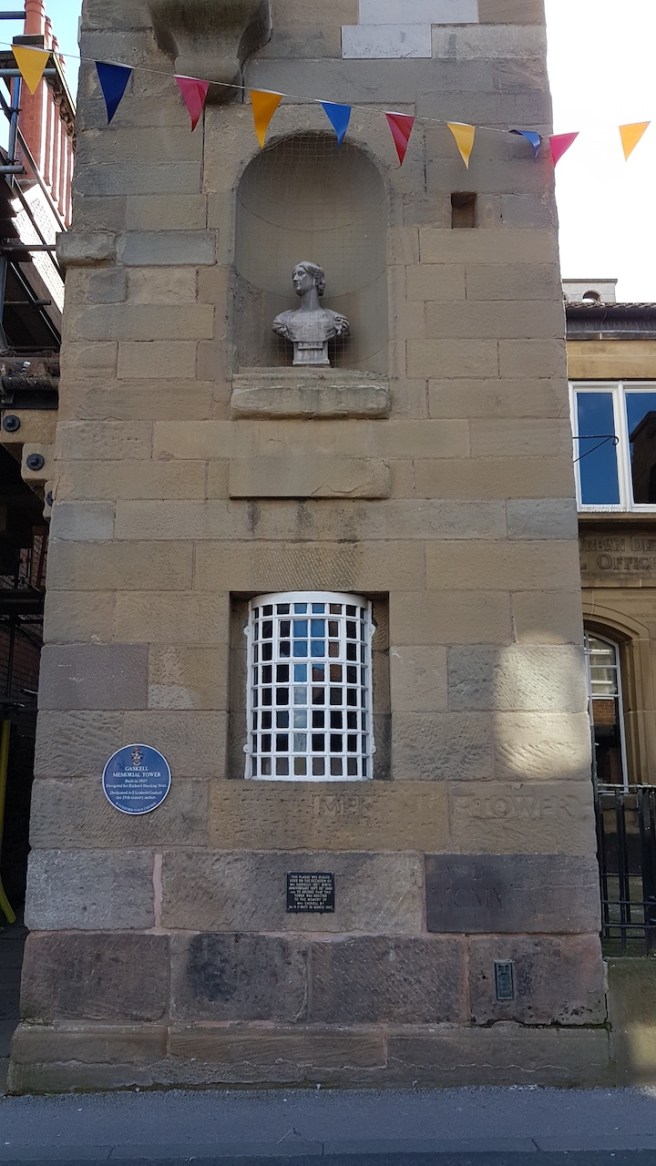
 Elizabeth Gaskell of course used Knutsford as Cranford and there is a suitable monument to her in the town……
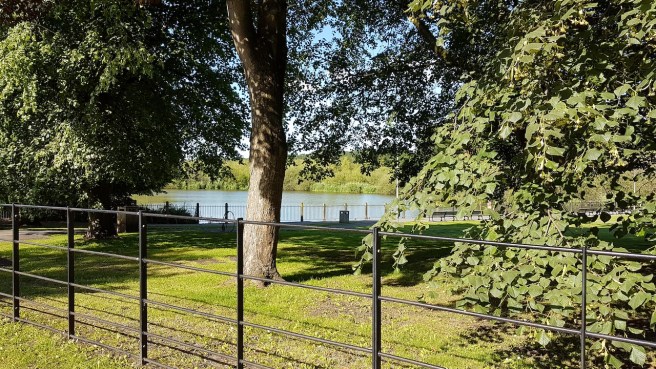
 We also strolled along the side of Knutsford’s own lake…how pleasant!
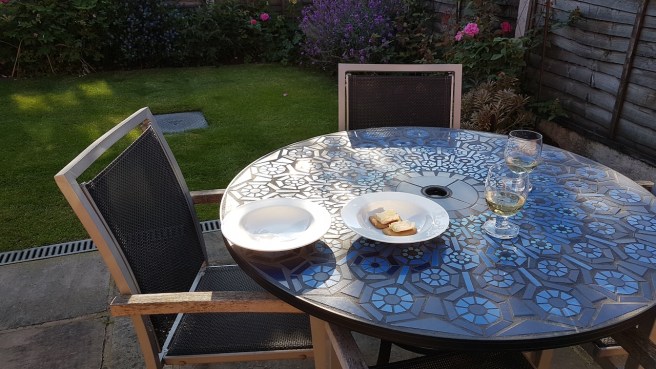
 Our little garden waited for us in the sun at the end of the day…
 One day we looked again at Tarporley a wonderful small village/town. nice to live here but a bit too expensive for us…..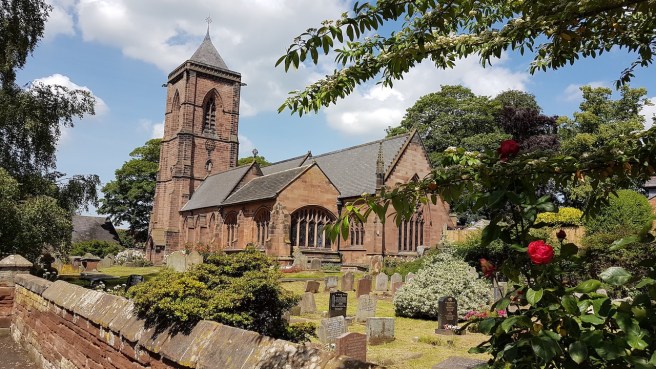
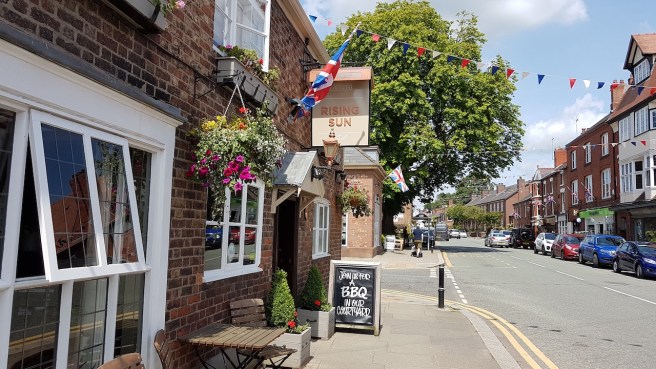
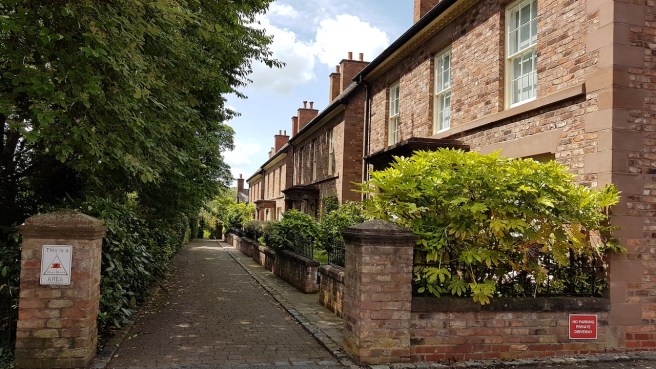 Sunday lunch was at the Bells of Lower Peover. yet another fantastic Cheshire pub….there are many.
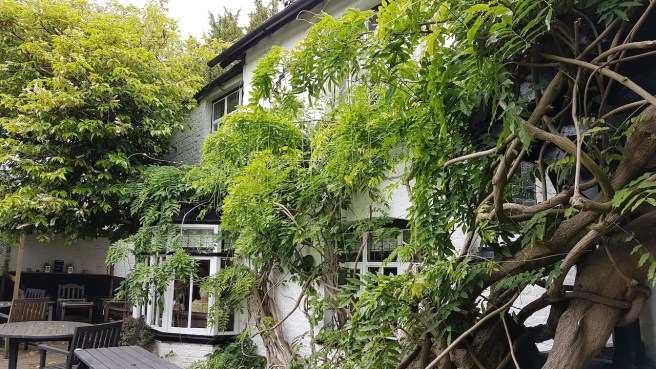 Whilst there we had a good look at St Oswalds and a little stroll around the lanes….

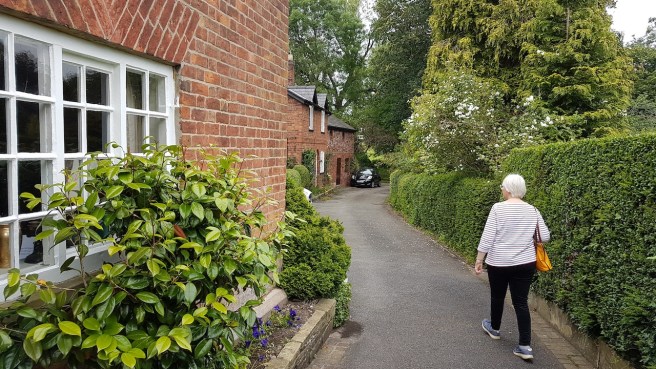
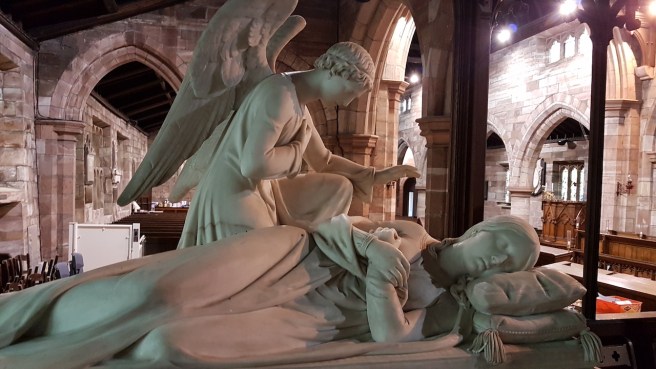
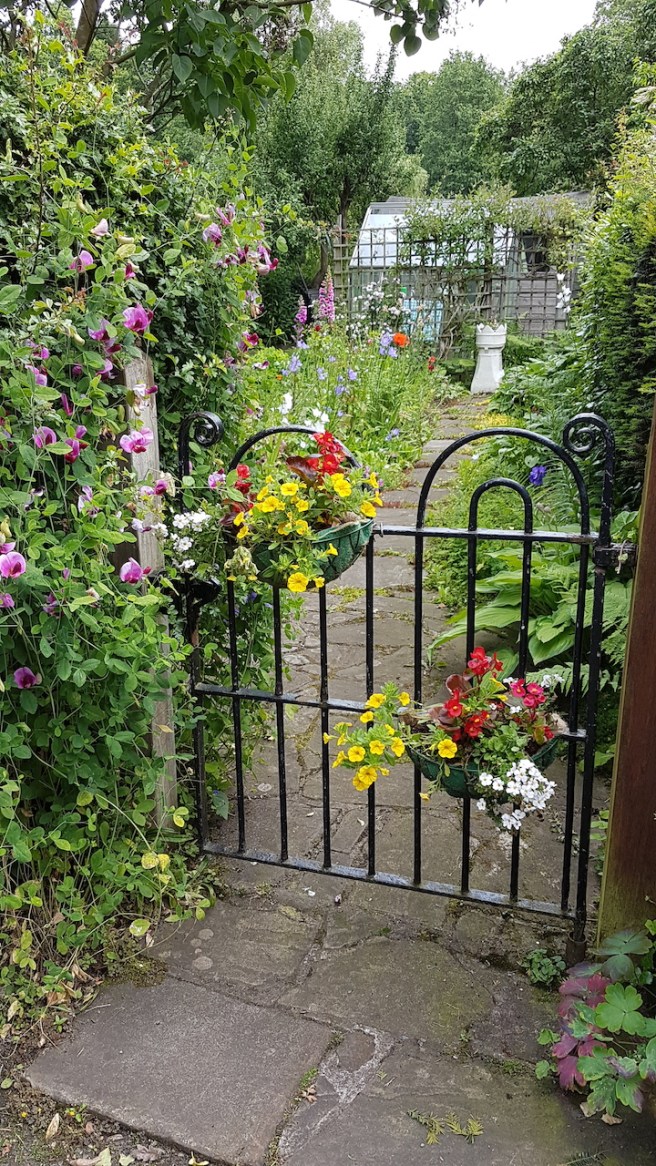 Driving on to
  Amazing how sentimental the Victorians were..there’s nothing like the Victorians!
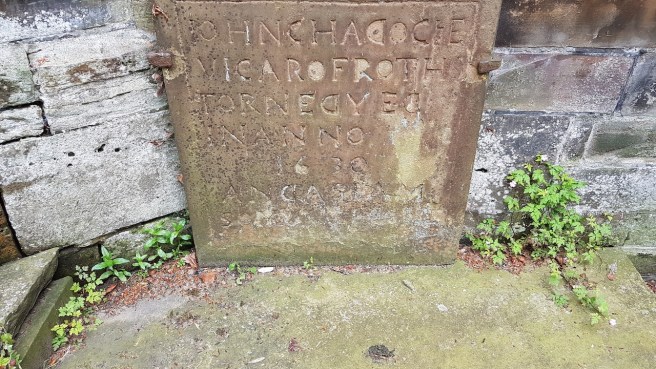
 The view from the back of the churchyard to where the vicar directed us was lovely…..the deepest and largest mere in Cheshire. We had a great 10 minutes admiring the scene.
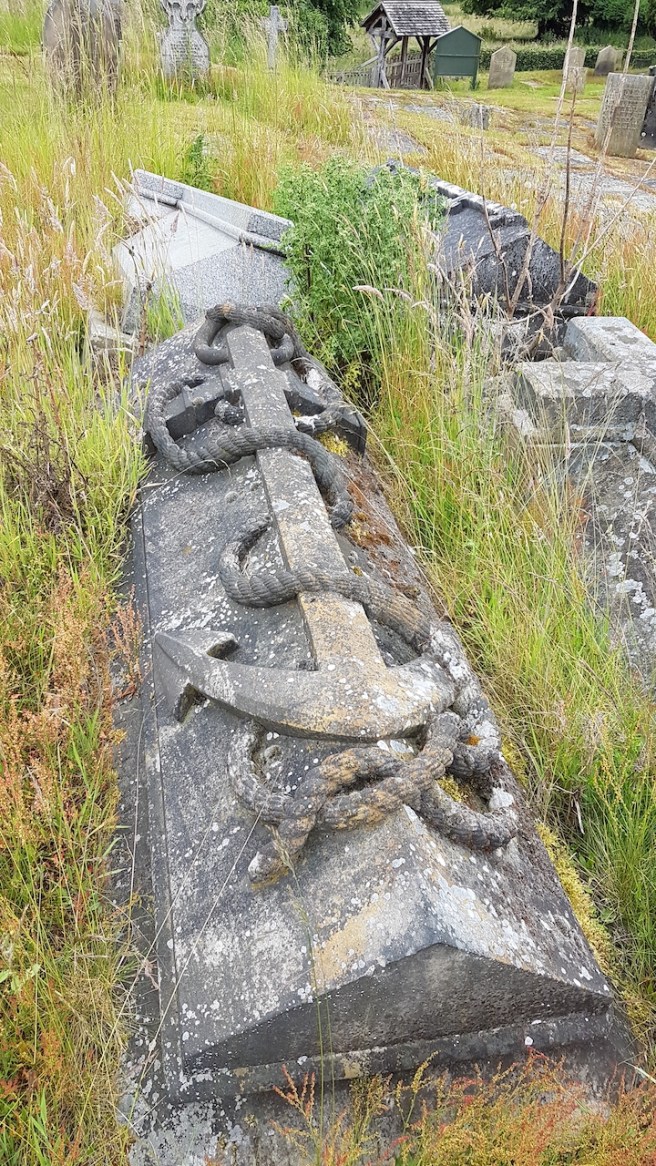
 Unusual to see a gravestone we would more expect to see where we live near the sea…..
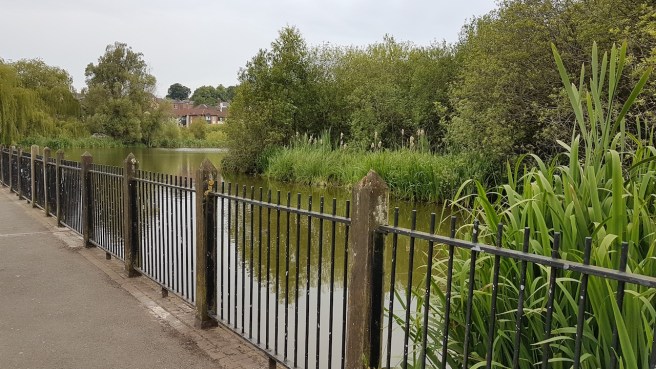
 A good week both for house-hunting and enjoying Cheshire. We decided to return home the ‘old’ way again. On our way a delightful village green…
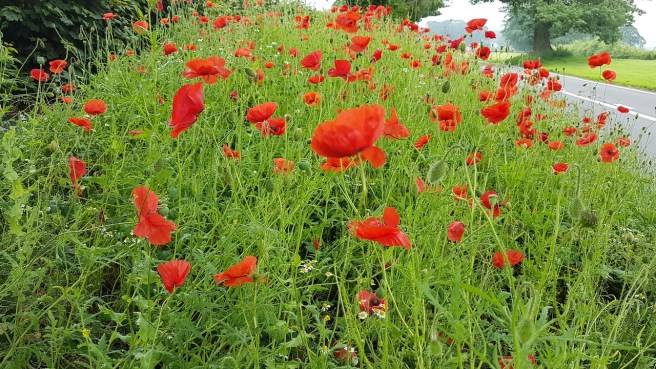
 and I couldn’t resist stopping to take a pic of the roadside verge. How much better it is when less cutting of verges takes place….
 This time before exiting Cheshire we called in to one of the prettiest villages in Cheshire in the deep south of the county –
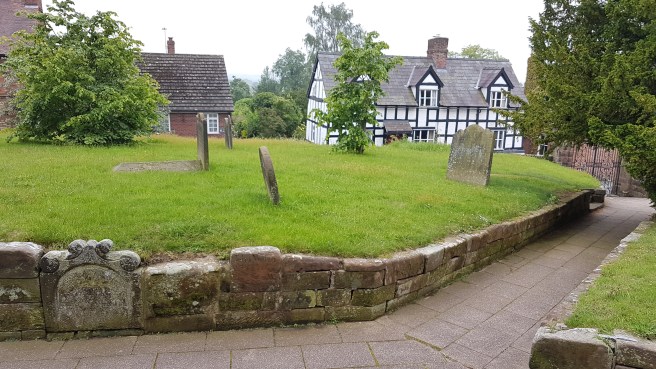
 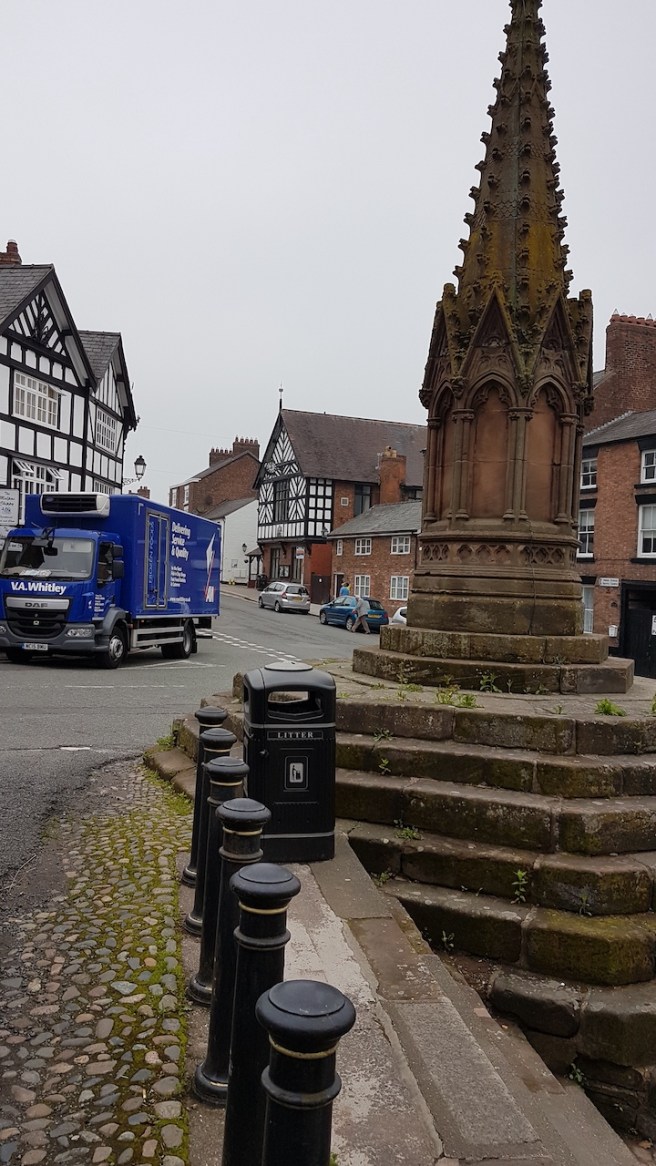 In its centre and at its highest point stood the magnificent church of St Oswalds.
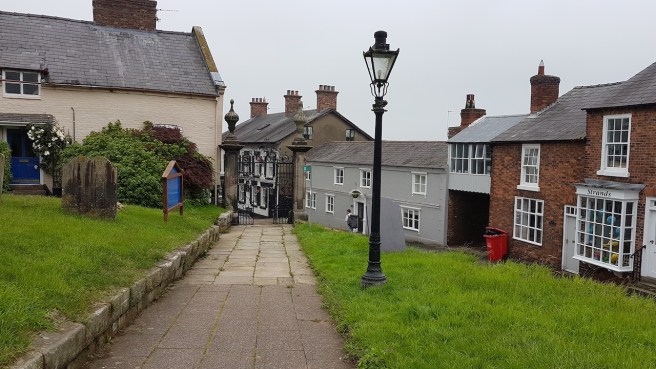
 Very imposing gateways to the churchyard were set off by some imposing buildings…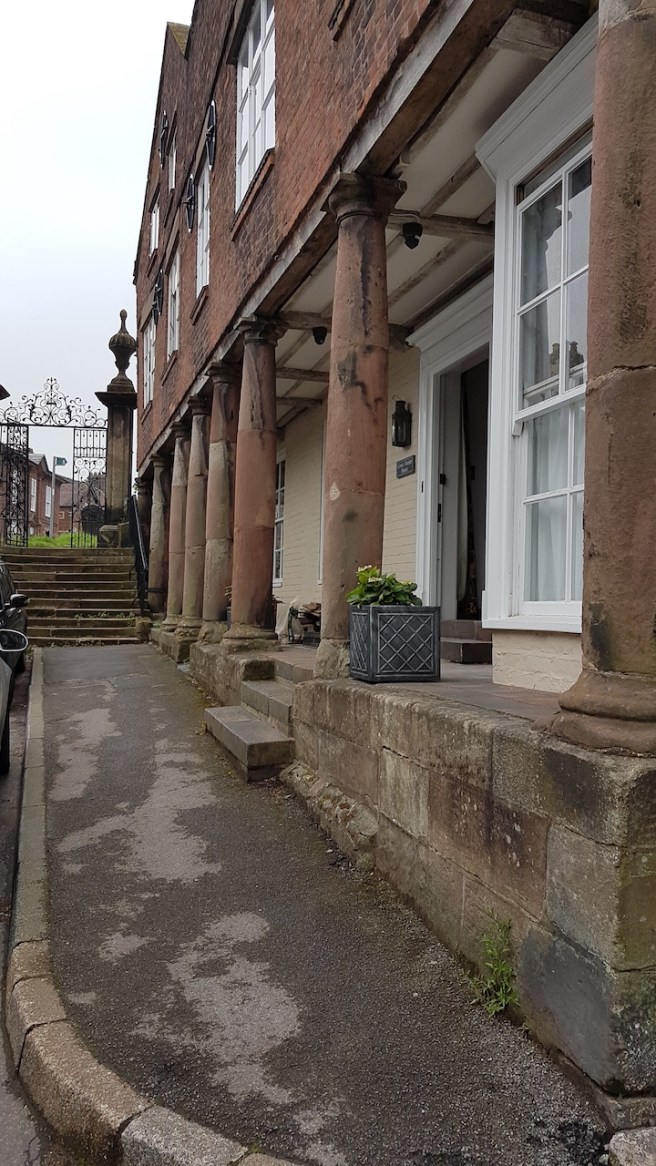
 Inside there are many treasures. This oak chest dates from the second half of the 13th century.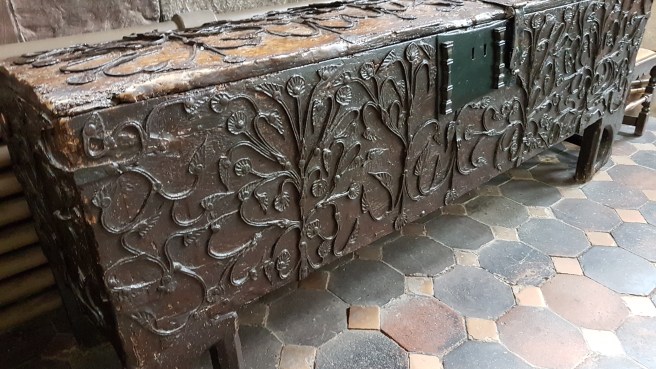
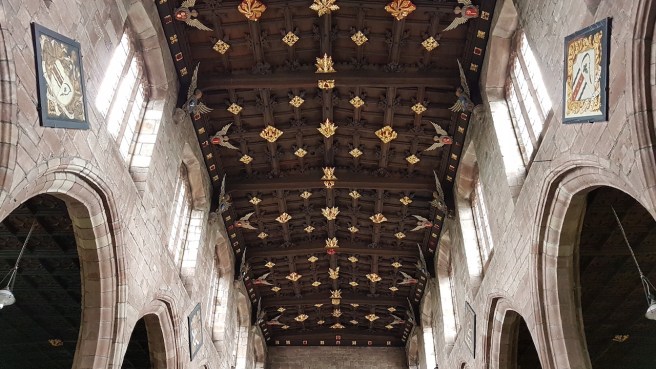
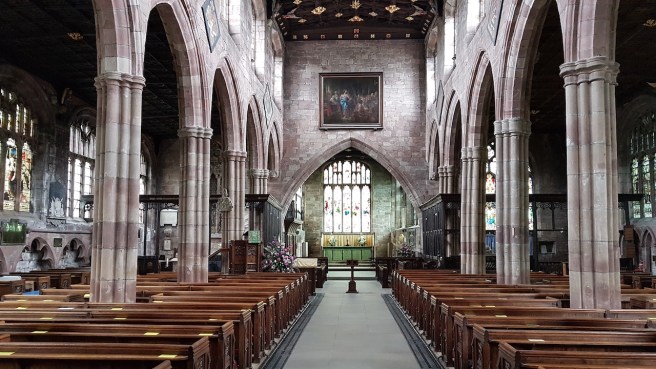 The roof is quite exceptional being a fine late C15 camber-beam affair with ornate bosses and angels (restored but none the worse for that) on the corbels.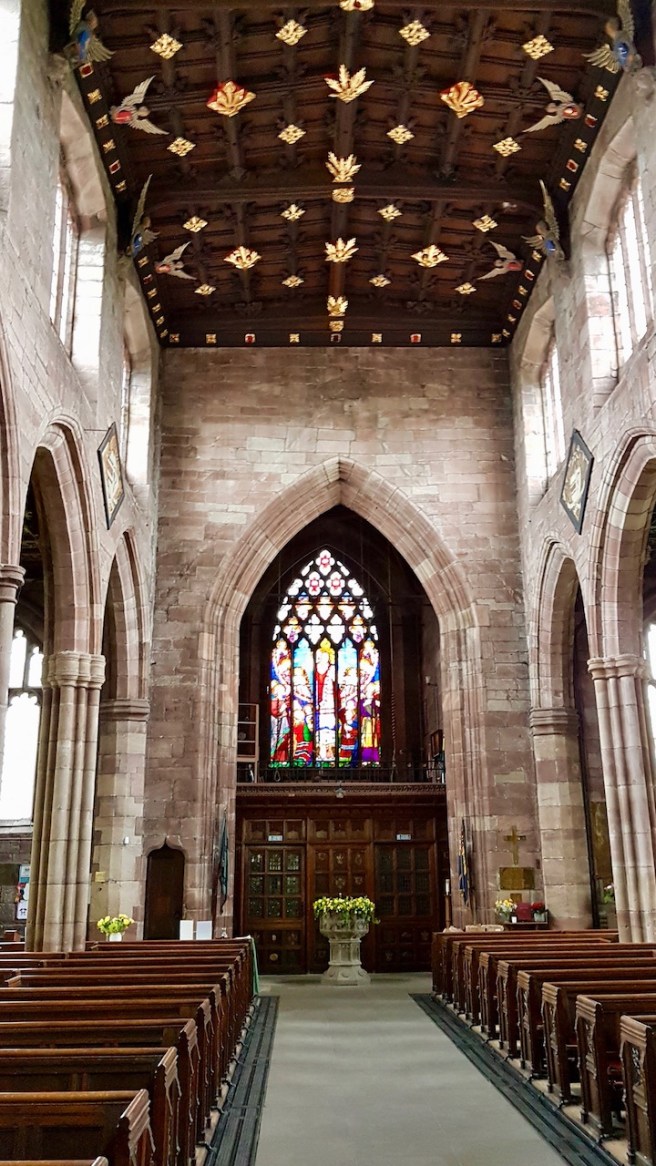
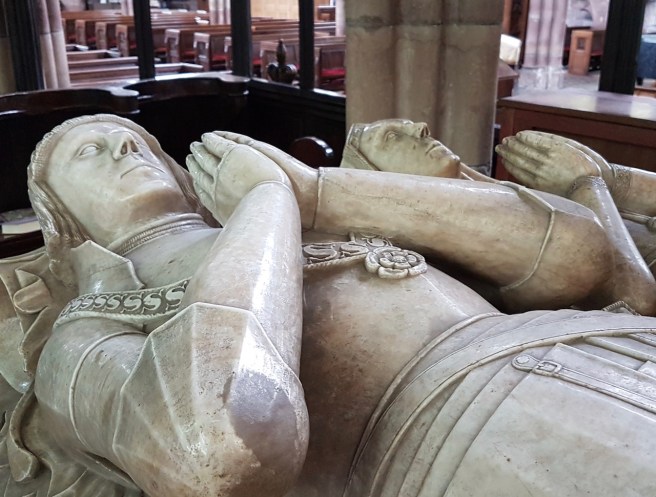
 In the Brereton chapel the tomb is that of Sir Randal Brereton and his wife, and is dated 1522. The monument in the Cholmondeley chapel was erected in 1605 and represents Sir Hugh Cholmondeley and his second wife, Mary.
 The usual little children and followers carved around the tomb itself are cute….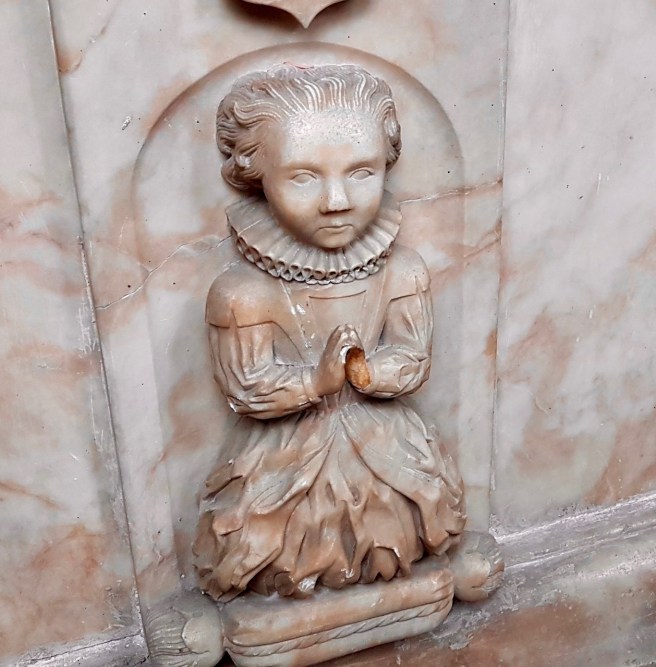
 Lunch stop this time was in Church Stretton which I hadn’t visited since a sixth-form History trip in the sixties. Spreading over its hillside site it made a good last stop.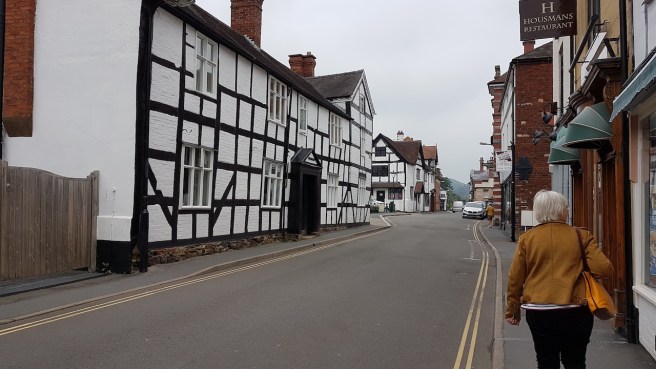
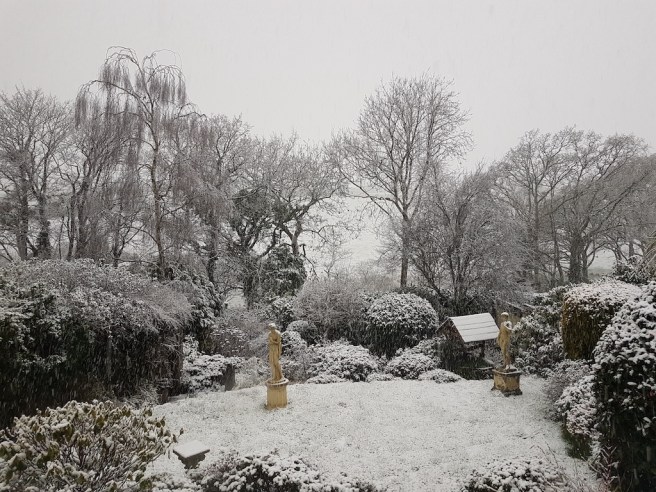
 As we are to move to Cheshire, it’s nice to have a record of our splendid garden coming into its own from the very beginning of the year…there are great views from all windows and angles, and something of interest at all times of year.
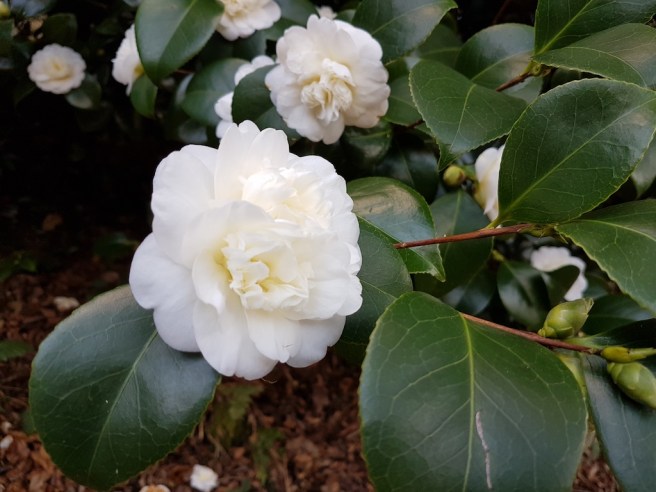
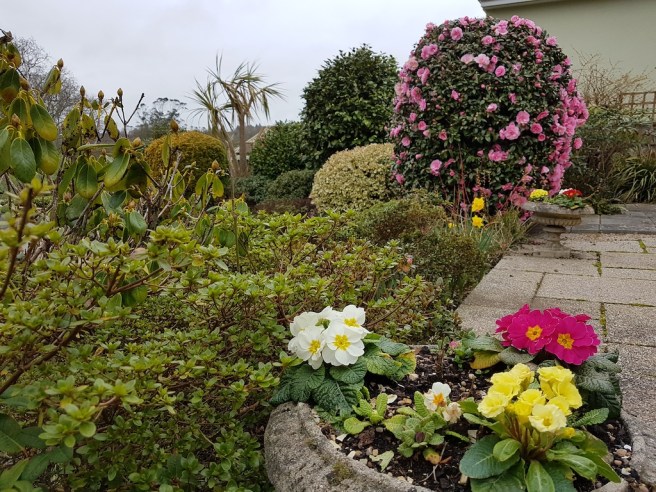
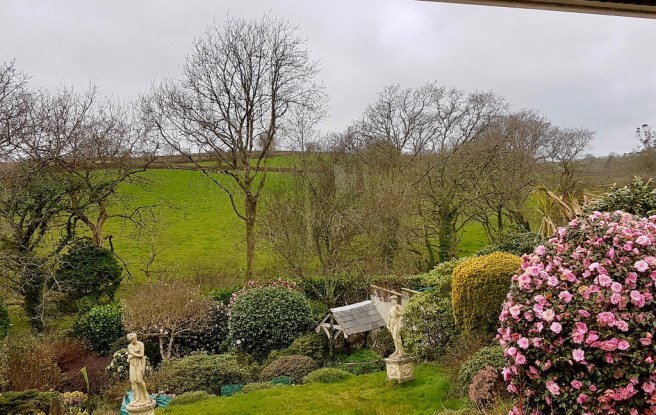
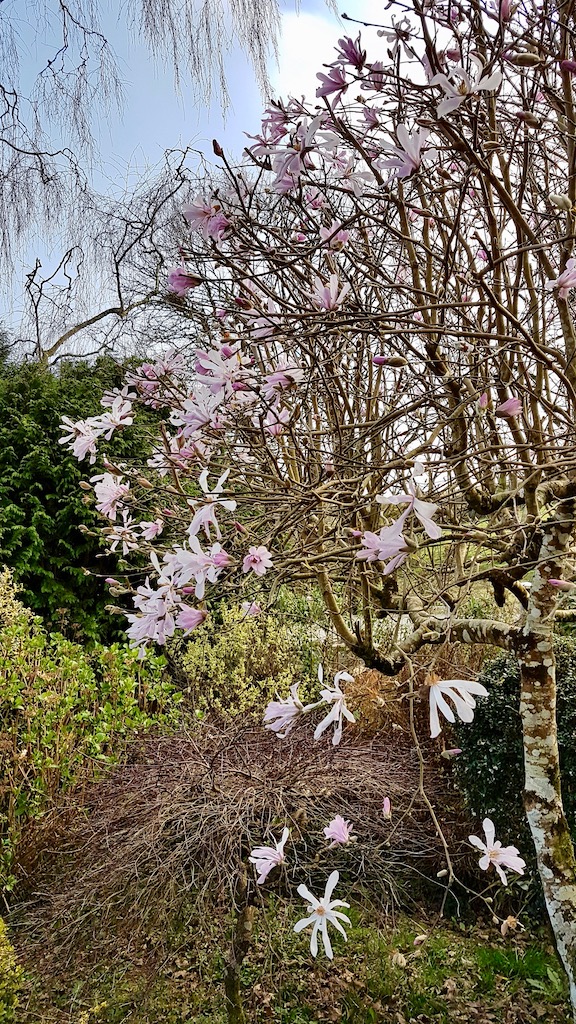
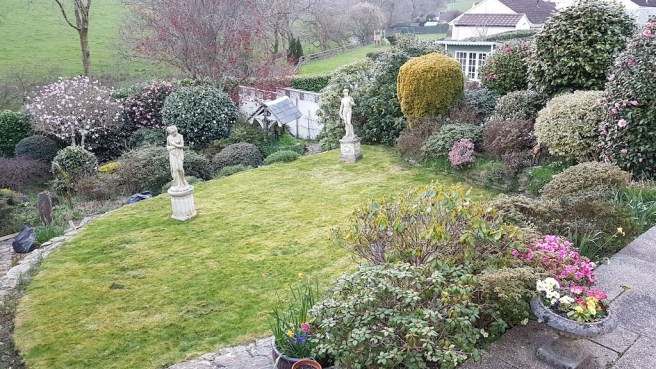
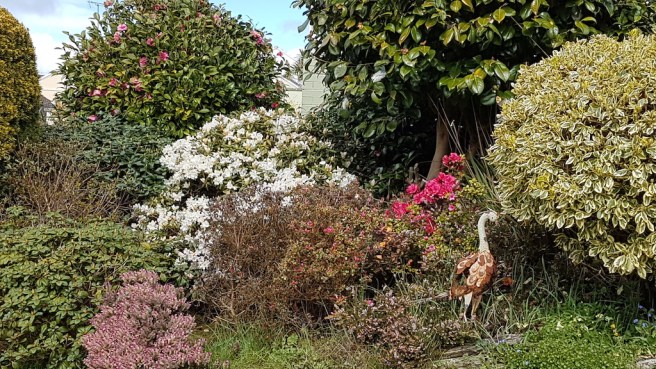
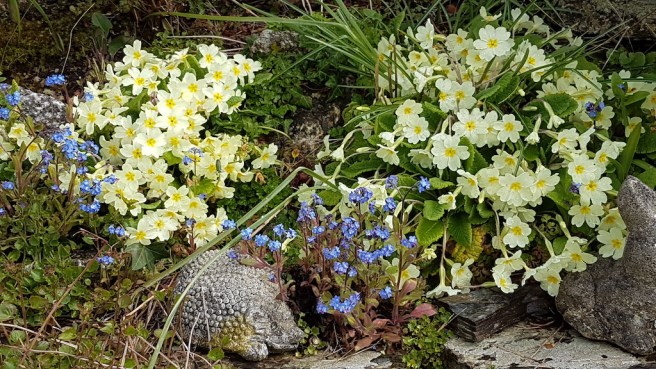
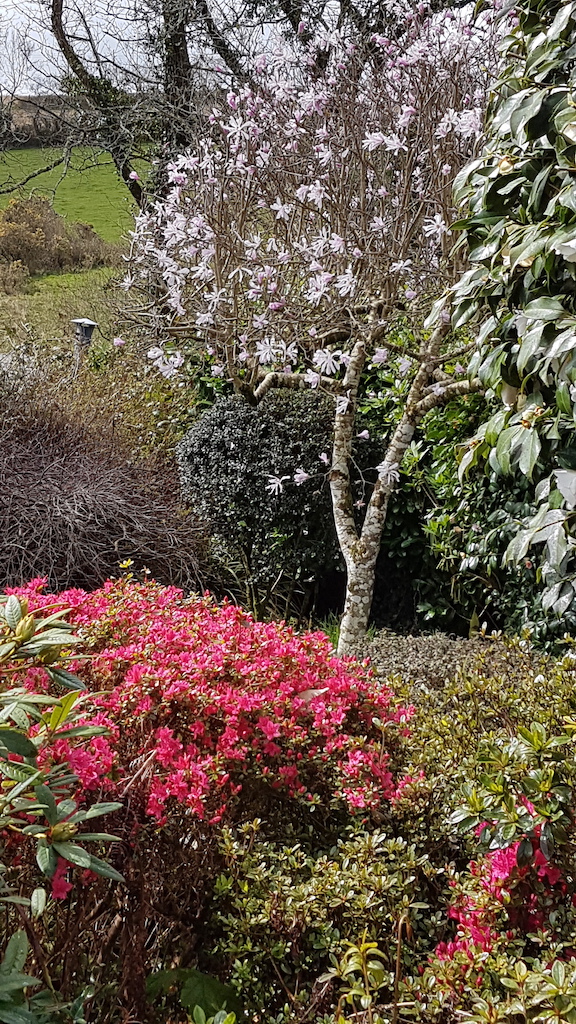
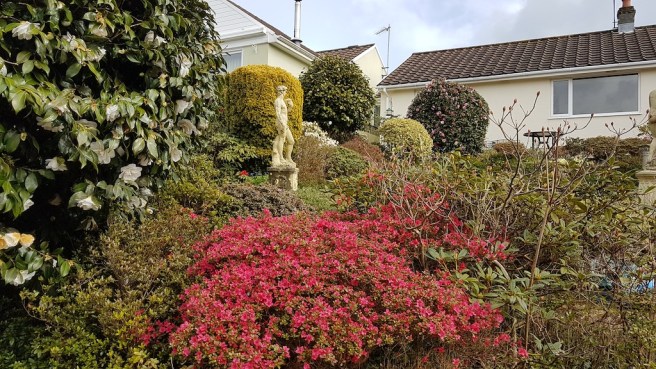
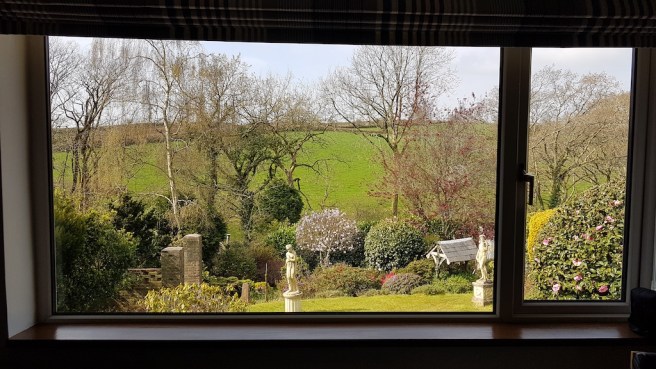

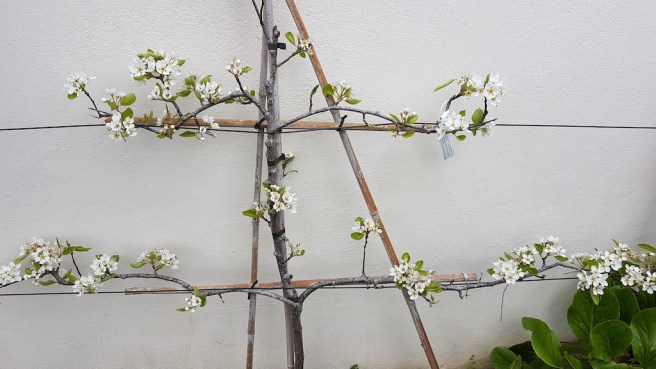
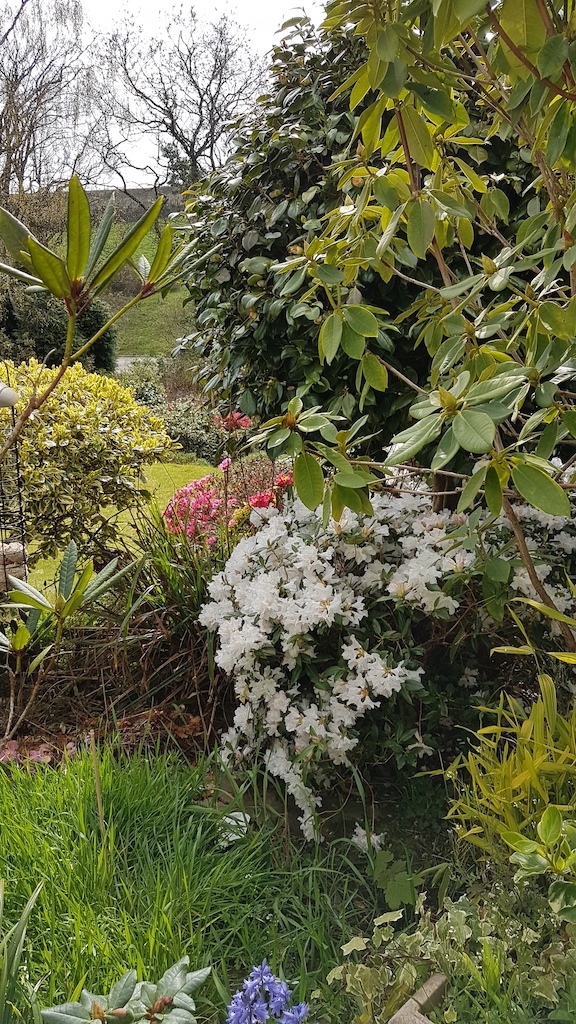

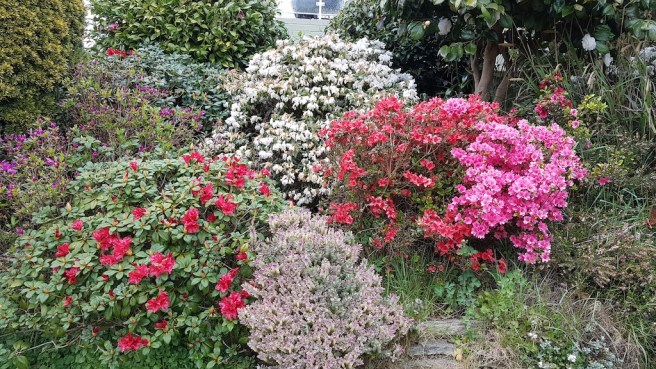
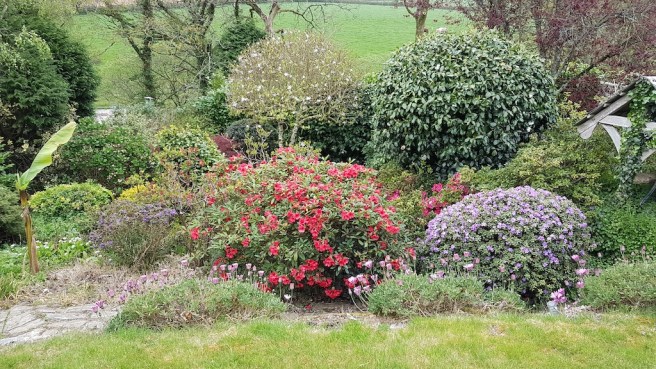
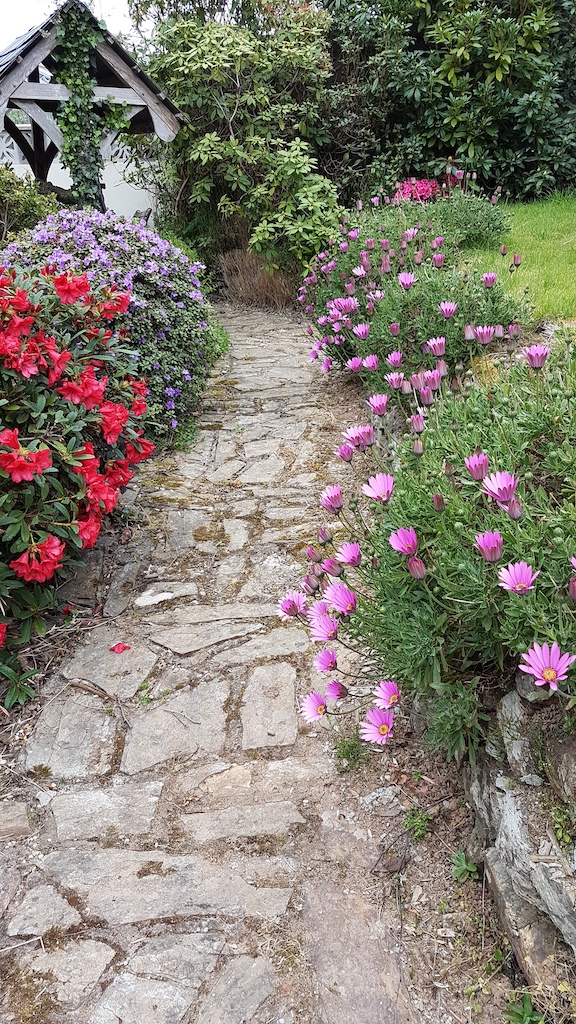

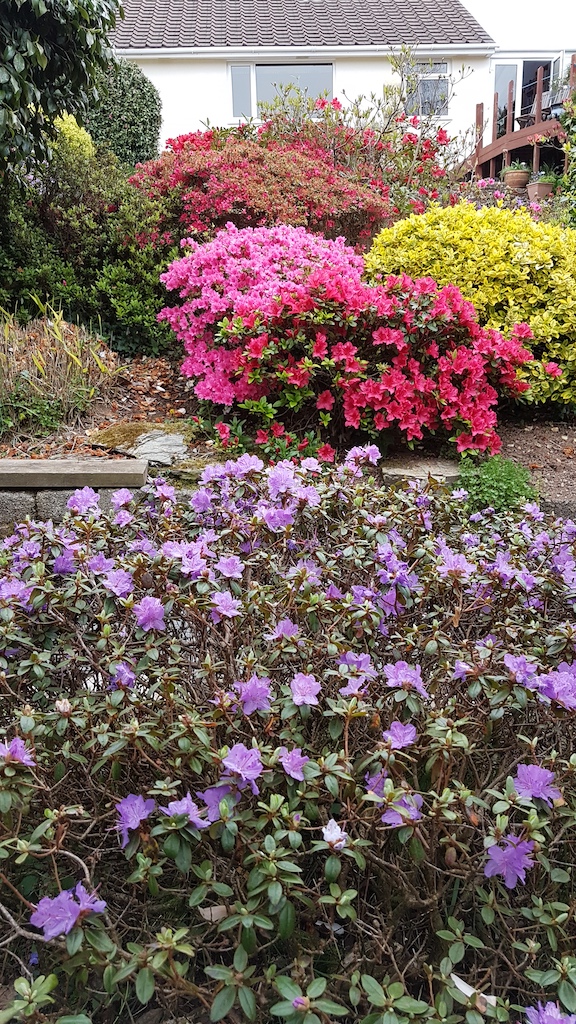
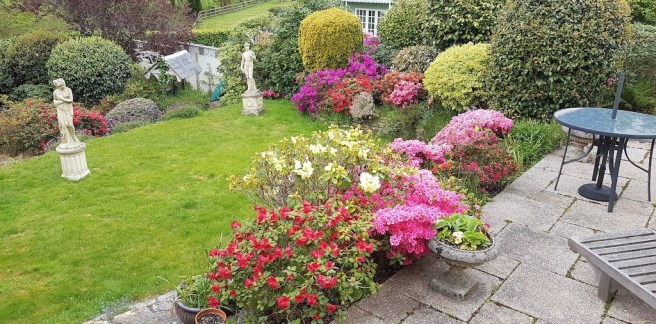
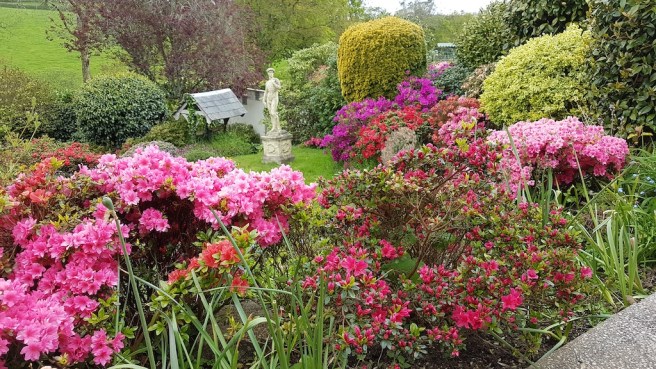

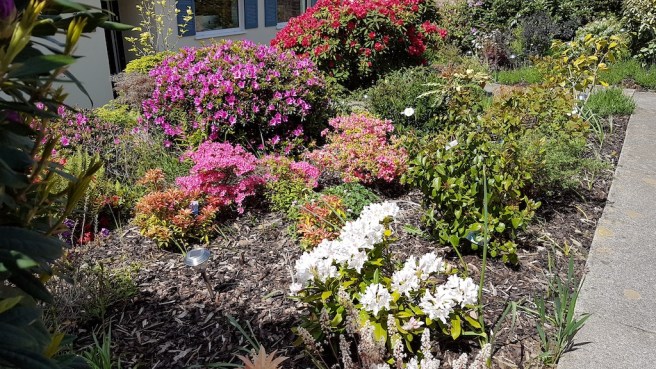
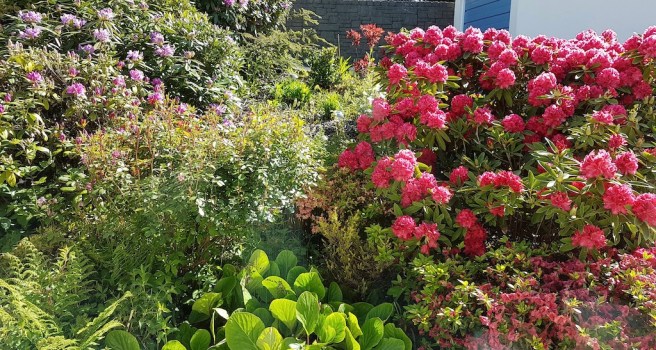
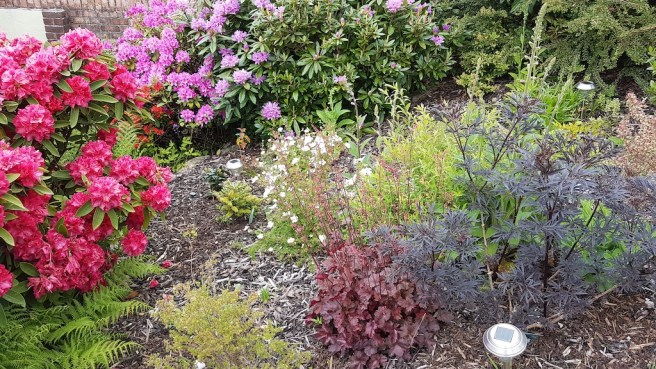
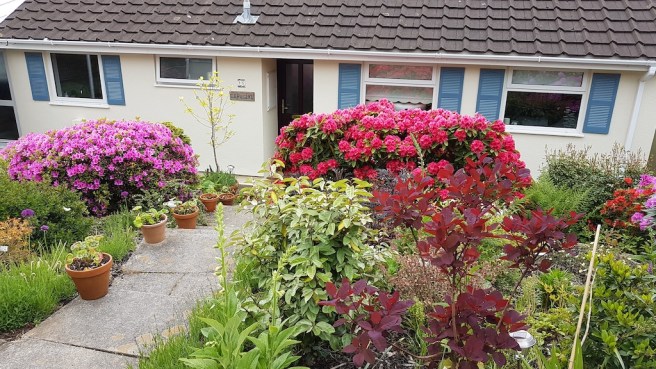
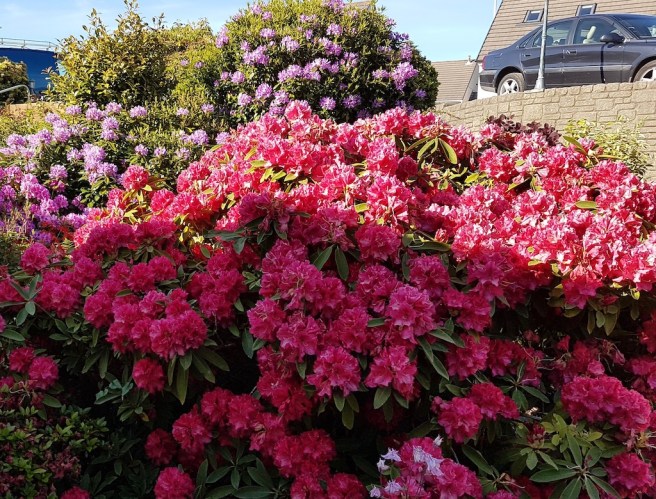
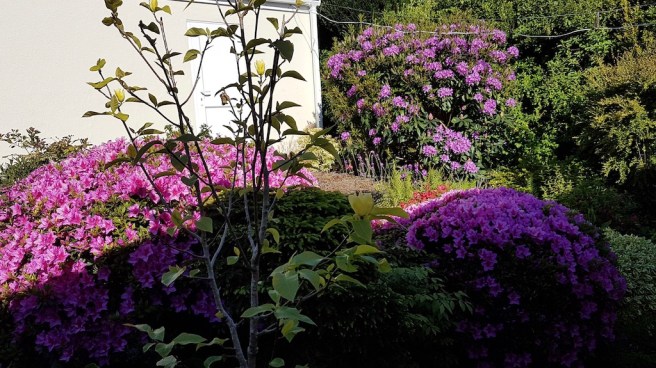
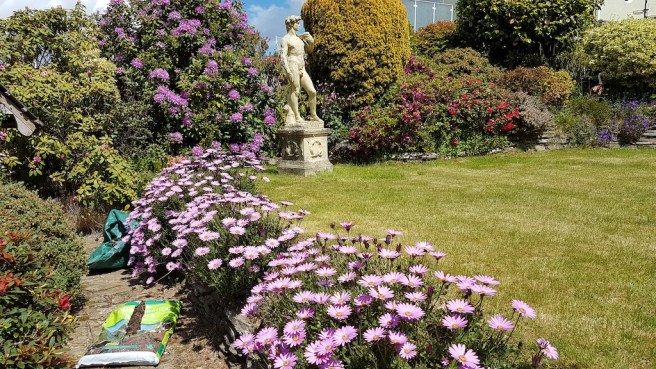
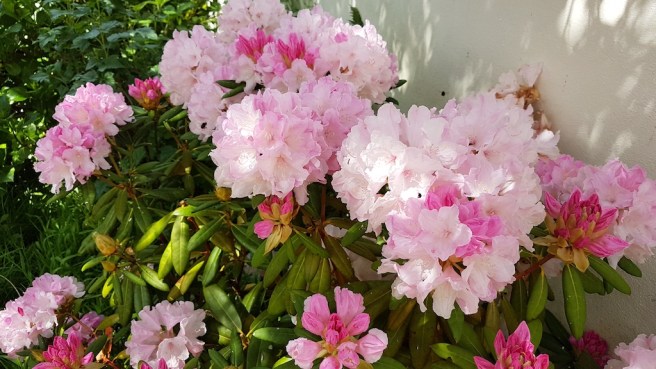
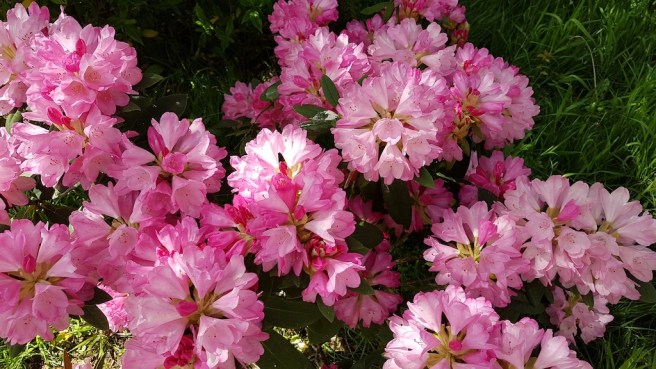 And of course when we walk our local lanes in Spring there is a profusion of flowers, the early snowdrops then the primroses and all the rest. Also, on our bus route into Looe there is a magnificent and extensive display of bluebells. Who could ask for more?
 Enjoying Cornwall...