We couldn’t visit this part of England without going to Chester of course. I have been a good few times but forgot how charming it is. Beautiful streetscapes….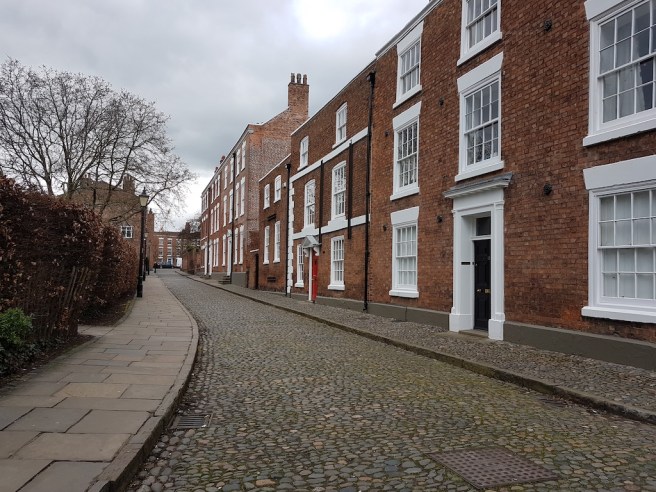 Wonderful cathedral….
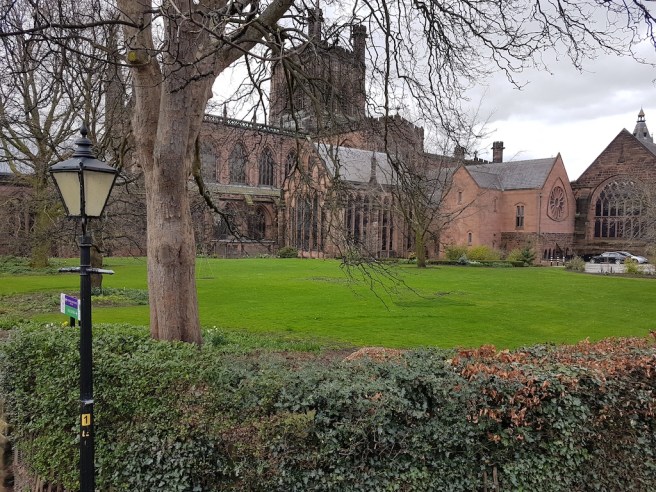 and the impressive walls….we started our walk of the two and a half mile circuit at the cathedral itself….
 and were soon enjoying unparalleled views…
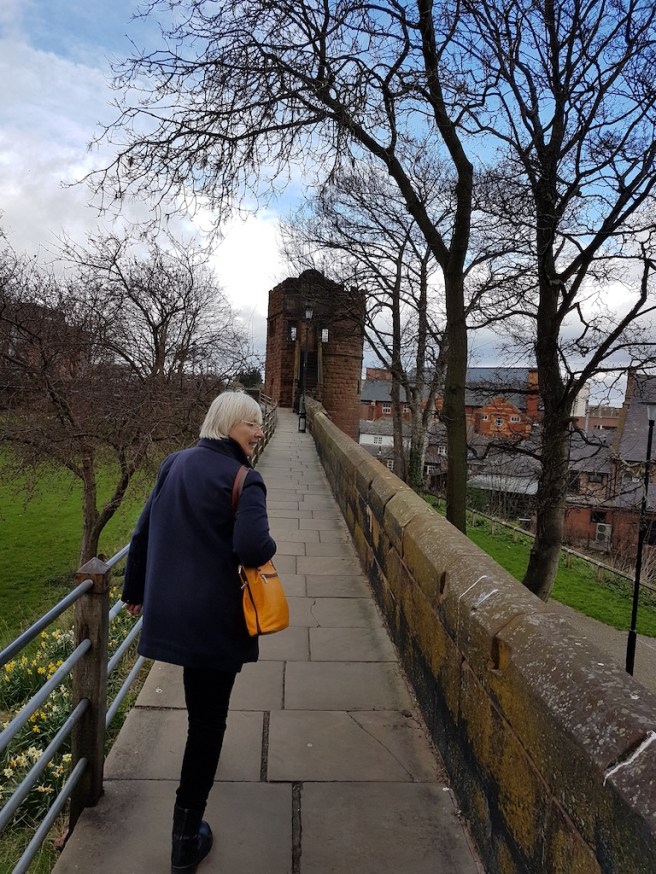 I suspect this was the Deanery with its beautiful gardens. It is now desirable but expensive apartments. What I wouldn’t give to live in a place like that!
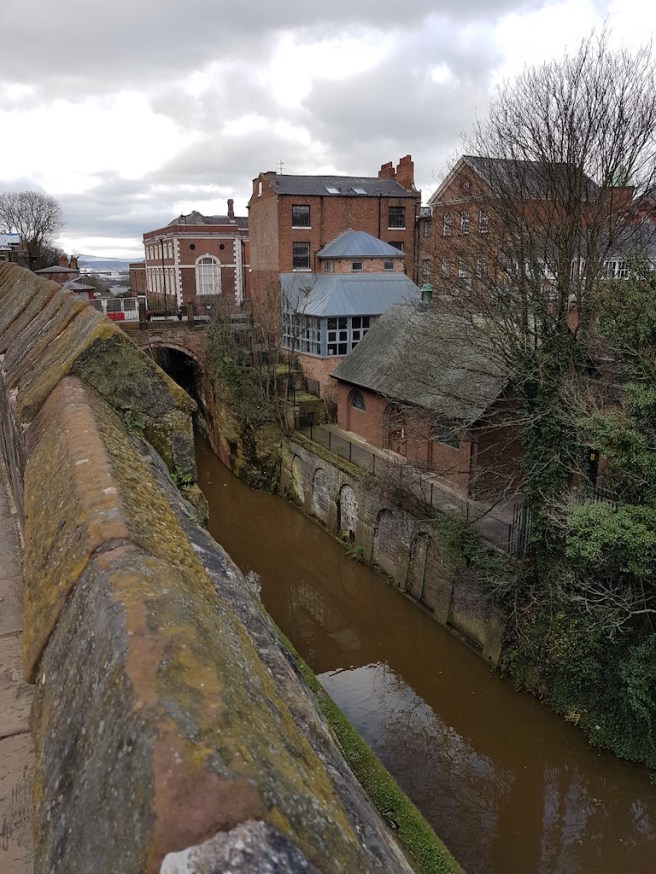
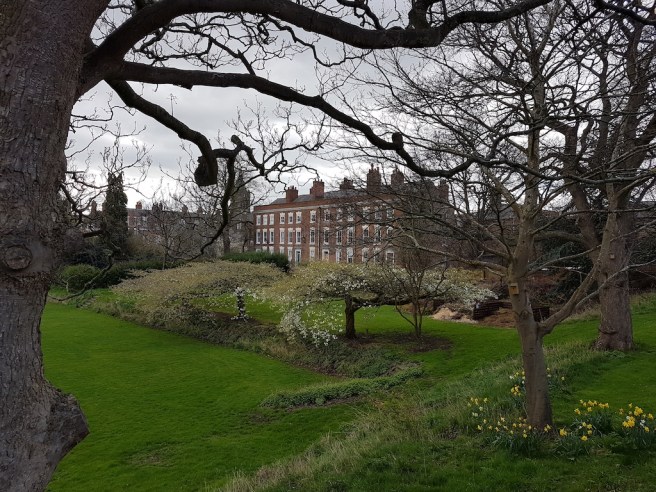 At times the walls soared on high. In this section you got a good idea of how formidable they would have been….
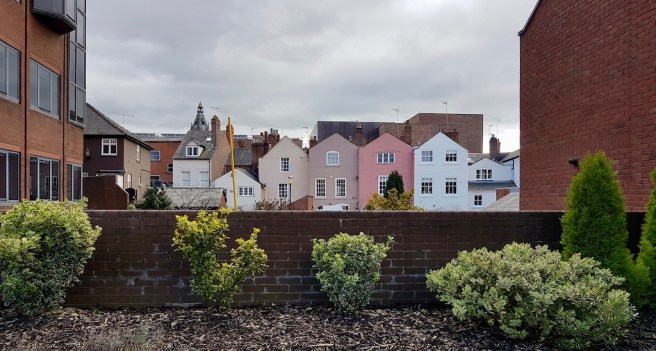
 And sometimes just occasionally it is nice to look at the backs of houses. Have you ever see a prettier back view than this?
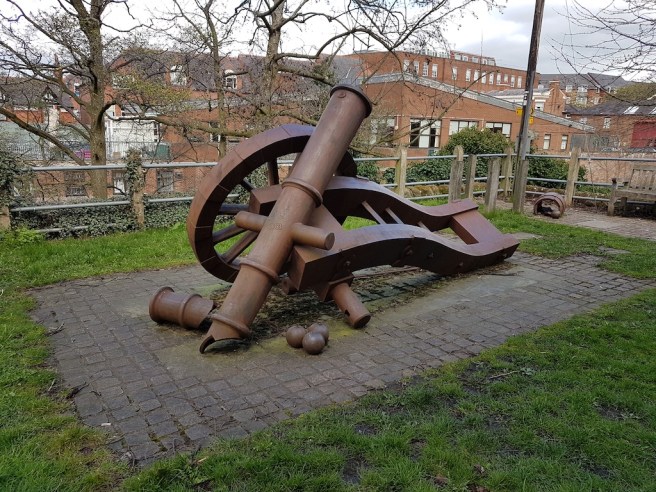
 Everywhere we went was full of interest. Here, near Telford’s wharf is a sculpture of Captain Morgan’s cannon – he waste of the Royalist defenders of Chester during the Civil War.
 When walking West we had excellent views in the distance of The North Welsh mountains…
 In comparison with even York, Exeter or Berwick these walls are momentous…
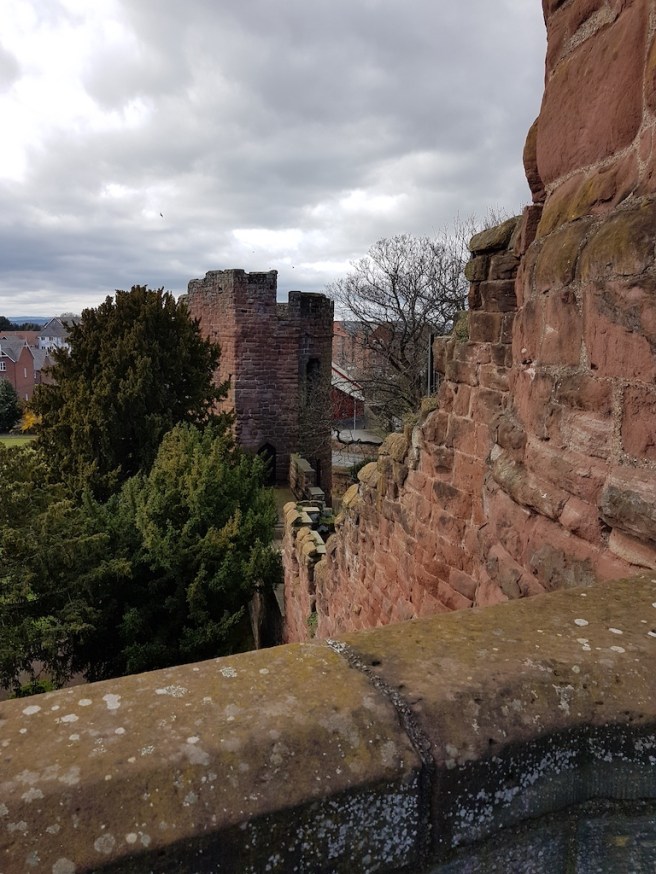 and what you see from them is soul-lifting in this day and age….
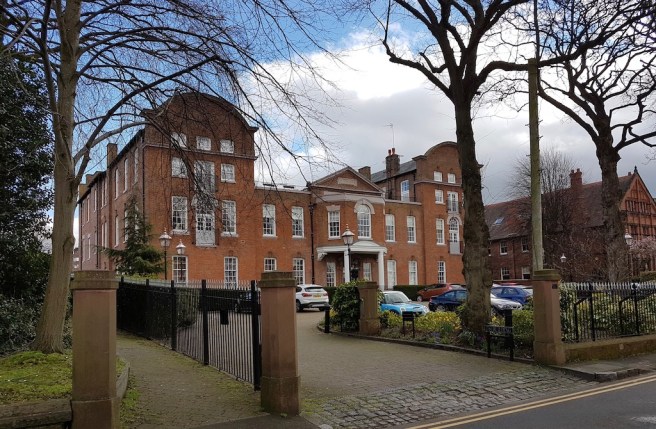 Plenty of handsome Georgian houses….
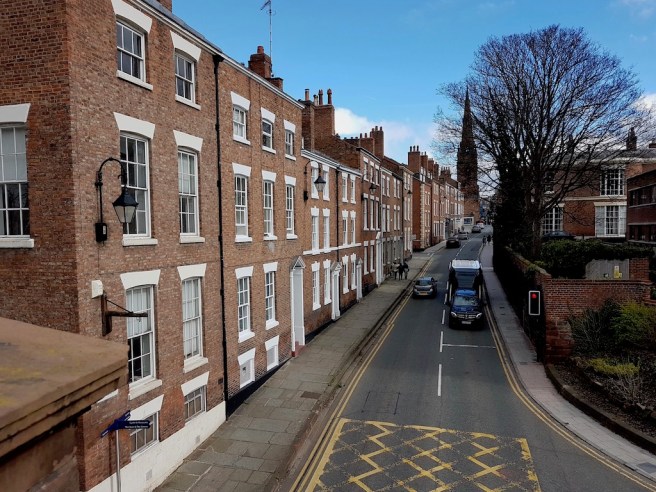 and even the Victorian terraces were special…
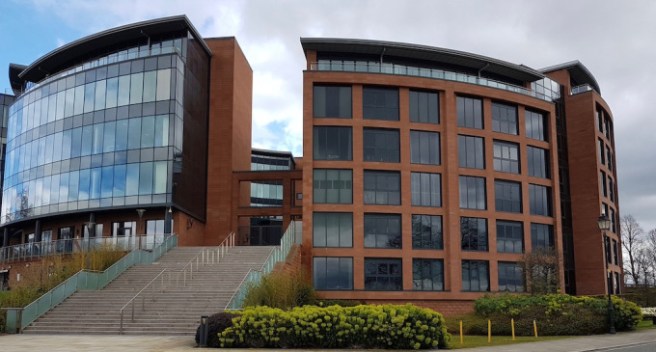
 ….as indeed most of the modern buildings we saw….
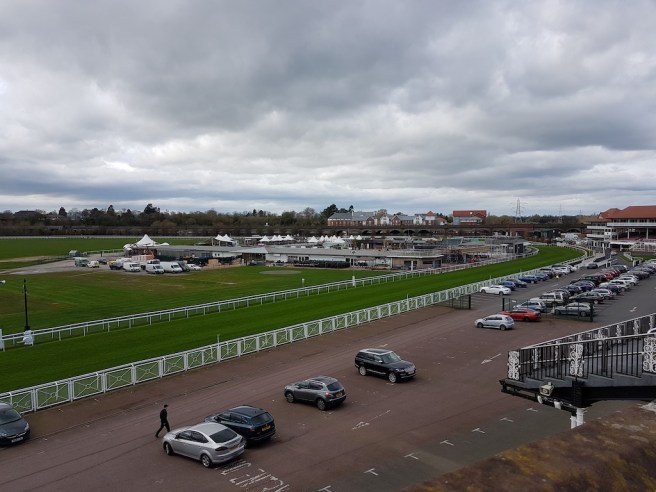
 The walk passes very close to the race course…who would pay to get in with views like these?
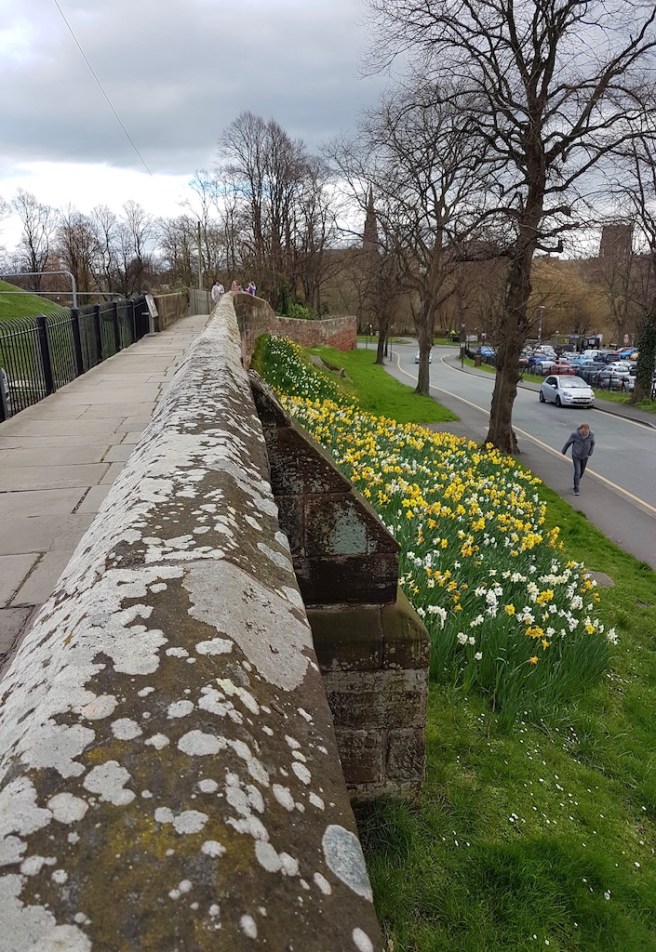
 and daffodils everywhere as at York..
 Here the castle…….rebuilt in stone in the twelfth century…
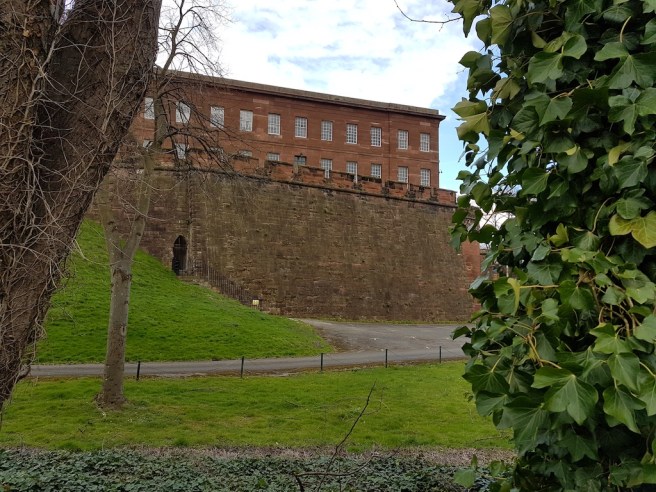
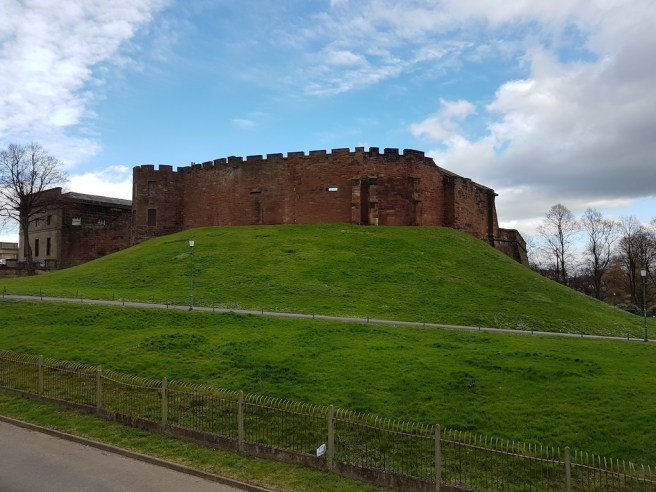 and later used as the county hall and for courts, as at Lincoln….
 The River Dee made its presence felt for a good part of the way….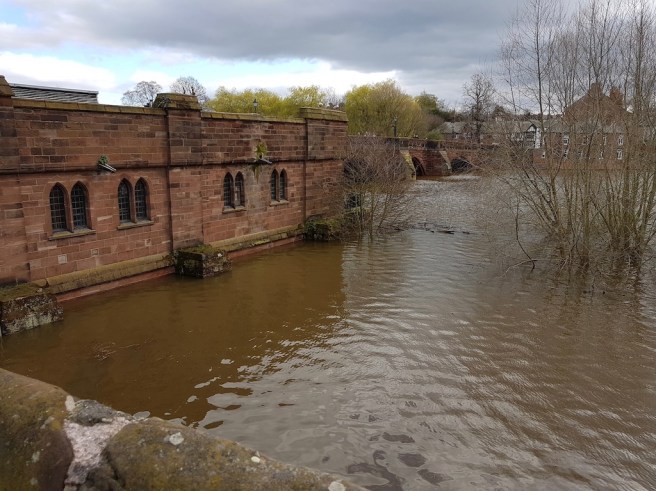
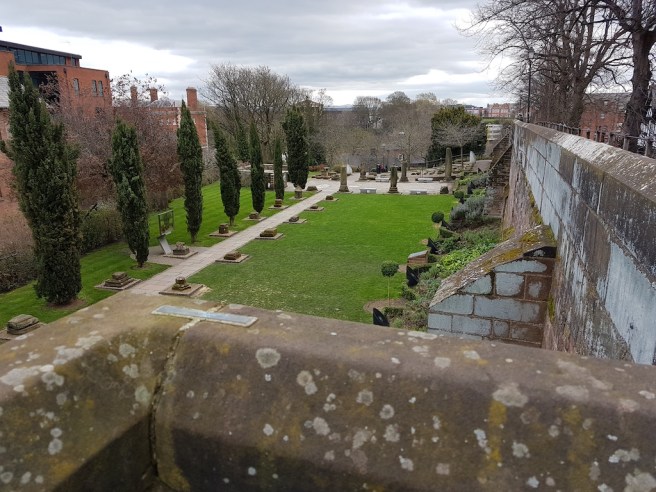
 and whilst we didn’t manage to see much of the Roman remains on this visit we did glimpse the Roman Gardens from the walls…..
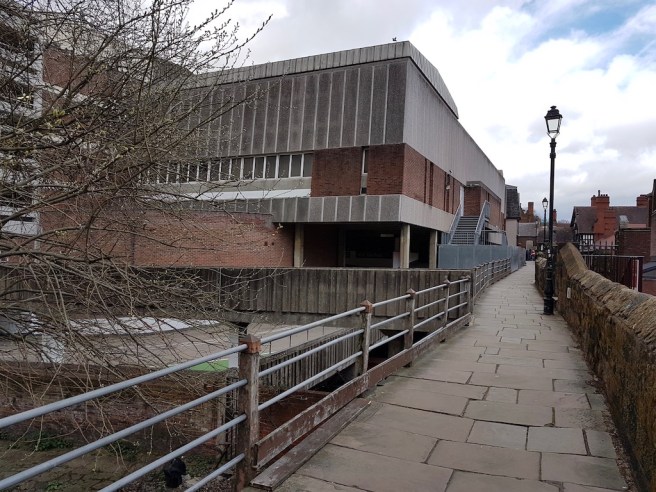
 It wouldn’t be possible that this was the perfect small city would it? Not when we saw two monstrous concrete car parks agreed by the Planners in, what, the Sixties or Seventies….I could see at the time what disastrous results they were inflicting on our heritage. Honestly, I would line all these so-called planners up standing on one leg in the blazing sun to gaze for ever at their works…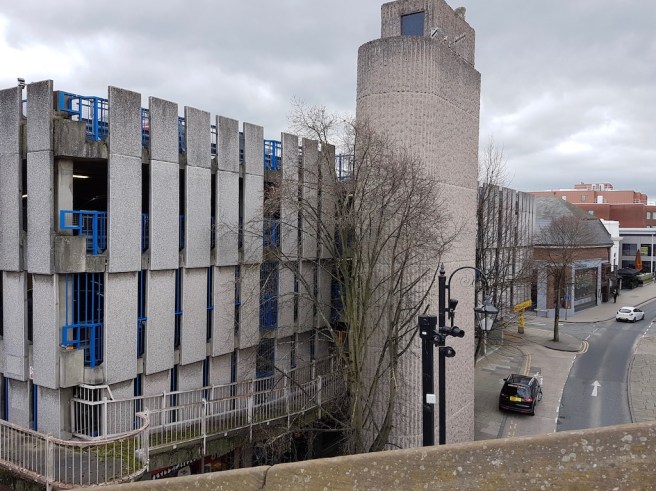
 We finished our walk at the famous Eastgate clock, it being lunch time. It really is rather special.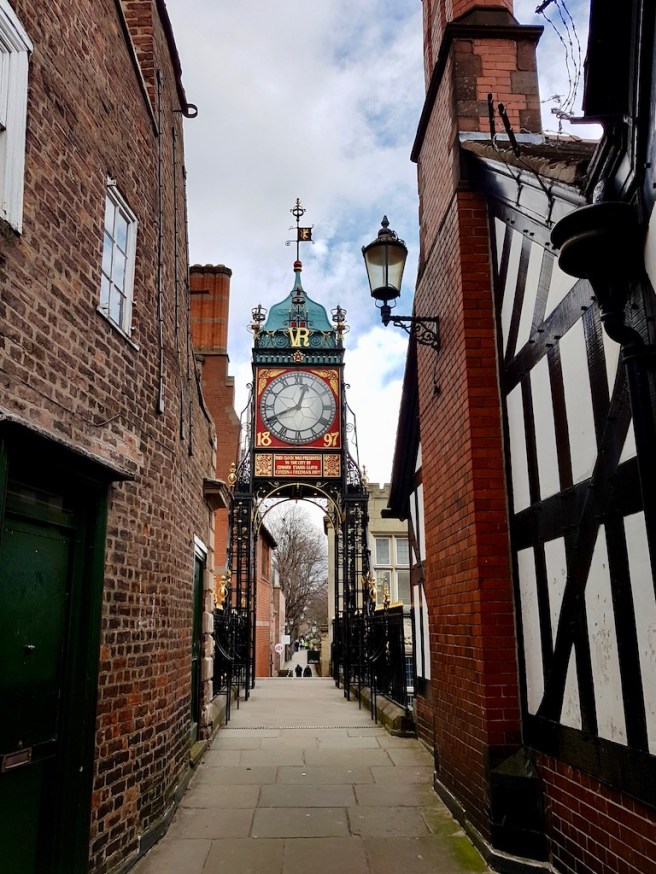
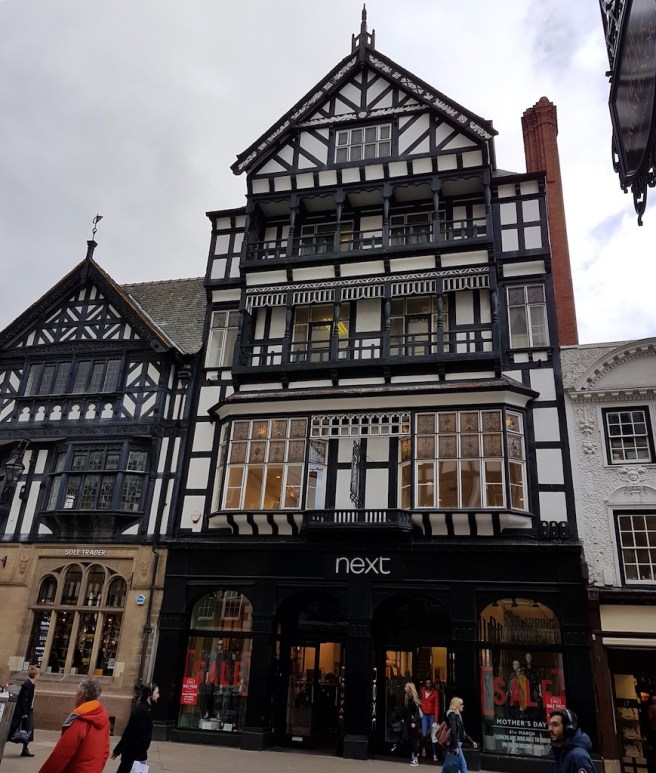
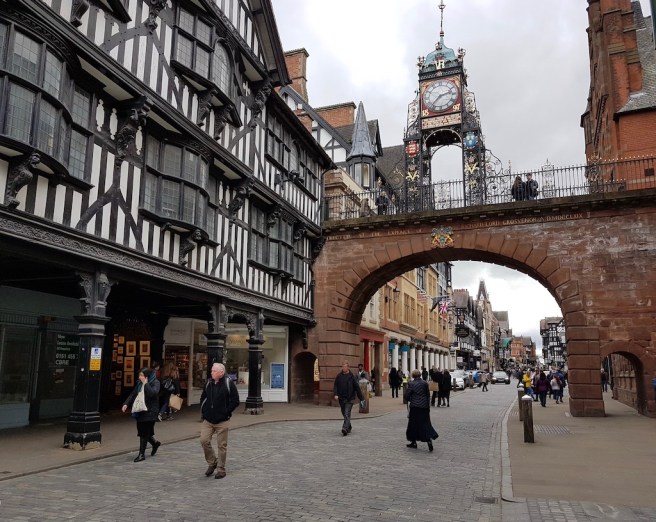 And whilst scouting out where to eat we had a good look at the famous Rows (sadly with one or two empty or run-down premises as is almost inevitable with first floor shopping
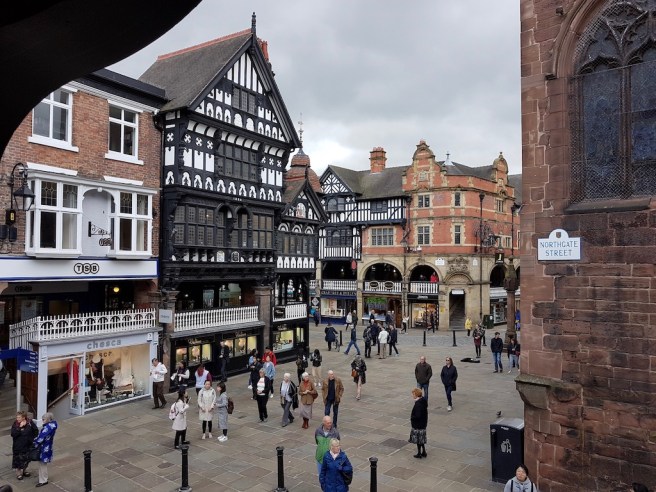 But on the whole we certainly got the feeling that Chester was bucking the trend for city centres and was prospering. Good to see.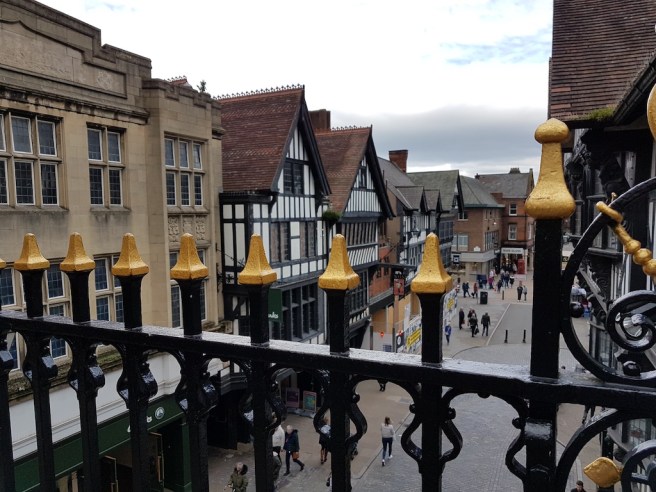
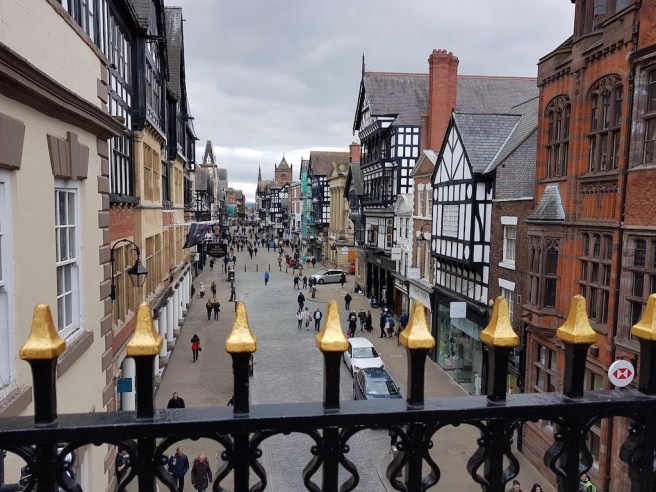
 We made our way then to Tarporley, a small town which we enjoyed very much and which would be second equal in our list of places to live. Again thriving, busy, beautiful buildings and shops you want to go to.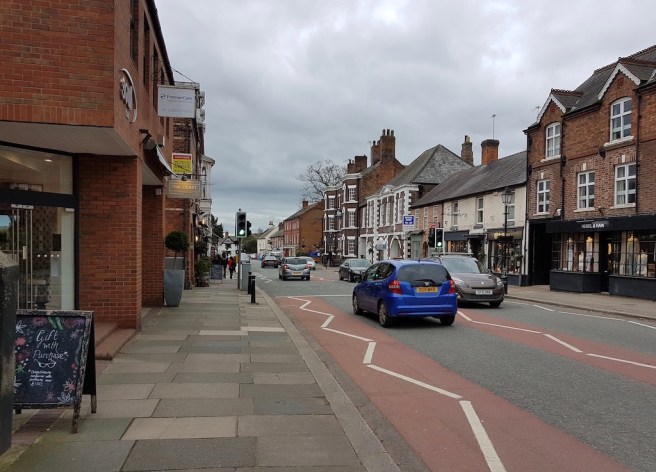
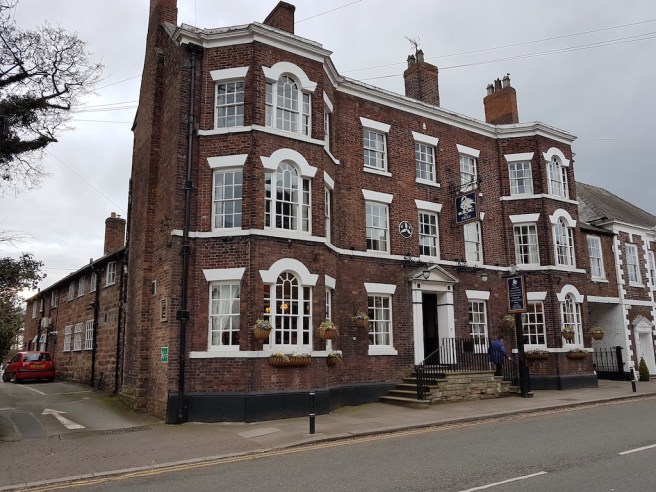
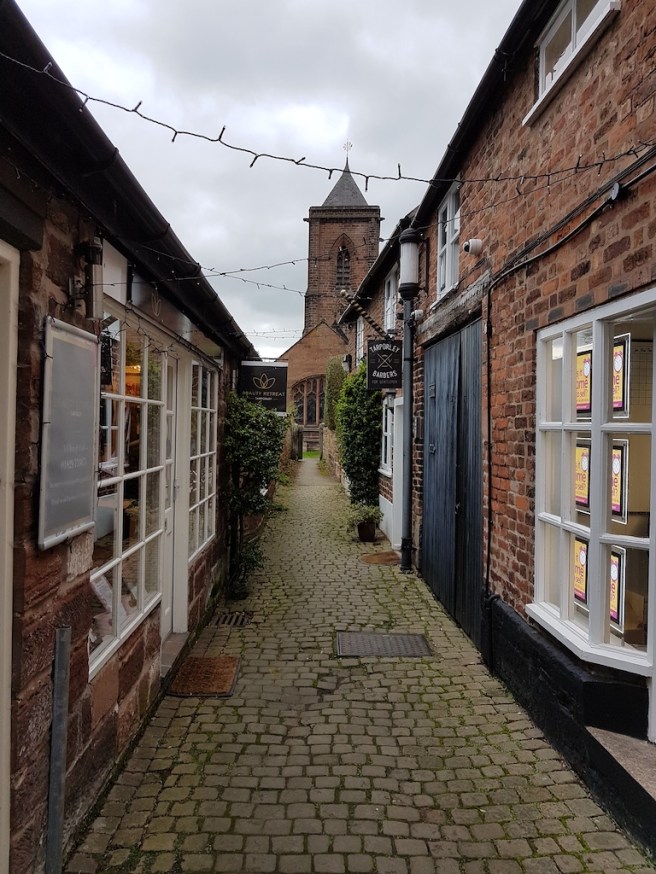 We couldn’t resist going into the sixteenth century Swan Hotel for a quick cup of tea, splendid both inside and out.
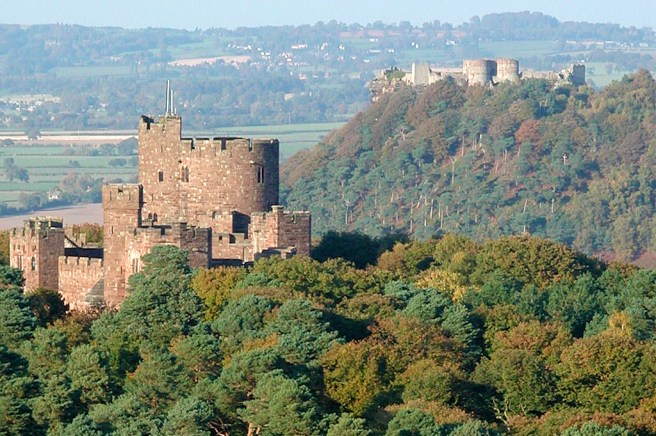
 Then into deepest Cheshire where we saw the famous two castles the medieval Beeston and Peckforton gazing at each other from their eminences…..Peckforton was a Victorian country house now turned into a hotel.
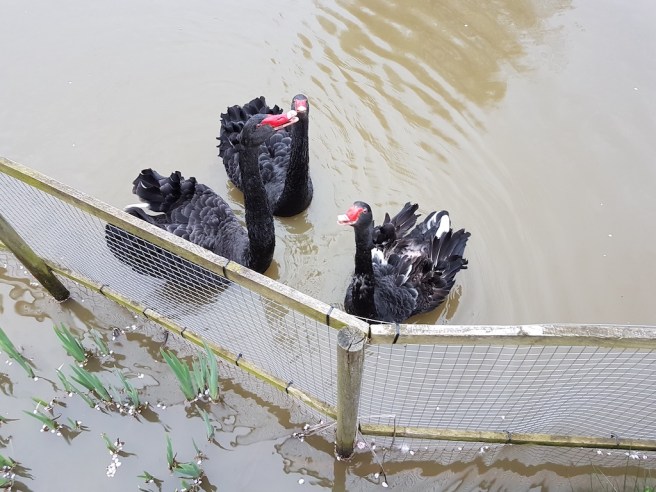
 on the way back we stopped at this very picturesque village with its lovely houses and pond complete with rare black swans..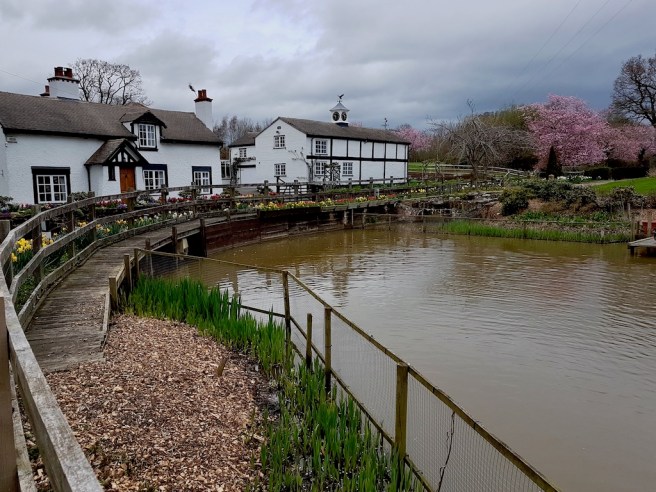
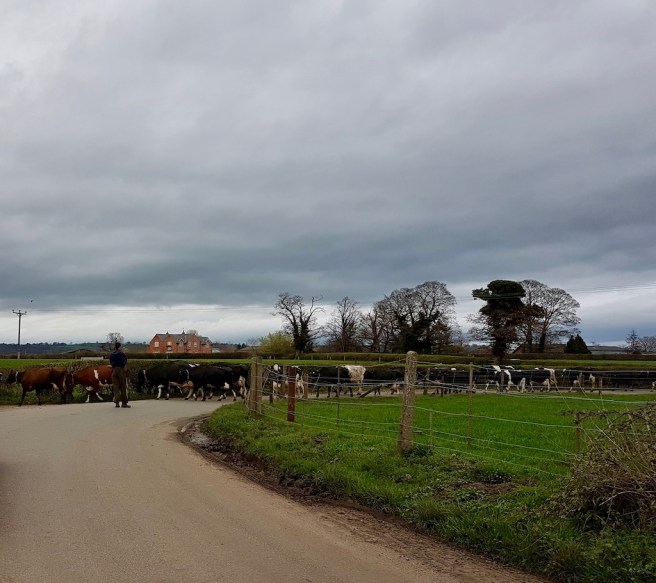
 We were also held up for a long while by cows on their way to milking……but no bother!
 Home at last….
Author: retirementgoodorbad
A week in the heart of rural England……..Part 1
 Looking to the future, we decided to go house hunting in Cheshire. I would like to be within striking distance of Manchester where I come from, with its magnificent facilities, and Cheshire adjoins it and is the epitome of rural England. I have looked at thousands of houses on-line and know we can find one somewhere in Cheshire which will allow us to free up a bit of capital and give us a bit of leeway in our plans (mainly travel and going out – theatres, concerts etc). We weren’t scouting particular houses but looking broadly across the whole county to assess where we would like to live. I booked a converted barn for a week which looked great in Sawdays which is usually very reliable, and so it proved. We were greeted by Martin, who farms the land, and one of his lovely dogs Beth. Martin was a great host for the whole week and gave us lots of good tips on where to go.
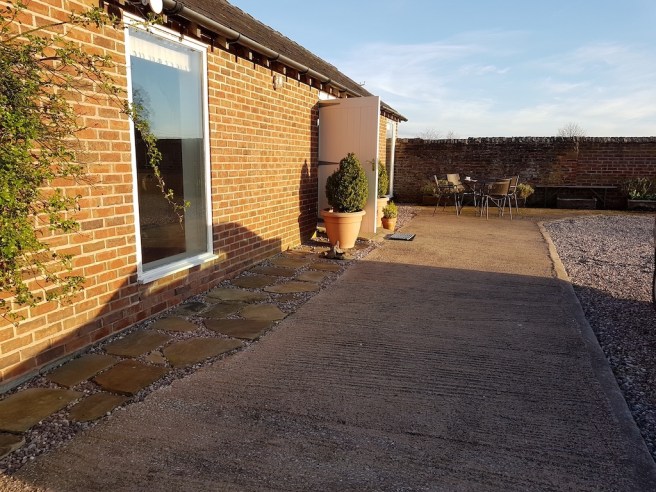 We settled in very quickly and were soon enjoying the March sunshine….
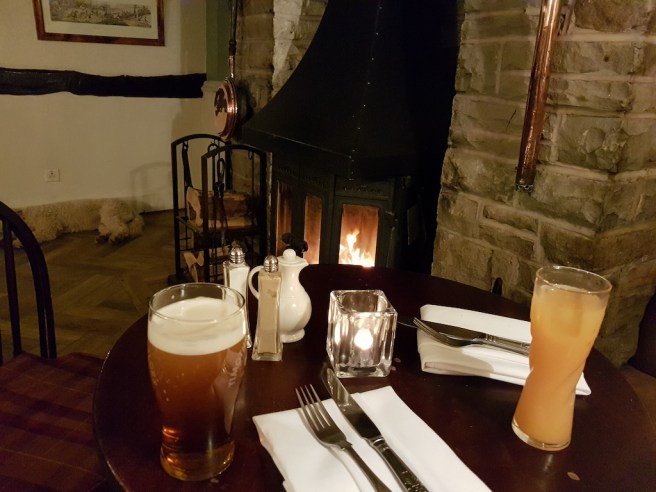
 and on our first evening we drove to the local pub…the Swettenham Arms…just what the doctor ordered – a nice gastropub with good ales.
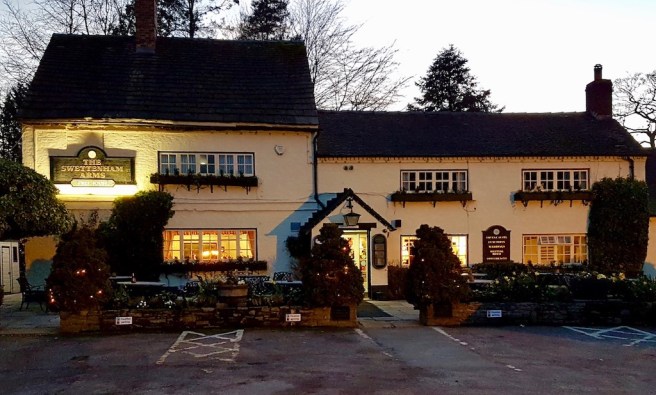
 Outside, across the car park, was the church of St Peter’s which is very unusual and interesting with its stone build, but with a brick tower….unfortunately we never got around to visiting it. Another time.
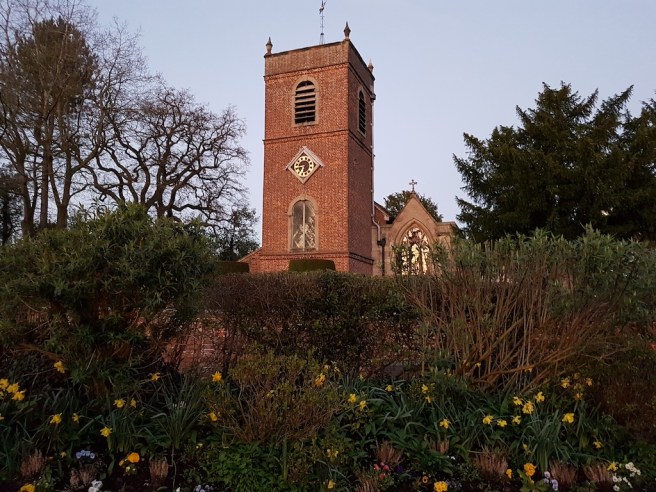 On our first full day we set out from our cottage in the grounds of Kermincham Hall past the pond and down its long drive which gave us a feeling of grandeur every time we used it, and…..
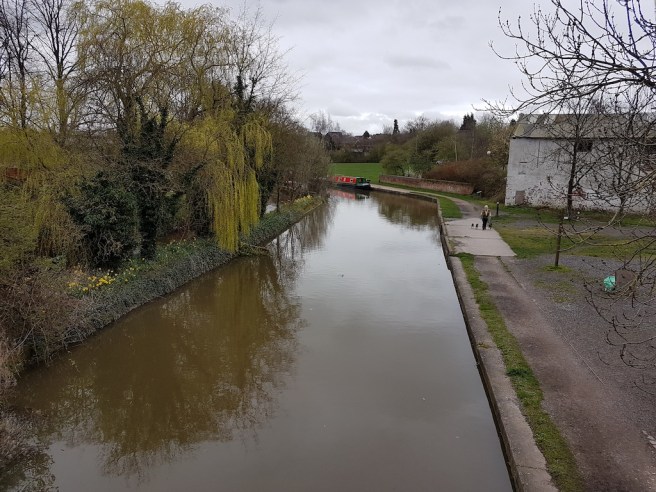
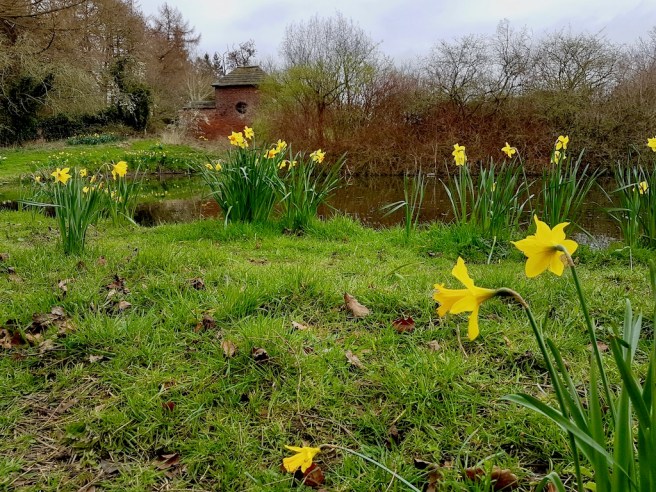 first of all explored Middlewich a historic town with its name suggesting a salt town and being the middle salt town in fact between Northwich and Nantwich. The Romans first mined salt here, and it was mined and processed til fairly recently. In reality the town itself apart from an attractive area by one of the three canals….
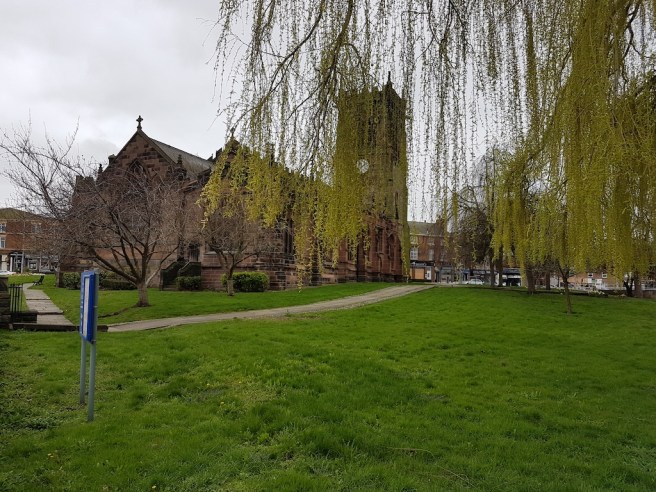
 and by the green surrounding the church…was a bit of a dump – very poor High Street with downmarket shops and giving a depressing, run down feeling. Reminiscent in fact of many towns today.
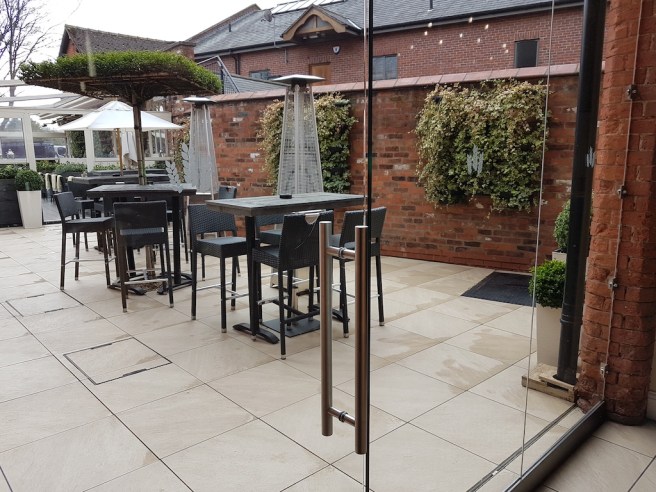
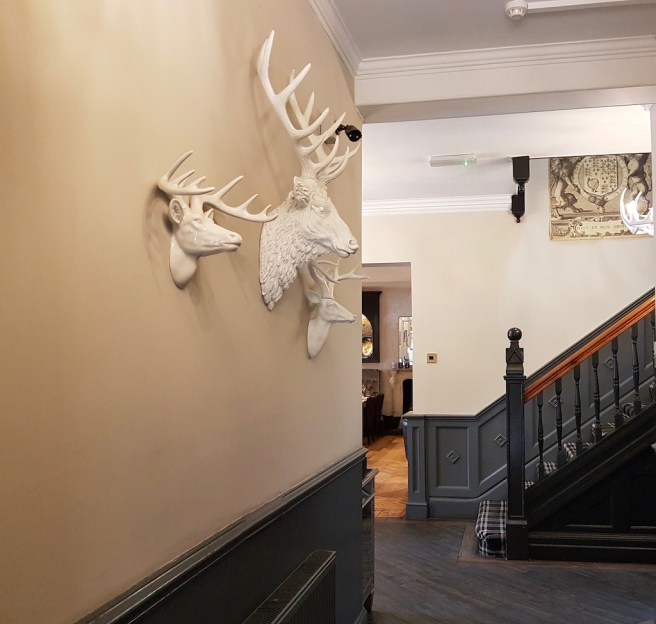
 Our mood lightened considerably however when we went next to Sandbach, a peach of a town. The first great thing about it was free parking. To the two of us who have run shops in several places it is a no-brainer. But councils everywhere seek to bleed town centres dry with heavy rates and support for out-of-town developments and the results are as obvious as they were in Middlewich. We hit upon a lovely hotel for lunch – a gastropub and boutique establishment, The Wheatsheaf. We ordered something light and settled down to read our newspaper and do the crossword between us. Forty minutes later, having completed the crossword but without food, I caught the eye of a member of staff and explained we were waiting. She could not have been more apologetic and efficient. Our open sandwiches and thrice-cooked chips appeared in no time. She explained that our order had been lost in a staff handover. Inexcusable of course, but I was gobsmacked when she again apologised and said we would not have to pay anything. Now that is, in the end, good customer service par excellence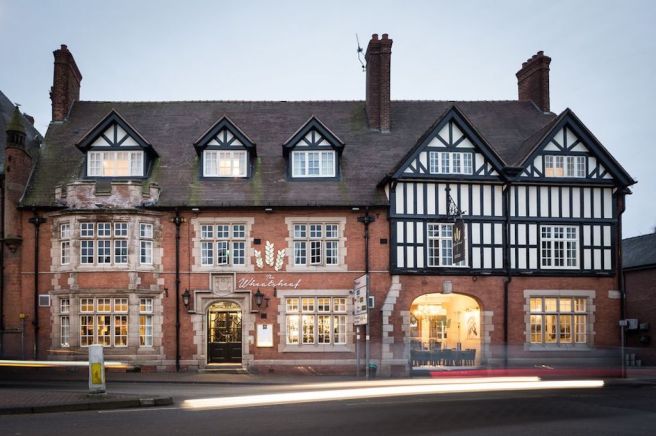
 Satisfied and satiated, we strolled through town and discovered it was market day with lots of good food stalls….but we were more taken with the buildings…..
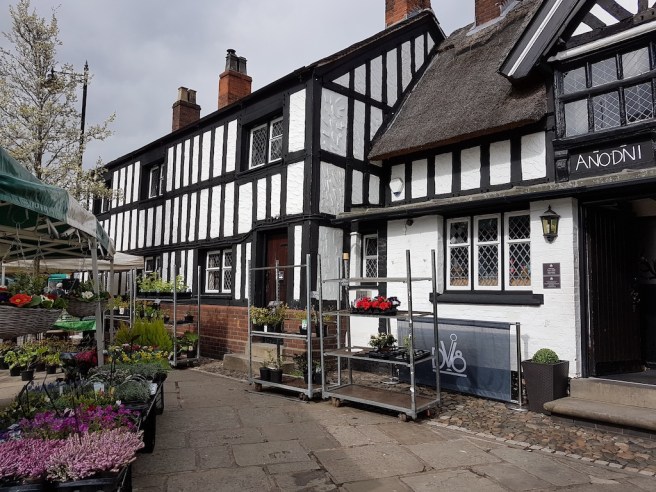
 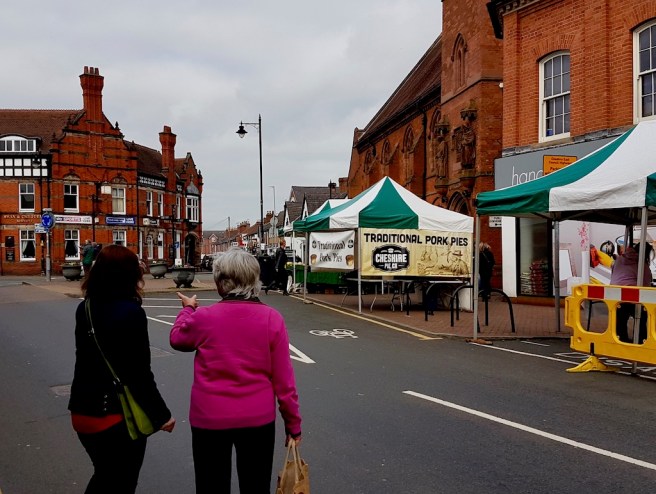 many of which were traditional Cheshire Black and White…
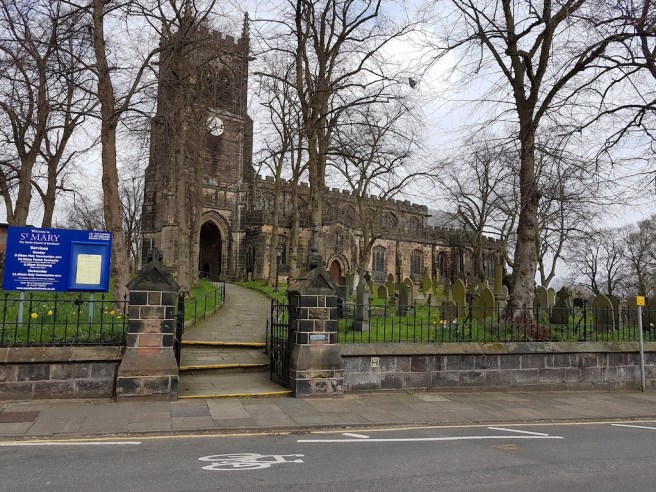
 The church and its grounds were exceptionally lovely…surrounded by Black and White houses on all sides…
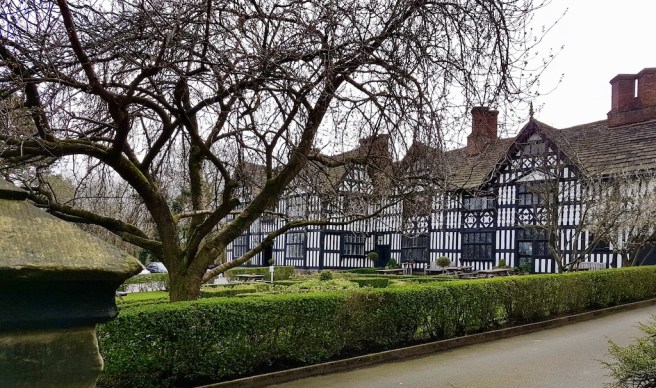
 and the pub opposite the church Old Hall where we called in for a quick half was amazing, believed to date from 1656 and once the residence of the Lords of the Manor of Sandbach. It is absolutely magnificent.
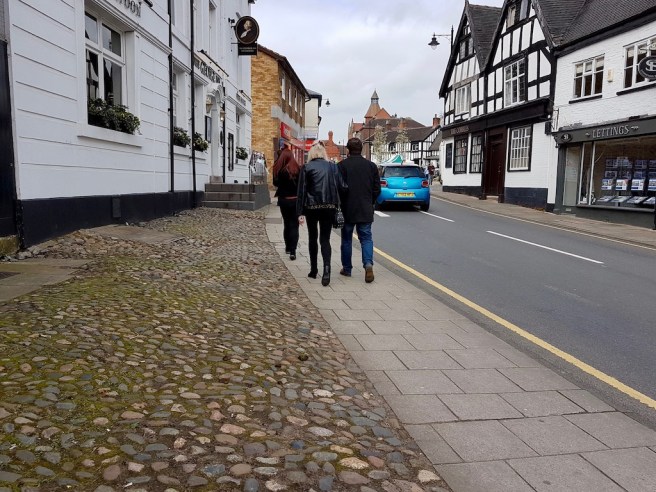
 The centre of the town is picturesque with its cobbles, more Black and White houses, good pubs on all sides (!)…..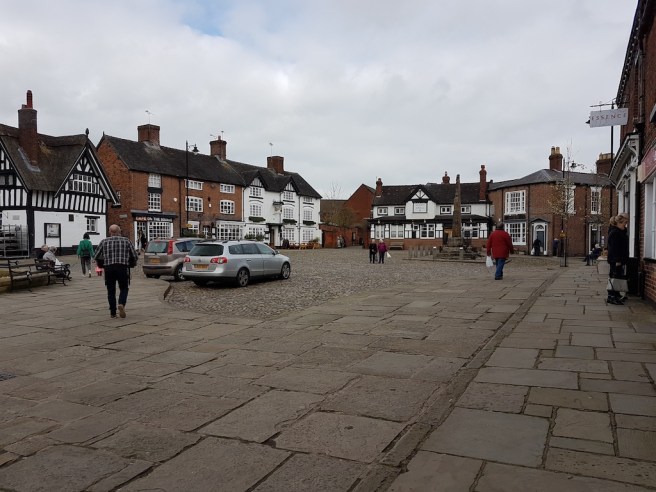
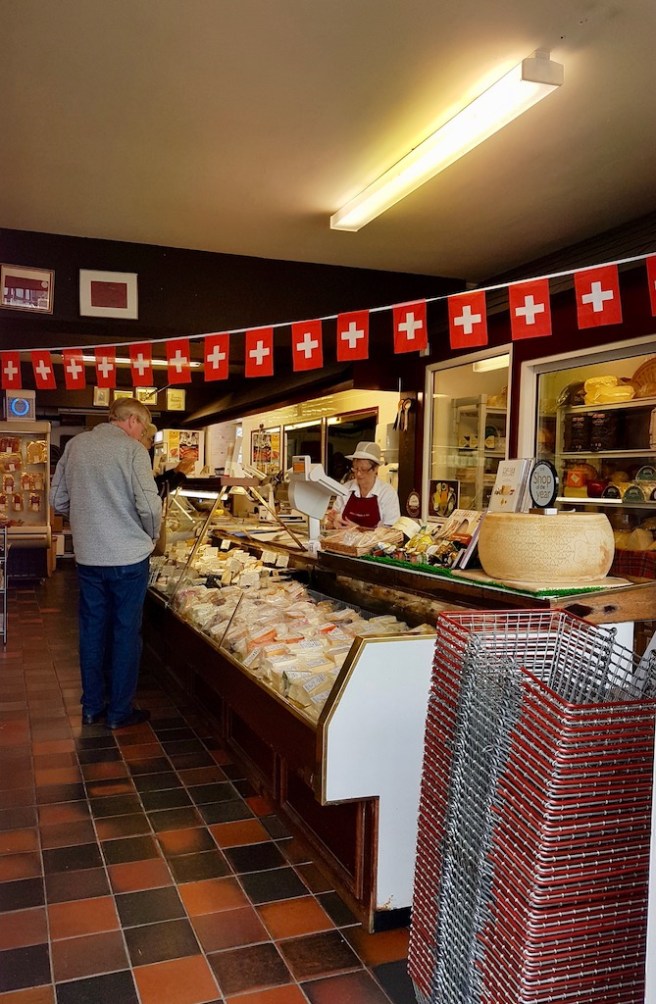
 and a lovely Deli (amongst many other fantastic Independent shops in town)…..
 and there were two impressive and massive Saxon stone crosses dominating the square.
 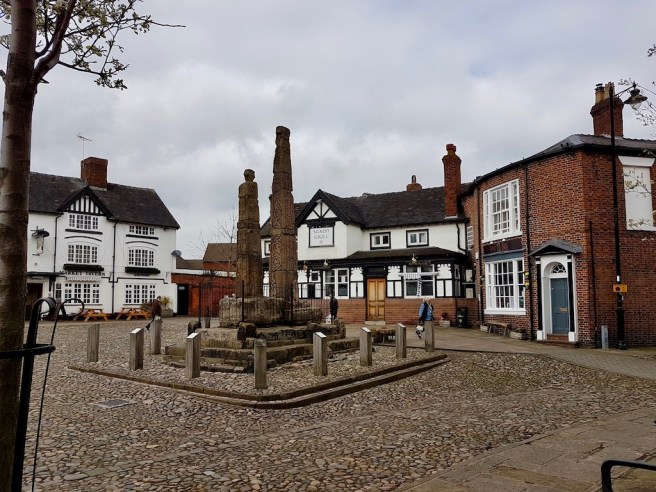 They are elaborately carved with animals and Biblical scenes including the Nativity of Christ and the Crucifixion, and probably date from the 9th century. They were originally painted as well as carved, and they are among the finest surviving examples of Anglo-Saxon high crosses. Later we found several towns and villages that we liked very much, but none of them matched Sandbach, our likely destination? Anyhow, next stop was Nantwich. We had been before to have a chat to the local bookshop owner. It was as pleasant as we remembered. Again a great church and a pretty close surrounding it….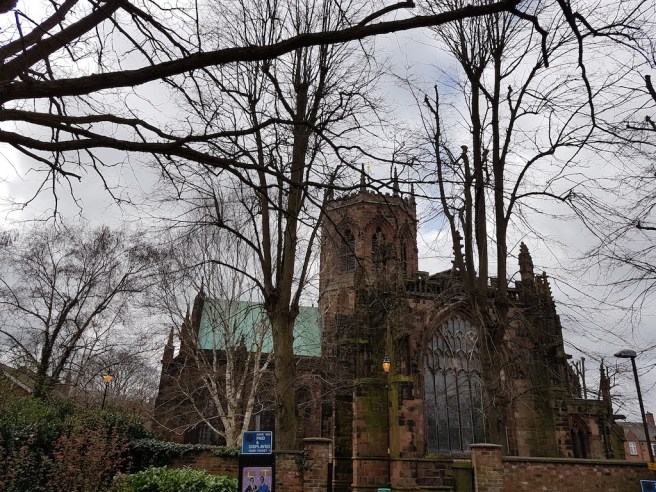
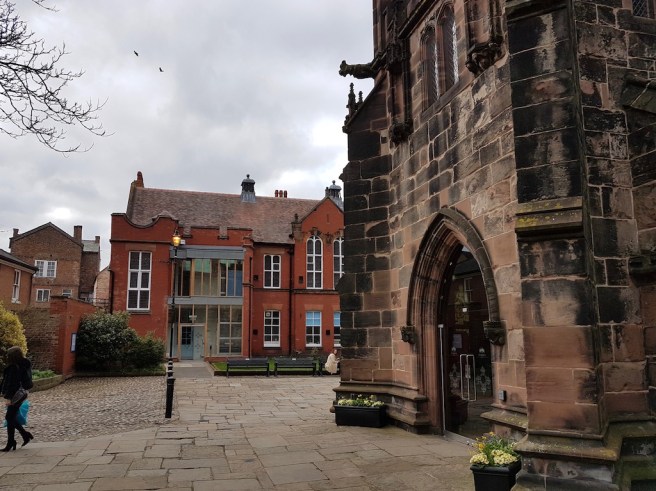 The streets were full of atmosphere and with a wonderful range of Independent shops again…and everywhere seemingly unspoilt and well cared for….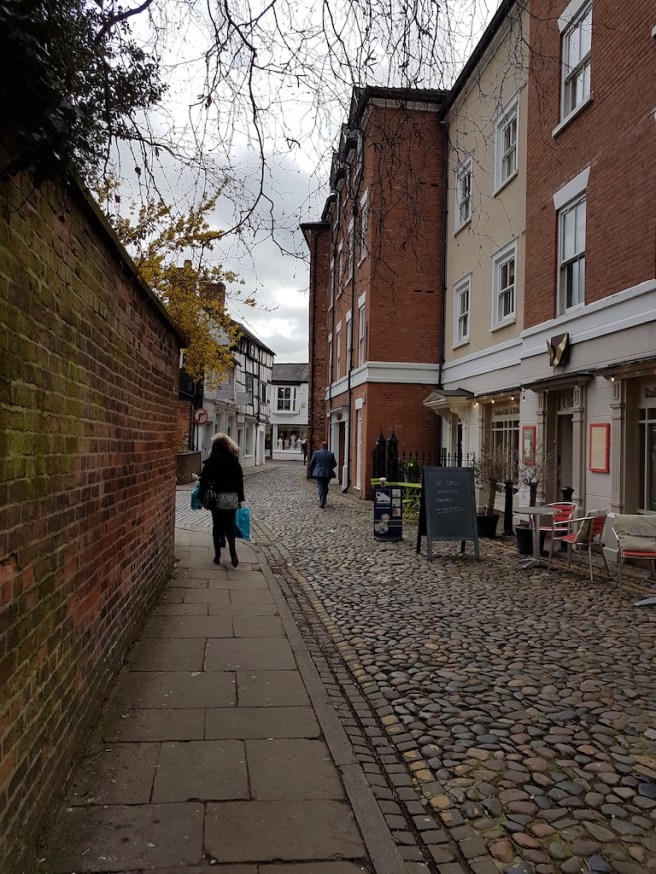
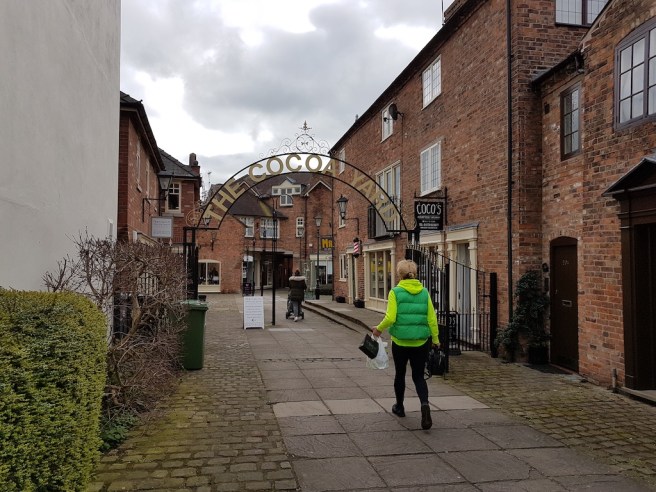 Even the multiples were well hidden.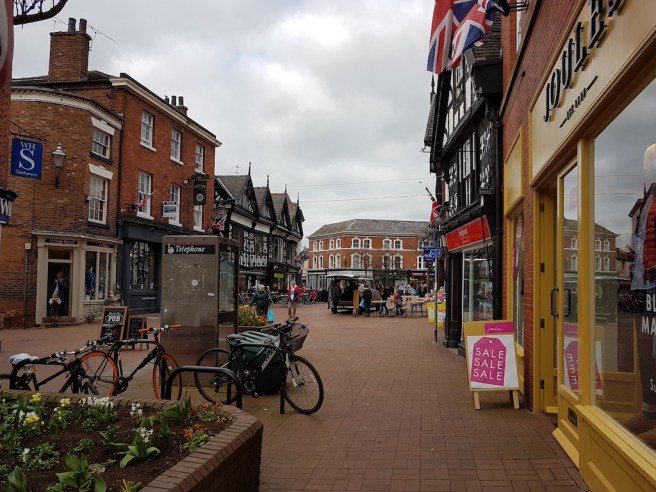
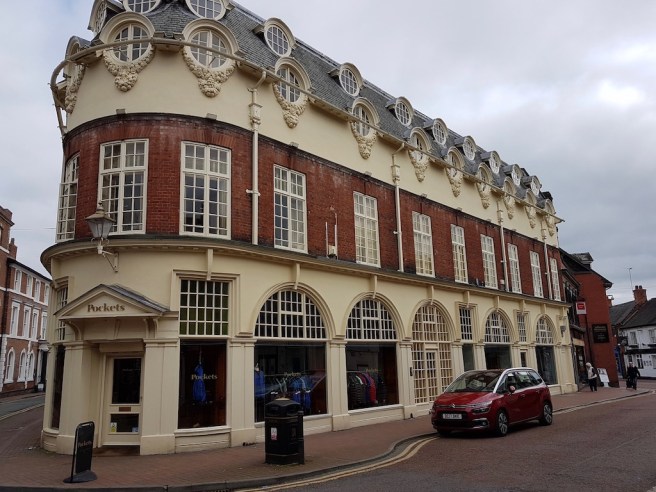
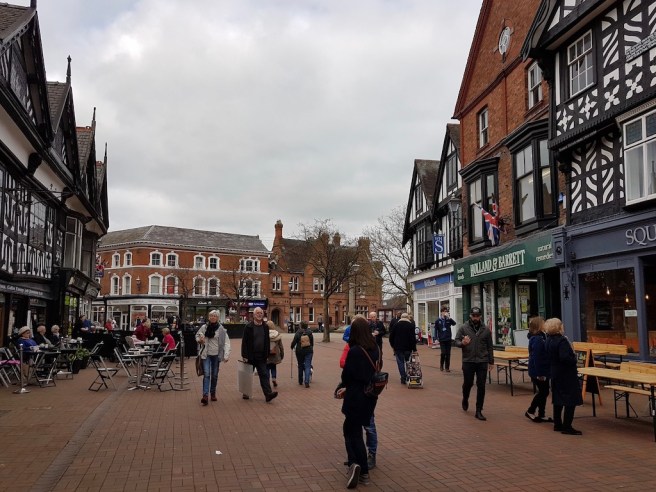 And the range and quality of the buildings and streetscape was exceptional …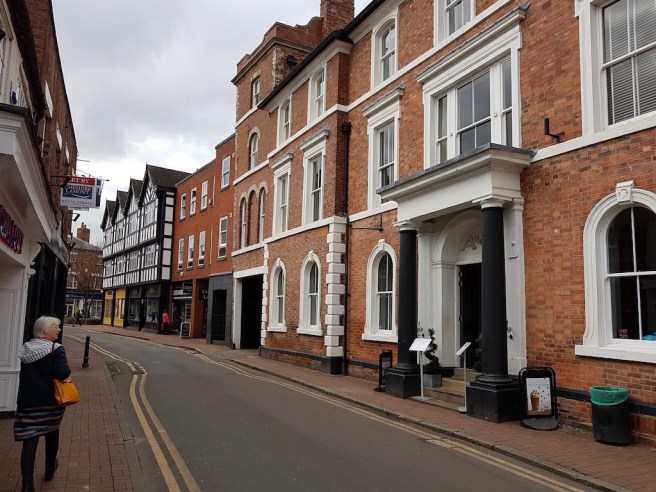
 One thing that wowed us was this boulder.
 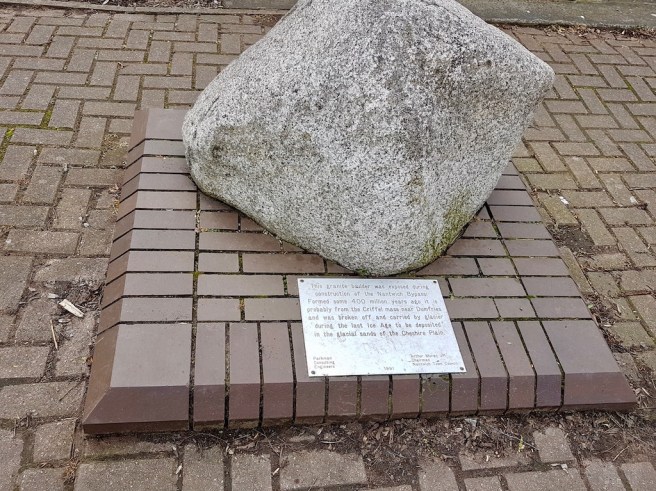 The inscription reads that it was found during the building of the by-pass, is 400 million years old, and is probably from of all places Dumfries in Scotland, having been carried here by glacial action. Incredible. Having decided to look at a range of new houses here, we had a delightful walk along the river….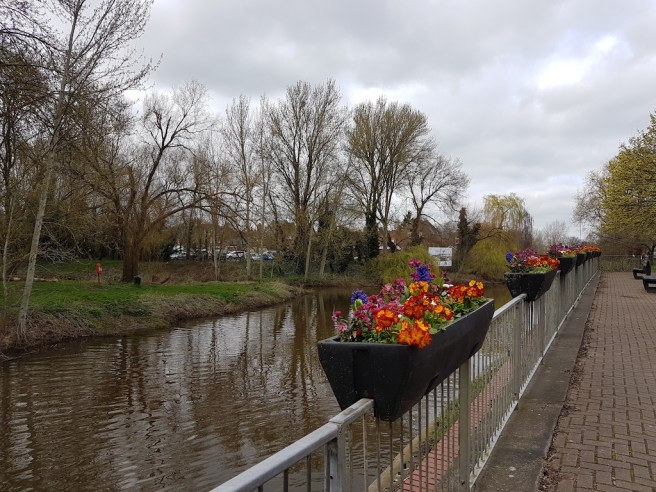
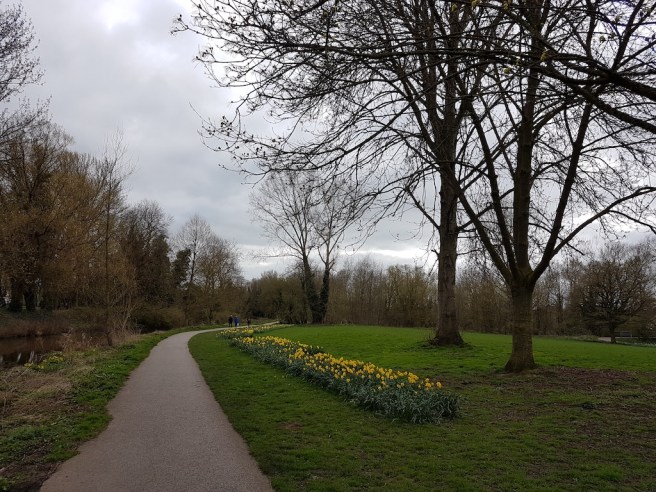
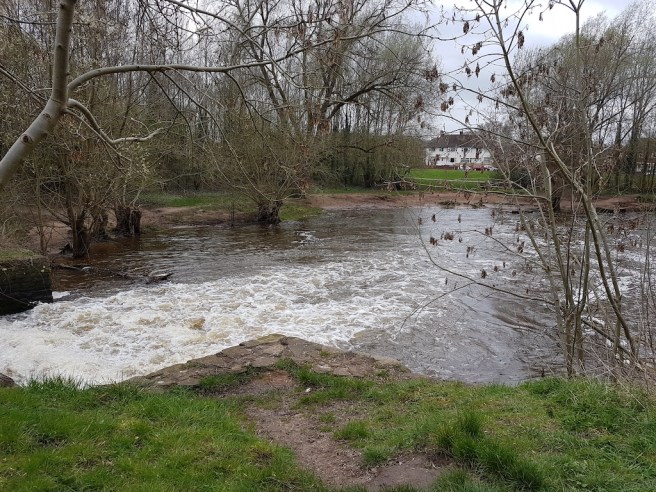 It was a long walk so we were glad of a suitable place of refreshment back in town..A terrific medium-sized town but not quite as lovable as Sandbach was our conclusion.
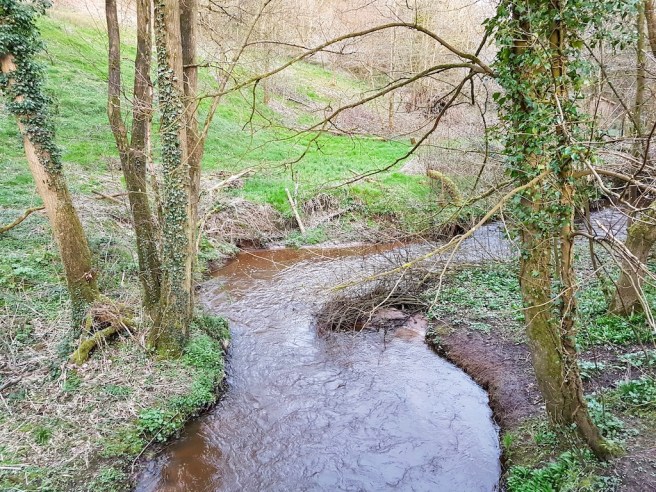
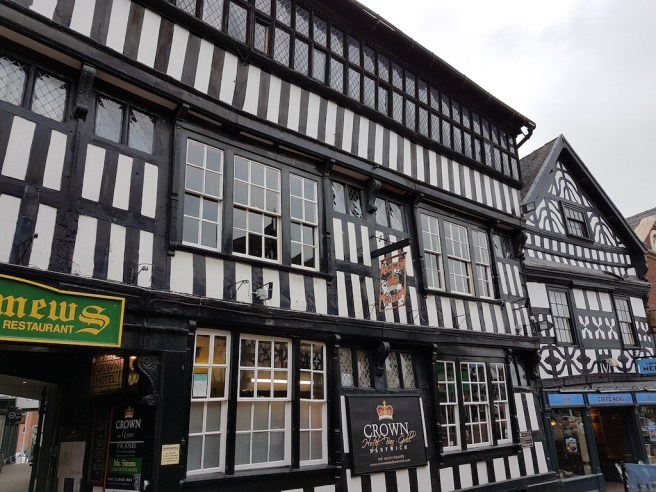 That evening we walked to the Swettenham Arms across three fields, by the nascent River Dane,
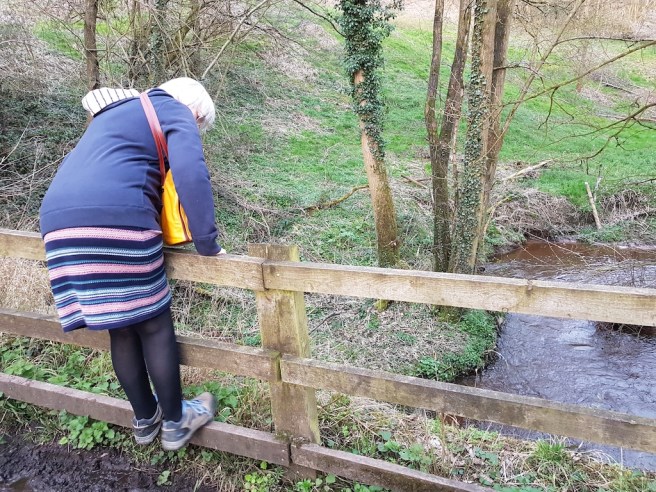
  sliding across the occasional fence to avoid the mud,
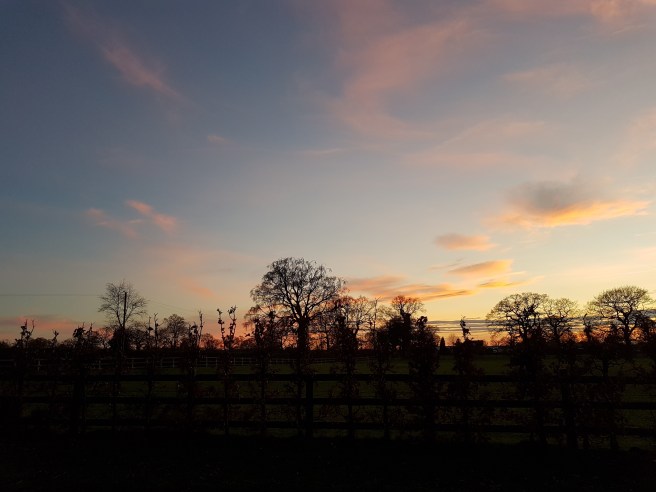
  and getting back just before sunset….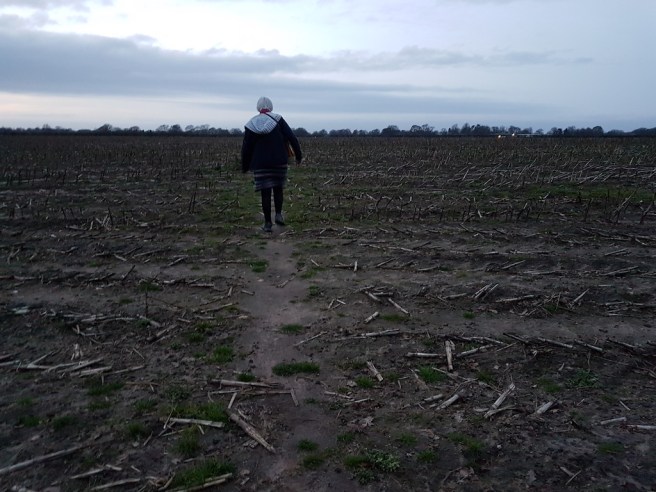
Reading Matters……
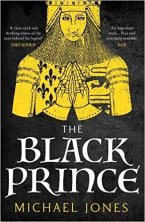 In 1346, at the age of sixteen, he won his spurs at Crecy; nine years later he conducted a brutal raid across Languedoc; in 1356 he captured the king of France at Poitiers; as lord of Aquitaine he ruled a vast swathe of southwestern France. He was Edward of Woodstock, eldest son of Edward III, but better known to posterity as ‘the Black Prince‘.The Prince learned the graft of warfare the hard way. At the famous English victory at Crécy in 1346, the 16-year-old Edward was placed in notional command of the vanguard. When he became severely pressed by a French onslaught (the English were outnumbered by almost two to one), his father is reported to have delayed sending his son any reinforcements, saying: ‘Let the boy win his spurs.’ And so the boy did, with a characteristic display of the courage and steadfastness that so impressed his contemporaries. Here and throughout, Jones captures the drama and press of a medieval battle. I normally shy away from the second tier of historians and go only for top league authors. So I was a bit reluctant to buy what I regarded as a ‘chancer’. I’m glad I did. Not only does Michael Jones tell an exciting tale of a chivalrous knight’s life, but he brings to the table his detailed research and telling use of original sources including the letters of the man himself and his friends, as also using contemporary chronicles both French and English ( and others). You get a very rounded picture of a man who was extolled as the greatest warrior of his day but also a man who was extremely religious in this very religious age. Michael Jones doesn’t shy away from discussing his alleged ruthlessness and misdeeds either. It’s a great pity that Edward and his father Edward III had such differences and misunderstandings which led to the eventual loss of all that the Black Prince had gained in France. A pity too that he died so young. Nevertheless his name and aura live on and you can do much worse than enjoy this book as much as I did.
Another great history book ‘Bosworth’ by a well-known historian (and politician) tells in detail the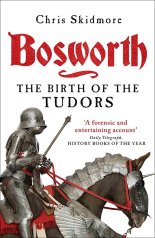 story of how a Queen’s love match with a Welsh servant led eventually to the birth in a following generation of Henry Tudor and the successful if rather surprising overthrow of the Yorkist dynasty. Skidmore is an excellent guide to how all this led to its culmination in the Battle of Bosworth. He describes the background in terrific detail as well as giving us a blow by blow understanding of the battle itself. Well researched and told in a lively manner, the only criticism I would have is the lack of clarity at times as to who we are reading about. I can’t count the number of times I had to peruse the genealogical chart to see which Margaret or which Edward he was talking about. I can only assume all those reviewers who praised its clarity didn’t read it in as much detail and with as much care as I did! Still buying two history books which I didn’t want to put down is a good result……..
This hardback book ‘Bomber Command’ was purchased as a £5 remainder at WHS. I have tried for some time now to research my father’s experience as a Bomb-aimer. No luck in getting his personal details so far and very frustrating considering I have his Forces ID number. However reading the book has given me an excellent idea of how lucky he was to survive, how brave he and the others were, how professional, and I also can appreciate why he didn’t say very much about his experiences and why he had a lifelong antipathy to war and armed struggles of all kinds. The only time we had a short chat he told me how sometimes when a plane returned they would literally have to hose out the remains of the Rear Gunner. I felt I couldn’t really take it any further, but as historian myself I really really should have done! ‘Bomber Command’ is terrific for the details but also covers the overall strategy and the controversies that have arisen since. Max Hastings is willing to be more critical of the key personnel involved than some other historians, but I found the research and output very balanced indeed. £5? A great buy!
Gardening in February…..
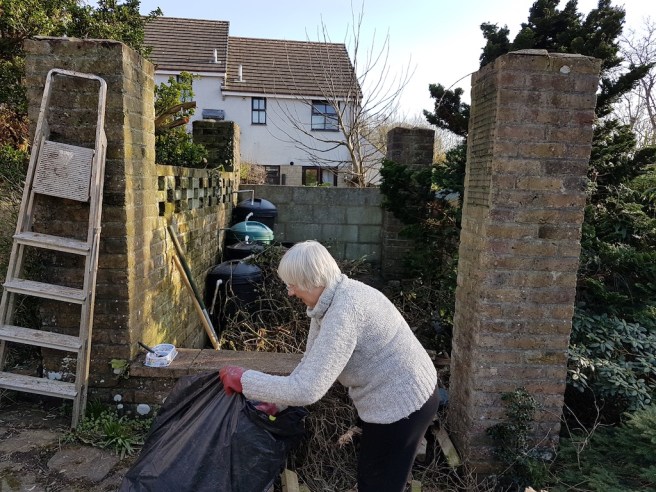
No two ways about it gardening can be hard work and because of the weather we have started early this year. My son helped dismantle the rotten pergola but then there was still a lot of clearing up to do. A new one should be in place in the next month or two…
 Apart from that, the garden is lovelier than this time last year. I really enjoy the benefits of global warning (if that is what they are).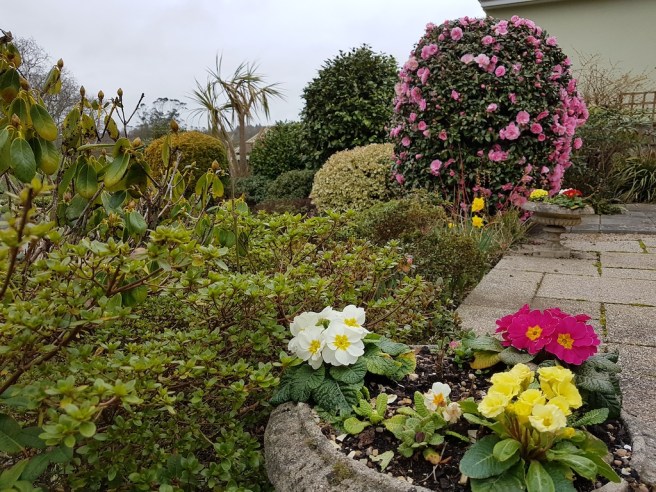
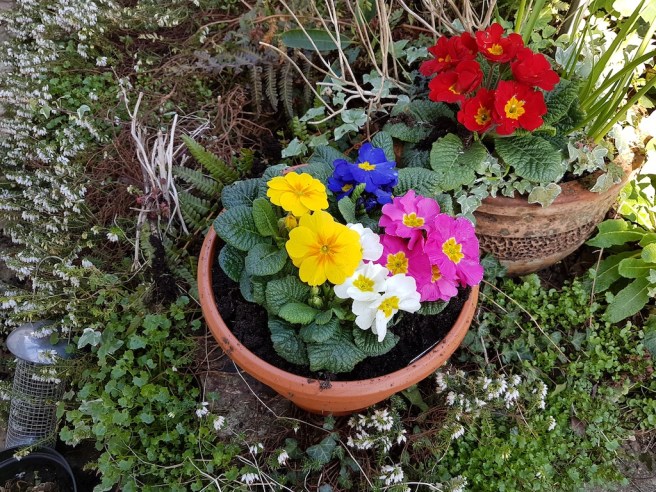
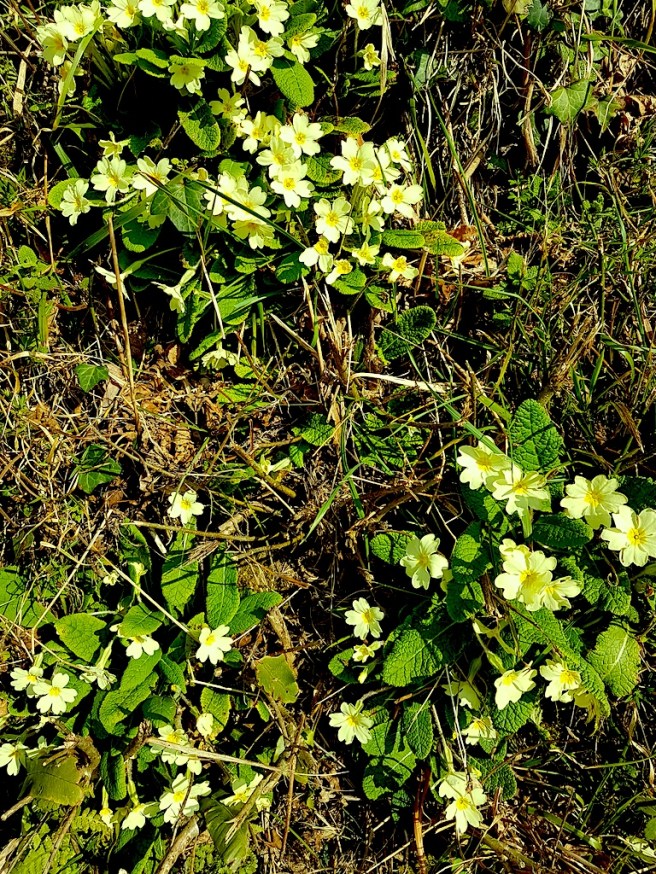
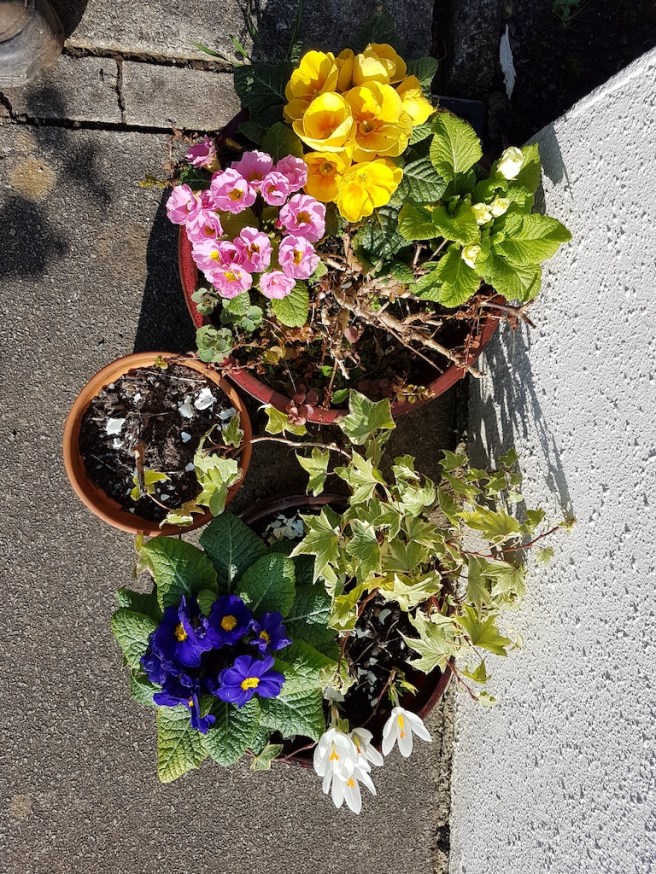 And it’s the same in our lanes…primroses and daffodils out, and wonderful days for walking (when its not raining that is)….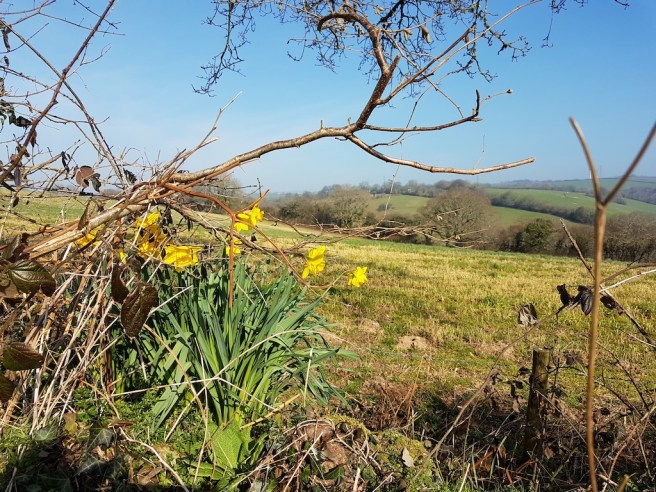
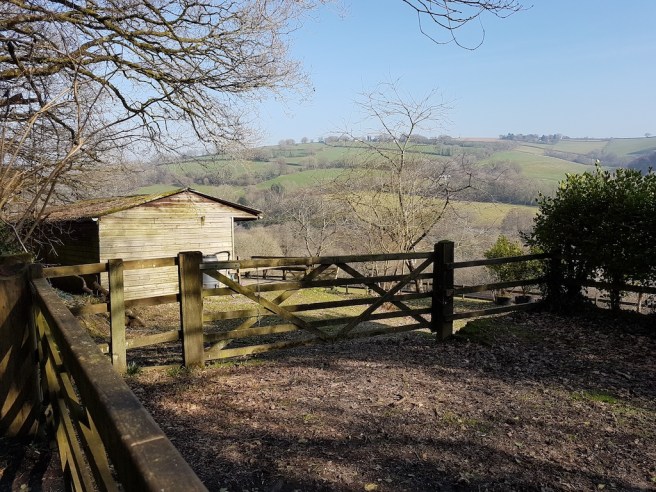 Let’s hear more about the benefits and really make them work for us……..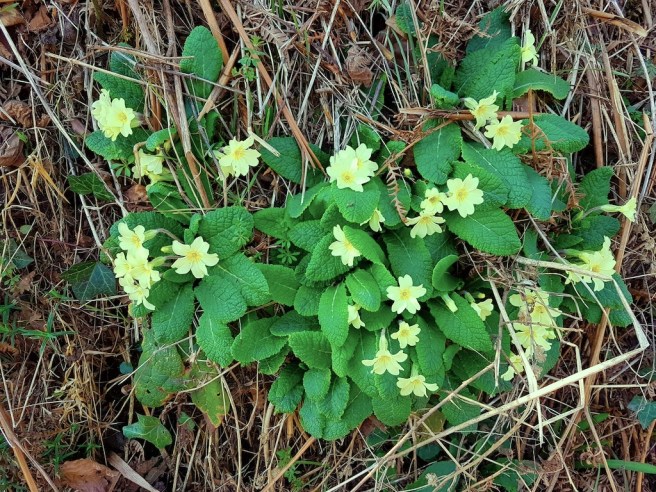
A lovely walk to Padstow….
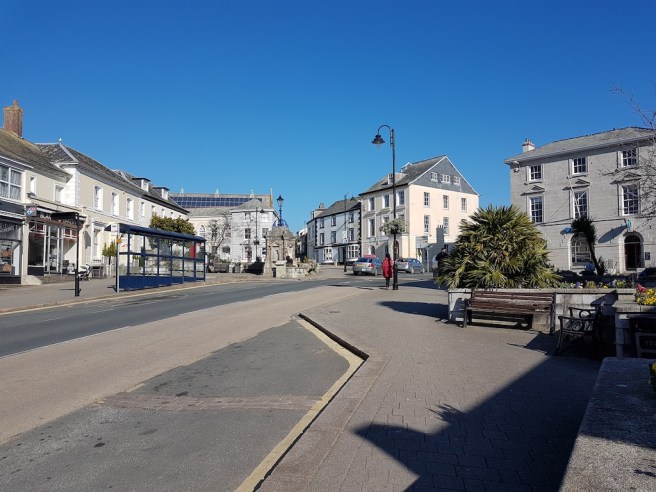
 We catch the 11 bus from Liskeard to Wadebridge. I don’t say much about our local town Liskeard but when you look around it is quite a handsome place with a lot of good quality buildings. You can see from the sky why we decided to go to the seaside…..
 From Wadebridge we catch a cute little local bus to Polzeath (pronounced Polzerth). We decided as we were in no hurry to have a good look around the beach there, so we walked towards the headland and returned via the houses – magnificent views and very expensive.
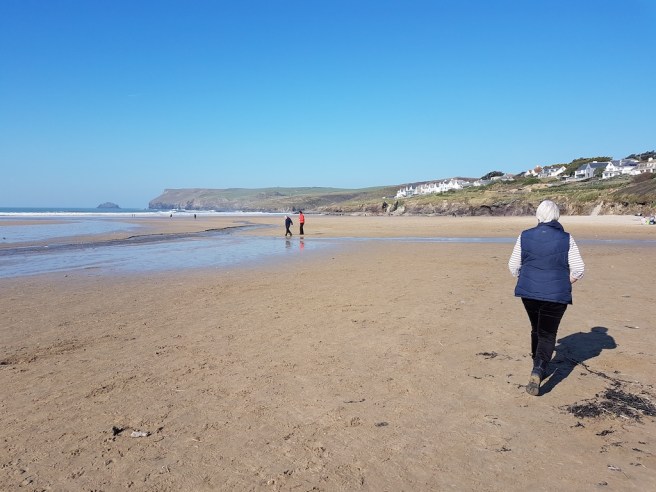 Good surfing conditions and a few were out….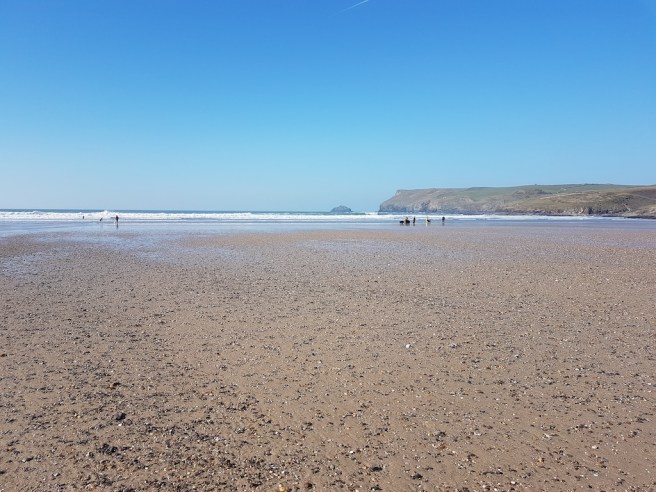
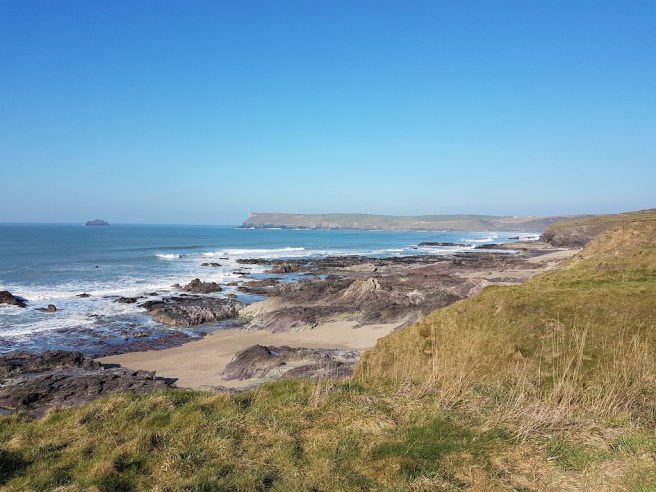
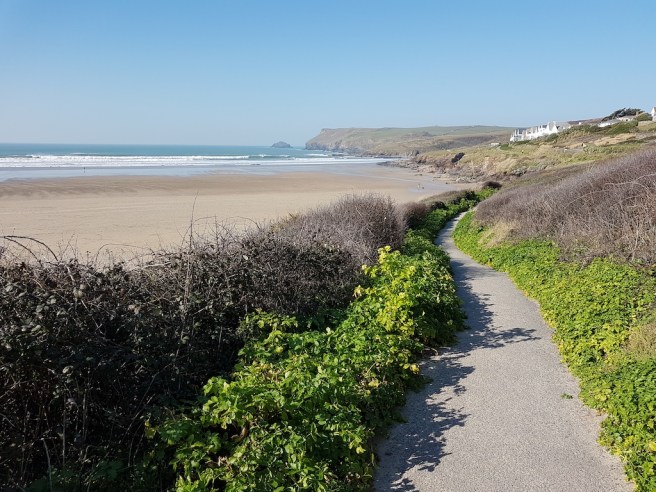 But it was time for our walk now, so we joined the South West Coast Path towards Rock.
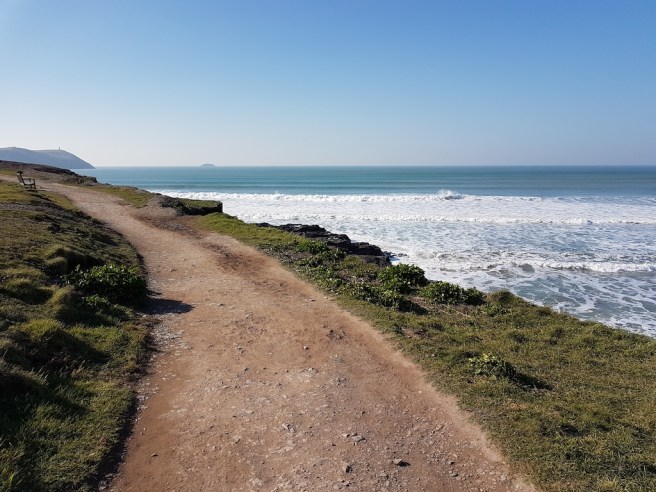 looking back now and again and……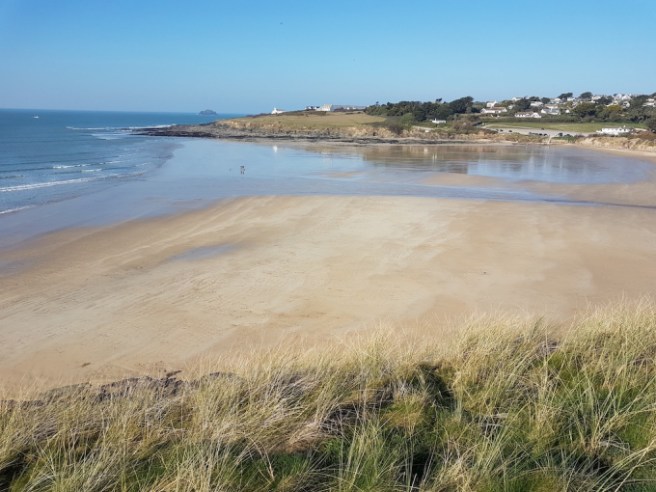
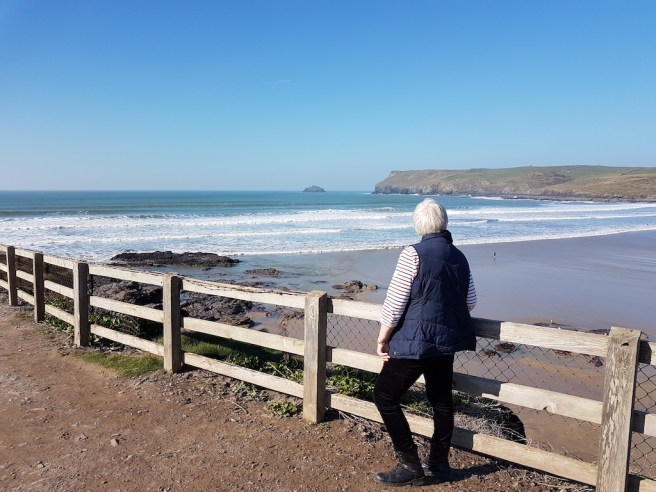 …..with the occasional stop for a drink (it was warm when you escaped the wind). Along the way there are many smaller beaches with easy ways down….
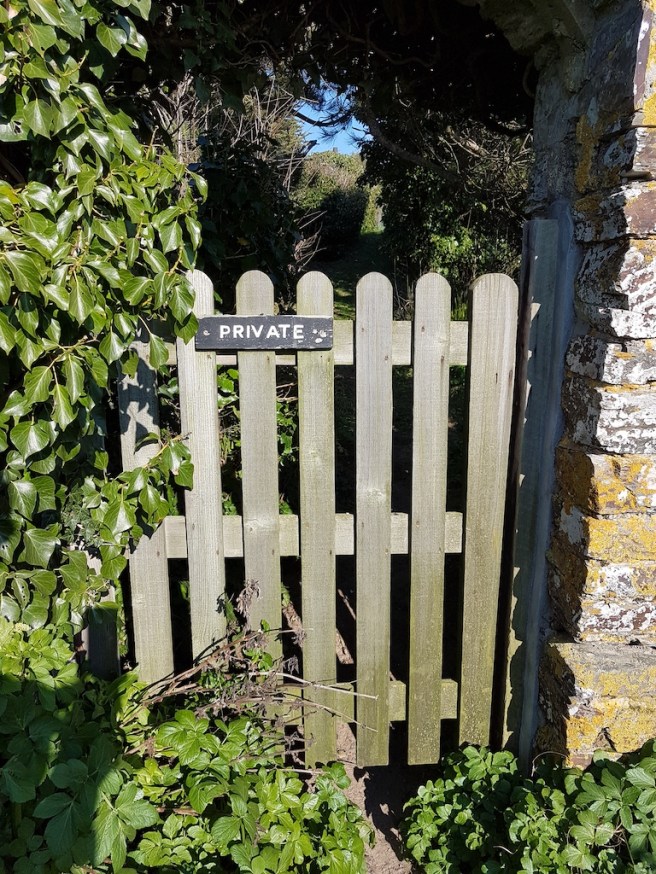
 I do like ‘Private’ signs. they encourage a more radical me…one who wants all land (as in Scotland) to be free access.
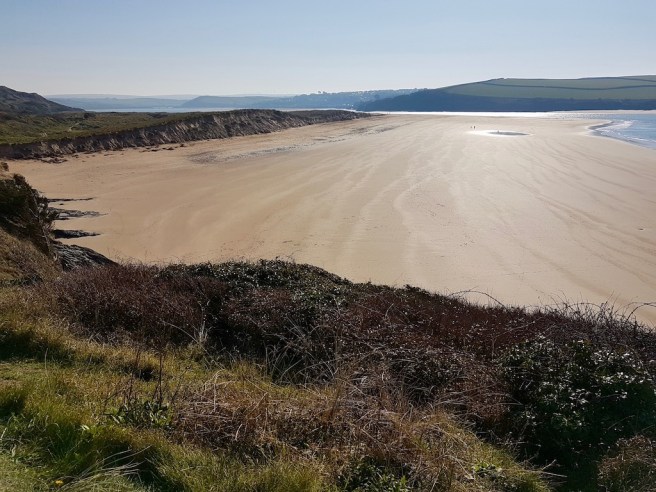
 Looking ahead this is Daymer beach…..
 We walked through the magnificent dunes…
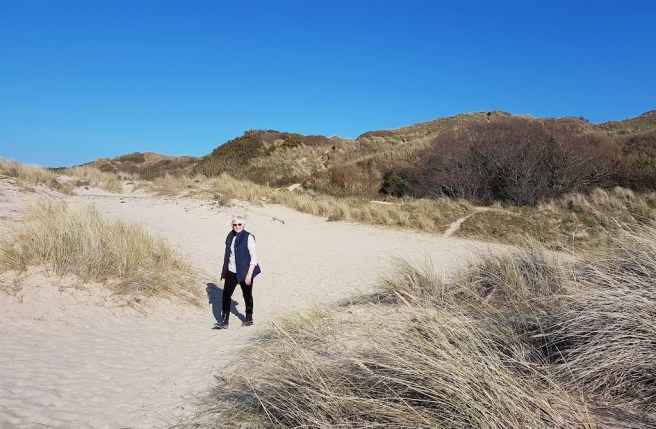 and of course what better at the end of a walk than a bit of light refreshment?
 Rather than walk up a steep hill through the residential road of exclusive Rock we took the ferry across to Padstow. Talking to the ferryman, when he closes at 4pm now but 6pm I think in Summer, there is a water taxi service should you wish to dine at one side or the other of the estuary and get back.
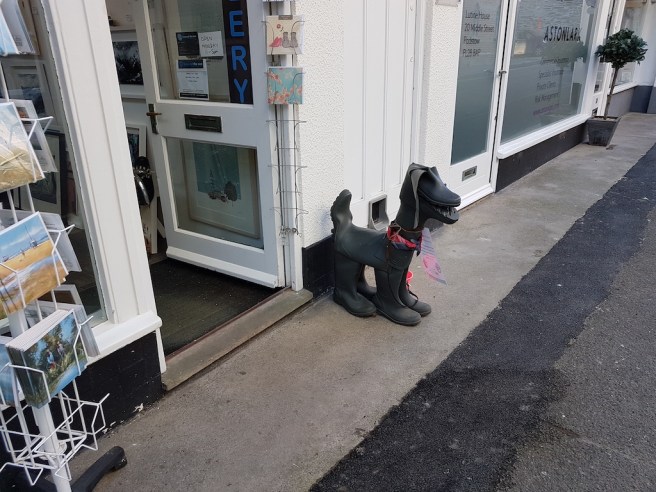
 I thought the wellington dog was good….
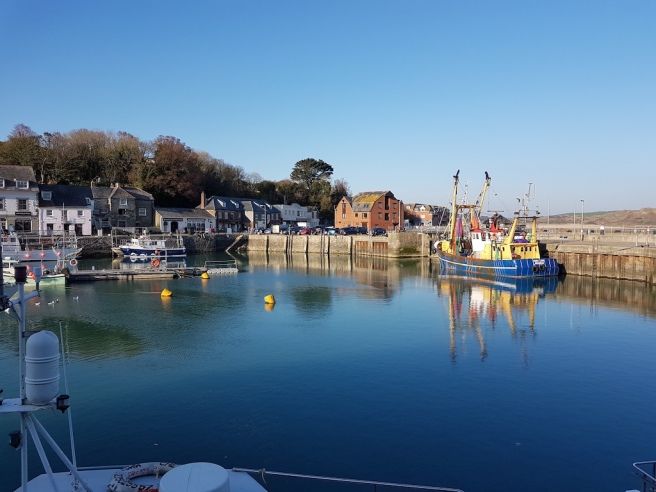
 One of the trawlers in Padstow harbour seemed particularly colourful……
 and all was still……..time for the bus home.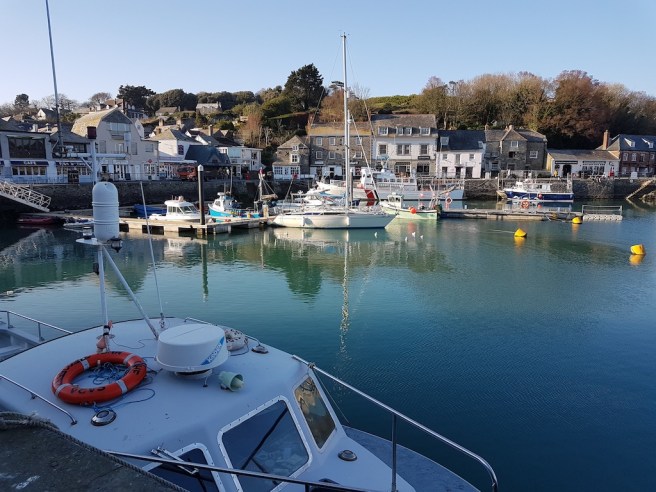
Flat hunting in Fowey…..
I have always had a desire to live in Fowey…and on this beautiful February day who could gainsay me? I had after many years of looking found on-line a flat that seemed to be in our price range. It, or rather they, for we looked at four or five flats, of one and two bedrooms, in the same building, were located at the Bodinnick ferry crossing. They were very nice but unfortunately just too small. Anyhow another good excuse to come to Fowey…….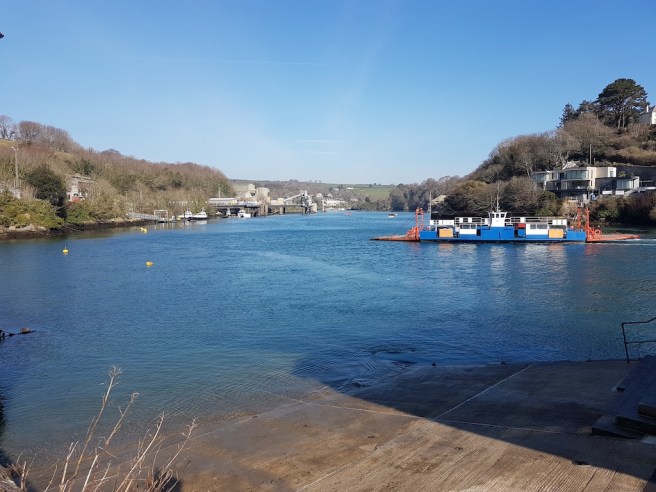
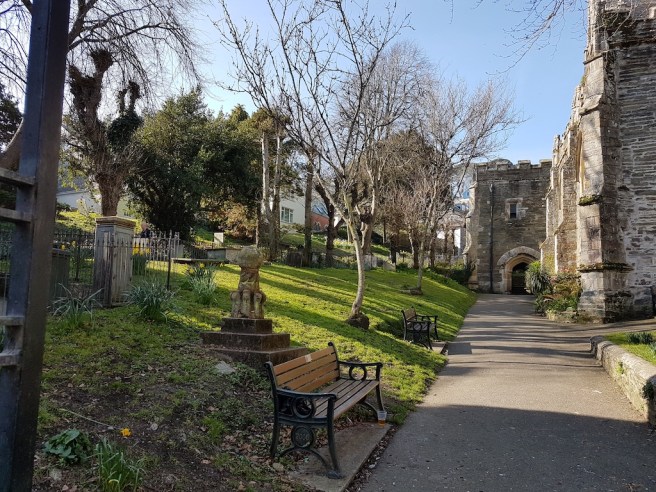
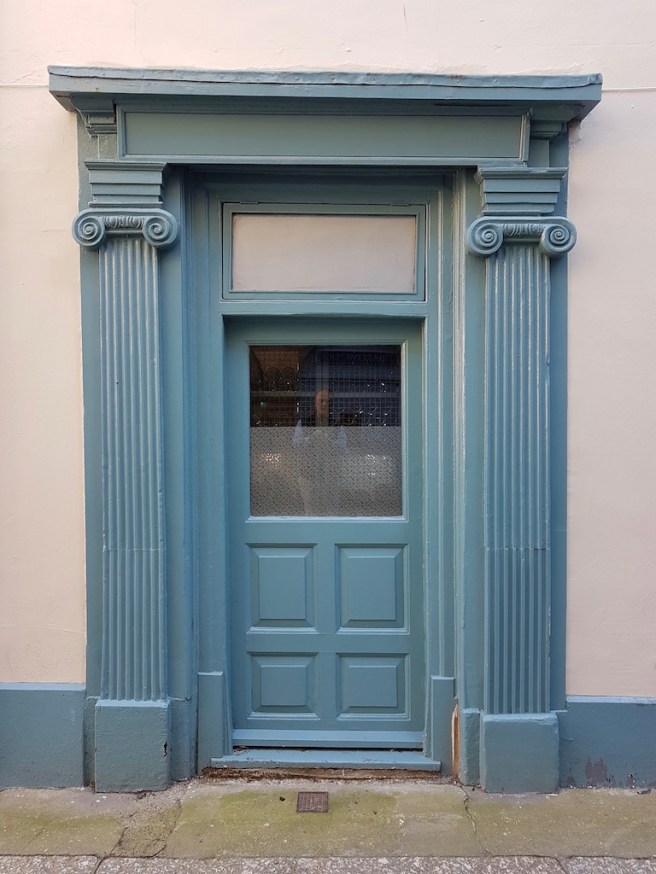
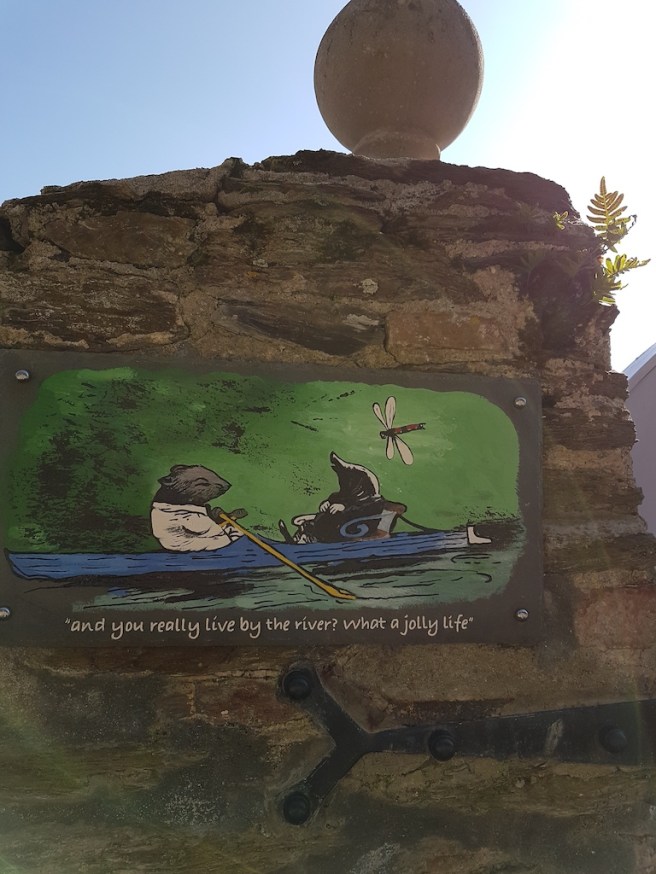
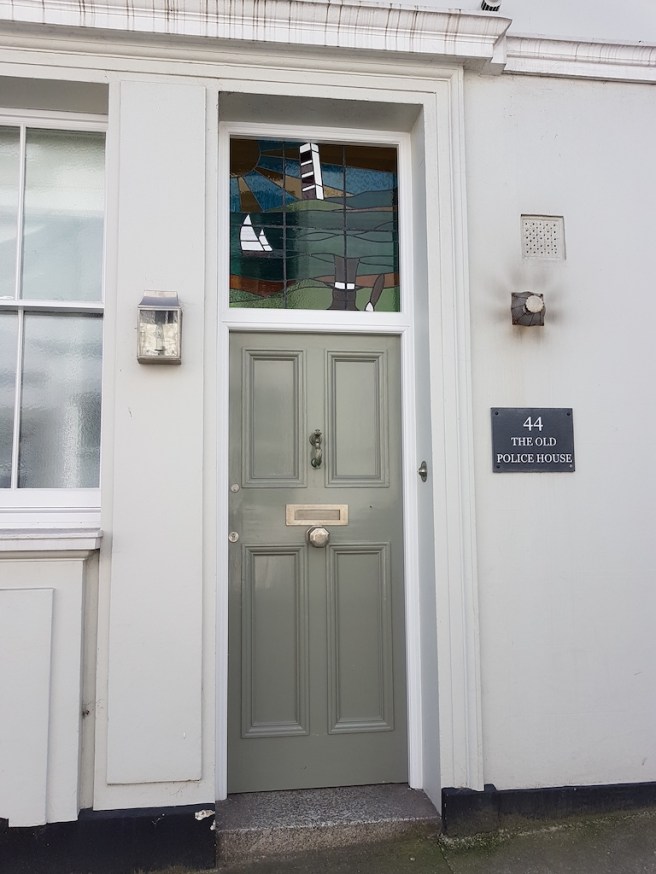
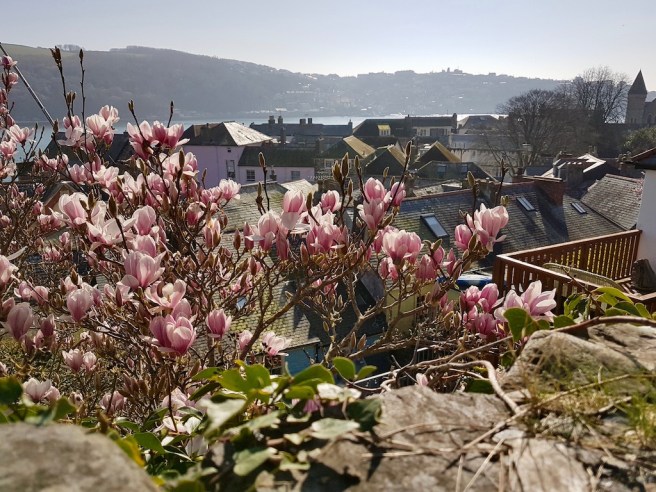 On the way back we called in to the Cormorant Hotel at Golant for a drink. This is the view from their car park….
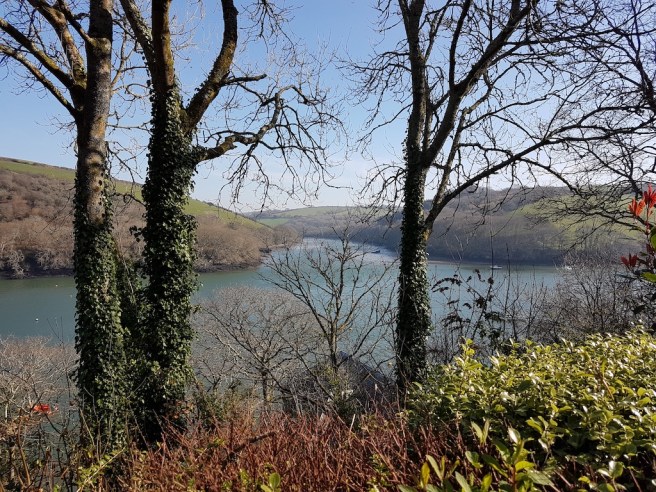 and terrace…wonderful. Unfortunately the hotel was closed for a few days for renewal, but we had a nice chat with the owner and will certainly be back.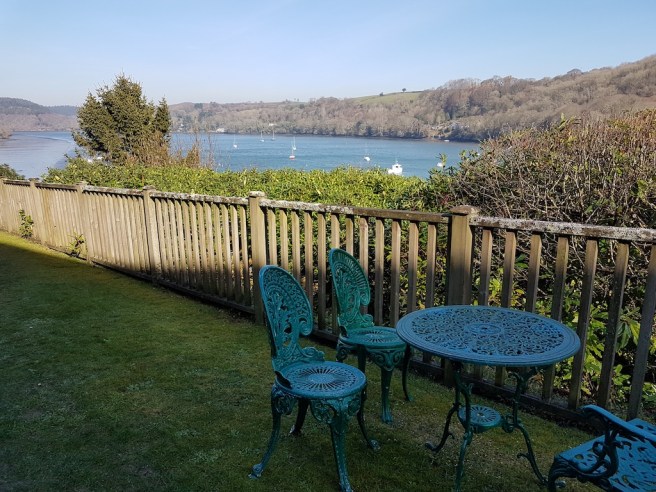
Doors and surfaces in Looe….
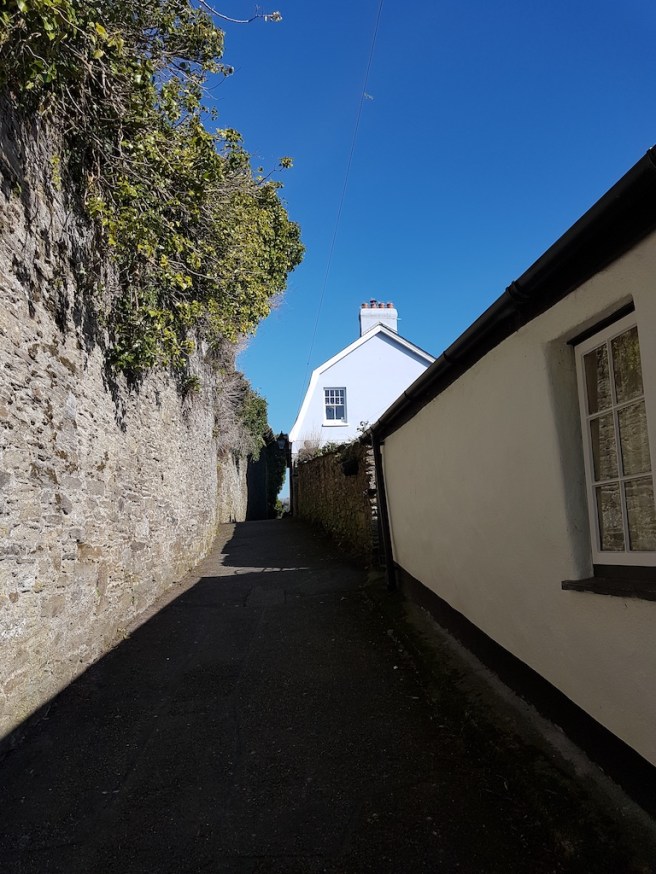
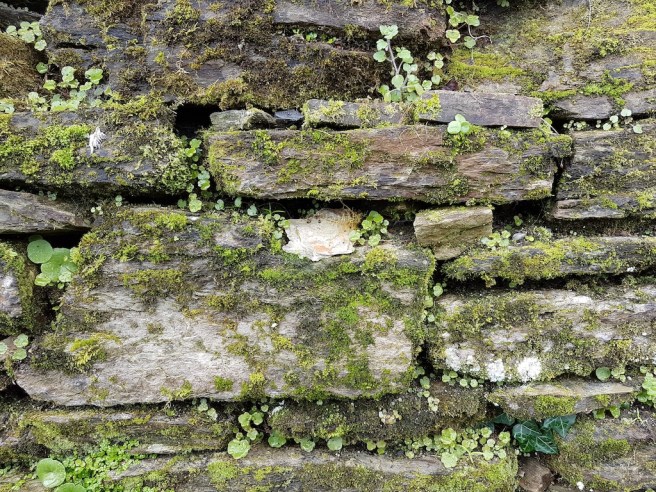 A lot of house walls and boundary walls in Cornwall have a veritable small world of green growth……they are almost becoming Cornish hedges.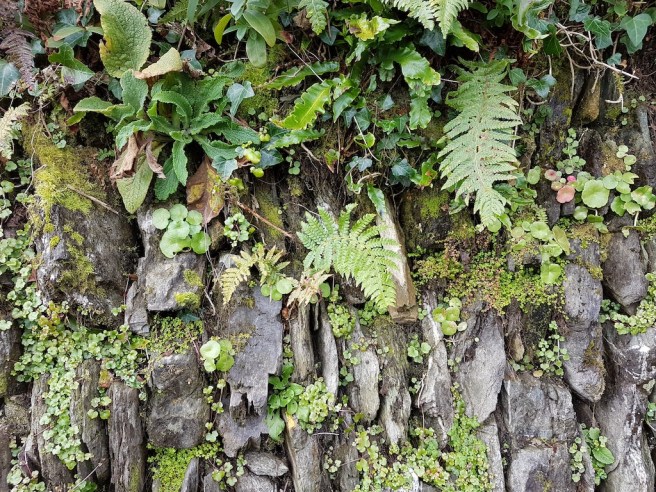
 You don’t see many bricks but some incorporate ‘Looe bricks’ as a design feature…
 ………..and here is the explanation for Looe bricks on a little glass panel to be found in a bus shelter on the front at Hannafore….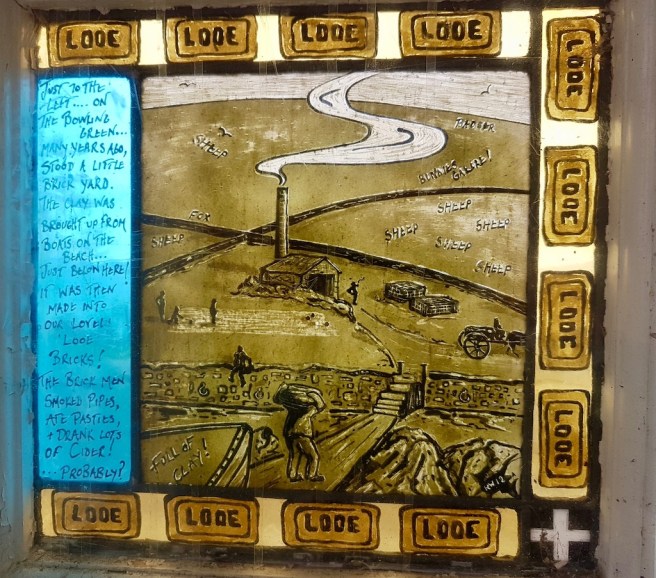
 I do love this feature in a tall wall at the end of the bridge in Looe……’Repeared By Ye County 1689’…..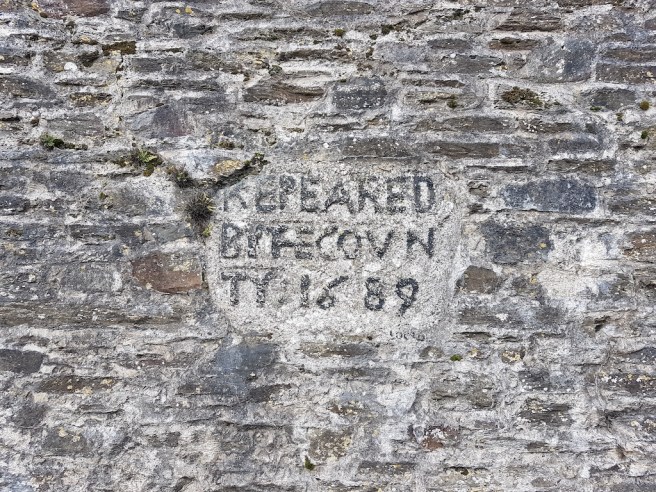
 It wasn’t such a nice day when we were there this time!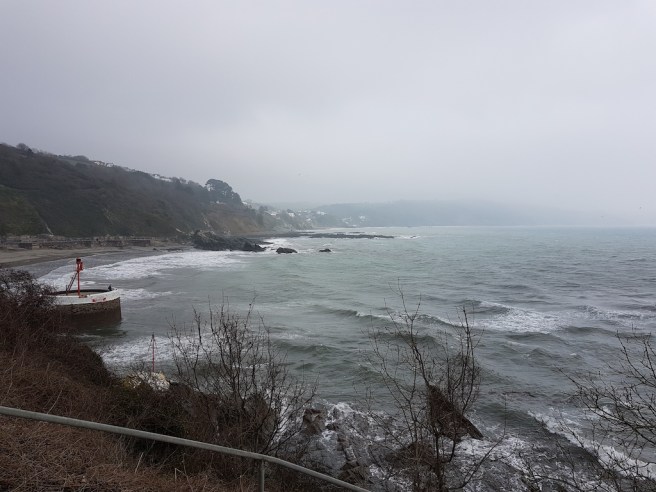
Tears at the opera…….not mine this time
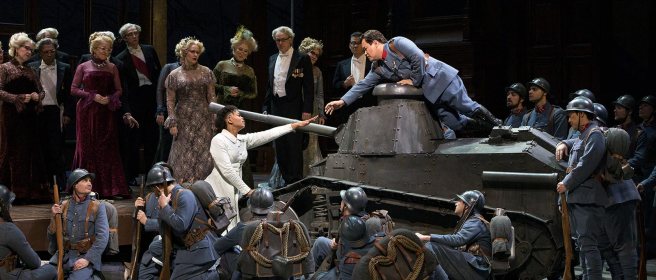 Saturday night at the New York’s Met, well Vue cinema Plymouth actually. A surprisingly large attendance, but the average age was let’s say over 60 – as usual. I really think a younger age profile would enjoy Opera so much. I was only introduced to it in my sixties, and am trying to make up for lost time. It’s great. Now I had never heard of Donizetti’s ‘La Fille Du Regiment’ but as soon as the excellent orchestra and conductor played the overtures you wondered why not. A breezy introduction to what followed set just the right mood for this comic opera. The usual corny back-story….here’s the Met’s summary…..
ACT I
The Tyrolean mountains. On their way to Austria, the terrified Marquise of Berkenfield and her butler, Hortensius, have paused in their journey because they have found the French army blocking their way. When the marquise hears from the villagers that the French troops have at last retreated, she comments on the crude ways of the French people (“Pour une femme de mon nom”). Hortensius asks Sulpice, sergeant of the 21st regiment, to let the marquise continue on. Sulpice is joined by Marie, the mascot, or “daughter,” of the regiment, which adopted her as an orphaned child. When Sulpice questions her about a young man she has been seen with, she explains that he is a local Tyrolean who—though an enemy—once saved her life. Troops of the 21st arrive with a prisoner: this same Tyrolean, Tonio, who says he has been looking for Marie. She steps in to save him, and while he toasts his new friends, Marie sings the regimental song (“Chacun le sait”). Tonio is ordered to follow the soldiers, but he escapes and returns to declare his love to Marie. Sulpice surprises them, and Marie must admit to Tonio that she can only marry a soldier from the 21st.
The Marquise of Berkenfield asks Sulpice for an escort to return her to her castle. When he hears the name Berkenfield, Sulpice remembers a letter he discovered near the young Marie when she was found. The marquise soon admits that she knew the girl’s father and says that Marie is the long-lost daughter of her sister. The child had been left in the care of the marquise, but was lost on a battlefield. Shocked by the girl’s rough manners, the marquise is determined to take her niece to her castle and to give her a proper education. Tonio has enlisted so that he can marry Marie (“Ah, mes amis”), but she has to leave both her regiment and the man she loves (“Il faut partir”).
ACT II
The marquise has arranged a marriage between Marie and Scipion, nephew of the Duchess of Krakenthorp. Sulpice has joined the marquise at the Berkenfield castle, recovering from an injury and supposed to help her with her plans. The marquise gives Marie a singing lesson, accompanying her at the piano. Encouraged by Sulpice, Marie slips in phrases of the regimental song, and the marquise loses her temper (Trio: “Le jour naissait dans la bocage”). Left alone, Marie thinks about the meaninglessness of money and position (“Par le rang et l’opulence”). She hears soldiers marching in the distance and is delighted when the whole regiment files into the hall. Tonio, Marie, and Sulpice are reunited. Tonio asks for Marie’s hand, declaring that Marie is his whole life (“Pour me rapprocher de Marie”), but the marquise declares her niece engaged to another man and dismisses Tonio. Alone with Sulpice, the marquise confesses the truth: Marie is her own illegitimate daughter whom she abandoned, fearing social disgrace.
Hortensius announces the arrival of the wedding party, headed by the Duchess of Krakenthorp. Marie refuses to leave her room, but when Sulpice tells her that the marquise is her mother, the surprised girl declares that she cannot go against her mother’s wishes and agrees to marry a man that she does not love. As she is about to sign the marriage contract, the soldiers of the 21st regiment, led by Tonio, storm in to rescue their “daughter.” The noble guests are horrified to learn that Marie was a canteen girl, but they change their opinion when she describes her upbringing, telling them that she can never repay the debt she owes the soldiers. The marquise is so moved that she gives her daughter permission to marry Tonio. Everyone joins in a final “Salut à la France.”
As is normal with these live broadcast events there is an opera star to introduce things and talk to set designers, producers, etc and also to the stars taking part – during the interval, in the middle of their performances, which is quite something. All very American and very enjoyable. The other quintessentially American thing was the lavishing of praise on the main sponsors. It does make one think how generous American benefactors are compared to their British equivalents – something I have been reading about recently.
The main leads were terrific, astonishingly good, even though Sulpice had a cold. The South African soprano Pretty Yende was Marie.  She could have been the star of the show but wasn’t only because tenor Javier Camarena was so so good.
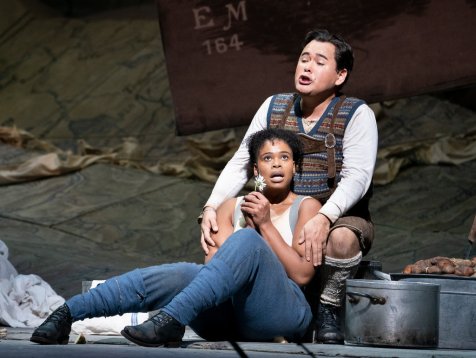 The opera is renowned for it being a feast of bel canto vocal fireworks—including the show-stopping tenor aria “Ah! Mes amis … Pour mon âme,” with its nine high Cs. This took the real Met audience by storm and they were standing and shouting for more, and so sustained was this and so full of the moment was Javier that the tears started to trickle down his face. No acting there! An encore was called for and given. An amazing feat in opera apparently, and we could see why. In some senses Javier with his short stature and ordinary looks is such an unlikely hero but wow did he steal the show. It was a real privilege to see this performance and massively enjoyable. Apart from the singing it was brilliantly staged and there was even an old big-screen star – Kathleen Turner – to enjoy in her speaking-only part. Her duel with the conductor was memorable. We enjoyed the music, but an Italian composer bulling up the French post-Napoleon? We discovered afterwards that Donizetti left his patron the King of Naples because he was being censored and felt free to do as he wished in Paris. All in all a wonderful evening. And back in time for Match of the Day.
Doors and Surfaces in Fowey……
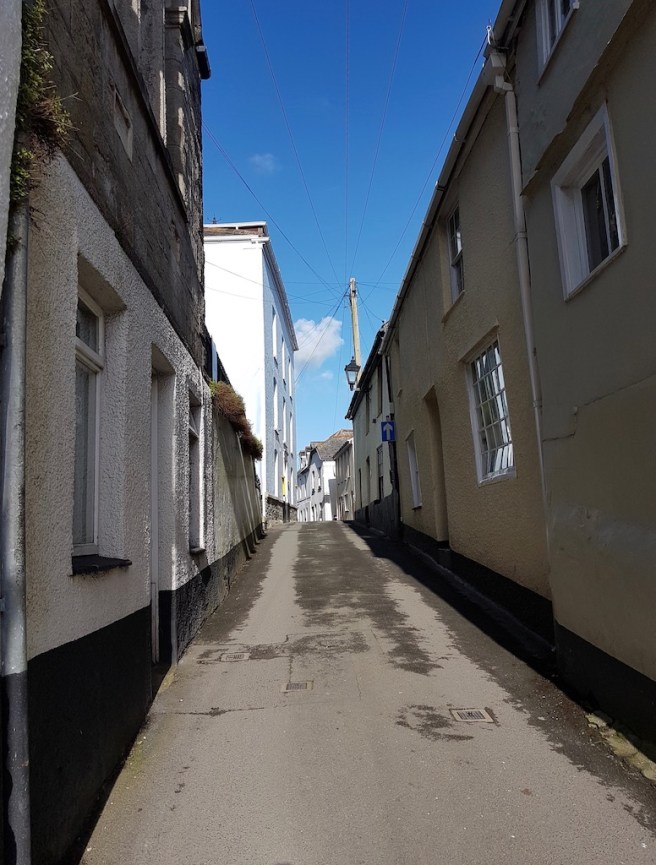
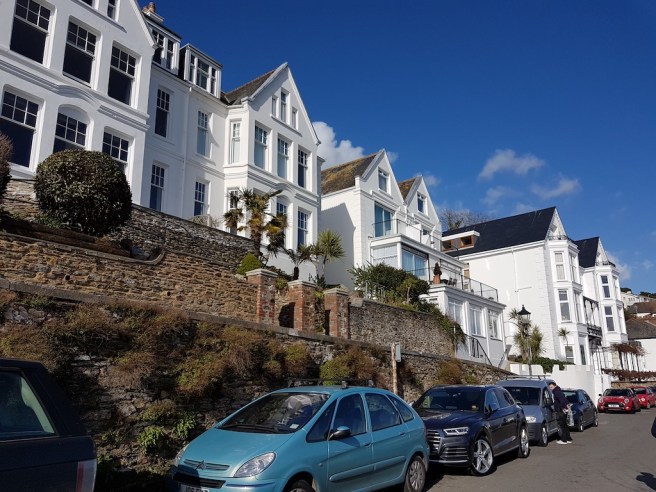 Yet another trip to the tip and another trip to Fowey as a reward. Parking free at this time of year. Great. Some Edwardian houses we hadn’t really noticed before gleaming in the bright sunshine on this February day. Fairly quiet although half-term, and a pleasure to wander around the streets.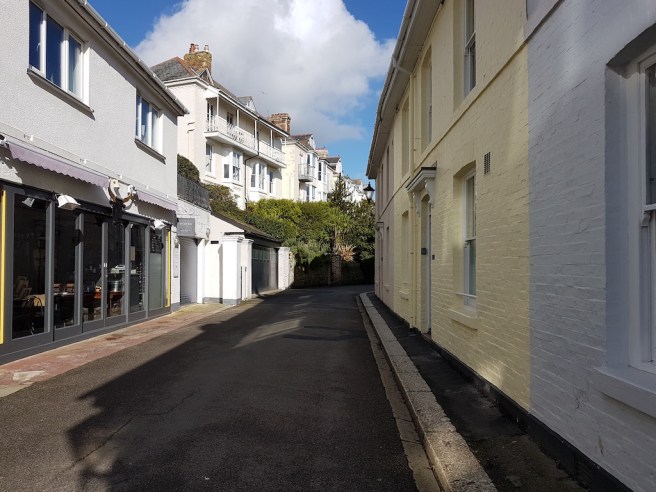
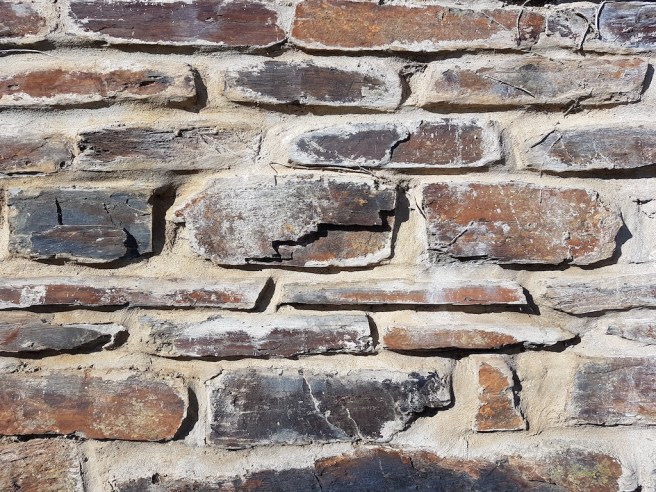
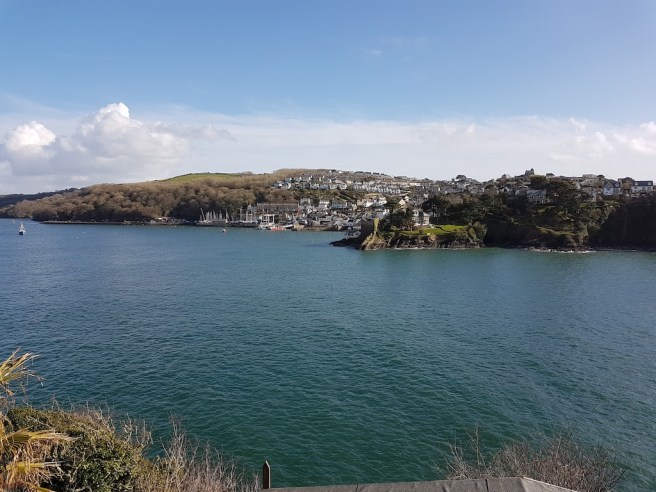 I thought I would use this trip to take some shots of the typically Cornish surfaces, and doorways. Interesting I think.


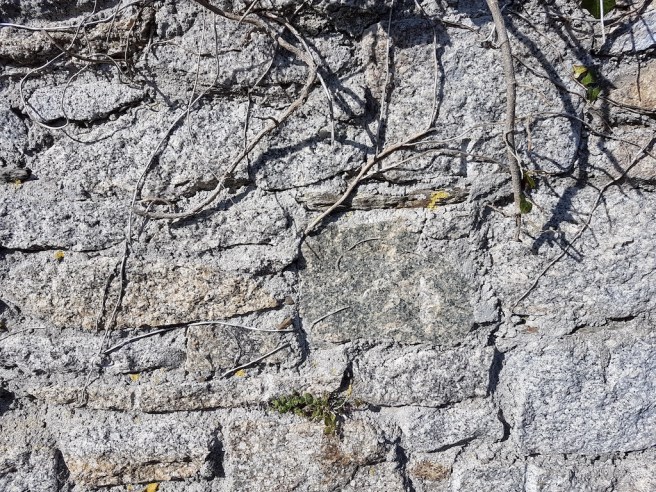
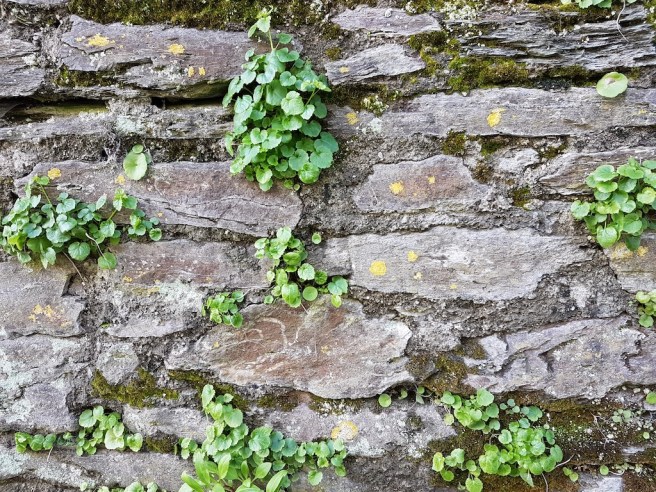
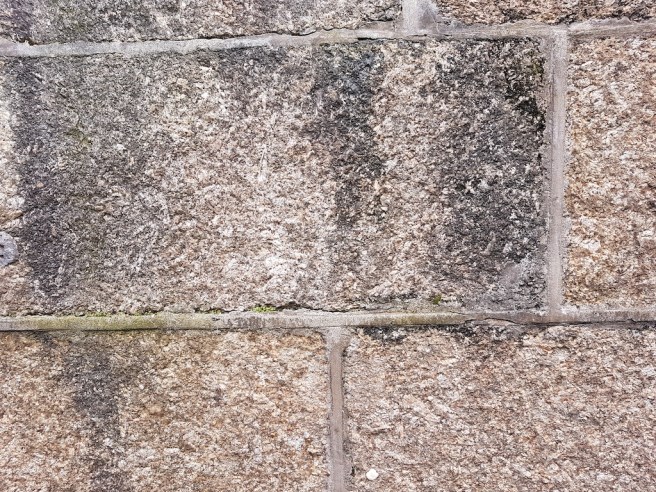 This time we wandered down through town to the Bodinnick ferry with a view across to Daphne Du Maurier’s house Ferryside.
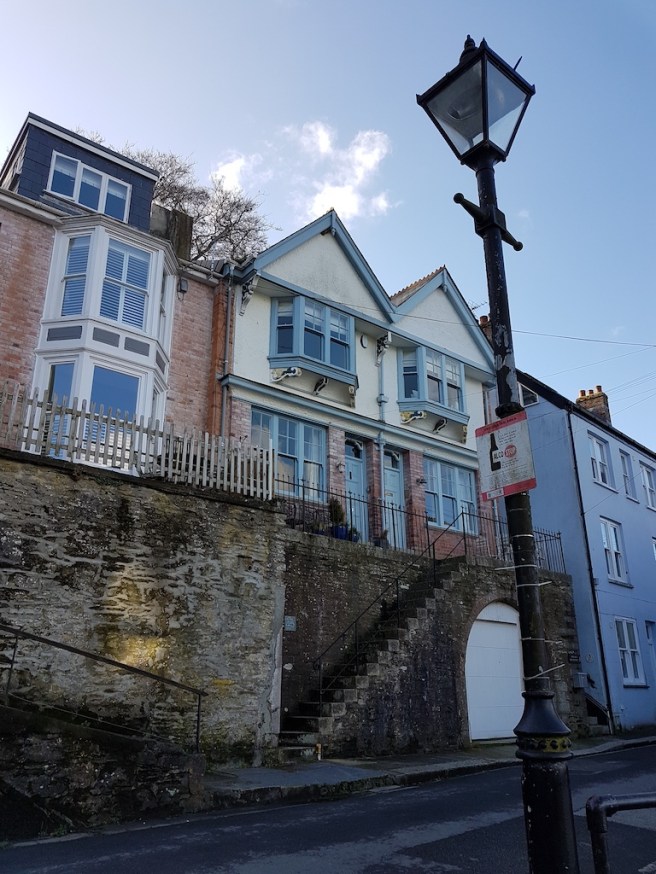
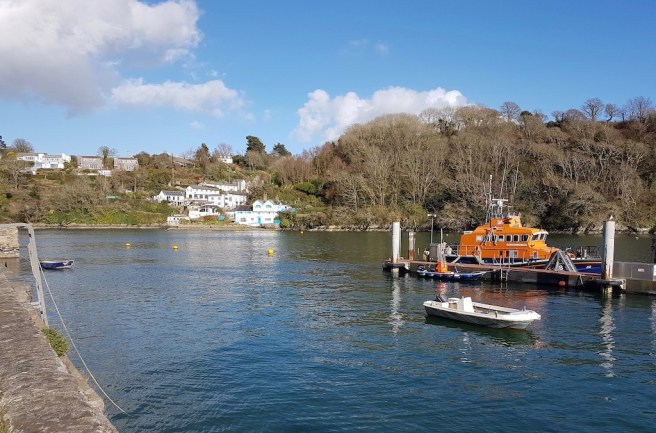 Liveable houses down here too!
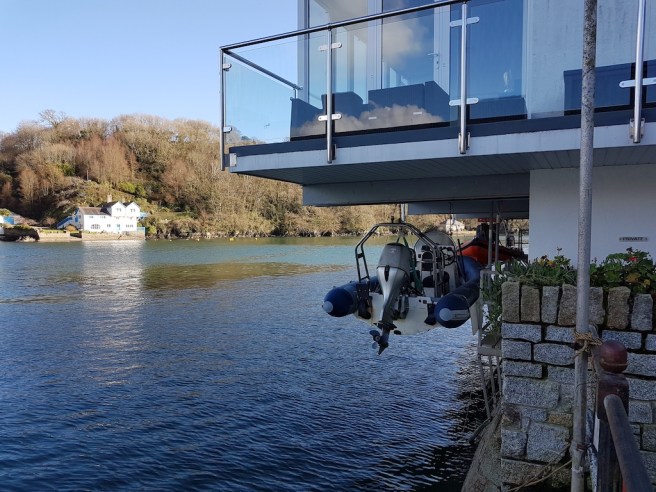
 I liked the idea of having my boat slung under the house ready for action and a quick get-away! Good view of Ferryside on the opposite bank….
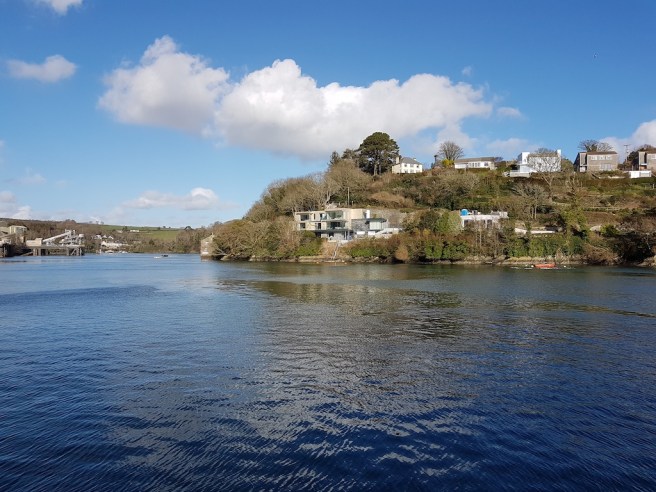
 This shot shows that Fowey and environs isn’t all about pretty houses and views…you can just see the china clay works downriver……
 The statue at the ferry terminus is rather good…
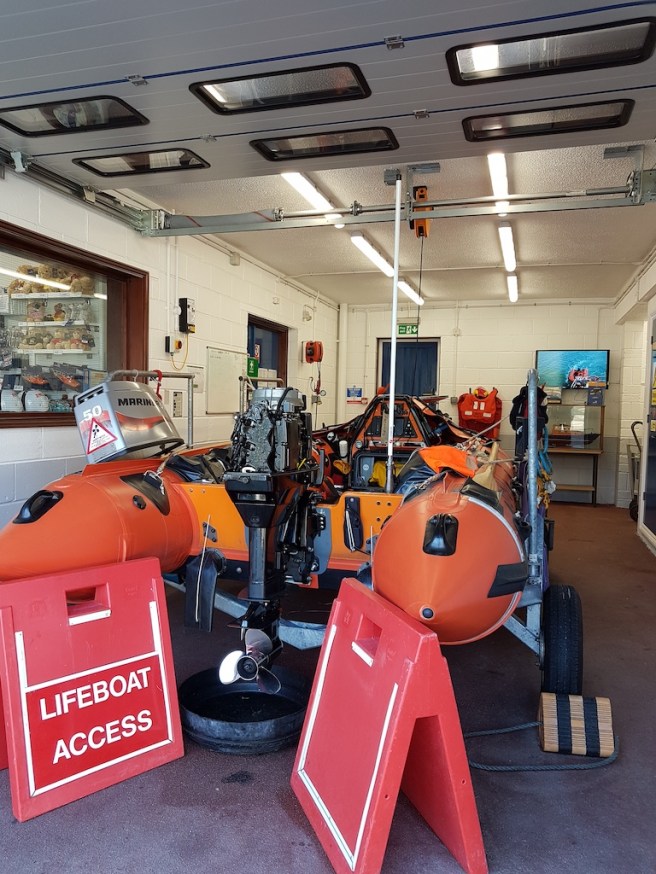
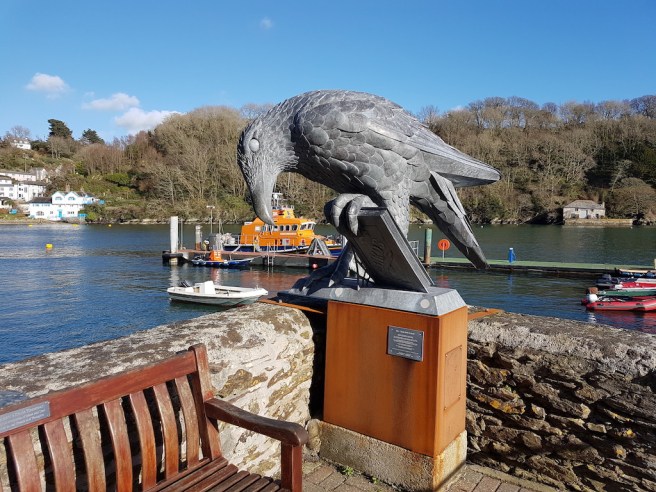 and always interesting to look inside the RNLI station….we donated.
 You are nearly always guaranteed a good view with a pint in Fowey….here from The King of Prussia……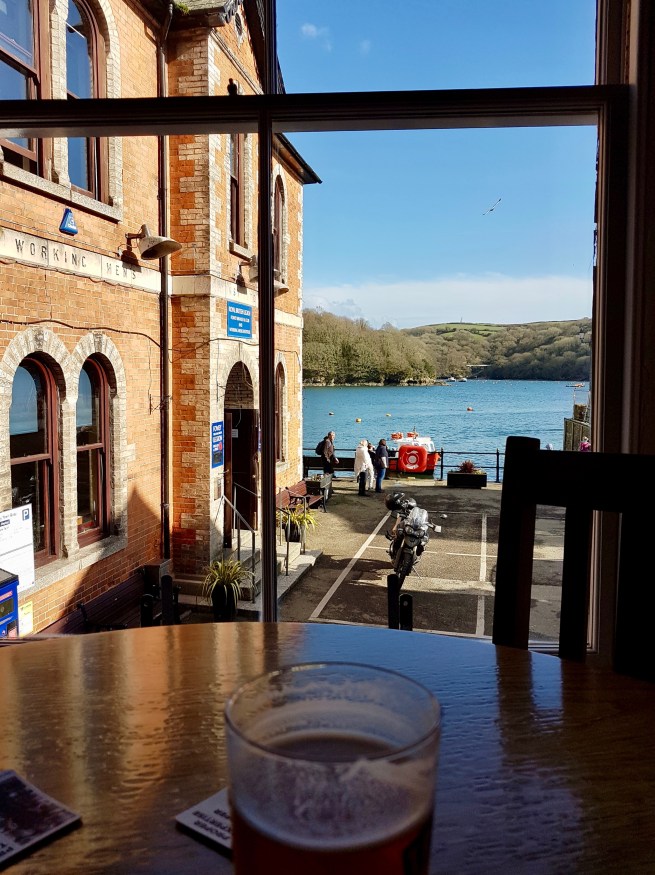
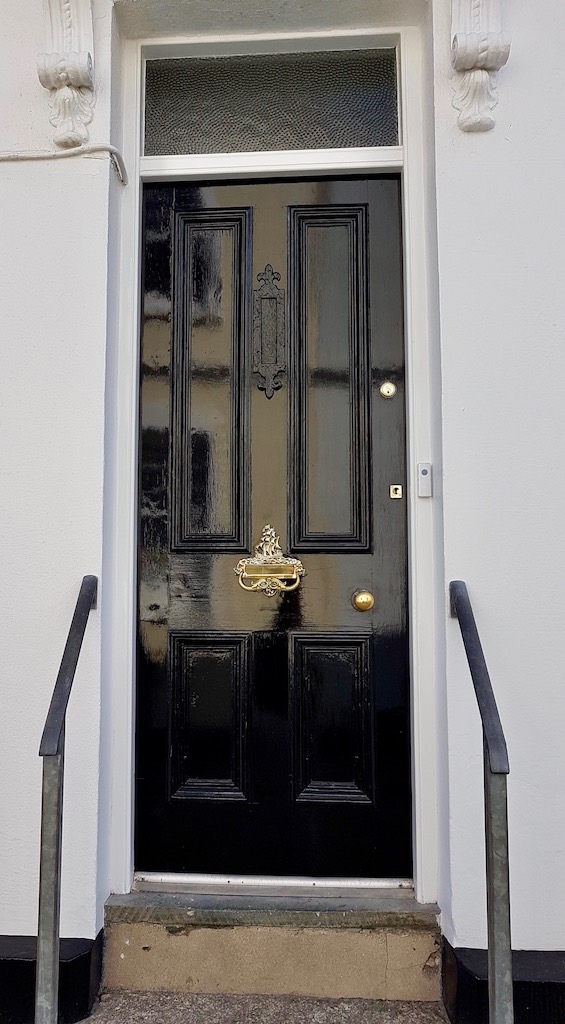
 Now for some doors…..and door-knockers….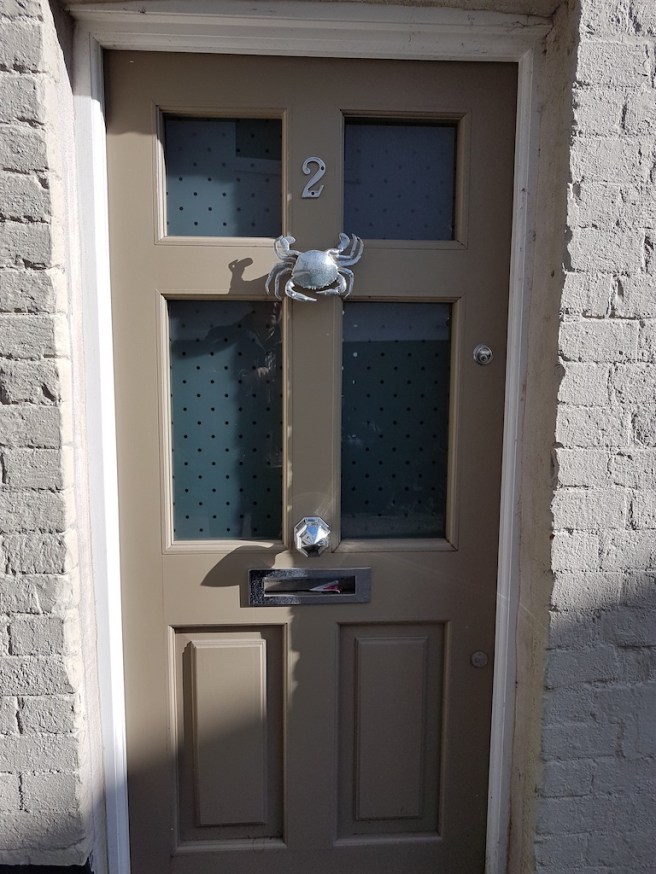
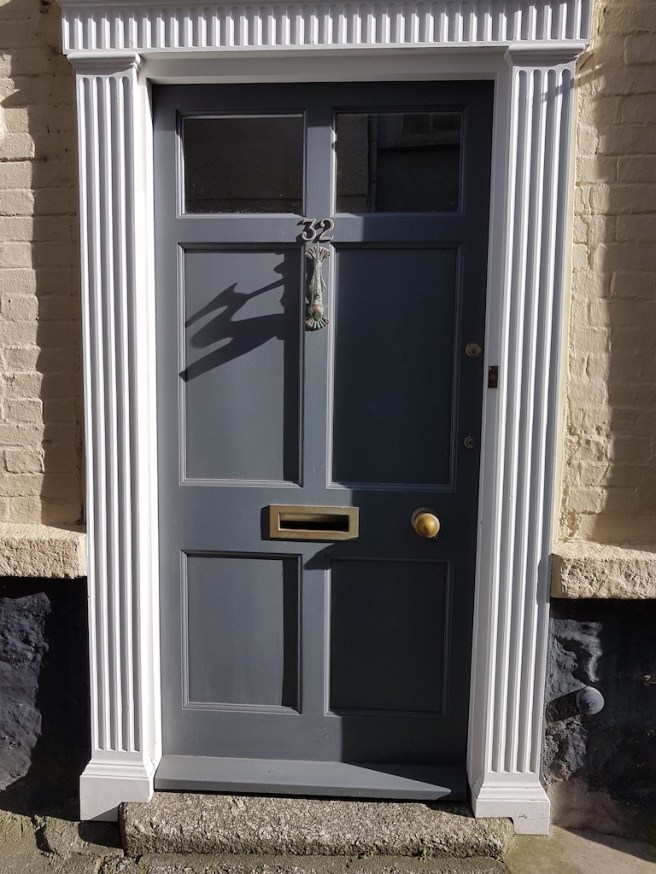
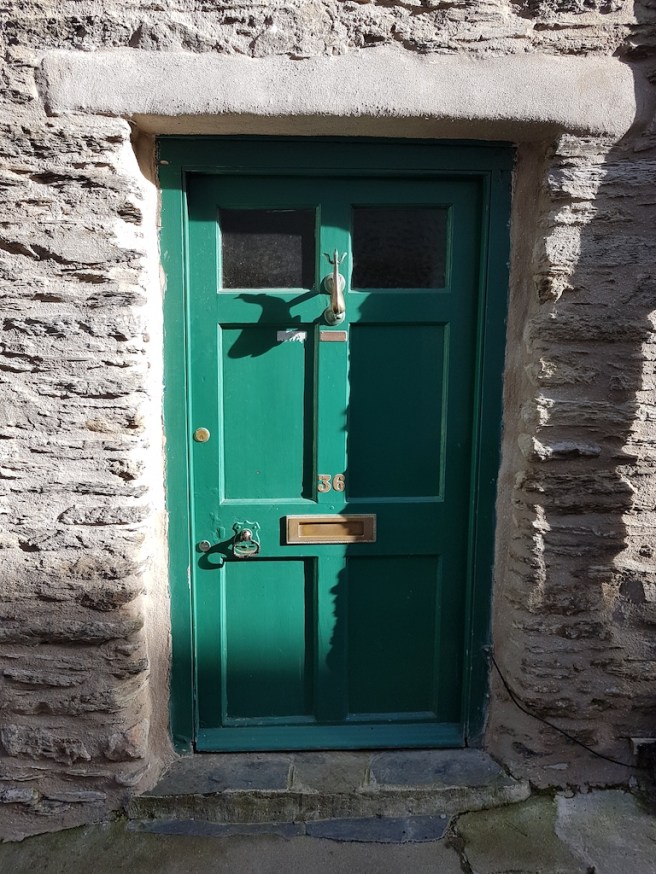
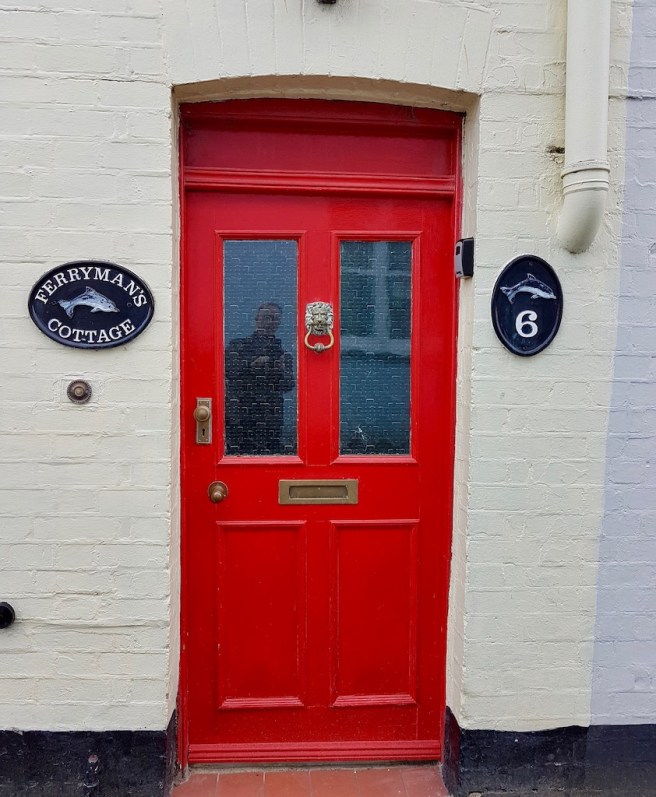
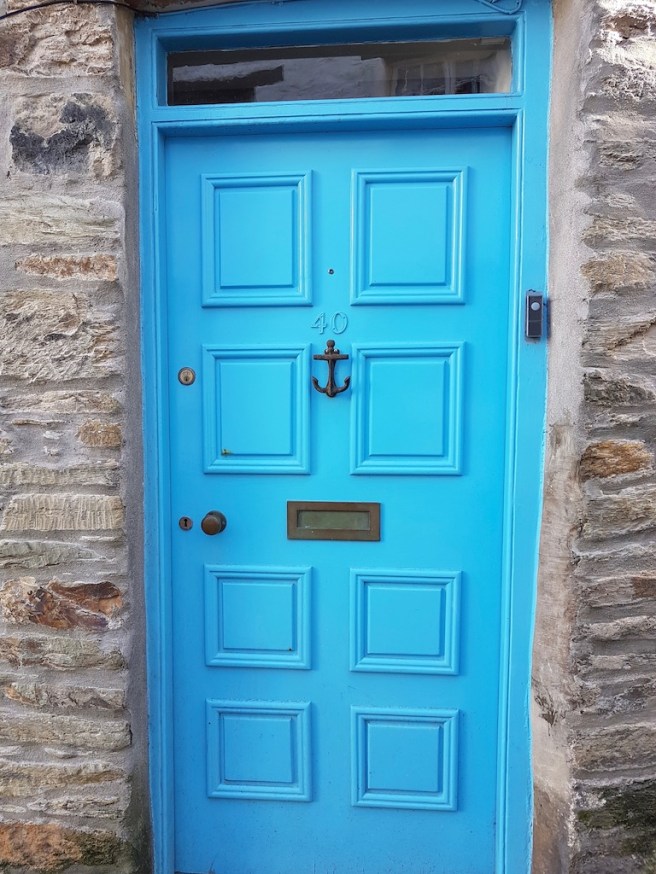
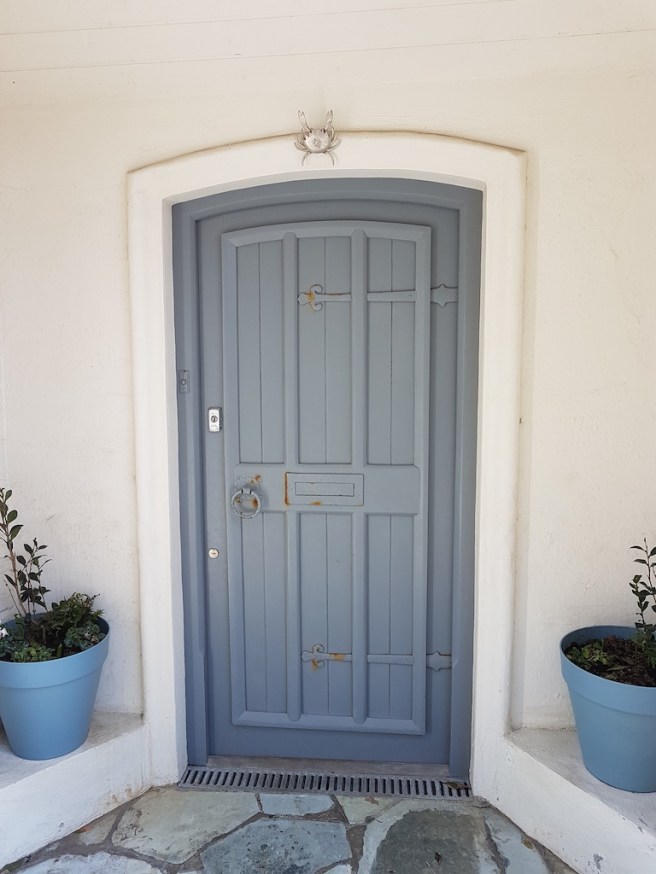
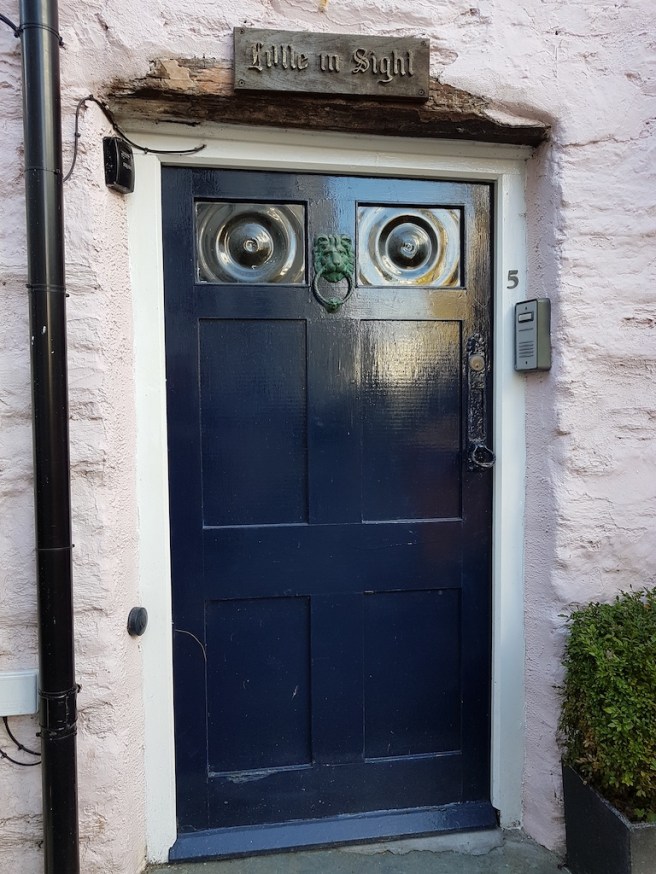
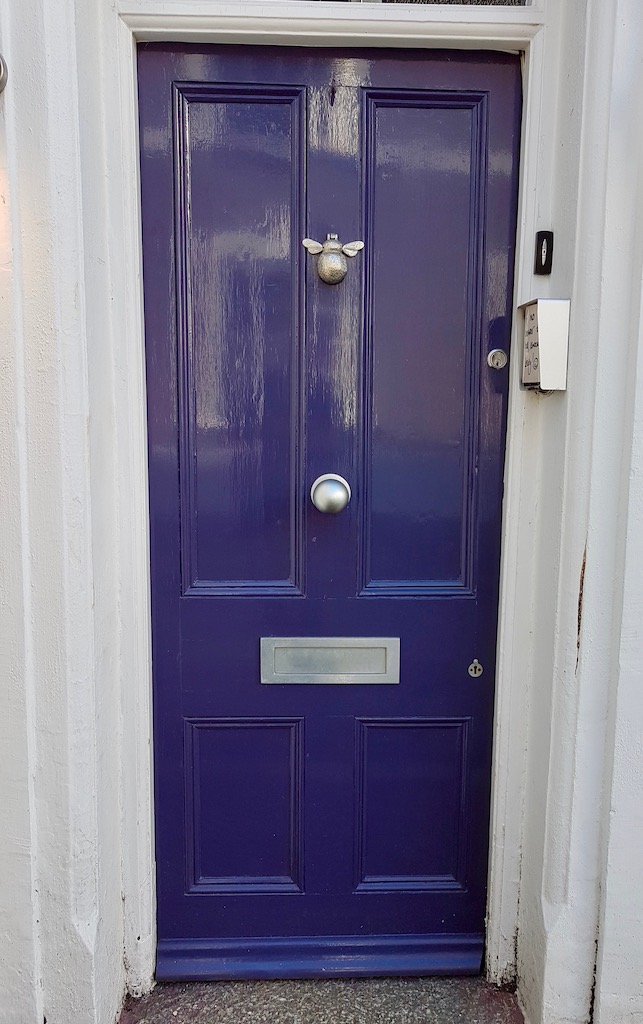 Then on the way back I noticed the old house of Q, or Sir Arthur Thomas Quiller-Couch, with its plaque.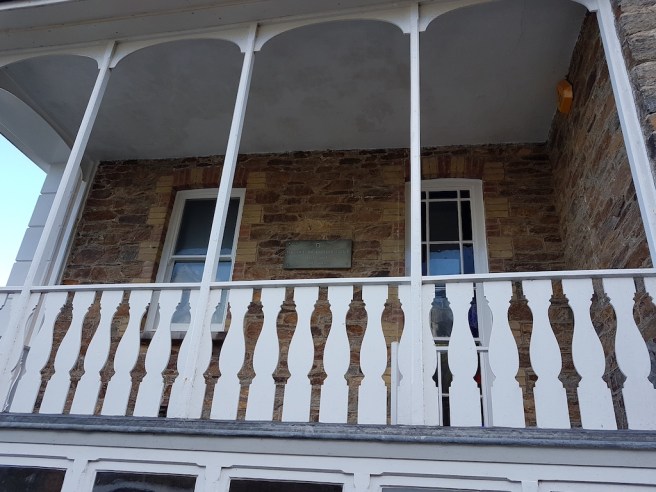
Heaving spent a little time as a journalist in London he returned to Cornwall in 1891, and settled in Fowey. In addition to publishing a series of critical articles, he completed Robert Louis Stevenson’s unfinished novel, “St Ives”. He was also known as a writer of excellent verse and a compiler of poetic works, most notably the “Oxford Book of English Verse, 1250-1900”, which appeared in 1900. This book is often quoted by John Mortimer’s “Rumpole of the Bailey”. Quiller-Couch was an active worker in local politics for the Liberal party. He was also Commodore of the Royal Fowey Yacht Club from 1911 until his death. He was knighted in 1910 and received a professorship of English at Cambridge in 1912. He retained this post for the remainder of his life. He later became Chair of English at the university and oversaw the beginnings of the English Faculty there. Many of Quiller-Couch’s fictional works have been long neglected but contain a wealth of Cornish folk lore. He was a noted literary critic, and published several volumes of criticism. He died in 1944, leaving his autobiography, “Memories and Opinions”, unfinished. This was published the following year. His novel, “Castle Dor” was also unfinished on Quiller-Couch’s death, and his daughter asked her friend Daphne du Maurier to complete this version of Tristan and Isolde, set in 19th century Cornwall.
Perranporth and other beaches on the North Coast…..
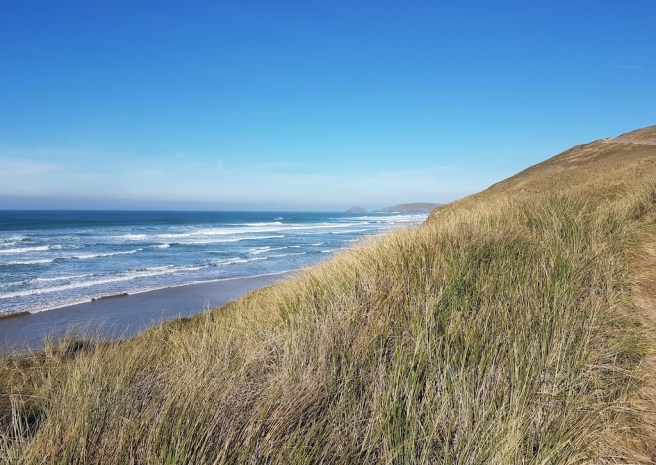
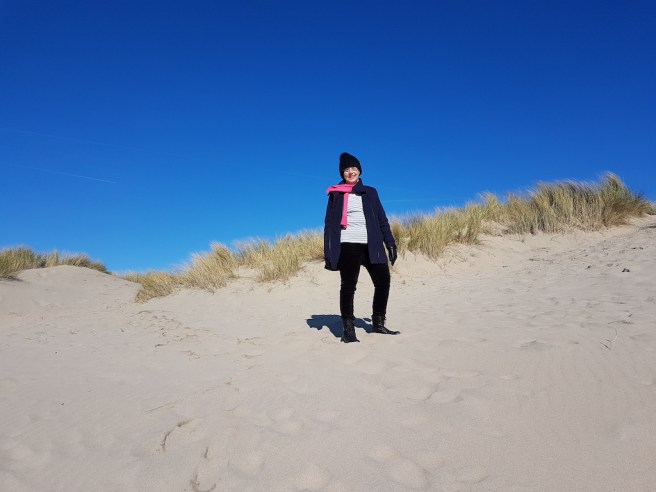
 We were trying to find the beach we had visited when first in Cornwall that has a small boardwalk and freshwater pond in the dunes. We thought it might be Perranporth so that is where we headed. We were wrong. Perranporth is the beach with a good bar/restaurant right on the beach and ‘unofficial’ nude bathing at the far end. What a lovely February day, and no Photoshop here!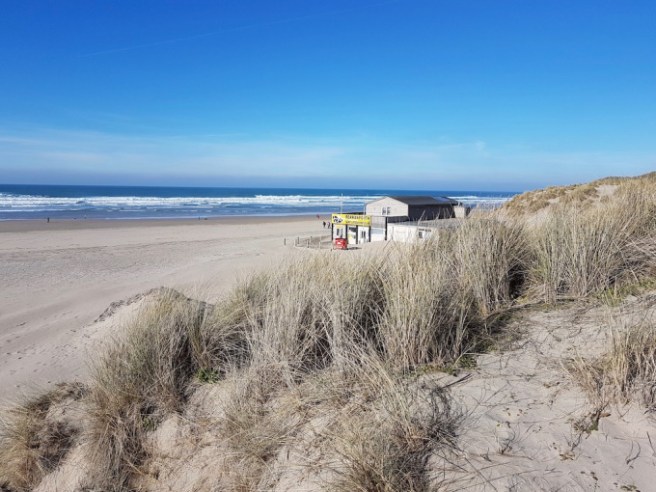

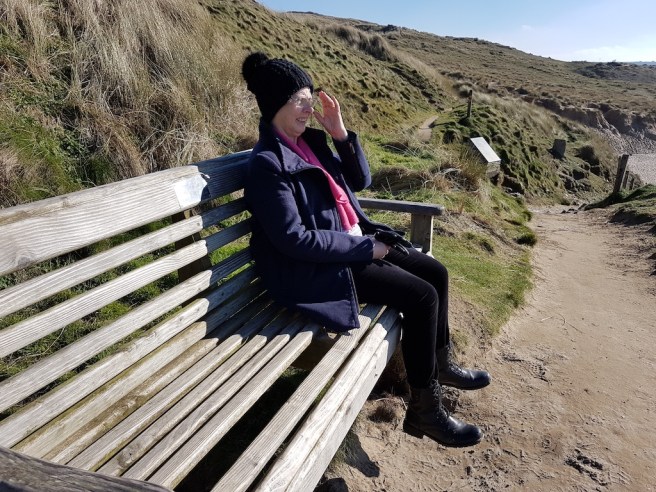
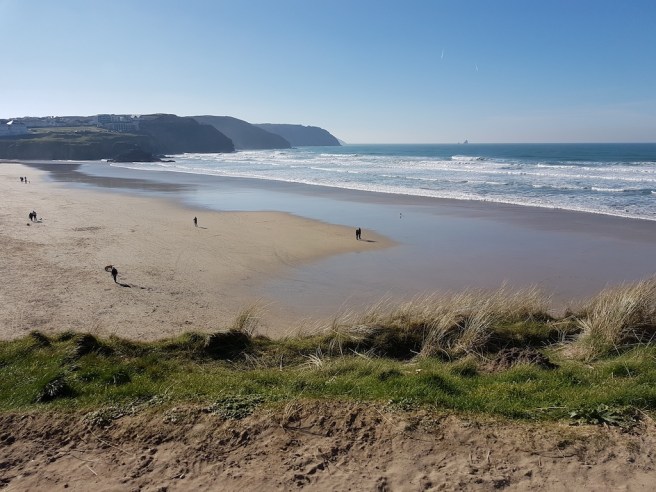 At the far end, having encountered no nudes unfortunately, we climbed up the Coast Path to a viewing point. The bench was obviously constructed for Giants as you can see!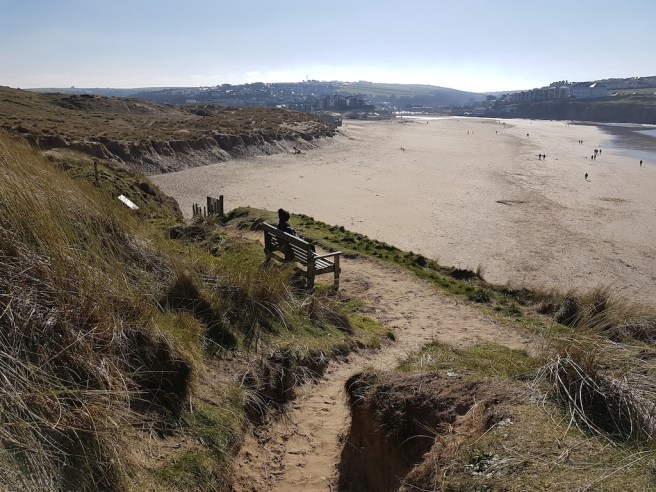
 Next to Trevaunce Cove….never been here before and a quaint harbour and beach (mostly covered when we were there). A fascinating place indeed.
 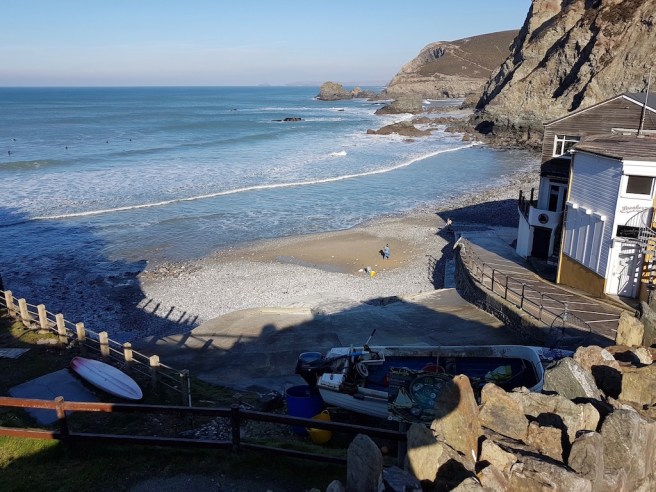 Most of the Cove is designated as an SSI because of the interesting geology and exposed lodes, and the village of St Agnes just above here was famous for its high quality tin….the last mine closing in 1941. There were outcrops of pure tin on the beach itself which were worked at low tide, others running under the sea, and more in the cliff face. Some of the spoil is still visible on the cliff top…….This little cove in its time was a real hive of industrial activity with hammer mills, loading of ships and much else apart from the mines themselves. However over a period of almost 400 years five attempts were made at constructing a harbour…all failed due to the rough seas. Huge granite slabs just washed away. On of the attempts was by Winstanley of Eddystone lighthouse fame.
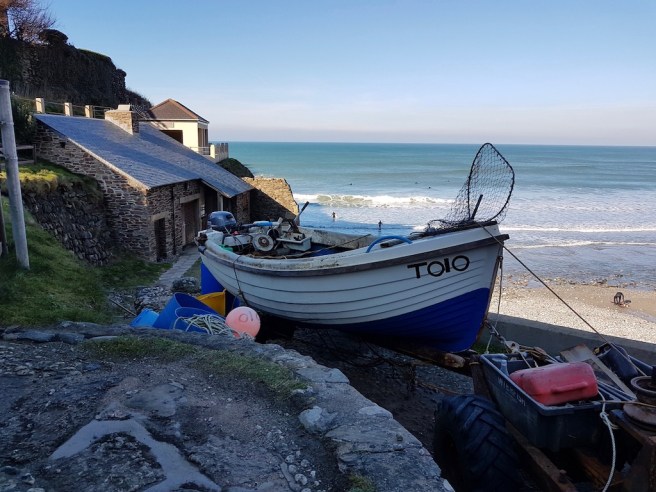
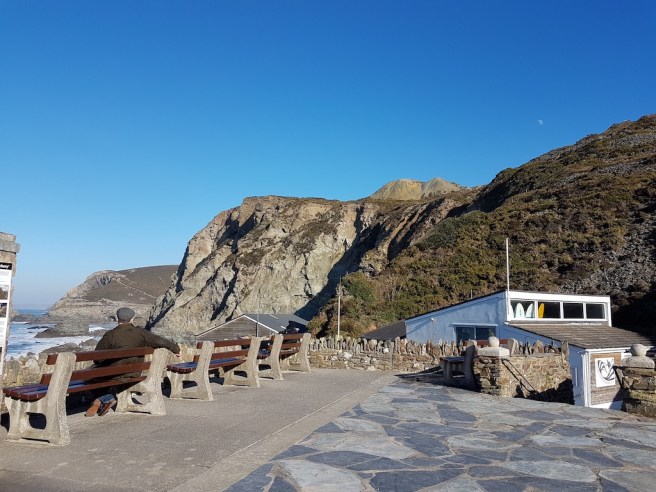 Trevaunce was also a fishery and the odd fishing boat remains as a reminder of the past…
 We climbed the cliffs and sat on the lowest bench I have come across (Guinness Book of Records?) to watch the surfers at play.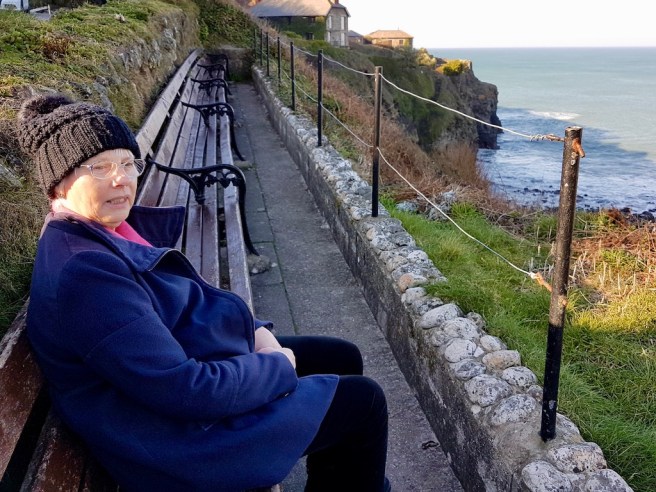
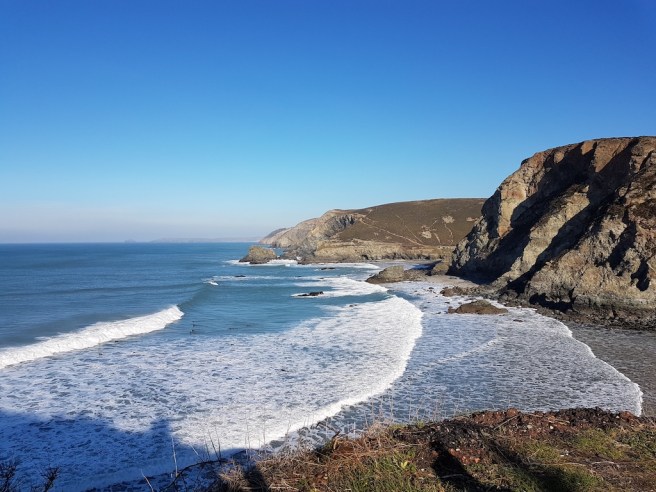 We then adjourned to the Driftwood Spars pub and brewery for a pint. The name stems from the huge beams (or spars) that comprise its structure, salvaged from shipwrecks along the coast and utilised for the building in the 1650s. The pub began life as a tin mining warehouse and has since been a chandlery, sail making loft and fish cellar, before it was eventually converted into a hotel and bar in the early 1900s.
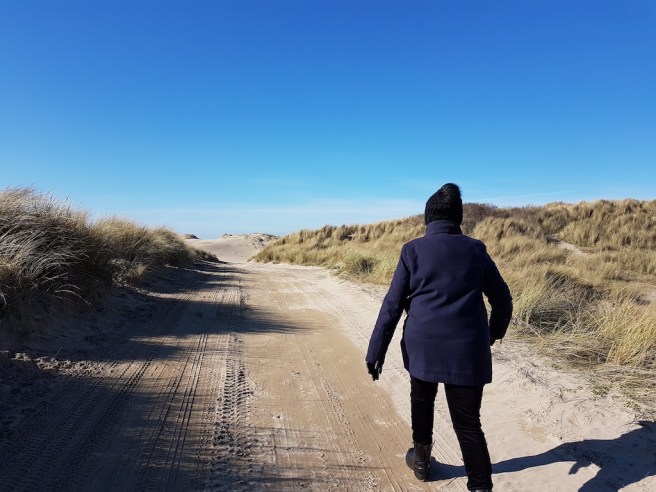
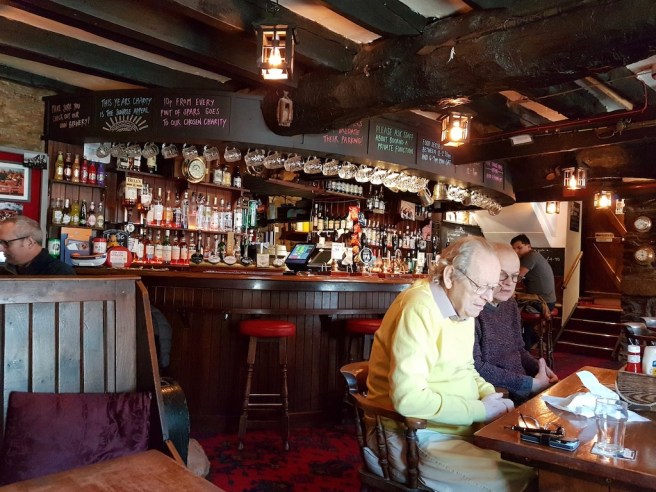 Suitably refreshed off we went to have one more try at finding the elusive beach of memory. Success at last, it was Holywell Bay, just as charming as we remembered!…..with its freshwater pool and river…
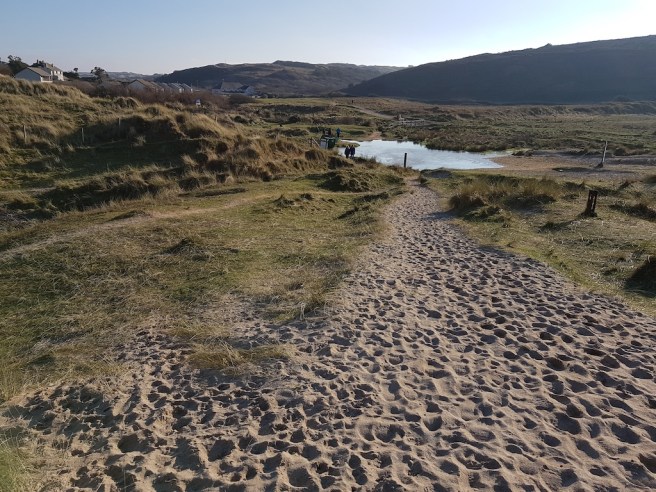 nice little boardwalk….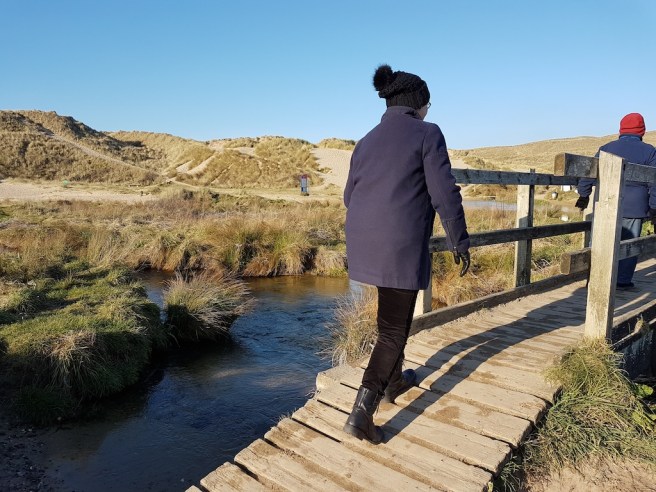
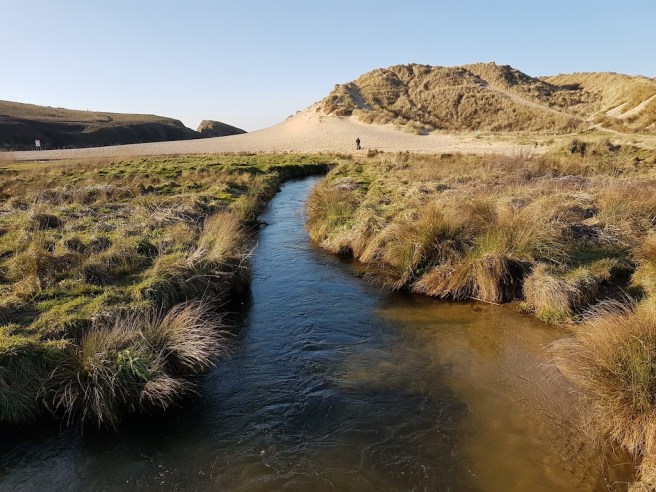 and beautiful dunes…..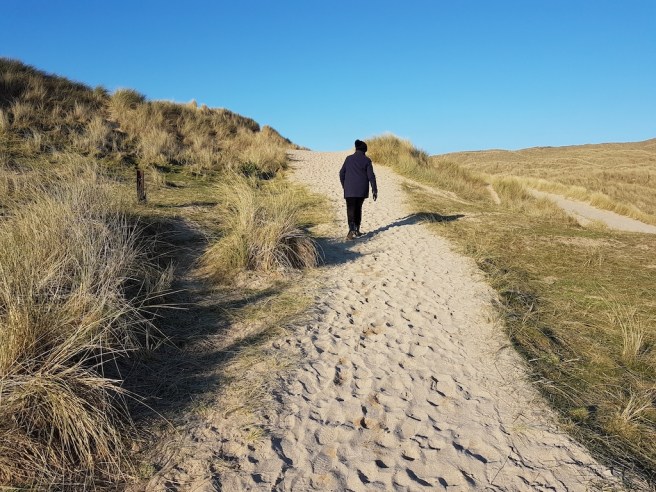
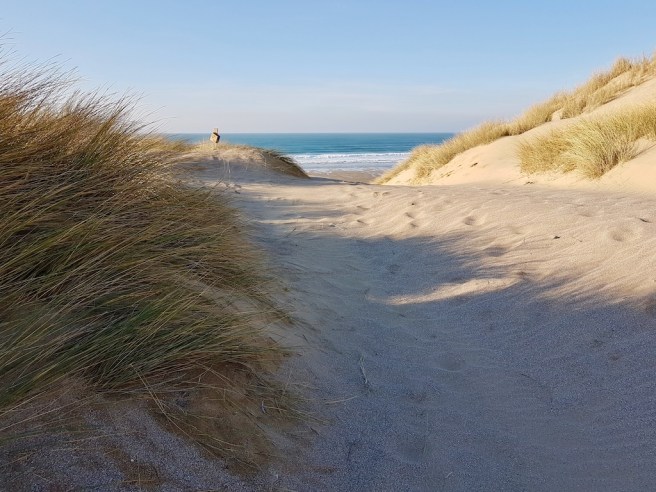 The beach was pretty fantastic too…..
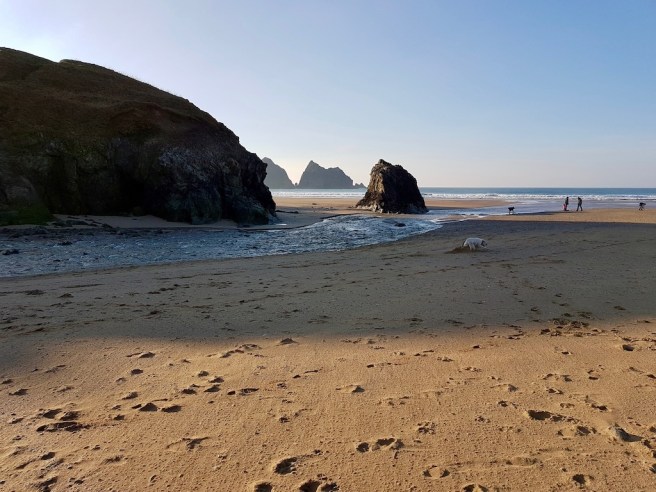 A lovely day by the seaside full of interest, and only 50 minutes away by car. Marvellous.
 Enjoying Cornwall...