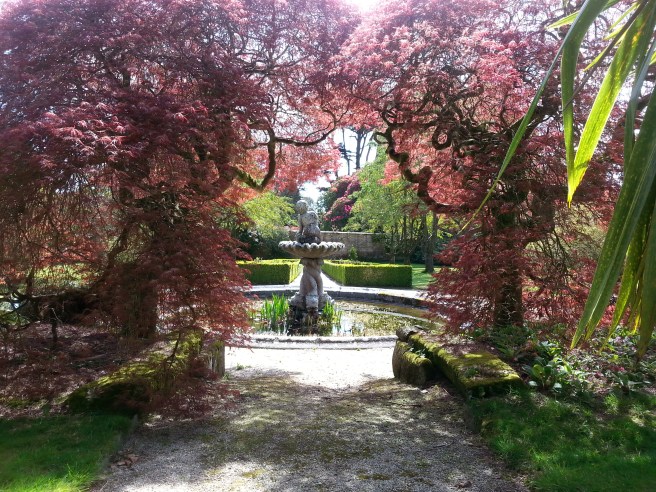
 Today we used our HHA membership to go to Tregrehan which ‘has been the home of the Carlyon family since the 16th century. The current occupier since 1987 is Tom Hudson, cousin of the late Gillian Carlyon. The listed house dates back to the late 17th century but was extensively remodelled in the mid 19th century.
 The Park and gardens date largely from the late 18th century and are heavily influenced by the then popular “picturesque” style of landscape designer Humphry Repton. Also listed by English Heritage as being of national importance.
Later additions/alterations include a collection of notable trees and shrubs from the southern hemisphere, particularly New Zealand. A branch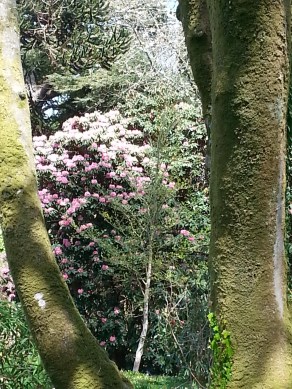 of the Carlyon family emigrated to NZ at the end of the 19th century and this connection aided the growing plant collection through the 20th century.
There is also a nationally important Camellia collection built up by Gillian Carlyon over 50 plus years.
Tregrehan is periodically also the venue for performances of open air theatre.
The Eden Project is close by and can be accessed on foot via the road through nearby Tregrehan Mills and then a footpath across adjoining fields.
A small history of the garden.
In a letter to Jovey Carlyon from Gilbert Rogers a Cornish forester based in India at Dehra Dun, N.W.Provinces, dated 1st July 1894 –
My dear Carlyon, It is so hot down here that I find it impossible to write decently. I only came down from the hills yesterday… I am writing to tell you that I have sent you a box containing some seeds of Quercus semecarpifolia in charcoal … the acorns may have all germinated on the way as they germinate here almost as soon as they fall to the ground but I hope that some of them, if they have germinated, will reach you alive. This species of oak covers the highest hills in Yarmsa & grows at elevations above the spruce & mixed with the silver fir, so should do well with you. It is very hardy grows very slowly & makes a fine tall straight stem if grown in close canopy….
This oak now stands proud at 25m height at Tregrehan. Veteran trees, oak and sweet chestnut survive since the first half of the 1600’s in the Park. Tregrehan garden is a woodland garden rich in exotic plants collected by enthusiasts from the early 19th century and continues today with Tom’s ongoing collection of unusual woody plants. In spring the excessive colours of camellias, rhododendrons and magnolias shout across the 20 acre valley. An extraordinary green-house (circa 1846) within the walled garden protects the more fragile species.’ We had a lovely time there and it is certainly one of
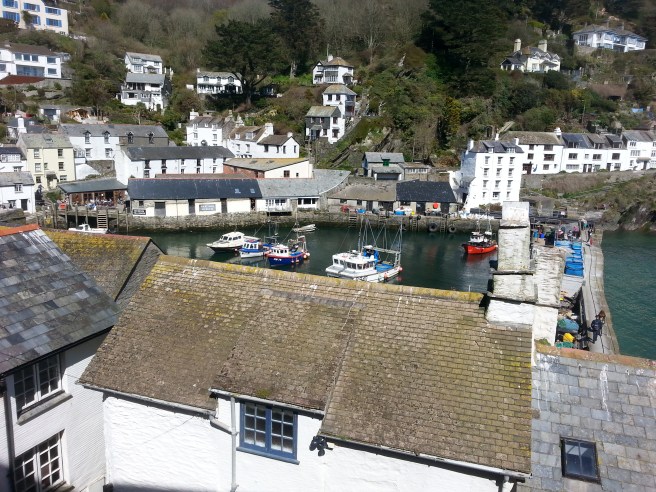 Having been within striking distance of Polperro we went there today using our bus passes, and the ‘normal’ bus we use for Looe one way or Liskeard the other. The route of the 73 is actually from Liskeard to Polperro. I said I would find out more about the Roman bridge. Here is the entry in ‘British Listed Buildings’…
 between House on Props (qv) and coal sheds, now shops to south west.
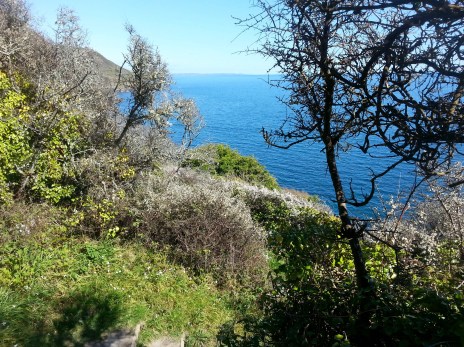 up to the top of the cliffs and
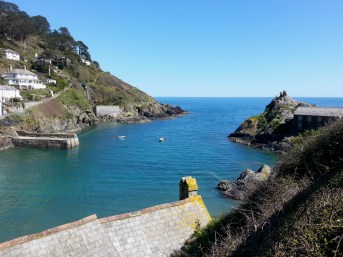
 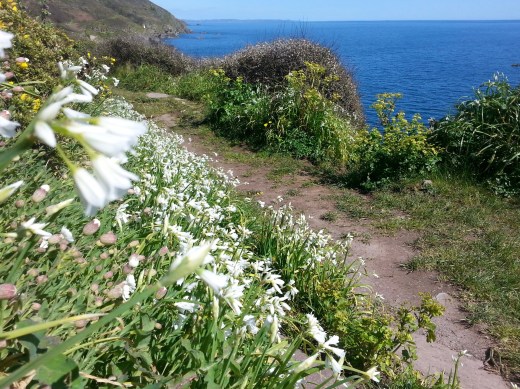 had a short walk Westwards along the Coastal Path returning on a higher route. Plenty of gorse and wild garlic in bloom. Could be the South of France!
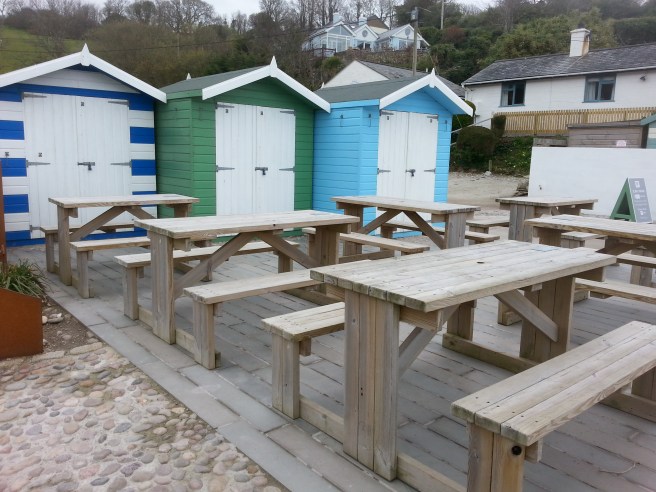 We’ve discovered a walk from the beautiful beach cafe in Talland Bay where you can take your tea and cake into one of the fitted-out beach huts when they are open (something we must do with visitors in the Summer). The route is along the Coast Path to Polperro, but as we only discovered this today when in the car, we explored to about half way having
  walked up the so-called ‘heart-attack hill’! Views superb as nearly always on the Coastal Path. You can just see Rame Head in the distance which more or less is at the boundary between Devon and Cornwall, and on a
 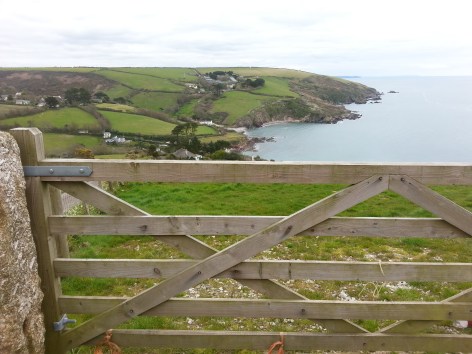 clear day you can see beyond to Devon itself…the peninsula at Salcombe.
 On our usual walk from Looe to Hannafore we saw the ladies gig crew practicing. There are 3 gigs based in Looe and we often see them heading out to sea or if the river is full heading up-river.
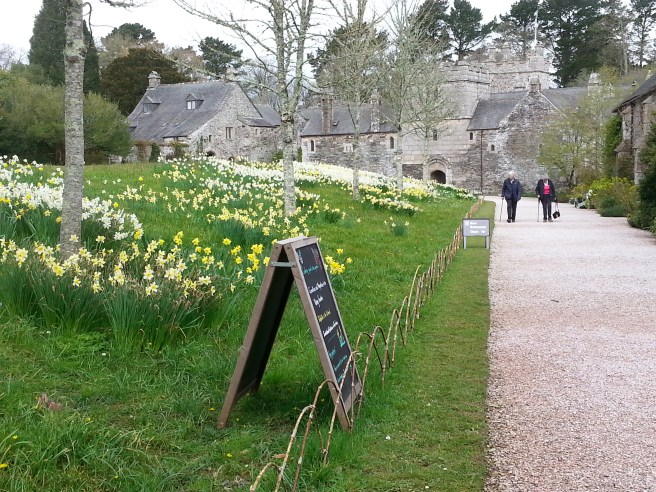 We are determined to get the maximum use from our National Trust and Historic Houses Association cards this year, so today it was a trip to Cotehele, just North of Plymouth on the river Tamar. Here is the Historic England background description to the house (for more detailed information about the house and estate see
  belonged to a family of the same name until 1353, when it was acquired through marriage by William Edgcumbe (d 1379). In the late C15 and early C16 an existing house was remodelled by Sir Richard Edgcumbe (d 1489) and his son, Sir Piers (d 1539). Sir Richard Edgcumbe supported Henry VII against Richard III and was handsomely rewarded after the Battle of Bosworth in 1485 (guidebook). A mid C16 plan of Cotehele (CRO)
 shows two parks, together with orchards and enclosures around the house. In the mid C16 Sir Piers Edgcumbe built a new house and enclosed a park at Mount Edgcumbe, Cornwall (qv), which was subsequently adopted as the family’s principal seat. Cotehele was occupied on an occasional basis, except for a period during the Civil War in the mid C17 when Colonel Piers Edgcumbe (c 1610-67), a supporter of the Crown, returned to the house, which he then occupied until his death. Col Edgcumbe’s son,
  Richard, was knighted in 1662, while his grandson, also Sir Richard (1680-1758), was created Baron Edgcumbe in 1742 for his political support for Sir Robert Walpole. It has been suggested that the first Lord Edgcumbe, a keen antiquarian, began to furnish Cotehele in a consciously antique style in the 1730s (CL 1990). An estate plan of 1731 by William Doidge
 (CRO) shows walled orchards to the west of the house, a bowling green to the south, and further enclosures to the east and north. In 1781 the second Baron’s younger brother and heir, George (1720-91), was created Viscount Mount Edgcumbe and Valletort, and in 1789, Earl of Mount Edgcumbe. The first Earl was a close friend of Horace Walpole, and, like his son, the second Earl (1764-1839), a member of the Society of Antiquaries; Cotehele was visited in 1781 and 1789 by King George III and Queen Charlotte. On the death of the third Earl in 1861, his widow, Caroline Augusta (1808-81) moved to Cotehele; the house was renovated and partially remodelled, and improvements
 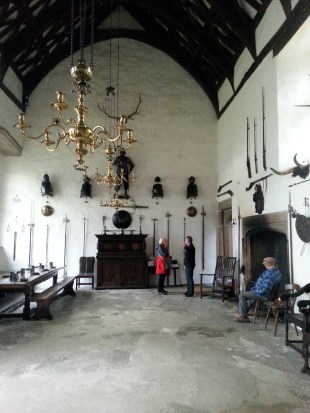 were made in the gardens, including the re-routing of a road to the east of the house (plan, CRO). Following the death of the Countess Dowager in 1881 the house was occupied by the fourth Earl’s sister, Lady Ernestine (d 1925). Piers, fifth Earl (1865-1944) also lived at Cotehele from 1941 following the destruction
  of Mount Edgcumbe during the Second World War. In 1947 his second cousin and heir, Kenelm (1873-1965), sixth Earl, passed Cotehele to the government in lieu of death duties. The estate was subsequently passed to the National Trust, in whose ownership it remains today (2000).’
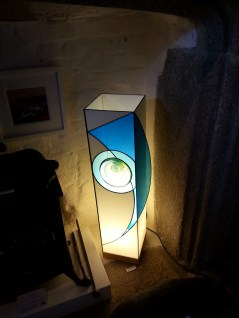 through banks of camellias and azaleas. We also found the art shop to be excellent displaying high quality pottery, paintings etc by local makers and artists. We bought a wonderful ‘flat’ vase here and a bronze-mix nude…they have some very unusual pieces (especially for a National Trust shop).
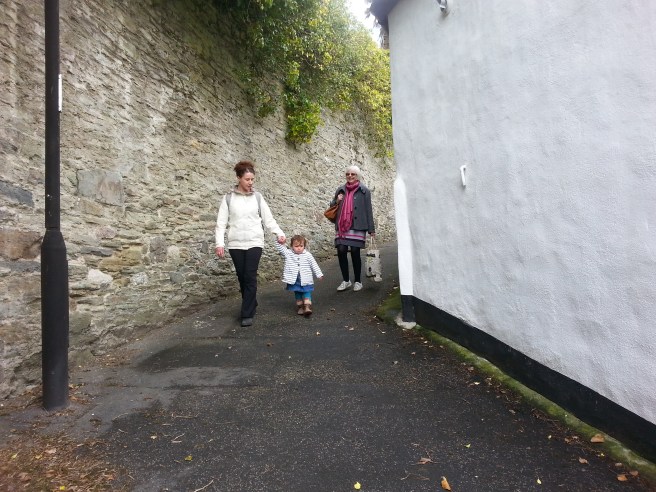 Two must-see places for visitors today – Fowey and Charlestown. I have already written about the former as one of my favourite towns, and it was a delight to wander yet again amongst the brilliant small shops and back lanes all the while immersed in the special atmosphere of a seaside town and port. Charlestown is different, very different.Located about a mile outside the town of St Austell it is ‘an amazingly pristine, unspoiled example of a late Georgian working port. It was constructed between 1791 and 1801 by Charles Rashleigh, entrepreneur and member of the local landowning family, in response to the growth of the local mining industry. Originally built to export copper and import coal, it was soon being used for the export of China Clay. It is from its creator that the the port gets its name.
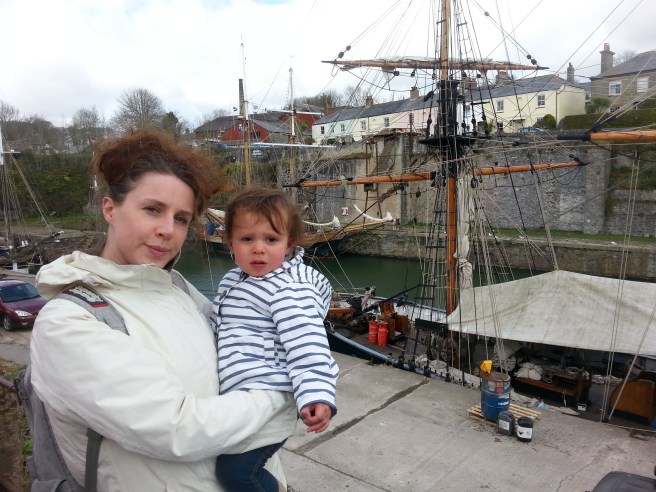 Upon completion, Charlestown was a model Georgian “new town”. By the 19th Century various associated businesses were established in sheds and warehouses around the harbour such as pilchard curing, shipbuilding, brick making and lime burning, and the population exploded to close on 3,000. Many attractive period properties sprang up in the village, ranging from elegant Georgian houses to squat fisherman’s cottages, and by and large they remain giving the town an unspoiled Georgian character. This unique combination has lead to Charlestown being a popular location for film and television locations, and to some extent this has probably helped subsidise its existence and prevent development. Credits include Poldark (past and present), Hornblower, Mansfield Park and many more.
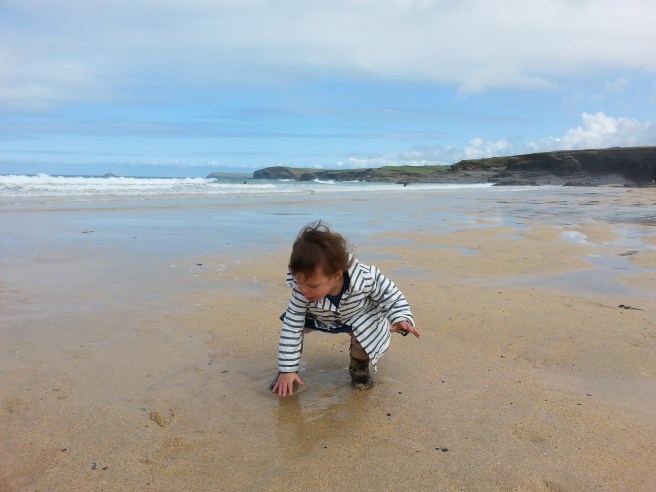 A huge benefit of being retired is that you can take advantage of any fine or relatively fine spell of weather at the drop of a hat. So today we went to the seaside. As we were
 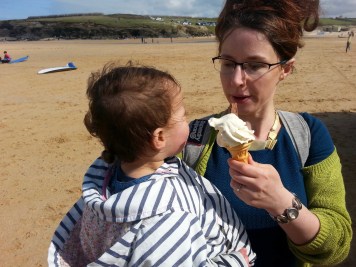 going to Lappa Valley theme park, our beach destination was on the north coast. Exploring a new beach can be hard work, so refreshment is sometimes needed! Lappa Valley is a theme park for younger children, which is ideal for a half-day visit combined with a beach. There are 3 steam trains and loads of mini playgrounds, plus a good collection of animals. My daughter rated it quite highly for a two-year old, and would definitely come back. She enjoyed it as you can see. Although we
  are in south-eastern Cornwall , all Cornwall is quite accessible for us, and you are never more than 16 miles from the sea wherever you are. The weather can be quite different on the south and north coasts at any one time, so the possibilities are endless. We are really looking forward to exploring more and more of the coastline, especially when the temperature is more suitable for picnics.
 Now it’s the turn of my daughter, son-in-law, and gorgeous grand daughter to visit, and you can still enjoy our beaches on a non-sunny day. Beach combing is such a pleasure, especially when you are young
 ! It does all get a bit
  much at times though….We now seem to have got into the habit of taking our visitors to The Talland Bay..you always get a nice welcome, the food is good and reasonably-priced, and there’s plenty to keep you occupied whatever your age…and preaching to the budgerigars can be fun……
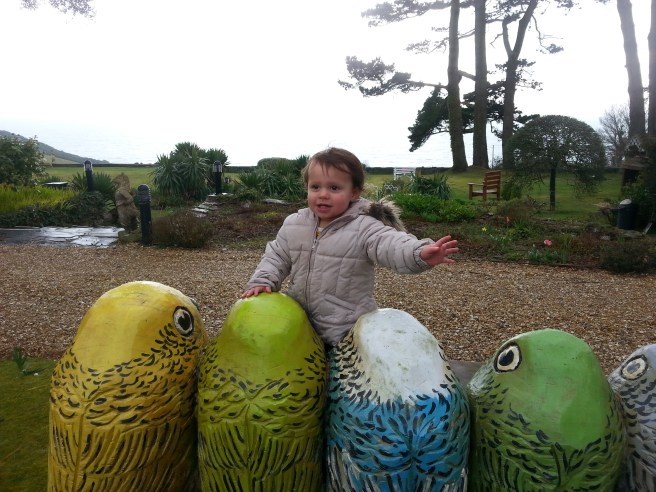 But who’s this?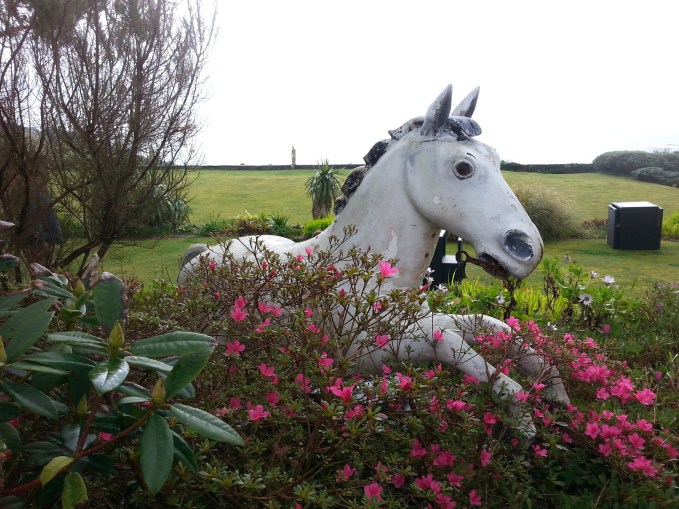


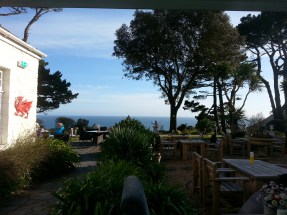 marvellous sea vista and sideways view to the small hamlet of Talland and its impressive cliff-top church, it is more or less halfway on the coast path between Looe and Polperro, and reachable by us in the car in 15 minutes. The
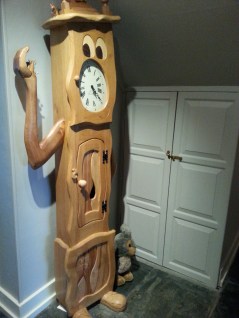
  y of the church in the 15th century. There survives old woodwork in its fine wagon roofs; and the many benchends (partly ca. 1520, the rest ca. 1600) are of the usual Cornish type and among the finest examples of these. But back to the hotel, not only do the gardens contain loads of talking points but inside is crammed full of quirky art works…..you could be in a boutique hotel in Barcelona. I particularly like the budgies outside and, the cheerful clock inside, and I love the naked bottom hanging outside the Gents!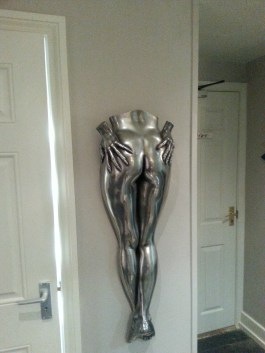

 Enjoying Cornwall...